
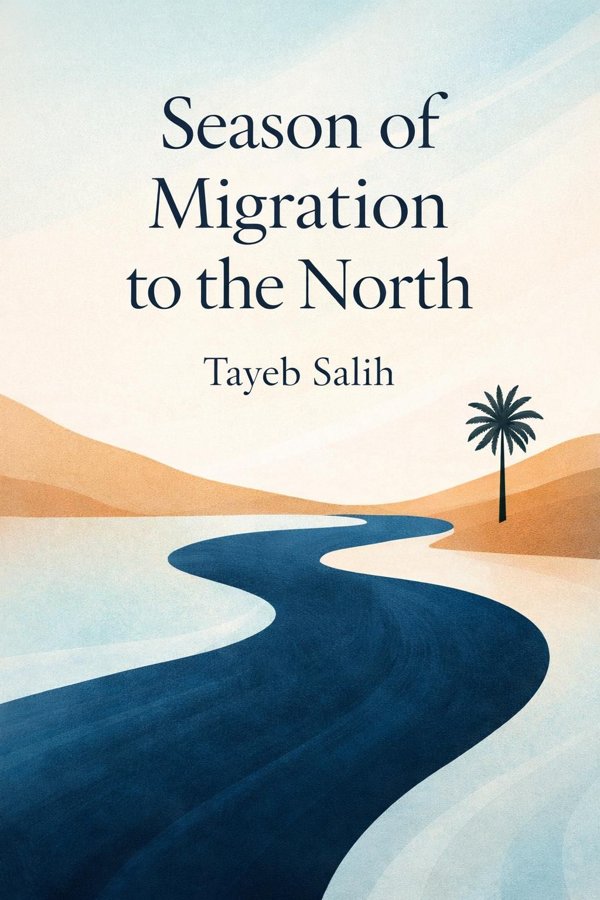
Season of Migration to the North: Summary & Key Insights
by Tayeb Salih
 10 min9 chaptersAudio available
Key Takeaways from Season of Migration to the North
Homecoming often sounds like a resolution, but in this novel it becomes the beginning of a deeper crisis.
Colonialism does not end when the flag comes down; it lingers in psychology, desire, and self-definition.
One of the novel’s most unsettling ideas is that identity can harden into theater.
We do not simply tell stories; stories shape what we can see, excuse, and become.
Love in this novel is rarely innocent.
What Is Season of Migration to the North About?
Season of Migration to the North by Tayeb Salih is a classics book spanning 5 pages. Season of Migration to the North is a haunting, intellectually sharp novel about what happens when colonial history enters the most intimate parts of human life: love, ambition, memory, masculinity, and home. Set in a Sudanese village after independence, the story follows an unnamed narrator who returns from years of study in Europe expecting a peaceful reintegration into village life. Instead, he becomes fascinated by Mustafa Sa’eed, a mysterious newcomer whose life in England reveals a darker, more destructive encounter between colonized and colonizer. Through their parallel journeys, Tayeb Salih turns a seemingly local story into a profound meditation on East and West, selfhood and performance, violence and desire. What makes the novel endure is its refusal to offer easy moral answers. Salih does not reduce colonialism to a political slogan or identity to a simple choice between tradition and modernity. Instead, he shows how power leaves psychological scars that continue long after empires fade. Salih, one of the most important voices in modern Arabic literature, wrote with the authority of someone deeply familiar with both Sudanese rural life and the cultural tensions of the postcolonial world. The result is a classic that remains urgent, unsettling, and deeply human.
This FizzRead summary covers all 9 key chapters of Season of Migration to the North in approximately 10 minutes, distilling the most important ideas, arguments, and takeaways from Tayeb Salih's work. Also available as an audio summary and Key Quotes Podcast.
Season of Migration to the North
Season of Migration to the North is a haunting, intellectually sharp novel about what happens when colonial history enters the most intimate parts of human life: love, ambition, memory, masculinity, and home. Set in a Sudanese village after independence, the story follows an unnamed narrator who returns from years of study in Europe expecting a peaceful reintegration into village life. Instead, he becomes fascinated by Mustafa Sa’eed, a mysterious newcomer whose life in England reveals a darker, more destructive encounter between colonized and colonizer. Through their parallel journeys, Tayeb Salih turns a seemingly local story into a profound meditation on East and West, selfhood and performance, violence and desire.
What makes the novel endure is its refusal to offer easy moral answers. Salih does not reduce colonialism to a political slogan or identity to a simple choice between tradition and modernity. Instead, he shows how power leaves psychological scars that continue long after empires fade. Salih, one of the most important voices in modern Arabic literature, wrote with the authority of someone deeply familiar with both Sudanese rural life and the cultural tensions of the postcolonial world. The result is a classic that remains urgent, unsettling, and deeply human.
Who Should Read Season of Migration to the North?
This book is perfect for anyone interested in classics and looking to gain actionable insights in a short read. Whether you're a student, professional, or lifelong learner, the key ideas from Season of Migration to the North by Tayeb Salih will help you think differently.
- ✓Readers who enjoy classics and want practical takeaways
- ✓Professionals looking to apply new ideas to their work and life
- ✓Anyone who wants the core insights of Season of Migration to the North in just 10 minutes
Want the full summary?
Get instant access to this book summary and 100K+ more with Fizz Moment.
Get Free SummaryAvailable on App Store • Free to download
Key Chapters
Homecoming often sounds like a resolution, but in this novel it becomes the beginning of a deeper crisis. The unnamed narrator returns to his Sudanese village after seven years of study in Europe, believing that his education has expanded him without severing him from his origins. He is greeted warmly by family, fields, river, and familiar rhythms of communal life. Yet beneath this comforting surface, he senses distance. He has come back physically, but inwardly he is split between experiences, languages, and ways of seeing the world.
This is one of the novel’s central insights: returning home after profound transformation is not a simple reversal of departure. The narrator wants to belong as he once did, but he now sees his village through altered eyes. Customs feel both intimate and newly strange. He understands the village from within, yet he also observes it with the analytical distance he acquired abroad. That doubled vision gives him insight, but it also produces alienation.
This tension is recognizable beyond the novel. Anyone who has moved between cultures, social classes, or educational worlds may know the feeling of being claimed by two realities without fully resting in either. A student returning from university to a small hometown, an immigrant revisiting a childhood country, or a professional navigating family traditions after years away can all experience this divided belonging.
Salih uses the narrator’s return to show that identity is not a fixed root but an ongoing negotiation. What matters is not pretending nothing has changed, but learning how to live honestly with change.
Actionable takeaway: When you return to a familiar place after major personal growth, expect complexity rather than instant comfort, and reflect on how your new perspective can deepen rather than erase your connection to home.
Colonialism does not end when the flag comes down; it lingers in psychology, desire, and self-definition. Mustafa Sa’eed embodies this truth. Brilliant, enigmatic, and emotionally guarded, he recounts his rise from Sudanese prodigy to celebrated intellectual in England. On the surface, his journey appears to fulfill the colonial promise that talent can cross borders and earn recognition. But Salih gradually reveals that Mustafa’s success is entangled with performance, resentment, and destructive power.
In London, Mustafa becomes both object and strategist within imperial culture. He is exoticized by English society and learns to manipulate those fantasies. His relationships with women become arenas where history, seduction, revenge, and self-invention collide. He speaks the language of refinement and intellect, but beneath it lies fury at a world that made him into a symbol before it allowed him to be a person.
Mustafa’s story matters because it rejects simplistic narratives of assimilation. He is neither a triumphant cosmopolitan hero nor a pure victim. He is a man shaped by empire so deeply that even his attempts at mastery reproduce violence. Salih suggests that colonial domination can distort not only institutions but the emotional imagination itself.
This idea remains relevant today. People navigating systems built on inequality may internalize the expectations placed on them, then use those expectations strategically while paying a private psychological cost. In workplaces, academia, or media, being rewarded for a version of oneself shaped by stereotype can feel like victory and erasure at once.
Actionable takeaway: Pay attention to the roles systems reward you for playing, and ask whether success within those roles is helping you become more whole or trapping you inside someone else’s script.
One of the novel’s most unsettling ideas is that identity can harden into theater. Mustafa Sa’eed does not merely live between cultures; he stages himself within them. He becomes a carefully constructed figure: the brilliant African intellectual, the mysterious outsider, the man others imagine before they truly know him. In doing so, he gains influence, but he also loses access to sincerity. His life becomes a sequence of roles, and each role intensifies his separation from an authentic self.
Salih shows that performance is not always superficial vanity. Often it is a survival strategy. In unequal societies, marginalized people learn to code-switch, adapt, and anticipate the fantasies of others. Mustafa masters this art to a terrifying degree. He turns European expectations into instruments, using language, charm, and symbolism to control how he is perceived. Yet his power is unstable because it depends on the same colonial myths he claims to outmaneuver.
The narrator, in contrast, is less theatrical but not immune. His fascination with Mustafa draws him into a mirror-like struggle. He begins questioning whether his own identity is also a kind of performance: educated yet rooted, modern yet traditional, insider yet observer. The novel suggests that selfhood becomes dangerous when it is built entirely in reaction to another gaze.
This speaks directly to modern life. Social media profiles, professional branding, and cultural self-presentation often reward curated identities over complicated truths. A person may become highly legible to others while growing increasingly opaque to themselves.
Salih’s warning is not that adaptation is wrong, but that a life organized around performance can become hollow or violent. Real freedom requires more than strategic self-display; it requires the courage to exist beyond spectacle.
Actionable takeaway: Notice where you are performing a version of yourself for approval, and create at least one relationship or space where you can speak without managing your image.
We do not simply tell stories; stories shape what we can see, excuse, and become. In Season of Migration to the North, narrative itself is a battleground. Much of Mustafa Sa’eed’s life reaches us through confession, recollection, rumor, and fragments. The narrator listens, interprets, doubts, and fills in gaps. This layered structure matters because it reminds us that no life is received directly. Every story is mediated by memory, desire, and power.
Mustafa’s confessions are especially slippery. He reveals startling truths, yet he also appears to curate his own legend. Is he exposing himself or controlling the narrative one final time? Salih never fully resolves the question. That ambiguity is the point. A charismatic storyteller can turn guilt into drama, pain into mystique, and domination into irresistible complexity. The narrator, and the reader with him, risks becoming captivated by the very figure he is trying to understand critically.
This idea has practical relevance. In everyday life, people often inherit family narratives, national myths, or personal self-explanations that feel complete but conceal as much as they reveal. A workplace may tell itself a story of meritocracy while ignoring structural bias. A family may repeat a story of sacrifice while hiding patterns of control. An individual may describe every failed relationship as bad luck rather than confronting recurring behavior.
Salih encourages suspicion without cynicism. He does not ask us to abandon stories, but to examine who benefits from them, what they leave out, and how they shape responsibility. Listening is necessary; so is interpretation.
Actionable takeaway: When a story about a person, institution, or even yourself feels unusually polished or dramatic, pause and ask what facts, voices, or motives might be missing from the version being told.
Love in this novel is rarely innocent. Desire is entangled with history, domination, fantasy, and emotional damage. Mustafa’s relationships in England are not simply private affairs; they become charged arenas where colonial power reverses, repeats, and mutates. Attraction is mixed with exoticism, projection, humiliation, and control. Salih shows that intimacy can carry the hidden scripts of entire civilizations.
What makes this portrayal so powerful is that it avoids easy blame. Mustafa is neither merely romantic nor merely monstrous. The women he encounters are also not one-dimensional symbols. Instead, the novel reveals how people can use one another to satisfy desires that are less about genuine encounter than about myth. Mustafa is desired as an idea of Africa, mystery, danger, and difference. He, in turn, often engages others not as full persons but as participants in a drama through which he reenacts colonial injury.
This insight reaches beyond the novel’s specific setting. Relationships are often shaped by social hierarchies people barely recognize. Class, race, gender expectations, and cultural stereotypes can influence who is seen as desirable, intimidating, redeemable, or disposable. Even in ordinary dating or marriage, people may seek validation, revenge, status, or escape under the name of love.
Salih’s deeper point is not that desire is corrupt by nature, but that it becomes destructive when self-knowledge is absent. Without honesty, intimacy turns into a site where unresolved wounds are repeated.
In practical terms, this asks readers to examine the stories they bring into relationships. Are you seeing a person, or a fantasy? Are you choosing connection, or trying to heal an old wound through someone else’s body and attention?
Actionable takeaway: Before entering or deepening a relationship, ask what need is driving your attraction, and whether you are responding to the actual person in front of you or to a symbolic role you want them to play.
A society can speak proudly of honor, continuity, and tradition while still failing the people most vulnerable within it. Hosna Bint Mahmoud’s fate is one of the novel’s most devastating indictments of that failure. After Mustafa’s disappearance, she is left in a precarious position, and the village moves to decide her future through familiar patriarchal logic. Her own will matters less than the communal expectation that a woman can be transferred, arranged, and contained for the sake of social order.
Hosna’s resistance is crucial. She is not a passive victim in spirit, even if the social structure around her denies her real protection. Her refusal to submit reveals the violence hidden beneath ordinary custom. Salih shows that domination does not only arrive from colonial powers or foreign cities. It also exists within local traditions when women are denied autonomy and treated as instruments of male prestige and communal convenience.
This is one of the novel’s sharpest interventions. It refuses any romanticization of the village as a pure refuge from the corruption of the West. The community may offer warmth, memory, and belonging, but it is also capable of coercion. In that sense, the novel critiques both imperial violence and internal social injustice.
The lesson remains painfully current. Harm often persists because communities normalize it as tradition, practicality, or private family business. Forced choices, silencing, and pressure disguised as care still shape many women’s lives across cultures.
To read Hosna carefully is to understand that justice requires more than affection for one’s culture; it requires the courage to confront what in that culture causes suffering. Love of community without criticism becomes complicity.
Actionable takeaway: When a social norm claims to preserve order or honor, ask whose freedom is being limited, and speak up when custom is used to justify coercion or silence.
The novel’s Sudanese village is not a background setting; it is a living moral landscape. Salih portrays it with affection, humor, sensual detail, and deep familiarity. The river, the agricultural cycles, the conversations among villagers, and the interwoven family ties all create a powerful sense of place. This local texture matters because it resists the colonial habit of treating non-European worlds as vague or primitive. The village is specific, intelligent, and fully inhabited.
At the same time, Salih refuses nostalgia. The village contains tenderness and cruelty, solidarity and gossip, rootedness and stagnation. It shelters the narrator when he returns, yet it cannot fully answer the questions he carries. It values continuity, but it also enforces conformity. The same communal intimacy that nourishes belonging can become invasive, judgmental, and restrictive.
This complexity is one reason the novel feels so modern. Rather than presenting “tradition” as either sacred wisdom or backward obstacle, Salih shows it as a human social world: rich, contradictory, and morally unfinished. Readers are invited to love place without idealizing it.
That perspective has broad application. We often talk about our communities in extremes: either defending them uncritically or dismissing them wholesale. A family, town, religion, or nation may indeed preserve what is precious while also carrying harmful habits. Maturity lies in holding both truths at once.
For the narrator, the challenge is not to choose between village life and global experience, but to inhabit his home with clearer eyes. Belonging becomes more honest when it includes critique.
Actionable takeaway: Practice describing your own community in balanced terms by naming both what sustains you and what needs to change, so loyalty does not prevent moral clarity.
Sometimes the most disturbing people fascinate us because they expose possibilities within ourselves. The narrator’s growing obsession with Mustafa Sa’eed is not simple curiosity; it is a confrontation with a double. Both men are educated Sudanese who traveled north, absorbed European influence, and returned home carrying inner divisions. Yet where the narrator seeks reintegration, Mustafa seems to embody fragmentation, secrecy, and extremity. Their relationship becomes a psychological mirror in which the narrator glimpses what he might become or what he has narrowly avoided.
This doubling gives the novel much of its depth. Mustafa is not just an individual with a tragic biography; he is also a provocation. He forces the narrator to ask whether education abroad truly produces wisdom, whether cultural hybridity can be lived without violence, and whether moral distance from another person is ever secure. The narrator wants to interpret Mustafa from a position of sanity and order, but the closer he gets, the more unstable his own identity feels.
This dynamic is easy to recognize in ordinary life. We are often drawn to people whose choices repel us because they reveal exaggerated versions of our own temptations: ambition without restraint, charm without conscience, rebellion without responsibility. Such figures can function as warnings, fantasies, or hidden mirrors.
Salih suggests that self-knowledge sometimes arrives indirectly, through troubling encounters. The danger lies in remaining a spectator. The narrator’s struggle intensifies because he cannot decide whether he is judging Mustafa, inheriting him, or becoming him.
Actionable takeaway: When someone unsettles you in a strangely personal way, ask what aspect of your own fears, desires, or contradictions their life is reflecting back to you, and use that discomfort as material for honest self-examination.
At the novel’s end, water is no longer just landscape; it becomes a profound symbol of surrender, danger, rebirth, and choice. The Nile has always been part of village life, a source of continuity and natural rhythm. But as the narrative moves toward crisis, drowning emerges as a metaphor for what it feels like to be overwhelmed by history, memory, guilt, and fractured identity. To sink is to lose agency. To struggle upward is to declare the will to live despite confusion.
This symbolic power culminates in the narrator’s near-drowning and desperate cry for help. The moment matters because it interrupts the fatalistic logic that has haunted the novel. So much of the story is driven by repetition: colonial domination reproducing itself in intimacy, violence echoing across generations, silence enabling tragedy. The narrator’s cry is not a complete solution, but it is a refusal to disappear into inherited despair.
Salih does not give readers a neat reconciliation between East and West, tradition and modernity, self and other. Instead, he offers a more modest and more human possibility: survival through conscious struggle. The narrator does not emerge with all answers. He emerges wanting life.
This ending resonates in contemporary terms. People facing burnout, inherited trauma, migration stress, or identity confusion often wait for clarity before acting. The novel suggests that sometimes the first meaningful act is simpler and more urgent: refusing annihilation, asking for help, choosing continued engagement with life.
In that sense, the final scene is both existential and practical. One does not need perfect coherence to begin again.
Actionable takeaway: When you feel overwhelmed by competing pressures or unresolved pain, do not wait for full certainty; take one life-affirming step immediately, such as reaching out for support, naming your crisis, or choosing a concrete act of self-preservation.
All Chapters in Season of Migration to the North
About the Author
Tayeb Salih (1929–2009) was a Sudanese novelist and short story writer celebrated as one of the defining voices of modern Arabic literature. Born in Karmakol in northern Sudan, he drew deeply on the landscapes, speech, and social life of rural Sudan in his fiction. He later worked in journalism and broadcasting, including with the BBC Arabic Service, and also held cultural and administrative roles in the Arab world. These experiences helped shape his sharp understanding of the tensions between local identity and global modernity. Salih’s work often explores colonial aftermath, migration, memory, and the moral complexity of social change. Season of Migration to the North remains his most famous novel and is widely regarded as a cornerstone of postcolonial and world literature.
Get This Summary in Your Preferred Format
Read or listen to the Season of Migration to the North summary by Tayeb Salih anytime, anywhere. FizzRead offers multiple formats so you can learn on your terms — all free.
Available formats: App · Audio · PDF · EPUB — All included free with FizzRead
Download Season of Migration to the North PDF and EPUB Summary
Key Quotes from Season of Migration to the North
“Homecoming often sounds like a resolution, but in this novel it becomes the beginning of a deeper crisis.”
“Colonialism does not end when the flag comes down; it lingers in psychology, desire, and self-definition.”
“One of the novel’s most unsettling ideas is that identity can harden into theater.”
“We do not simply tell stories; stories shape what we can see, excuse, and become.”
“Desire is entangled with history, domination, fantasy, and emotional damage.”
Frequently Asked Questions about Season of Migration to the North
Season of Migration to the North by Tayeb Salih is a classics book that explores key ideas across 9 chapters. Season of Migration to the North is a haunting, intellectually sharp novel about what happens when colonial history enters the most intimate parts of human life: love, ambition, memory, masculinity, and home. Set in a Sudanese village after independence, the story follows an unnamed narrator who returns from years of study in Europe expecting a peaceful reintegration into village life. Instead, he becomes fascinated by Mustafa Sa’eed, a mysterious newcomer whose life in England reveals a darker, more destructive encounter between colonized and colonizer. Through their parallel journeys, Tayeb Salih turns a seemingly local story into a profound meditation on East and West, selfhood and performance, violence and desire. What makes the novel endure is its refusal to offer easy moral answers. Salih does not reduce colonialism to a political slogan or identity to a simple choice between tradition and modernity. Instead, he shows how power leaves psychological scars that continue long after empires fade. Salih, one of the most important voices in modern Arabic literature, wrote with the authority of someone deeply familiar with both Sudanese rural life and the cultural tensions of the postcolonial world. The result is a classic that remains urgent, unsettling, and deeply human.
You Might Also Like





Browse by Category
Ready to read Season of Migration to the North?
Get the full summary and 100K+ more books with Fizz Moment.