
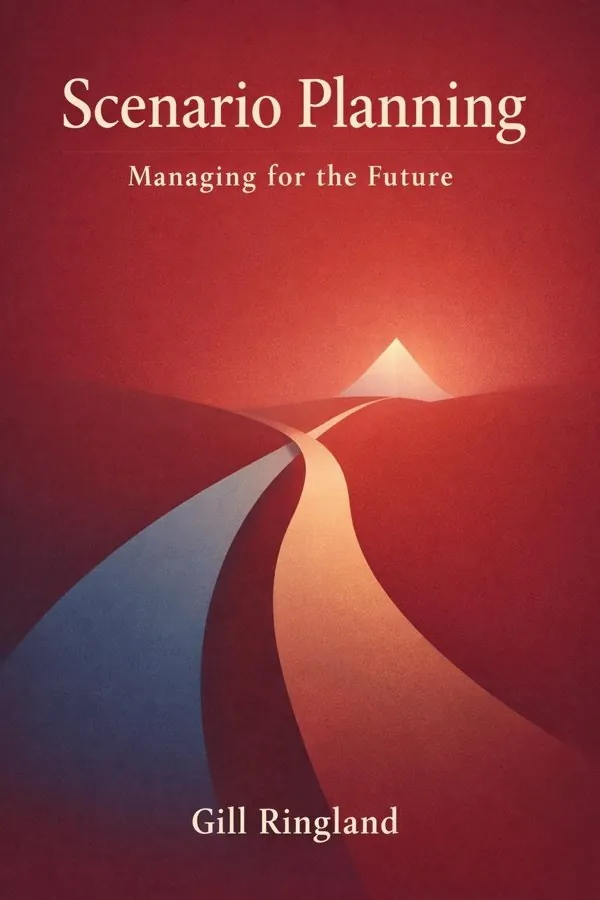
Scenario Planning: Managing for the Future: Summary & Key Insights
 10 min4 chaptersAudio available
What Is Scenario Planning: Managing for the Future About?
Scenario Planning: Managing for the Future by Gill Ringland is a strategy book spanning 4 pages. Scenario Planning: Managing for the Future introduces the concept and practice of scenario planning as a strategic management tool. It explains how organizations can use structured foresight to anticipate change, manage uncertainty, and make better long-term decisions. The book provides frameworks, case studies, and methodologies for developing and applying scenarios in business and policy contexts.
This FizzRead summary covers all 4 key chapters of Scenario Planning: Managing for the Future in approximately 10 minutes, distilling the most important ideas, arguments, and takeaways from Gill Ringland's work. Also available as an audio summary and Key Quotes Podcast.
Scenario Planning: Managing for the Future
Scenario Planning: Managing for the Future introduces the concept and practice of scenario planning as a strategic management tool. It explains how organizations can use structured foresight to anticipate change, manage uncertainty, and make better long-term decisions. The book provides frameworks, case studies, and methodologies for developing and applying scenarios in business and policy contexts.
Who Should Read Scenario Planning: Managing for the Future?
This book is perfect for anyone interested in strategy and looking to gain actionable insights in a short read. Whether you're a student, professional, or lifelong learner, the key ideas from Scenario Planning: Managing for the Future by Gill Ringland will help you think differently.
- ✓Readers who enjoy strategy and want practical takeaways
- ✓Professionals looking to apply new ideas to their work and life
- ✓Anyone who wants the core insights of Scenario Planning: Managing for the Future in just 10 minutes
Want the full summary?
Get instant access to this book summary and 100K+ more with Fizz Moment.
Get Free SummaryAvailable on App Store • Free to download
Key Chapters
When I speak about scenario planning, I often begin with its lineage. The method did not emerge overnight; it was born out of necessity, in contexts where strategists had to think under uncertainty. Its early development can be traced to the military sphere—particularly post-war operations research and Cold War strategic studies, where planners confronted the possibility of multiple, radically different futures. The RAND Corporation and French military strategist Gaston Berger both contributed conceptual building blocks, emphasizing foresight and long-term thinking. But it was within the energy industry that scenario planning found its modern form.
In the 1970s, Royal Dutch Shell faced an unpredictable oil environment. A group led by Pierre Wack, drawing on the methods of Herman Kahn, used scenario planning to prepare the company for possible oil shocks. They did not try to forecast prices; instead, they imagined coherent worlds shaped by plausible economic and political forces. When the oil crisis arrived, Shell was ready—it had rehearsed the future. That success invited attention from business schools and governments around the world, and scenario planning became an essential component of strategic foresight.
Unlike traditional forecasting, scenarios do not project trends; they question them. They help organizations step outside the framing assumptions of the present. This philosophical foundation is crucial. A scenario is not a prediction but a narrative framework—a way to create meaning about the future. In my consulting experience, the moment people grasp this distinction, everything changes. They realize that scenario planning is not about finding the ‘right’ future but about exploring the range of plausible futures and what those might mean for today’s choices.
At its core, scenario planning integrates objective analysis and subjective insight. It draws upon data about technological shifts, demographic patterns, geopolitical movements, and environmental trends, but it also relies on imagination—the ability to connect dots differently. This balance between analytic and creative cognition is what distinguishes scenario work from other strategy tools.
Another aspect of its foundation lies in systems thinking. Scenarios work best when we understand that all factors influencing the future are interconnected. Economic trends shape politics; technologies transform societies. The craft of scenario building, therefore, demands a holistic awareness: to see patterns and relationships rather than isolated variables. This mindset of systemic awareness underpins the modern discipline of strategic foresight.
By understanding its origins and philosophical stance, we begin to recognize why scenario planning has become indispensable to leaders managing complexity. It is both a conceptual framework and a collaborative process—a way to align people around shared uncertainties so they can make coherent strategic responses.
Every scenario exercise begins with focus. Before imagining worlds, we must decide what question we are trying to answer. In my facilitation practice, I often describe this as identifying the ‘focal issue’. Whether a corporation is concerned about industry transformation, climate regulation, or technological disruption, the focal issue acts as the anchor. It ensures that scenarios remain relevant to decision-making and not mere speculation.
Once the focal issue is defined, we explore the driving forces—those social, technological, economic, environmental, and political trends shaping the context. This stage is both analytical and exploratory: we gather signals from research, expert interviews, and environmental scanning. Through this process we build a picture of the forces at play, then ask two key questions: which of these are predetermined (likely to continue regardless of other changes) and which are genuinely uncertain? It is the uncertainties that give life to scenarios. They represent the points of divergence—the aspects of the future that could unfold in multiple directions.
With these forces identified, the next step is structure. We typically construct a framework using two critical uncertainties that form axes. Each axis spans a range—from one extreme state to its opposite—and together they create four quadrants, each representing a distinct future world. This matrix does not limit imagination; instead, it provides a disciplined taxonomy around which we build narrative detail. The worlds may differ in economic structure, technological orientation, governance style, or cultural ethos—whatever dimensions matter most to the focal issue.
The next phase is storytelling. In workshops, participants are encouraged to inhabit these worlds, to think through how decisions would play out under each. This creative exercise converts abstract analysis into lived experience. It helps strategists internalize the logic of each world and identify early indicators that a particular scenario may be emerging.
Finally, once the scenarios are articulated, we use them to test and refine current strategies. Each scenario becomes a wind tunnel: we place our existing plans within each future world and ask, would this strategy survive? What risks would threaten it? What opportunities might it unlock? Through this process, organizations uncover vulnerabilities and discover strategic options that are robust across different futures.
The process I describe is iterative and participatory. It demands rigorous preparation but rewards engagement. High-quality scenarios do not arise from an isolated think tank; they emerge from collective insight. This is why facilitation skills, stakeholder mapping, and diversity of perspective are vital components of successful scenario planning.
By guiding participants through focal issues, driving forces, critical uncertainties, framework design, and narrative building, we create a space where strategy and creativity coalesce. The outcome is not a static report but a dynamic capability—an organizational habit of thinking in multiple futures.
+ 2 more chapters — available in the FizzRead app
All Chapters in Scenario Planning: Managing for the Future
About the Author
Gill Ringland is a British author and consultant specializing in strategic foresight and scenario planning. She has served as CEO of SAMI Consulting and has extensive experience advising corporations and governments on future-oriented strategy and risk management.
Get This Summary in Your Preferred Format
Read or listen to the Scenario Planning: Managing for the Future summary by Gill Ringland anytime, anywhere. FizzRead offers multiple formats so you can learn on your terms — all free.
Available formats: App · Audio · PDF · EPUB — All included free with FizzRead
Download Scenario Planning: Managing for the Future PDF and EPUB Summary
Key Quotes from Scenario Planning: Managing for the Future
“When I speak about scenario planning, I often begin with its lineage.”
“Every scenario exercise begins with focus.”
Frequently Asked Questions about Scenario Planning: Managing for the Future
Scenario Planning: Managing for the Future by Gill Ringland is a strategy book that explores key ideas across 4 chapters. Scenario Planning: Managing for the Future introduces the concept and practice of scenario planning as a strategic management tool. It explains how organizations can use structured foresight to anticipate change, manage uncertainty, and make better long-term decisions. The book provides frameworks, case studies, and methodologies for developing and applying scenarios in business and policy contexts.
You Might Also Like
Mastery
Robert Greene
10 min
Cut Costs Not Corners: A Practical Guide to Staying Competitive and Improving Profits
Colin Barrow
10 min
Good Strategy/Bad Strategy: The Difference and Why It Matters
Richard P. Rumelt
10 min
On Grand Strategy
John Lewis Gaddis
10 min
The Six Disciplines of Digital Transformation
George Westerman
10 min
7 Powers: The Foundations of Business Strategy
Hamilton Helmer
10 minBrowse by Category
Ready to read Scenario Planning: Managing for the Future?
Get the full summary and 100K+ more books with Fizz Moment.