
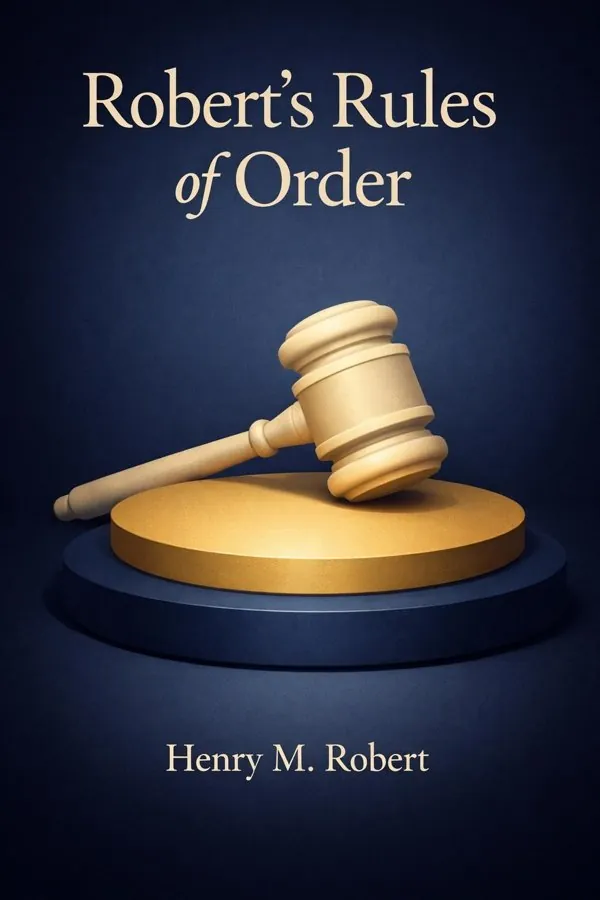
Robert's Rules of Order: Summary & Key Insights
 10 min9 chaptersAudio available
Key Takeaways from Robert's Rules of Order
A meeting becomes meaningful only when it transforms scattered opinions into a legitimate collective decision.
Not every meeting should do the same kind of work, and confusion begins when organizations fail to distinguish one type from another.
Groups often mistake spontaneity for productivity, but most meetings become more effective when business follows a disciplined sequence.
Ideas do not become decisions until they are put into a form the assembly can act on.
The quality of a meeting depends less on whether people speak than on whether they speak under rules that make real deliberation possible.
What Is Robert's Rules of Order About?
Robert's Rules of Order by Henry M. Robert is a organization book spanning 9 pages. Robert's Rules of Order is one of the most influential guides ever written on how groups make decisions. First published in 1876 by Henry M. Robert, the book translates the principles of parliamentary procedure into a practical system for meetings, debate, motions, voting, elections, and organizational governance. Its central concern is simple but profound: how can a group of equal members disagree, deliberate, and still arrive at fair, binding decisions without confusion or chaos? Robert's answer is a structured process that protects both majority rule and minority rights. The book matters because most organizations fail not from lack of good intentions, but from disorder: unclear agendas, unfocused debate, procedural disputes, and decisions that later get challenged. Robert's Rules provides a common language and framework that allows churches, nonprofits, clubs, boards, professional associations, and public bodies to function with legitimacy and consistency. Henry M. Robert brought unusual authority to the task. As a U.S. Army officer and engineer, he approached meetings the way an engineer approaches systems: by designing procedures that are orderly, durable, and fair. The result is not merely a rulebook, but a manual for democratic self-government in everyday life.
This FizzRead summary covers all 9 key chapters of Robert's Rules of Order in approximately 10 minutes, distilling the most important ideas, arguments, and takeaways from Henry M. Robert's work. Also available as an audio summary and Key Quotes Podcast.
Robert's Rules of Order
Robert's Rules of Order is one of the most influential guides ever written on how groups make decisions. First published in 1876 by Henry M. Robert, the book translates the principles of parliamentary procedure into a practical system for meetings, debate, motions, voting, elections, and organizational governance. Its central concern is simple but profound: how can a group of equal members disagree, deliberate, and still arrive at fair, binding decisions without confusion or chaos? Robert's answer is a structured process that protects both majority rule and minority rights.
The book matters because most organizations fail not from lack of good intentions, but from disorder: unclear agendas, unfocused debate, procedural disputes, and decisions that later get challenged. Robert's Rules provides a common language and framework that allows churches, nonprofits, clubs, boards, professional associations, and public bodies to function with legitimacy and consistency. Henry M. Robert brought unusual authority to the task. As a U.S. Army officer and engineer, he approached meetings the way an engineer approaches systems: by designing procedures that are orderly, durable, and fair. The result is not merely a rulebook, but a manual for democratic self-government in everyday life.
Who Should Read Robert's Rules of Order?
This book is perfect for anyone interested in organization and looking to gain actionable insights in a short read. Whether you're a student, professional, or lifelong learner, the key ideas from Robert's Rules of Order by Henry M. Robert will help you think differently.
- ✓Readers who enjoy organization and want practical takeaways
- ✓Professionals looking to apply new ideas to their work and life
- ✓Anyone who wants the core insights of Robert's Rules of Order in just 10 minutes
Want the full summary?
Get instant access to this book summary and 100K+ more with Fizz Moment.
Get Free SummaryAvailable on App Store • Free to download
Key Chapters
A meeting becomes meaningful only when it transforms scattered opinions into a legitimate collective decision. Robert begins with the idea of the deliberative assembly: a body of people, equal in parliamentary standing, gathered to consider matters and decide them together. This is not just a crowd or an audience. It is a decision-making institution governed by rules that allow members to think together without surrendering fairness, order, or individual dignity.
At the heart of this idea is balance. The majority must be able to decide, or the group cannot act. But the minority must be able to speak, propose alternatives, and challenge errors, or the process becomes domination rather than deliberation. Parliamentary procedure exists to protect both sides at once. It channels disagreement into a recognizable structure so that conflict can produce decisions instead of dysfunction.
This principle matters in every kind of organization. A neighborhood association deciding whether to increase dues, a nonprofit board debating a new program, or a student senate considering a resolution all need a framework that distinguishes discussion from decision. Without shared rules, strong personalities tend to control outcomes, quieter members are overlooked, and important actions may later be disputed as invalid.
Robert's insight is that order is not the enemy of democracy; it is what makes democracy operational. A group cannot govern itself by goodwill alone. It needs procedures that define who may speak, how proposals are brought forward, when discussion ends, and how the final will of the body is determined.
Actionable takeaway: Treat every formal meeting as a deliberative assembly with a clear decision-making purpose, and adopt rules that protect both the right to decide and the right to be heard.
Not every meeting should do the same kind of work, and confusion begins when organizations fail to distinguish one type from another. Robert carefully identifies regular meetings, special meetings, adjourned meetings, annual meetings, executive sessions, and convention-style gatherings because each carries different expectations, powers, and notice requirements. This classification is not bureaucratic trivia; it is how an organization protects legitimacy.
A regular meeting is the standard recurring gathering where ordinary business is conducted. Members know when it will occur and what kinds of matters may arise. A special meeting, by contrast, is called to address a specific urgent issue and typically cannot roam freely into unrelated business. An adjourned meeting continues the business of a previous session. Annual meetings often include elections, reports, and major institutional decisions. Executive sessions limit attendance to protect confidentiality in matters such as personnel, litigation, or sensitive negotiations.
These distinctions matter in practice. Imagine a board that calls a special meeting to discuss a building repair but then uses it to pass an unrelated bylaw amendment. Members who did not attend because of the stated purpose may rightly question the fairness or validity of that action. Or consider an annual meeting where election procedures are unclear; the resulting leadership dispute can divide an organization for months.
By assigning each meeting a proper scope, Robert helps organizations avoid procedural overreach. People participate more confidently when they know what kind of gathering they are attending, what can be done there, and what requires broader notice or another meeting entirely.
Actionable takeaway: Define the type and purpose of every meeting in advance, and do not use one kind of meeting to do work that properly belongs to another.
Groups often mistake spontaneity for productivity, but most meetings become more effective when business follows a disciplined sequence. Robert's order of business gives assemblies a reliable structure: reading and approval of minutes, reports of officers and boards, reports of committees, unfinished business, new business, and related procedural items. This sequence prevents meetings from becoming a jumble of interruptions, forgotten obligations, and impulsive detours.
The deeper logic is that organizations function best when they move from record to accountability to action. Minutes connect the current meeting to the previous one. Officer and committee reports provide information and recommendations. Unfinished business ensures that previously introduced matters are not abandoned merely because they are inconvenient. New business creates space for fresh proposals without allowing them to overwhelm the meeting before existing duties are addressed.
In practical settings, this structure saves time and reduces conflict. A nonprofit board that jumps directly into new ideas may ignore unfinished budget questions and later discover that it approved projects without clear funding. A club that never reviews minutes may repeat motions, misremember decisions, or dispute what authority was granted. By following a standard order, members know when to raise issues and are less likely to interrupt proceedings with procedural confusion.
A structured agenda also improves participation. Members can prepare in advance, anticipate when topics will arise, and contribute more thoughtfully. The presiding officer benefits too, because the chair is no longer improvising the flow of business under pressure.
Actionable takeaway: Use a consistent order of business for formal meetings so the group can move from information to accountability to decision without losing continuity or focus.
Ideas do not become decisions until they are put into a form the assembly can act on. Robert's system of motions is the language through which a body conducts business. A member makes a main motion to propose action, another member seconds it to show that at least two people wish the matter considered, and the chair states the question so it belongs to the assembly rather than the individual who introduced it. From there, debate and decision can proceed in an orderly way.
Robert distinguishes several classes of motions because not all procedural needs are equal. Main motions bring substantive proposals before the body. Subsidiary motions, such as amend, refer to committee, or previous question, help the assembly shape or dispose of the main question. Privileged motions deal with urgent matters affecting the meeting itself, like adjournment or recess. Incidental motions arise from procedure, such as points of order or appeals.
This classification matters because it prevents procedural collisions. Suppose a committee recommendation is under debate and a member wants to adjust the wording. The proper move is to amend, not to launch into an entirely new proposal. Or imagine the discussion has become repetitive and the body wants to close debate; a motion for the previous question provides a formal mechanism rather than relying on the chair's impatience.
Motions discipline conversation by converting vague preferences into concrete propositions. They force clarity: what exactly is being proposed, what change is requested, and what vote is required? In organizations, many disputes stem not from disagreement itself but from uncertainty about what was actually before the group.
Actionable takeaway: When a group must decide something, insist that the issue be framed as a clear motion before debate begins, so members know exactly what they are discussing and voting on.
The quality of a meeting depends less on whether people speak than on whether they speak under rules that make real deliberation possible. Robert treats debate as essential to democratic decision-making, but he also insists that debate must be controlled if it is to be fair. Members generally speak through the chair, confine remarks to the pending question, avoid personal attacks, and respect limits intended to prevent one person from monopolizing the floor.
These rules do not suppress disagreement. They make disagreement usable. Without them, meetings drift into side conversations, repeated speeches, emotional escalation, and personal conflict. Members begin answering one another instead of addressing the motion. The strongest voices dominate, while thoughtful but less assertive members withdraw. Debate then produces heat without insight.
Robert's framework protects the assembly from both chaos and premature closure. Members must have a real chance to argue for and against a proposal. At the same time, debate cannot continue indefinitely merely because some participants are unwilling to accept a coming decision. Rules governing recognition, relevance, and decorum keep the focus on whether the motion should be adopted and on what terms.
A practical example is a board discussing whether to launch a new service. Productive debate would include cost concerns, mission alignment, staffing implications, and possible amendments. Unproductive debate would include attacks on who first suggested the idea, stories unrelated to the proposal, or repeated restatements after key points have already been made.
Actionable takeaway: Protect the right to robust debate, but enforce relevance, equal access to the floor, and respectful conduct so discussion sharpens judgment instead of undermining the group.
An assembly may be sovereign in principle, but it cannot do all of its work as a committee of the whole. Robert shows that officers and committees are the machinery through which an organization sustains continuity, manages complexity, and prepares business for efficient decision. The assembly remains the ultimate authority, but delegated roles allow it to function intelligently between meetings and at scale.
Officers such as the chair, secretary, and treasurer do far more than hold titles. The chair preserves impartiality, recognizes members, states questions, and ensures that procedure is followed. The secretary safeguards the official memory of the organization through accurate minutes and records. The treasurer reports on financial condition and stewardship. Each role exists to support the body, not to dominate it.
Committees serve a similarly practical purpose. A finance committee can analyze budgets in detail that would overwhelm a full assembly. A nominations committee can identify qualified candidates. A bylaws committee can review proposed amendments for coherence and conflict. By studying issues in depth and bringing back recommendations, committees allow the assembly to make better-informed decisions without drowning in detail.
Still, Robert warns indirectly against confusion of power. Committees recommend; unless explicitly authorized, they do not replace the will of the assembly. Officers administer; they do not own the organization. Many governance problems arise when a board chair acts like a chief executive without consent, or when committees quietly make policy decisions that should have been brought before the membership.
Actionable takeaway: Clarify the duties and limits of every officer and committee so delegated work strengthens the assembly instead of displacing it.
Rules are most valuable not when everything is calm, but when emotions rise and trust is tested. Robert devotes significant attention to order, discipline, points of order, appeals, and the handling of misconduct because organizations need ways to correct errors without collapsing into personal struggle. Procedure is a peacekeeping tool. It gives members a lawful method to challenge improper actions and gives the chair a framework for preserving decorum without arbitrary force.
A point of order allows a member to call attention to a breach of rules at the moment it occurs. An appeal allows the assembly, under proper conditions, to review a ruling of the chair. These devices are fundamental in democratic governance because they ensure that authority is not unchecked. The chair leads the meeting, but the assembly remains the final judge of many procedural disputes.
Discipline is handled with similar care. Members who persistently violate decorum may be called to order, and serious cases can lead to sanctions under the body's rules. Yet even here, due process matters. The aim is not humiliation, but protection of the assembly's ability to conduct business fairly.
Consider a contentious membership meeting where one participant repeatedly interrupts speakers and ignores rulings. If the chair simply argues with the person, the entire meeting may derail. If the chair follows recognized procedure, members can see that order is being maintained by rule rather than personal preference. That distinction preserves legitimacy, even in conflict.
Actionable takeaway: Use procedural remedies such as points of order, appeals, and formal discipline to address conflict through rules rather than personalities.
Organizations do not govern themselves meeting by meeting alone; they also need durable rules and orderly transitions of power. Robert treats bylaws and elections as the constitutional backbone of any deliberative body. Bylaws define the organization's essential structure: its name, purpose, membership rules, officers, meetings, quorum, and amendment procedures. Elections determine who will exercise authority within that structure. Together, they ensure continuity beyond any single leader or moment.
Bylaws matter because they answer foundational questions before conflict arises. How often does the group meet? Who may vote? What constitutes a quorum? How are officers chosen? When these matters are left vague, organizations often rely on habit, personality, or convenience until a disagreement exposes the weakness. A good set of bylaws reduces uncertainty and makes procedural decisions predictable.
Elections are equally important because they test whether the organization truly honors equal participation. Robert's procedural guidance helps ensure nominations are handled fairly, ballots are counted properly, and winners are declared under known rules. This is especially vital when offices carry influence over finances, agenda-setting, or public representation.
A common governance failure is treating bylaws as an afterthought and elections as ceremonial. In reality, weak bylaws invite power struggles, while sloppy elections damage trust in leadership from the start. Even small associations benefit from taking these matters seriously.
Actionable takeaway: Review bylaws regularly for clarity and run elections by explicit rules so leadership transitions are orderly, credible, and accepted by the whole body.
All Chapters in Robert's Rules of Order
About the Author
Henry Martyn Robert (1837-1923) was an American Army officer, civil engineer, and the author of Robert's Rules of Order, the most widely used manual of parliamentary procedure in the United States. A graduate of the U.S. Military Academy at West Point, Robert served in the Corps of Engineers and developed a reputation for precision, order, and disciplined thinking. His interest in meeting procedure grew after he was unexpectedly asked to preside over a church meeting and discovered how difficult it was to guide discussion fairly without a clear system. Drawing on existing parliamentary traditions, he published Robert's Rules of Order in 1876 to provide organizations with a practical framework for orderly deliberation. His work has shaped the governance of churches, civic groups, associations, boards, and public bodies for generations.
Get This Summary in Your Preferred Format
Read or listen to the Robert's Rules of Order summary by Henry M. Robert anytime, anywhere. FizzRead offers multiple formats so you can learn on your terms — all free.
Available formats: App · Audio · PDF · EPUB — All included free with FizzRead
Download Robert's Rules of Order PDF and EPUB Summary
Key Quotes from Robert's Rules of Order
“A meeting becomes meaningful only when it transforms scattered opinions into a legitimate collective decision.”
“Not every meeting should do the same kind of work, and confusion begins when organizations fail to distinguish one type from another.”
“Groups often mistake spontaneity for productivity, but most meetings become more effective when business follows a disciplined sequence.”
“Ideas do not become decisions until they are put into a form the assembly can act on.”
“The quality of a meeting depends less on whether people speak than on whether they speak under rules that make real deliberation possible.”
Frequently Asked Questions about Robert's Rules of Order
Robert's Rules of Order by Henry M. Robert is a organization book that explores key ideas across 9 chapters. Robert's Rules of Order is one of the most influential guides ever written on how groups make decisions. First published in 1876 by Henry M. Robert, the book translates the principles of parliamentary procedure into a practical system for meetings, debate, motions, voting, elections, and organizational governance. Its central concern is simple but profound: how can a group of equal members disagree, deliberate, and still arrive at fair, binding decisions without confusion or chaos? Robert's answer is a structured process that protects both majority rule and minority rights. The book matters because most organizations fail not from lack of good intentions, but from disorder: unclear agendas, unfocused debate, procedural disputes, and decisions that later get challenged. Robert's Rules provides a common language and framework that allows churches, nonprofits, clubs, boards, professional associations, and public bodies to function with legitimacy and consistency. Henry M. Robert brought unusual authority to the task. As a U.S. Army officer and engineer, he approached meetings the way an engineer approaches systems: by designing procedures that are orderly, durable, and fair. The result is not merely a rulebook, but a manual for democratic self-government in everyday life.
You Might Also Like

A Guide to the Project Management Body of Knowledge (PMBOK® Guide)
Project Management Institute
10 min
Organizational Behavior
Stephen P. Robbins
10 min
Accelerate: The Science of Lean Software and DevOps – Building and Scaling High Performing Technology Organizations
Nicole Forsgren, Jez Humble, Gene Kim
10 min
Awakening Compassion at Work: The Quiet Power That Elevates People and Organizations
Monica C. Worline, Jane E. Dutton
10 min
Building an Inclusive Organization: Leveraging the Power of a Diverse Workforce
Stephen Frost
10 min
Collaborative Intelligence: Thinking with People Who Think Differently
Dawna Markova, Angie McArthur
10 minBrowse by Category
Ready to read Robert's Rules of Order?
Get the full summary and 100K+ more books with Fizz Moment.