
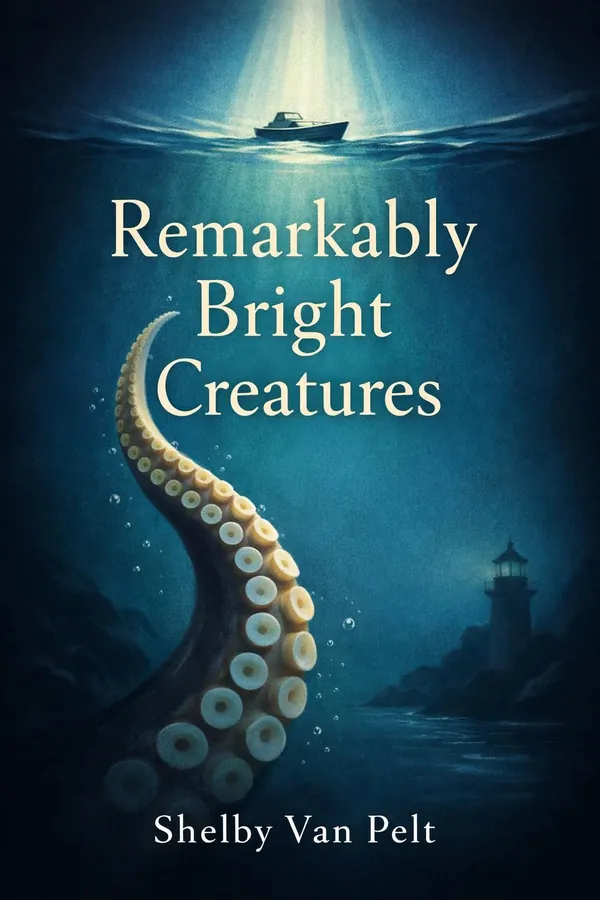
Remarkably Bright Creatures: Summary & Key Insights
 10 min9 chaptersAudio available
Key Takeaways from Remarkably Bright Creatures
Loss does not always arrive as dramatic sorrow; often, it settles into routines.
The people or beings who help us heal are not always the ones we expect.
A capable life is not the same as a connected life.
Unanswered questions can keep grief alive for decades.
Sometimes humor tells the truth more directly than solemnity.
What Is Remarkably Bright Creatures About?
Remarkably Bright Creatures by Shelby Van Pelt is a classics book. What if the being who understands your grief best is an octopus? Shelby Van Pelt’s Remarkably Bright Creatures is a warm, witty, and emotionally resonant novel about loneliness, loss, aging, and the surprising relationships that can restore meaning to a life that feels permanently broken. Set in the small coastal town of Sowell Bay, the story follows Tova Sullivan, a practical widow who works nights cleaning the local aquarium, and Marcellus, a famously intelligent giant Pacific octopus who observes human behavior with piercing clarity. As Tova continues to live under the shadow of her husband’s death and the long-ago disappearance of her son, an unlikely chain of events begins to reveal hidden truths and offer the possibility of healing. Van Pelt’s debut stands out for its charm, emotional intelligence, and memorable voice, especially through Marcellus’s perspective, which brings humor and wisdom to deeply human questions. The novel matters because it shows that connection can come from unexpected places, and that even after years of silence, grief, and regret, life can still open into wonder.
This FizzRead summary covers all 9 key chapters of Remarkably Bright Creatures in approximately 10 minutes, distilling the most important ideas, arguments, and takeaways from Shelby Van Pelt's work. Also available as an audio summary and Key Quotes Podcast.
Remarkably Bright Creatures
What if the being who understands your grief best is an octopus? Shelby Van Pelt’s Remarkably Bright Creatures is a warm, witty, and emotionally resonant novel about loneliness, loss, aging, and the surprising relationships that can restore meaning to a life that feels permanently broken. Set in the small coastal town of Sowell Bay, the story follows Tova Sullivan, a practical widow who works nights cleaning the local aquarium, and Marcellus, a famously intelligent giant Pacific octopus who observes human behavior with piercing clarity. As Tova continues to live under the shadow of her husband’s death and the long-ago disappearance of her son, an unlikely chain of events begins to reveal hidden truths and offer the possibility of healing. Van Pelt’s debut stands out for its charm, emotional intelligence, and memorable voice, especially through Marcellus’s perspective, which brings humor and wisdom to deeply human questions. The novel matters because it shows that connection can come from unexpected places, and that even after years of silence, grief, and regret, life can still open into wonder.
Who Should Read Remarkably Bright Creatures?
This book is perfect for anyone interested in classics and looking to gain actionable insights in a short read. Whether you're a student, professional, or lifelong learner, the key ideas from Remarkably Bright Creatures by Shelby Van Pelt will help you think differently.
- ✓Readers who enjoy classics and want practical takeaways
- ✓Professionals looking to apply new ideas to their work and life
- ✓Anyone who wants the core insights of Remarkably Bright Creatures in just 10 minutes
Want the full summary?
Get instant access to this book summary and 100K+ more with Fizz Moment.
Get Free SummaryAvailable on App Store • Free to download
Key Chapters
Loss does not always arrive as dramatic sorrow; often, it settles into routines. One of the most affecting ideas in Remarkably Bright Creatures is that grief can become invisible even to the person carrying it. Tova Sullivan is not outwardly theatrical in her sadness. She keeps moving. She works the night shift at the aquarium. She shops, cleans, remembers, and endures. Yet every part of her life has been shaped by what she has lost: first her son Erik, who vanished decades earlier, and later her husband, Will. Shelby Van Pelt shows that grief is not only crying or collapse. It can also look like orderliness, self-control, and a refusal to burden others.
This makes the novel especially powerful because it reflects how many people actually live after loss. They function. They show up. They become reliable. But beneath that capability lies an unresolved ache. Tova’s habits are not simply signs of discipline; they are also defenses against chaos. Her nightly cleaning work gives structure to pain that otherwise has nowhere to go.
In real life, this insight matters because many people underestimate the emotional force of long-standing grief, especially when it appears “managed.” A neighbor who never speaks about a deceased spouse, a parent who throws themselves into errands after a child leaves, or a friend who always seems fine may still be living in profound emotional aftermath.
The practical lesson is to pay attention to routine as a language of feeling. Ask what your habits may be protecting. If you are supporting someone else, do not assume silence means healing. Actionable takeaway: identify one routine in your life that may be masking grief or loneliness, and gently create space to talk, write, or reflect on what sits beneath it.
The people or beings who help us heal are not always the ones we expect. At the heart of Remarkably Bright Creatures is an unlikely bond between Tova and Marcellus, the giant Pacific octopus at the Sowell Bay Aquarium. Their connection is not sentimental in a simplistic way. It works because both are observant, isolated, and far more perceptive than the world gives them credit for. Through their interactions, Shelby Van Pelt suggests that companionship is not limited by age, species, or social norms. What matters is recognition: the feeling that something alive truly sees you.
Marcellus, with his sharp intelligence and dry commentary, notices what humans miss. Tova, in turn, treats him with respect rather than as a mere exhibit. This mutual regard gives each of them a strange kind of dignity. It also opens the novel into one of its most moving truths: healing often begins with small moments of being witnessed.
This idea applies far beyond fiction. People frequently imagine that support must come in expected forms, such as family, close friends, or formal therapy. But comfort can arrive through a pet, a casual coworker, a neighbor, a volunteer role, or a place that creates regular contact and purpose. The point is not that all bonds are equal, but that meaningful connection is often available where we are not looking.
The novel encourages openness to relationships that do not fit our scripts. A retired person may find renewed joy in mentoring a teenager. A lonely worker may feel understood through routine exchanges with someone at a local café. A grieving person may reconnect to life through caring for an animal.
Actionable takeaway: instead of focusing only on the relationships you think should sustain you, notice where genuine warmth and recognition already exist, and invest a little more attention there.
A capable life is not the same as a connected life. Tova is efficient, responsible, and respected, but she is also deeply alone. One of Shelby Van Pelt’s sharpest observations is that loneliness often hides behind people who appear the most put together. Tova pays her bills, keeps her home in order, and fulfills her obligations. From the outside, she seems stable. Yet stability has become a shell that keeps others at a distance and protects her from further pain.
This matters because modern culture often praises independence without asking what it costs. People who are self-sufficient are admired, especially older adults who do not “need anything.” But the novel reveals the danger in this mindset. Tova’s competence has become a reason others leave her undisturbed, which reinforces her isolation. The very traits that make her admirable also make it easier for people to overlook her need for closeness.
Van Pelt contrasts this with the awkward but sincere efforts of others who begin to enter Tova’s life. These interactions are imperfect, sometimes inconvenient, and occasionally uncomfortable. But they reveal something essential: relationships are rarely neat. Human connection requires tolerance for mess, repetition, misunderstanding, and vulnerability.
In practical terms, this idea invites readers to reconsider the people in their lives who “never ask for help.” That person may not be thriving; they may simply be practiced at coping. It also encourages self-awareness. If you pride yourself on not needing anyone, it is worth asking whether independence has quietly become emotional avoidance.
Actionable takeaway: reach out to one highly competent person in your life with a specific offer of time, conversation, or help, and if you are that person, practice accepting one small gesture of support.
Unanswered questions can keep grief alive for decades. A major emotional engine of Remarkably Bright Creatures is the mystery surrounding Tova’s son, Erik, who disappeared at eighteen. Because there was never a full resolution, Tova’s sorrow cannot settle into a clean narrative. Shelby Van Pelt uses this mystery not simply as a plot device, but as a way to explore how uncertainty deepens emotional suffering. It is often easier to mourn a known ending than to live with an open wound of not knowing.
The novel shows that mystery can work in two opposite ways. On one hand, it traps people in suspended grief, where hope and despair coexist without closure. On the other hand, it can give pain direction. Once hidden clues and possibilities begin to emerge, Tova’s life shifts. The unanswered past is no longer just a private burden; it becomes something that can be investigated, interpreted, and perhaps understood.
This reflects real life in important ways. Families dealing with estrangement, missing information, adoption secrets, or unresolved conflicts often carry emotional tension for years. The lack of clarity can distort identity, relationships, and self-trust. Even when full answers are impossible, pursuing understanding can itself be healing.
Practically, this means that some suffering needs inquiry, not only endurance. A difficult family history may benefit from a conversation, a search through old letters, or a carefully framed question to someone who knows more than they have said. Not every mystery will be solved, but naming the unknown often reduces its power.
Actionable takeaway: identify one unresolved question in your life that still carries emotional weight, and take one realistic step toward clarity, whether through conversation, research, journaling, or professional support.
Sometimes humor tells the truth more directly than solemnity. One reason Remarkably Bright Creatures feels so fresh is that it refuses to treat emotional depth as the opposite of comedy. Marcellus’s voice is dry, superior, observant, and often hilarious. He comments on humans with amusement and irritation, yet his wit does not trivialize the novel’s grief. Instead, it makes the sadness more bearable and, paradoxically, more believable.
Shelby Van Pelt understands that people rarely live inside a single emotional tone. Even in periods of mourning, absurdity continues. Bodies fail at inconvenient moments. People say the wrong thing. Bureaucracies remain ridiculous. Daily life insists on comedy amid heartbreak. By allowing humor into a story about loss and loneliness, Van Pelt creates emotional realism rather than emotional dilution.
This is useful beyond literature because many people feel guilty for laughing in difficult times, as if humor betrays seriousness. The novel suggests the opposite. Humor can be a form of resilience, perspective, and shared humanity. It lets people breathe without denying the depth of what hurts. In families, workplaces, hospitals, and friendships, a well-timed moment of levity can restore dignity and warmth.
The key is the kind of humor. Marcellus’s commentary works because it is rooted in insight, not cruelty. It exposes vanity, blindness, and human strangeness while still allowing compassion. That balance matters in real life too. The best humor in hard times does not dismiss pain; it creates room around it.
Actionable takeaway: when facing a heavy season, allow yourself one source of gentle, intelligent humor each day, and use laughter not to avoid reality, but to stay emotionally flexible enough to face it.
Transformation often begins not with dramatic reinvention, but with awkward, ordinary opportunities. Another key idea in Remarkably Bright Creatures is that second chances usually arrive in unpolished forms. They may come as a confusing friendship, an inconvenient truth, a job that seems beneath your ambitions, or a relationship that initially feels mismatched. The novel’s younger storyline, especially through Cameron, highlights this well. He is adrift, somewhat immature, and uncertain of his future. Yet his flaws do not disqualify him from growth. They are the raw material for it.
Shelby Van Pelt avoids the fantasy that people become better through sudden enlightenment alone. Instead, change happens through embarrassment, persistence, responsibility, and being drawn into other people’s lives. Cameron’s development is compelling because it is uneven. He makes mistakes, misreads situations, and often lacks direction, but he is still capable of sincerity and evolution.
This makes the novel quietly encouraging. Many readers think they have missed their moment, whether in youth or later life. But Van Pelt argues that renewal can begin from almost any starting point. What matters is not polish; it is willingness. The chance to become more honest, dependable, and connected often appears in situations that first seem disappointing.
In practical life, this can mean saying yes to a humble job that teaches discipline, repairing a strained relationship through small consistent effort, or taking responsibility before you feel fully ready. It may also mean seeing potential in someone who is still rough around the edges.
Actionable takeaway: if an opportunity for growth seems ordinary or inconvenient rather than exciting, do not dismiss it too quickly; ask whether it might be a second chance in disguise.
Belonging is less often created by grand declarations than by repeated, ordinary contact. In Remarkably Bright Creatures, Sowell Bay is not simply a backdrop; it is a social ecosystem where people cross paths, form impressions, misjudge one another, and slowly become connected. Shelby Van Pelt shows that community is built in increments: familiar faces, recurring conversations, routine responsibilities, and small acts of attention.
This matters because many people imagine community as something dramatic and instantly fulfilling. In reality, it often emerges through modest repetition. Tova’s life at the aquarium, her interactions around town, and the network of people who gradually affect one another all illustrate that belonging is cumulative. A place begins to feel meaningful because someone remembers your habits, notices your absence, or expects to see you tomorrow.
The novel also reminds readers that community can irritate before it comforts. Small towns, workplaces, volunteer groups, and neighborhood circles can feel intrusive, gossipy, or inconvenient. Yet they also provide the texture of mutual awareness that keeps isolation from becoming total. People become real to one another through continued exposure.
Applied practically, this suggests that if you want more connection, dramatic self-disclosure is not always the first step. Showing up consistently matters more. Attend the same class, visit the same library, volunteer weekly, walk the same route, or chat with the same barista. Over time, recognition becomes familiarity, and familiarity becomes care.
Actionable takeaway: choose one local place or recurring activity where you can participate consistently for a month, and let repetition, rather than intensity, begin to build a sense of community.
Being smart is not just about solving problems; it is also about noticing what others ignore. Marcellus is remarkable not merely because he is an octopus with extraordinary cognition, but because his intelligence includes perception, memory, pattern recognition, and emotional insight. Through him, Shelby Van Pelt broadens the reader’s idea of what intelligence looks like. He understands enclosures, locks, habits, motives, and relationships. He reads people better than many people read themselves.
This idea enriches the whole novel. Human characters often misjudge one another because they focus on surface behavior rather than underlying feeling. Marcellus, by contrast, sees the deeper arrangement of things. His awareness highlights how often humans confuse busyness with purpose, politeness with honesty, and independence with contentment. In this way, the novel gently critiques narrow definitions of intelligence that prioritize credentials or verbal sophistication while ignoring emotional acuity.
The practical value of this insight is significant. In everyday life, strong perception can improve leadership, parenting, friendship, and decision-making. A manager who notices that an employee’s irritability reflects exhaustion rather than disrespect will respond more wisely. A friend who recognizes loneliness beneath sarcasm may offer better support. Emotional perception helps people act with more precision and compassion.
It also encourages humility. Someone may not express themselves elegantly or hold formal status, yet still understand a room, a relationship, or a problem more deeply than others. The novel asks readers to respect forms of intelligence that are intuitive, relational, and embodied.
Actionable takeaway: in your next important interaction, spend more time observing patterns, tone, and unspoken signals before reacting, and treat emotional perception as a skill worth practicing.
The truths we fear most are sometimes the ones that free us. Remarkably Bright Creatures moves toward revelation, but its emotional power comes from how those revelations function. Truth in this novel is not clean or painless. It disrupts assumptions, exposes missed connections, and forces characters to reconsider who they are to one another. Yet Shelby Van Pelt suggests that honest knowledge, even when destabilizing, is kinder than lifelong uncertainty or inherited misunderstanding.
This is an important distinction. Many people avoid truth because they believe ignorance protects peace. The novel argues that concealment often preserves only stagnation. Tova has lived for years with grief shaped by absence and ambiguity. As hidden realities come into view, the process is uncomfortable, but it also opens the door to tenderness, reconciliation, and a new future. Hope does not come from pretending the past was easier than it was. It comes from finally seeing it more clearly.
In everyday life, this message applies to family stories, personal identity, unresolved conflict, and self-knowledge. Difficult truths about relationships, origins, failures, or past choices may initially unsettle us. But clarity creates the possibility of wise action. Without it, we remain trapped in versions of the story that may be incomplete or false.
The novel does not romanticize disclosure. Timing, care, and context matter. Still, it insists that truth is often the threshold to renewal. A life built around avoidance may feel stable, but it cannot fully heal.
Actionable takeaway: consider one truth you have postponed facing, and ask what small, safe step would move you from avoidance toward clarity, because hope often begins where denial ends.
All Chapters in Remarkably Bright Creatures
About the Author
Shelby Van Pelt is an American author whose debut novel, Remarkably Bright Creatures, became widely celebrated for its originality, emotional warmth, and memorable storytelling. Before publishing fiction, she pursued a professional career outside the literary world, eventually turning more fully toward writing. Her work is marked by compassion, humor, and a strong interest in the hidden emotional lives of ordinary people. In Remarkably Bright Creatures, she combines an inventive premise with an accessible literary style, exploring grief, loneliness, aging, and human connection through both human and animal perspectives. Van Pelt quickly gained a broad readership with her debut, which appealed to book club audiences and general fiction readers alike. She is recognized for writing stories that are tender, intelligent, and quietly uplifting.
Get This Summary in Your Preferred Format
Read or listen to the Remarkably Bright Creatures summary by Shelby Van Pelt anytime, anywhere. FizzRead offers multiple formats so you can learn on your terms — all free.
Available formats: App · Audio · PDF · EPUB — All included free with FizzRead
Download Remarkably Bright Creatures PDF and EPUB Summary
Key Quotes from Remarkably Bright Creatures
“Loss does not always arrive as dramatic sorrow; often, it settles into routines.”
“The people or beings who help us heal are not always the ones we expect.”
“A capable life is not the same as a connected life.”
“Unanswered questions can keep grief alive for decades.”
“Sometimes humor tells the truth more directly than solemnity.”
Frequently Asked Questions about Remarkably Bright Creatures
Remarkably Bright Creatures by Shelby Van Pelt is a classics book that explores key ideas across 9 chapters. What if the being who understands your grief best is an octopus? Shelby Van Pelt’s Remarkably Bright Creatures is a warm, witty, and emotionally resonant novel about loneliness, loss, aging, and the surprising relationships that can restore meaning to a life that feels permanently broken. Set in the small coastal town of Sowell Bay, the story follows Tova Sullivan, a practical widow who works nights cleaning the local aquarium, and Marcellus, a famously intelligent giant Pacific octopus who observes human behavior with piercing clarity. As Tova continues to live under the shadow of her husband’s death and the long-ago disappearance of her son, an unlikely chain of events begins to reveal hidden truths and offer the possibility of healing. Van Pelt’s debut stands out for its charm, emotional intelligence, and memorable voice, especially through Marcellus’s perspective, which brings humor and wisdom to deeply human questions. The novel matters because it shows that connection can come from unexpected places, and that even after years of silence, grief, and regret, life can still open into wonder.
You Might Also Like




Browse by Category
Ready to read Remarkably Bright Creatures?
Get the full summary and 100K+ more books with Fizz Moment.