
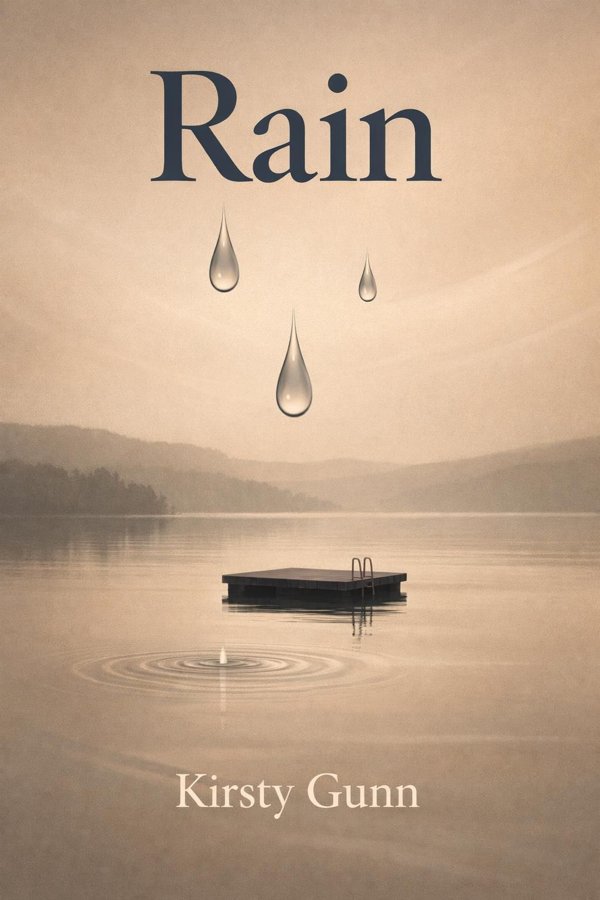
Rain: Summary & Key Insights
by Kirsty Gunn
 10 min9 chaptersAudio available
Key Takeaways from Rain
The most dangerous moments in literature often begin in beauty, and Rain understands that perfectly.
One of the novel’s greatest strengths is that it never gives us full adult clarity, and that limitation is exactly what makes it powerful.
Children do not simply live beside adult lives; they are shaped by them in ways adults often fail to recognize.
One of the most unsettling truths in Rain is that attention itself can become dangerous.
In Rain, weather is not background decoration; it is part of the novel’s emotional grammar.
What Is Rain About?
Rain by Kirsty Gunn is a classics book spanning 4 pages. Kirsty Gunn’s Rain is a short novel with the emotional force of a much larger work. Set during a family summer by a lake, it follows twelve-year-old Janey as she watches what should be an ordinary holiday slowly darken into something unsettling and irreversible. Through Janey’s sensitive, partial understanding of adult behavior, Gunn explores how children absorb tension long before they can name it. What begins as sunlight, water, and holiday freedom becomes a study of neglect, desire, power, and the shattering end of innocence. What makes Rain endure is not plot alone, but the extraordinary precision of its language. Gunn writes in lyrical, atmospheric prose that turns weather, landscape, and gesture into emotional signals. The lake is never just a lake; the rain is never just rain. Every detail carries pressure. The novel matters because it captures a truth many readers recognize but rarely see expressed so clearly: families can appear intact even as emotional danger gathers beneath the surface. New Zealand-born writer Kirsty Gunn established herself as a distinctive literary voice with this debut, bringing together psychological insight, poetic control, and a fearless attention to childhood vulnerability.
This FizzRead summary covers all 9 key chapters of Rain in approximately 10 minutes, distilling the most important ideas, arguments, and takeaways from Kirsty Gunn's work. Also available as an audio summary and Key Quotes Podcast.
Rain
Kirsty Gunn’s Rain is a short novel with the emotional force of a much larger work. Set during a family summer by a lake, it follows twelve-year-old Janey as she watches what should be an ordinary holiday slowly darken into something unsettling and irreversible. Through Janey’s sensitive, partial understanding of adult behavior, Gunn explores how children absorb tension long before they can name it. What begins as sunlight, water, and holiday freedom becomes a study of neglect, desire, power, and the shattering end of innocence.
What makes Rain endure is not plot alone, but the extraordinary precision of its language. Gunn writes in lyrical, atmospheric prose that turns weather, landscape, and gesture into emotional signals. The lake is never just a lake; the rain is never just rain. Every detail carries pressure. The novel matters because it captures a truth many readers recognize but rarely see expressed so clearly: families can appear intact even as emotional danger gathers beneath the surface. New Zealand-born writer Kirsty Gunn established herself as a distinctive literary voice with this debut, bringing together psychological insight, poetic control, and a fearless attention to childhood vulnerability.
Who Should Read Rain?
This book is perfect for anyone interested in classics and looking to gain actionable insights in a short read. Whether you're a student, professional, or lifelong learner, the key ideas from Rain by Kirsty Gunn will help you think differently.
- ✓Readers who enjoy classics and want practical takeaways
- ✓Professionals looking to apply new ideas to their work and life
- ✓Anyone who wants the core insights of Rain in just 10 minutes
Want the full summary?
Get instant access to this book summary and 100K+ more with Fizz Moment.
Get Free SummaryAvailable on App Store • Free to download
Key Chapters
The most dangerous moments in literature often begin in beauty, and Rain understands that perfectly. Janey’s summer world appears calm: a lakeside house, warm days, a family away from routine, the promise of rest and freedom. Gunn builds this setting with luminous detail, allowing the reader to feel the stillness before sensing how fragile it is. The lake seems clear and open, yet its very smoothness hints at hidden depths. This contrast becomes the novel’s first major insight: serenity can conceal emotional instability.
Janey experiences the holiday as a child would, through sensations before conclusions. She notices light on the water, voices in rooms, shifting moods, the rhythms of family life. Because she does not interpret everything directly, the reader must do some of the emotional work. That narrative choice mirrors real childhood experience. Children often register atmosphere long before they understand causes. A tense silence at dinner, an adult’s forced laughter, a parent’s sudden withdrawal: these are first felt as disturbances in the air.
In practical terms, the opening of Rain shows how environments shape perception. We all know situations that look idyllic from the outside but feel unstable from within: a family vacation marked by resentment, a beautiful home full of anxiety, a celebration haunted by conflict. Gunn reminds us not to mistake appearances for safety.
The opening chapters also prepare the novel’s tragedy by making ordinary details meaningful. A reader learns to pay attention not just to what happens, but to tone, pause, and repetition. That is where the real story begins.
Actionable takeaway: When judging any situation, look beyond surface calm and ask what emotional currents may be moving underneath.
One of the novel’s greatest strengths is that it never gives us full adult clarity, and that limitation is exactly what makes it powerful. Janey narrates from the threshold between childhood and adolescence. She sees sharply, feels deeply, and notices more than the adults around her assume, yet she cannot completely understand the forces shaping their behavior. This creates a perspective of partial knowledge, where the reader senses danger gathering before Janey can fully articulate it.
Gunn uses this voice to capture a central truth about growing up: children are rarely as unaware as adults imagine, but they often lack the language to interpret what they know. Janey notices drunkenness, sexual tension, neglect, boredom, and emotional withdrawal through fragments. She registers tone, body language, and sudden shifts in attention. Her innocence is not ignorance; it is a vulnerable openness to experience without the protection of explanation.
This matters beyond the novel because Janey’s point of view teaches us how much human understanding depends on framing. In families, workplaces, and relationships, people often perceive enough to feel discomfort long before they can form a coherent account. A teenager may know something is wrong at home without being able to explain why. An employee may sense a leader’s instability before any explicit crisis appears. Emotional knowledge often arrives before intellectual certainty.
Rain asks readers to honor that kind of perception. Janey’s observations carry truth precisely because they are incomplete. The novel does not reward confident judgment; it rewards careful attention. We are made to dwell in uncertainty, which deepens empathy and sharpens awareness.
Actionable takeaway: Trust early emotional signals, even when you cannot yet explain them fully, and give yourself time to understand what your instincts are noticing.
Children do not simply live beside adult lives; they are shaped by them in ways adults often fail to recognize. In Rain, Janey watches her parents and the adults around them with a mixture of fascination, loyalty, confusion, and fear. Her father’s drinking, her mother’s preoccupation, and the unpredictable energy of the adults create a world in which Janey is physically present but emotionally unprotected. Gunn’s insight is subtle but devastating: neglect does not always look like abandonment. Sometimes it looks like adults being absorbed in themselves.
Janey studies gestures and moods because children depend on adults not only for care, but for the emotional map of reality. When the adults become erratic or unavailable, the child’s world loses coherence. A parent’s loud laughter may feel less like joy than warning. A distracted conversation may communicate indifference more powerfully than words. In this way, Gunn shows that family harm can emerge from atmosphere as much as from event.
This idea has wide application. Many readers will recognize families in which no one openly explains what is wrong, yet everyone adapts to tension. Children become watchers. They become careful, intuitive, and prematurely mature. In professional terms, we might call this hypervigilance. In emotional terms, it is what happens when safety depends on reading a room accurately.
Rain also exposes the moral blindness of adults who assume children will simply “forget” or “not notice.” Janey notices everything that matters, even if she cannot order it. The adults’ failure is not just what they do; it is their refusal to see her as someone affected by their choices.
Actionable takeaway: Never assume children are untouched by adult conflict; if you shape the atmosphere, you also shape their inner world.
One of the most unsettling truths in Rain is that attention itself can become dangerous. Janey is at an age where she is becoming newly visible, and that visibility changes the emotional stakes of the novel. Gunn explores the overlap between desire, power, and vulnerability without sensationalizing it. Janey does not fully understand the gaze directed toward her or the implications of adult interest, but the reader does, and that gap creates profound tension.
The novel’s treatment of this theme is important because it refuses simple categories. Harm does not arrive as melodrama; it arrives through ambiguity, proximity, and failures of protection. Adults who should establish boundaries instead blur them. Janey’s vulnerability lies not only in her youth, but in her longing to be seen, included, and understood. This is what makes dangerous attention so psychologically complex: it often disguises itself as recognition.
Outside the novel, this insight remains urgently relevant. Many experiences of exploitation begin not with explicit force, but with a child or adolescent being singled out, flattered, drawn into adult emotional territory, or left without supervision. Gunn captures how such situations are enabled by family distraction, denial, or emotional carelessness.
The brilliance of Rain is that it connects this danger to larger emotional patterns. When a family is fractured, when adults are self-involved, when communication is weak, children are left to navigate signals they should never have to decode alone. Janey’s exposure is not accidental; it grows out of a broader climate of neglect.
Actionable takeaway: Treat boundary-setting and attentive care as forms of protection, especially when a young person is seeking approval, belonging, or visibility.
In Rain, weather is not background decoration; it is part of the novel’s emotional grammar. Gunn uses sunlight, humidity, still air, and finally rain to externalize what the characters cannot say. The natural world mirrors pressure, release, unease, and collapse. This technique gives the novel its haunting atmosphere while also deepening its psychological meaning. The storm is not just an event in the setting; it is a form of revelation.
The title itself signals this method. Rain suggests cleansing, grief, obscurity, heaviness, and inevitability all at once. As tension gathers in the family, the environment seems to absorb and express it. The lake’s surface, the changing sky, the density of the air: these elements turn emotion into something almost physical. Readers feel dread before they can summarize its cause.
This is one reason the novel is so memorable. Gunn understands that many human experiences are first bodily and atmospheric. We may say “something felt off” long before we can explain what happened. Literature at its best can render that sensation, and Rain does so with remarkable precision.
There is also a practical reading lesson here. Gunn invites us to pay attention to symbolism without reducing it to puzzle-solving. Weather in this novel works because it remains rooted in lived sensation. In our own lives, physical surroundings often shape emotional states more than we admit. A silent room can intensify conflict. A storm can make fear feel larger. Heat can sharpen irritability. Place and mood are intertwined.
Actionable takeaway: Pay attention to how environment affects feeling; sometimes the atmosphere around an experience helps reveal what words alone cannot express.
Every quiet disaster builds toward a moment when the hidden can no longer remain hidden. In Rain, the storm functions as that moment of rupture. What has been accumulating through glances, silences, desires, carelessness, and emotional drift finally reaches a breaking point. Gunn structures the novel so that the storm feels both sudden and inevitable. It does not come out of nowhere; it arrives because the conditions for it have been forming all along.
This is the novel’s structural brilliance. Rather than relying on plot twists, Gunn creates pressure through accumulation. The reader senses that something must give. When it does, the event carries the force of revelation. The storm exposes not only vulnerability and loss, but the failure of the adults to prevent what should have been preventable. A family crisis is revealed as the consequence of many smaller failures of attention.
This pattern is recognizable in life. Major breakdowns in families, institutions, or relationships rarely begin at the moment of collapse. They begin earlier, in repeated dismissals of warning signs. A parent ignores distress. A partner normalizes disrespect. A manager excuses instability. The final crisis feels abrupt only because people resisted seeing what was developing.
In Janey’s case, the storm marks more than danger; it marks irreversible knowledge. Childhood can survive confusion, but once a child understands that adults cannot or will not keep her safe, something fundamental changes. That is why the storm resonates beyond plot. It symbolizes the end of illusion.
Gunn’s achievement is to make this rupture emotionally exact rather than theatrically exaggerated. The force of the scene lies in how deeply prepared it is.
Actionable takeaway: Do not wait for dramatic collapse to take warning signs seriously; most crises announce themselves long before the breaking point.
The deepest wounds in Rain are not only the events themselves, but the way they continue to live on in memory. After the crisis, nothing can return to the original summer stillness. Gunn is interested in aftermath not as tidy resolution, but as lingering consciousness. Janey is altered by what she has seen and felt, and the novel suggests that traumatic knowledge does not disappear simply because the moment has passed.
This focus on memory gives Rain its lasting emotional depth. Childhood experiences often become formative not because they were fully understood at the time, but because they continue to be reinterpreted later. A tone of voice, a room, a stretch of water, a storm: these details remain charged. Memory preserves atmosphere as much as event. Gunn captures how the mind carries fragments, and how those fragments shape identity.
For readers, this can be a powerful recognition. Many people revisit childhood not through clear narratives, but through sensations and isolated images that still hold force. Rain honors that psychological truth. It does not force closure where closure would feel false. Instead, it shows how memory can become both burden and meaning-making process.
There is also a broader ethical point. What adults dismiss as temporary can become permanent in a child’s inner life. A single season may echo for years. That is why care, attention, and responsibility matter so much in the present; they outlast the moment.
The novel leaves readers with the sense that remembering is not passive. To remember is to continue feeling, sorting, and trying to understand what happened.
Actionable takeaway: Take seriously the lasting imprint of emotionally charged experiences, especially in childhood, and make space to revisit them with honesty rather than denial.
Rain is not a novel that denies love; it is a novel that questions whether love alone is enough. Janey’s family is not portrayed as simply monstrous or loveless. That complexity is part of what makes the book unsettling. Affection exists. Bonds exist. Shared routines and familiar tenderness exist. Yet none of these prevent harm. Gunn’s major insight is that love without attention, maturity, and responsibility can fail catastrophically.
This is an uncomfortable idea because many people equate love with safety. The novel insists they are not the same. A parent may love a child and still neglect her emotionally. A family may care for one another and still create conditions in which danger flourishes. Good intentions do not erase blindness. Emotional dependency does not produce protection. In this sense, Rain is a critique of sentimental ideas about family.
The novel also shows how family roles can trap everyone. Parents become absorbed in their own frustrations. Children adapt to instability. Silence hardens into habit. Love remains, but it is no longer active, vigilant, or reliable. Readers may recognize this pattern in households where no one openly rejects one another, yet no one truly protects the vulnerable either.
This idea applies beyond family life. In any relationship, care must be demonstrated through action, awareness, and boundaries, not merely feeling. To say “I care” while ignoring obvious harm is a contradiction.
What gives Rain its emotional sophistication is that it never reduces its characters to moral slogans. Instead, it shows how ordinary failures of care can have extraordinary consequences.
Actionable takeaway: Measure love not only by feeling, but by the quality of attention, accountability, and protection it provides.
Some novels remain with readers because they entertain; others endure because they name difficult truths with unusual precision. Rain belongs to the second category. Its status as a modern classic comes from the way it transforms a brief, intimate story into a profound meditation on innocence, family tension, memory, and emotional danger. Gunn does not rely on scale. She relies on compression, atmosphere, and moral acuity.
The novel also endures because it trusts readers. It does not overexplain motives or flatten complexity into easy lessons. Instead, it asks us to inhabit uncertainty, to read gestures carefully, and to understand that the most important events in a life may unfold through mood, omission, and perception. That kind of writing rewards rereading. A first reading may leave an impression of dread and sorrow; a second often reveals how meticulously Gunn planted every emotional signal.
From a literary perspective, Rain is an excellent example of how prose style can intensify ethical vision. Gunn’s language is lyrical without becoming decorative. Her beauty serves seriousness. The elegance of the sentences heightens, rather than softens, the novel’s painful insights. That balance is rare.
For contemporary readers, the book remains relevant because its themes have not faded. Questions of childhood vulnerability, adult self-absorption, blurred boundaries, and the hidden costs of family silence still resonate strongly. The novel speaks to anyone who has sensed that what appears ordinary can hold deep fracture.
Actionable takeaway: Read Rain slowly and attentively; its lasting power lies in noticing how small details reveal large emotional truths.
All Chapters in Rain
About the Author
Kirsty Gunn is a New Zealand-born fiction writer celebrated for her lyrical prose, emotional precision, and psychologically rich explorations of family life, memory, and vulnerability. She first gained major recognition with Rain, a debut novel that quickly marked her out as a distinctive voice in contemporary literature. Her work often focuses on intimate domestic settings while uncovering the tensions, desires, and fractures that shape inner lives. Gunn is admired for combining poetic language with unsettling emotional clarity, creating fiction that is both beautiful and disturbing. Over the course of her career, she has written novels, short fiction, and other literary works that continue to attract readers interested in serious, stylistically accomplished writing. Rain remains one of her best-known books and an important example of her gift for capturing fragile human experience.
Get This Summary in Your Preferred Format
Read or listen to the Rain summary by Kirsty Gunn anytime, anywhere. FizzRead offers multiple formats so you can learn on your terms — all free.
Available formats: App · Audio · PDF · EPUB — All included free with FizzRead
Download Rain PDF and EPUB Summary
Key Quotes from Rain
“The most dangerous moments in literature often begin in beauty, and Rain understands that perfectly.”
“One of the novel’s greatest strengths is that it never gives us full adult clarity, and that limitation is exactly what makes it powerful.”
“Children do not simply live beside adult lives; they are shaped by them in ways adults often fail to recognize.”
“One of the most unsettling truths in Rain is that attention itself can become dangerous.”
“In Rain, weather is not background decoration; it is part of the novel’s emotional grammar.”
Frequently Asked Questions about Rain
Rain by Kirsty Gunn is a classics book that explores key ideas across 9 chapters. Kirsty Gunn’s Rain is a short novel with the emotional force of a much larger work. Set during a family summer by a lake, it follows twelve-year-old Janey as she watches what should be an ordinary holiday slowly darken into something unsettling and irreversible. Through Janey’s sensitive, partial understanding of adult behavior, Gunn explores how children absorb tension long before they can name it. What begins as sunlight, water, and holiday freedom becomes a study of neglect, desire, power, and the shattering end of innocence. What makes Rain endure is not plot alone, but the extraordinary precision of its language. Gunn writes in lyrical, atmospheric prose that turns weather, landscape, and gesture into emotional signals. The lake is never just a lake; the rain is never just rain. Every detail carries pressure. The novel matters because it captures a truth many readers recognize but rarely see expressed so clearly: families can appear intact even as emotional danger gathers beneath the surface. New Zealand-born writer Kirsty Gunn established herself as a distinctive literary voice with this debut, bringing together psychological insight, poetic control, and a fearless attention to childhood vulnerability.
You Might Also Like






Browse by Category
Ready to read Rain?
Get the full summary and 100K+ more books with Fizz Moment.