
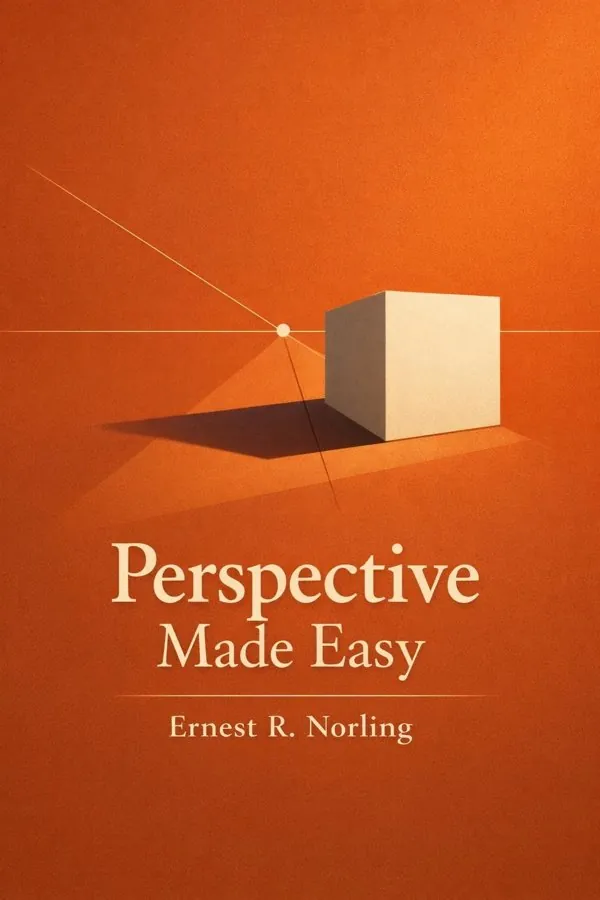
Perspective Made Easy: Summary & Key Insights
 10 min4 chaptersAudio available
What Is Perspective Made Easy About?
Perspective Made Easy by Ernest R. Norling is a design book spanning 4 pages. A classic instructional art book that introduces the principles of perspective drawing in a clear and accessible way. Using simple language and over 250 illustrations, Norling explains how to create the illusion of depth and space, covering topics such as vanishing points, horizon lines, and the perspective of circles and shadows. The book is widely used by artists, designers, and students as a foundational guide to mastering perspective.
This FizzRead summary covers all 4 key chapters of Perspective Made Easy in approximately 10 minutes, distilling the most important ideas, arguments, and takeaways from Ernest R. Norling's work. Also available as an audio summary and Key Quotes Podcast.
Perspective Made Easy
A classic instructional art book that introduces the principles of perspective drawing in a clear and accessible way. Using simple language and over 250 illustrations, Norling explains how to create the illusion of depth and space, covering topics such as vanishing points, horizon lines, and the perspective of circles and shadows. The book is widely used by artists, designers, and students as a foundational guide to mastering perspective.
Who Should Read Perspective Made Easy?
This book is perfect for anyone interested in design and looking to gain actionable insights in a short read. Whether you're a student, professional, or lifelong learner, the key ideas from Perspective Made Easy by Ernest R. Norling will help you think differently.
- ✓Readers who enjoy design and want practical takeaways
- ✓Professionals looking to apply new ideas to their work and life
- ✓Anyone who wants the core insights of Perspective Made Easy in just 10 minutes
Want the full summary?
Get instant access to this book summary and 100K+ more with Fizz Moment.
Get Free SummaryAvailable on App Store • Free to download
Key Chapters
Every artist begins with one invisible but fundamental element—the horizon line. It is both a physical and psychological anchor in a drawing, the point where the sky appears to meet the ground, and the level that defines your eye’s height relative to everything you observe. In my teaching, I always start here because once you grasp how the horizon works, perspective ceases to be confusing. The horizon line is not arbitrary; it moves with you. If you stand up, it rises. If you crouch down, it sinks. Everything above it lies above your eye level, and everything below it lies below your eye level. That distinction immediately tells you where objects should appear in space.
Think of walking down a long road. Notice how the rows of houses, trees, or fences seem to decrease in size as they stretch into the distance, all pointing toward a common spot on the horizon. That spot is your vanishing point. The horizon is therefore not just the dividing line—it is the key reference plane governing all perspective in your drawing. Once established correctly, it allows every other form to align naturally. When you know your eye level, you can accurately judge how tall an object should appear compared to others, how its top and bottom edges will tilt, and how far it should recede.
Many beginners make the mistake of ignoring where they stand in relation to what they draw. They try to capture forms but misplace the horizon, causing everything to appear skewed or floating. By consciously locating eye level, you immediately gain control over the spatial relationship in your picture. Whether you are sketching a cup on a table or a vast cityscape, the rule remains constant: the horizon line represents your viewpoint in space, and all elements must harmonize with it.
Once you have the horizon and eye level fixed, the next natural step is establishing vanishing points. These are the invisible magnets toward which all parallel lines in your drawing will converge. Vanishing points are not arbitrary—they exist everywhere your vision aligns with infinite distance. A single vanishing point means you’re looking straight ahead, parallel to one set of lines; two or three vanishing points come into play when your viewpoint involves angles or extreme verticals.
In one-point perspective, imagine facing a long hallway. The lines of the floor, ceiling, and walls all appear to meet at one distant spot. That spot lies exactly on the horizon. Everything perpendicular to you converges there, while objects parallel to the picture plane retain their true shape. You can already feel space expanding, simply by drawing lines toward that point.
To extend realism, artists often turn to two-point perspective—how we see objects turned at an angle. When you stand at a street corner, you’re looking into two receding directions at once. Each set of parallel lines meets the horizon at its own vanishing point. You see the front face of a building diminishing toward one side, and another face receding toward the other. Suddenly, space is no longer flat—it wraps around you. Two-point perspective gives volume, dynamic tension, and movement to still forms.
In extreme situations—looking straight up at a skyscraper or down from a tall tower—we add a third vanishing point. Vertical lines, which previously remained parallel, now also converge. This three-point perspective creates dramatic depth, emphasizing how far we are from our subject. Whether it’s a bird’s-eye or worm’s-eye view, the principle remains: vanishing points set the boundaries of infinite distance. They are the anchors of believable space.
+ 2 more chapters — available in the FizzRead app
All Chapters in Perspective Made Easy
About the Author
Ernest R. Norling was an American artist, illustrator, and educator known for his accessible teaching style in art instruction. His works, particularly on perspective and drawing techniques, have influenced generations of art students and professionals.
Get This Summary in Your Preferred Format
Read or listen to the Perspective Made Easy summary by Ernest R. Norling anytime, anywhere. FizzRead offers multiple formats so you can learn on your terms — all free.
Available formats: App · Audio · PDF · EPUB — All included free with FizzRead
Download Perspective Made Easy PDF and EPUB Summary
Key Quotes from Perspective Made Easy
“Every artist begins with one invisible but fundamental element—the horizon line.”
“Once you have the horizon and eye level fixed, the next natural step is establishing vanishing points.”
Frequently Asked Questions about Perspective Made Easy
Perspective Made Easy by Ernest R. Norling is a design book that explores key ideas across 4 chapters. A classic instructional art book that introduces the principles of perspective drawing in a clear and accessible way. Using simple language and over 250 illustrations, Norling explains how to create the illusion of depth and space, covering topics such as vanishing points, horizon lines, and the perspective of circles and shadows. The book is widely used by artists, designers, and students as a foundational guide to mastering perspective.
You Might Also Like
The Design of Everyday Things
Don Norman
10 min
The Better Angels of Our Nature
Steven Pinker
10 min
A Designer's Art
Paul Rand
10 min
Architects' Sketchbooks
Various Editors
10 min
Architectural Graphic Standards
The American Institute of Architects
10 min
Design Is Storytelling
Ellen Lupton
10 minBrowse by Category
Ready to read Perspective Made Easy?
Get the full summary and 100K+ more books with Fizz Moment.