
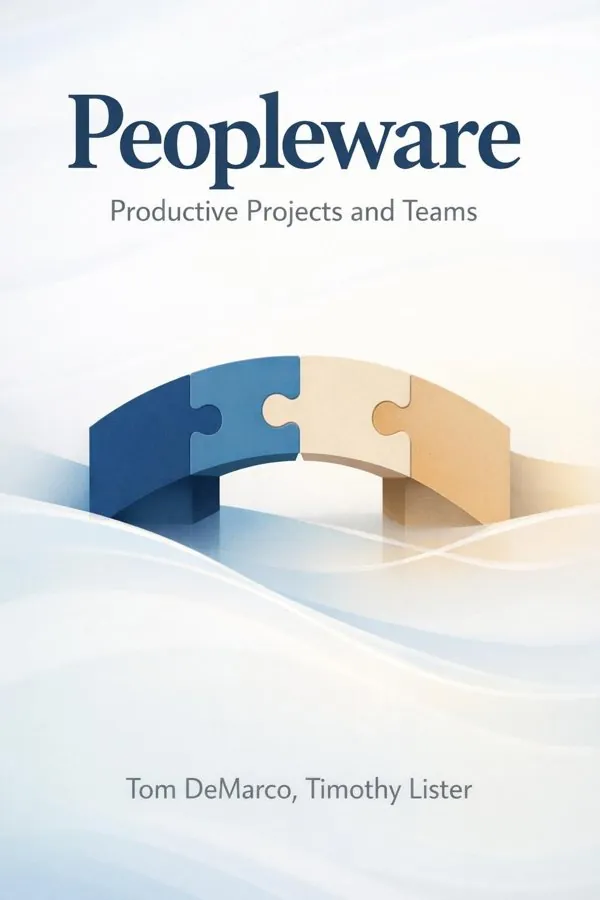
Peopleware: Productive Projects and Teams: Summary & Key Insights
by Tom DeMarco, Timothy Lister
 10 min12 chaptersAudio available
What Is Peopleware: Productive Projects and Teams About?
Peopleware: Productive Projects and Teams by Tom DeMarco, Timothy Lister is a organization book spanning 12 pages. Peopleware: Productive Projects and Teams explores the human aspects of software development, emphasizing that the success of projects depends more on team dynamics and management than on technical factors. The authors argue that productivity and quality are primarily influenced by the work environment, communication, and organizational culture, rather than by tools or methodologies.
This FizzRead summary covers all 12 key chapters of Peopleware: Productive Projects and Teams in approximately 10 minutes, distilling the most important ideas, arguments, and takeaways from Tom DeMarco, Timothy Lister's work. Also available as an audio summary and Key Quotes Podcast.
Peopleware: Productive Projects and Teams
Peopleware: Productive Projects and Teams explores the human aspects of software development, emphasizing that the success of projects depends more on team dynamics and management than on technical factors. The authors argue that productivity and quality are primarily influenced by the work environment, communication, and organizational culture, rather than by tools or methodologies.
Who Should Read Peopleware: Productive Projects and Teams?
This book is perfect for anyone interested in organization and looking to gain actionable insights in a short read. Whether you're a student, professional, or lifelong learner, the key ideas from Peopleware: Productive Projects and Teams by Tom DeMarco, Timothy Lister will help you think differently.
- ✓Readers who enjoy organization and want practical takeaways
- ✓Professionals looking to apply new ideas to their work and life
- ✓Anyone who wants the core insights of Peopleware: Productive Projects and Teams in just 10 minutes
Want the full summary?
Get instant access to this book summary and 100K+ more with Fizz Moment.
Get Free SummaryAvailable on App Store • Free to download
Key Chapters
Early in our investigations, we found an uncomfortable truth: productivity cannot be commanded; it must be cultivated. A motivated, satisfied developer will consistently outperform a demoralized one using better tools. This doesn’t happen because of personality quirks—it’s rooted in psychology. When people feel ownership and purpose, they work with an energy that defies schedule charts.
We often saw managers reach for control when projects fell behind—more rules, stricter oversight, longer hours. Yet every added constraint seemed to erode morale further. The developers’ motivation evaporated, and the project slowed even more. Productivity, as we came to see, is profoundly emotional. People need to care. They need quiet pride in their craft and confidence that their contribution matters. Once fear or apathy takes hold, no amount of management heroics can resurrect momentum.
Job satisfaction, therefore, is not a luxury. It’s a core productivity driver. That begins with respect — trusting your team’s judgment, acknowledging their skill, and inviting them into decisions. A sense of community beats documentation every time because it builds understanding that no process can document. And in teams where laughter and mutual regard thrive, we found fewer defects, less turnover, and a higher creative energy. Happiness isn’t a byproduct; it’s a vital input to quality.
When we measured productivity across dozens of teams, one recurring factor stood out: environment. The physical space where people work dramatically affects how well they perform. Programmers need long stretches of undisturbed concentration — what we call 'flow time' — but modern offices seem designed precisely to destroy it.
Noise, interruptions, unplanned meetings, and meaningless chatter fracture that fragile mental focus. We discovered that top programmers have significantly more uninterrupted time than average ones, often because their environment shields them. We once observed a developer who could not get twenty minutes of quiet in a workday; his output was a fraction of what his colleague achieved in a private office.
This is not an indulgence; it’s an investment. Creating quiet, providing adequate personal space, and giving people control over their immediate environment correlates directly with higher quality and faster delivery. The myth that open offices foster communication has cost the industry dearly. Real communication is deliberate and meaningful, not a byproduct of forced proximity.
A humane environment respects the psychology of deep work. Privacy is not isolation, and silence is not uncollaborative — they are the foundations upon which meaningful collaboration is built.
+ 10 more chapters — available in the FizzRead app
All Chapters in Peopleware: Productive Projects and Teams
About the Authors
Tom DeMarco and Timothy Lister are software engineers and management consultants, co-founders of The Atlantic Systems Guild. They are known for their influential work on software project management and human factors in technology organizations.
Get This Summary in Your Preferred Format
Read or listen to the Peopleware: Productive Projects and Teams summary by Tom DeMarco, Timothy Lister anytime, anywhere. FizzRead offers multiple formats so you can learn on your terms — all free.
Available formats: App · Audio · PDF · EPUB — All included free with FizzRead
Download Peopleware: Productive Projects and Teams PDF and EPUB Summary
Key Quotes from Peopleware: Productive Projects and Teams
“Early in our investigations, we found an uncomfortable truth: productivity cannot be commanded; it must be cultivated.”
“When we measured productivity across dozens of teams, one recurring factor stood out: environment.”
Frequently Asked Questions about Peopleware: Productive Projects and Teams
Peopleware: Productive Projects and Teams by Tom DeMarco, Timothy Lister is a organization book that explores key ideas across 12 chapters. Peopleware: Productive Projects and Teams explores the human aspects of software development, emphasizing that the success of projects depends more on team dynamics and management than on technical factors. The authors argue that productivity and quality are primarily influenced by the work environment, communication, and organizational culture, rather than by tools or methodologies.
You Might Also Like

A Guide to the Project Management Body of Knowledge (PMBOK® Guide)
Project Management Institute
10 min
Organizational Behavior
Stephen P. Robbins
10 min
Accelerate: The Science of Lean Software and DevOps – Building and Scaling High Performing Technology Organizations
Nicole Forsgren, Jez Humble, Gene Kim
10 min
Awakening Compassion at Work: The Quiet Power That Elevates People and Organizations
Monica C. Worline, Jane E. Dutton
10 min
Building an Inclusive Organization: Leveraging the Power of a Diverse Workforce
Stephen Frost
10 min
Collaborative Intelligence: Thinking with People Who Think Differently
Dawna Markova, Angie McArthur
10 minBrowse by Category
Ready to read Peopleware: Productive Projects and Teams?
Get the full summary and 100K+ more books with Fizz Moment.