
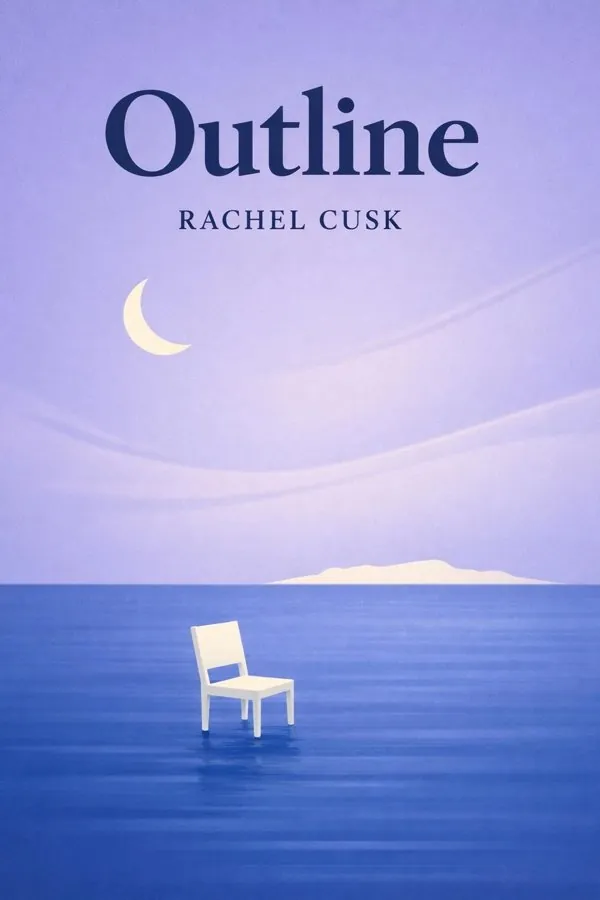
Outline: Summary & Key Insights
by Rachel Cusk
 10 min9 chaptersAudio available
Key Takeaways from Outline
A life can be revealed most clearly when someone thinks they are simply making conversation.
We rarely encounter people as complete beings; we meet them in fragments, and yet those fragments can feel startlingly whole.
Fiction does not simply invent; it rearranges experience into forms that memory can bear.
The artist’s dilemma is that real observation requires distance, while real feeling often destroys it.
When routines fall away, identity becomes less solid and more observable.
What Is Outline About?
Outline by Rachel Cusk is a classics book spanning 6 pages. Rachel Cusk’s Outline is a novel that seems, at first, to withhold the usual satisfactions of fiction. There is no dramatic plot engine, no confessional narrator eager to explain herself, and no neat arc of transformation. Instead, Cusk gives us a British writer who travels to Athens to teach a summer course and spends much of the book listening. On planes, in apartments, at dinner tables, on boats, and in classrooms, she encounters people who tell her about marriages, ambitions, failures, betrayals, children, art, and the strange stories by which they justify their lives. Through these conversations, the narrator herself comes into focus indirectly, as if identity were something visible only in outline. What makes Outline so important is the radical elegance of its method. Cusk turns conversation into narrative architecture and absence into a way of seeing. The book asks what a self really is when stripped of performance, and whether listening can reveal more than confession. Already recognized as one of the boldest contemporary stylists in English, Cusk writes with precision, irony, and emotional intelligence, making Outline a landmark novel about storytelling, perception, and the unstable shape of human identity.
This FizzRead summary covers all 9 key chapters of Outline in approximately 10 minutes, distilling the most important ideas, arguments, and takeaways from Rachel Cusk's work. Also available as an audio summary and Key Quotes Podcast.
Outline
Rachel Cusk’s Outline is a novel that seems, at first, to withhold the usual satisfactions of fiction. There is no dramatic plot engine, no confessional narrator eager to explain herself, and no neat arc of transformation. Instead, Cusk gives us a British writer who travels to Athens to teach a summer course and spends much of the book listening. On planes, in apartments, at dinner tables, on boats, and in classrooms, she encounters people who tell her about marriages, ambitions, failures, betrayals, children, art, and the strange stories by which they justify their lives. Through these conversations, the narrator herself comes into focus indirectly, as if identity were something visible only in outline.
What makes Outline so important is the radical elegance of its method. Cusk turns conversation into narrative architecture and absence into a way of seeing. The book asks what a self really is when stripped of performance, and whether listening can reveal more than confession. Already recognized as one of the boldest contemporary stylists in English, Cusk writes with precision, irony, and emotional intelligence, making Outline a landmark novel about storytelling, perception, and the unstable shape of human identity.
Who Should Read Outline?
This book is perfect for anyone interested in classics and looking to gain actionable insights in a short read. Whether you're a student, professional, or lifelong learner, the key ideas from Outline by Rachel Cusk will help you think differently.
- ✓Readers who enjoy classics and want practical takeaways
- ✓Professionals looking to apply new ideas to their work and life
- ✓Anyone who wants the core insights of Outline in just 10 minutes
Want the full summary?
Get instant access to this book summary and 100K+ more with Fizz Moment.
Get Free SummaryAvailable on App Store • Free to download
Key Chapters
A life can be revealed most clearly when someone thinks they are simply making conversation. Outline opens on a flight to Athens, where the narrator finds herself seated next to a wealthy Greek businessman who speaks at length about his marriages, his children, his ambitions, and his understanding of women and fate. On the surface, this is only a travel encounter, the kind of accidental intimacy produced by transit. But Rachel Cusk uses it to establish the entire logic of the novel: strangers often expose themselves more fully than friends do, and what they choose to emphasize becomes a map of their inner life.
The man’s monologue is not just information; it is self-construction. He tells stories to make sense of himself, to defend his decisions, and to impose order on experiences that may in fact be contradictory. The narrator contributes very little, yet her silence is active. She listens, assesses, and allows the reader to observe how people narrate their own importance. The airplane itself matters as a setting because it is a threshold space, suspended between one life and another. In that in-between zone, identities loosen and speech becomes freer.
This opening also signals Cusk’s challenge to traditional characterization. Instead of introducing the protagonist through action or internal confession, she lets us meet her through what others say in her presence. In ordinary life, this happens more often than novels admit: we learn about ourselves through other people’s projections, confessions, and assumptions.
A practical way to apply this idea is to notice how people tell their own stories in everyday settings such as taxis, trains, dinners, or work meetings. What do they return to? What do they omit? Those patterns often reveal more than direct claims about personality. Actionable takeaway: listen for the structure of a person’s story, not just its facts, because the shape of what they tell you is often the clearest outline of who they are.
We rarely encounter people as complete beings; we meet them in fragments, and yet those fragments can feel startlingly whole. Once in Athens, the narrator moves through borrowed spaces and temporary arrangements, staying with hosts and meeting acquaintances whose lives seem mid-collapse, mid-repair, or mid-performance. These encounters create the sense that everyone is carrying an unfinished private history, and that the visible part of a life is only the edge of something much larger.
Her host, for example, speaks out of domestic strain and emotional upheaval. The details of his home, his relationships, and his habits are not presented as background decoration but as signs of moral and psychological condition. In Outline, rooms, meals, balconies, and city heat all become extensions of character. Athens is not merely a destination; it is a stage on which instability, displacement, and self-explanation become especially vivid. The narrator, as a visitor, sees with the peculiar clarity of someone who belongs nowhere in particular.
Cusk suggests that modern life often feels discontinuous. People no longer move through stable social scripts with confidence. Marriage, work, parenthood, art, and friendship all appear vulnerable to reinterpretation. As a result, individuals narrate themselves constantly, trying to stitch coherence out of events that resist neat meaning. The city scenes reinforce this effect by presenting one life after another as a partial disclosure rather than a finished portrait.
This idea has practical relevance because we often judge others too quickly from a single moment: a tense conversation, a chaotic household, a polished public persona. Outline reminds us that every person is a fragment of a longer story we cannot fully see. In work, friendship, and family life, that awareness can foster humility and patience. Actionable takeaway: when meeting someone in a difficult or unusual moment, resist turning the fragment into the whole person; leave room for the unseen chapters of their life.
Fiction does not simply invent; it rearranges experience into forms that memory can bear. In the classroom sections of Outline, the narrator’s role as a writing teacher allows Cusk to explore what storytelling is for and why people turn to art when life itself feels shapeless. Students discuss craft, but beneath the technical language lie deeper anxieties: how much of the self should enter writing, whether honesty is possible, and whether turning life into narrative clarifies experience or distorts it.
The novel treats writing as both revelation and defense. To write is to choose, frame, omit, and emphasize. That means every story is already an interpretation. The classroom becomes a mirror chamber in which the concerns of fiction overlap with the concerns of identity. People do not merely write stories; they live by them. Memory itself behaves like an author, smoothing some details, heightening others, and forcing events into patterns that may be emotionally true even when they are not strictly factual.
Cusk’s insight is especially powerful because she avoids sentimental claims about artistic healing. Writing can illuminate, but it can also imprison a person inside a preferred version of the self. A failed marriage, for example, can become a tragedy, a farce, a moral lesson, or a tale of liberation depending on who tells it and why. The narrator’s attention to these shifts encourages readers to see narrative as a tool rather than a transparent window.
In practical terms, this idea applies beyond literature. We all narrate our careers, relationships, mistakes, and ambitions in ways that influence our future choices. If you repeatedly describe yourself as unlucky, misunderstood, or exceptional, your story may begin to govern your behavior. Actionable takeaway: examine the stories you tell about your own life and ask whether they are helping you understand reality or merely protecting a fixed image of yourself.
The artist’s dilemma is that real observation requires distance, while real feeling often destroys it. In Outline, conversations about literature, performance, and creative life reveal the tension between immersion and detachment. Characters speak about failed relationships, public identities, and artistic ambitions in ways that suggest creation is inseparable from vulnerability. To make art, one must be open enough to register life deeply, yet separate enough to shape it.
Cusk treats this tension with unusual subtlety. The narrator herself appears detached, but her restraint is not emptiness. It is a discipline of perception. She does not rush to declare opinions or dramatize her feelings. Instead, she creates a space in which others disclose themselves. That method resembles the work of an artist: to observe without immediate interference, to let contradiction remain visible, and to resist reducing people to lessons. At the same time, the conversations show how painful such detachment can be. Many speakers crave recognition, certainty, and emotional reassurance. Art offers no guarantee of any of these.
This theme also points to the cost of self-awareness. The more people analyze their own experiences, the harder it may become to live them spontaneously. Cusk does not resolve the problem; she honors it. Art is shown neither as salvation nor as vanity, but as a way of enduring the complexity of existence.
The idea has practical use for anyone balancing professional objectivity with personal involvement: teachers, therapists, managers, parents, and creators all face versions of this challenge. Total detachment becomes coldness, while total immersion becomes confusion. Actionable takeaway: cultivate a form of reflective distance in difficult situations, not to suppress feeling, but to see it clearly enough that you can respond rather than merely react.
When routines fall away, identity becomes less solid and more observable. One of Outline’s quiet achievements is its use of travel not as adventure but as destabilization. In Athens, moving through unfamiliar streets, temporary lodgings, and loosely connected social scenes, the narrator occupies a state of partial anonymity. This creates a paradox: by being less socially defined, she becomes more available to the lives of others. Travel loosens the ties of role, reputation, and habit, allowing new forms of encounter.
This fluidity comes into sharper focus during the boat-trip sections, where water becomes an image for changeable identity. On the sea, categories feel less fixed: marriage can seem provisional, desire can shift, and the story one has told about one’s life may suddenly appear arbitrary. Several conversations circle around freedom, but Cusk is too intelligent to romanticize it. Freedom can feel exhilarating, yet it can also feel like groundlessness. If no role fully secures the self, then one must live with uncertainty.
The narrator’s openness to shifting contexts suggests that the self is not a sealed interior essence but something relational, altered by setting, company, and perspective. This idea helps explain the book’s form. Because the narrator remains elusive, we are invited to see her as a receptive consciousness, changing shape according to each encounter.
In ordinary life, travel is not the only force that makes identity fluid. Divorce, career changes, relocation, parenthood, grief, and aging can have similar effects. These moments can be frightening because old definitions stop working. Yet they also offer a chance to observe who we are without familiar scripts. Actionable takeaway: when you enter an unfamiliar phase of life, treat the instability not only as loss but as an opportunity to notice which parts of your identity are essential and which were merely habitual.
What a person withholds can shape a narrative as strongly as what they reveal. One of the most striking features of Outline is the narrator’s restraint. She rarely offers direct self-disclosure, and Cusk turns that apparent absence into the book’s central technique. The narrator becomes a listening surface onto which others project stories, assumptions, judgments, and desires. Yet she is not passive. Her silence structures the novel, guides its rhythm, and determines what can emerge.
In conventional fiction, readers are taught to seek access to a protagonist’s inner life through confession, thought, or decisive action. Outline breaks that expectation. The narrator’s identity appears in outline only, inferred through the kinds of people she notices, the details she records, and the tonal shifts she permits. This creates a distinctive reading experience: instead of being told who she is, we sense her through contrast, omission, and response. Silence, in other words, becomes a form of authorship.
Cusk also shows that silence can be ethically significant. In a culture that often rewards constant self-expression, listening may be a more demanding act than speaking. To remain quiet is not always to submit; it can be a way of resisting simplification. The narrator refuses to become a spectacle, and in doing so she exposes how much other people need an audience.
This idea matters in everyday communication. Many people feel pressured to fill silence, explain themselves, or respond instantly. But thoughtful silence can create room for truth, especially in emotionally charged conversations. It allows others to reveal the deeper patterns of what they think and fear. Actionable takeaway: in your next important conversation, speak less than usual and notice what becomes audible when you stop trying to define yourself immediately.
People often understand love not through feeling alone but through the stories they build around it. Across Outline, many of the most memorable conversations involve marriage, divorce, infidelity, resentment, parenthood, and the negotiations of domestic life. These are not simply social topics; they are the arenas in which identity is most intensely tested. Partners do not only live together; they become mirrors, rivals, witnesses, and narrators of one another’s lives.
Cusk presents marriage as a narrative system. Each person in a relationship develops an explanation for what happened, who sacrificed more, who failed to see the truth, and what freedom would now mean. Because these explanations are emotionally necessary, they often become rigid. The characters are compelling precisely because they are not objective. Their accounts reveal longing, vanity, injury, and self-protection all at once. Rather than deciding who is right, the novel shows how intimate life produces competing mythologies.
This treatment is one reason Outline feels so psychologically accurate. In real relationships, conflict is rarely about a single event. It is about incompatible stories of significance. One person experiences a move as devotion, another as coercion. One remembers silence as peace, another as abandonment. The novel repeatedly demonstrates that living with someone means inhabiting a shared reality that may never be truly shared.
The insight extends beyond marriage to friendship, family, and work partnerships. Misunderstanding often persists because each side is defending a coherent narrative of self. Progress begins when people realize that disagreement may concern interpretation more than fact. Actionable takeaway: when a relationship conflict feels stuck, ask not only what happened, but what story each person is telling about what happened and what that story protects.
We like to imagine identity as something self-generated, but much of who we are is assembled in relation to others. Outline is built on this unsettling truth. The narrator’s apparent lack of self-assertion allows readers to see how identity can be formed indirectly, through encounters, projections, and reflections. Every person she meets tells not just their own story but, implicitly, a story about her: what kind of woman they think she is, what role they assign her, what response they hope to draw out.
This means the book is never only about the speakers. It is also about the relational field that makes speech possible. The narrator becomes daughter, teacher, stranger, confidante, professional, foreigner, woman, and witness, depending on who is addressing her. Cusk suggests that the self is not a fixed core hidden behind social experience but something continually outlined by context. That does not make identity false; it makes it dynamic.
There is a liberating and troubling dimension to this view. It is liberating because it weakens the pressure to discover one final, authentic self. It is troubling because it implies that self-knowledge is always partial. We may never fully know who we are outside the situations that call us forth. This uncertainty gives Outline its haunting quality. The narrator is both present and elusive because that is what personhood often feels like.
Practically, this perspective can change how we think about social friction and self-doubt. If you feel different at work than at home, with friends than with family, that may not be hypocrisy. It may reflect the relational nature of identity itself. Actionable takeaway: instead of asking which version of you is the real one, ask what each context reveals, demands, or suppresses, and use that insight to live more consciously.
Some novels express ideas through plot; Outline expresses them through structure. Rachel Cusk’s fragmented, conversational form is not a stylistic gimmick but the embodiment of the book’s deepest argument. By minimizing conventional exposition and allowing the novel to unfold through encounters, Cusk makes readers experience uncertainty, incompleteness, and indirect knowledge rather than merely reading about them. The form teaches us how to interpret the world the book presents.
This is why Outline feels so original. Most novels promise access: access to motivation, backstory, conflict, and emotional resolution. Cusk instead offers adjacency. We stand beside lives as they reveal themselves imperfectly. The result resembles ordinary consciousness more closely than many realist novels do. In life, we rarely possess full explanations. We overhear, infer, misread, revise, and move on. The novel’s structure honors that fragmentary reality.
The philosophical implication is significant. If human beings are known only partially, then humility becomes a necessary interpretive stance. The book resists summary judgments and asks readers to tolerate ambiguity without turning it into emptiness. This is not mere difficulty for its own sake. It is a disciplined refusal of simplification.
The lesson reaches beyond literature. Form matters in every kind of communication. A meeting agenda shapes what can be said. A social media post compresses complexity into performance. A long conversation allows contradictions to surface. The medium influences meaning. Actionable takeaway: pay attention not just to what is being communicated in your life and work, but to the form through which it is communicated, because structure often determines what truths can appear.
All Chapters in Outline
About the Author
Rachel Cusk is a Canadian-born British writer celebrated for her intellectually rigorous fiction and memoir. Born in 1967, she spent part of her childhood in Los Angeles before growing up in the UK, where she later studied English at Oxford. She first gained recognition for novels such as Saving Agnes and The Country Life, then expanded her reputation through nonfiction works that examined motherhood, marriage, and family with unusual candor. Her Outline trilogy—Outline, Transit, and Kudos—firmly established her as one of the most innovative contemporary novelists, praised for reshaping narrative through indirection, conversation, and omission. Cusk’s writing consistently explores identity, artistic consciousness, gender, and the stories people tell to survive their own lives. She is widely regarded as a major voice in modern English-language literature.
Get This Summary in Your Preferred Format
Read or listen to the Outline summary by Rachel Cusk anytime, anywhere. FizzRead offers multiple formats so you can learn on your terms — all free.
Available formats: App · Audio · PDF · EPUB — All included free with FizzRead
Download Outline PDF and EPUB Summary
Key Quotes from Outline
“A life can be revealed most clearly when someone thinks they are simply making conversation.”
“We rarely encounter people as complete beings; we meet them in fragments, and yet those fragments can feel startlingly whole.”
“Fiction does not simply invent; it rearranges experience into forms that memory can bear.”
“The artist’s dilemma is that real observation requires distance, while real feeling often destroys it.”
“When routines fall away, identity becomes less solid and more observable.”
Frequently Asked Questions about Outline
Outline by Rachel Cusk is a classics book that explores key ideas across 9 chapters. Rachel Cusk’s Outline is a novel that seems, at first, to withhold the usual satisfactions of fiction. There is no dramatic plot engine, no confessional narrator eager to explain herself, and no neat arc of transformation. Instead, Cusk gives us a British writer who travels to Athens to teach a summer course and spends much of the book listening. On planes, in apartments, at dinner tables, on boats, and in classrooms, she encounters people who tell her about marriages, ambitions, failures, betrayals, children, art, and the strange stories by which they justify their lives. Through these conversations, the narrator herself comes into focus indirectly, as if identity were something visible only in outline. What makes Outline so important is the radical elegance of its method. Cusk turns conversation into narrative architecture and absence into a way of seeing. The book asks what a self really is when stripped of performance, and whether listening can reveal more than confession. Already recognized as one of the boldest contemporary stylists in English, Cusk writes with precision, irony, and emotional intelligence, making Outline a landmark novel about storytelling, perception, and the unstable shape of human identity.
More by Rachel Cusk
You Might Also Like
Browse by Category
Ready to read Outline?
Get the full summary and 100K+ more books with Fizz Moment.