
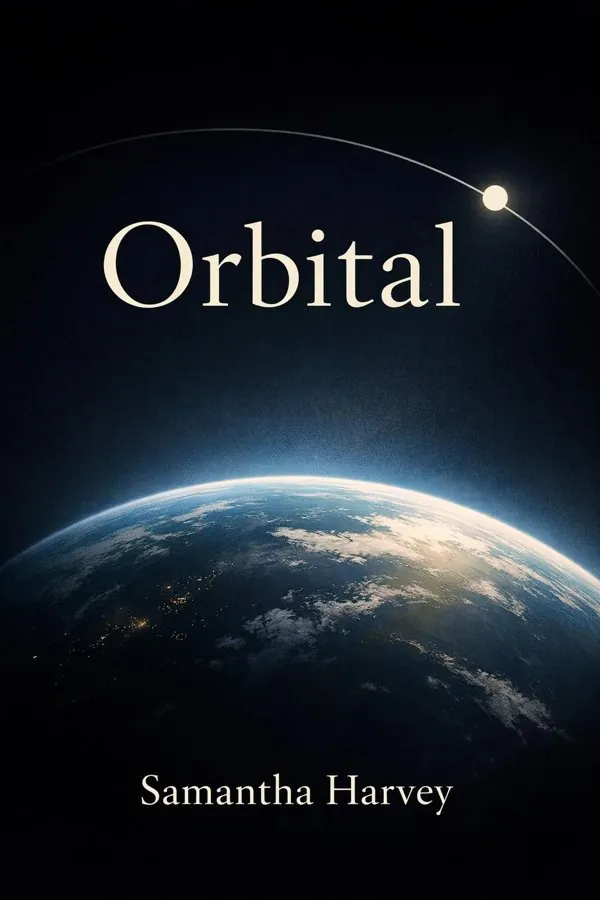
Orbital: Summary & Key Insights
 10 min5 chaptersAudio available
What Is Orbital About?
Orbital by Samantha Harvey is a classics book spanning 5 pages. A lyrical and contemplative novel set aboard a space station orbiting Earth, following six astronauts from different nations as they reflect on their lives, the fragility of the planet below, and the interconnectedness of humanity. Through poetic prose and shifting perspectives, the book explores time, memory, and the human condition against the vastness of space.
This FizzRead summary covers all 5 key chapters of Orbital in approximately 10 minutes, distilling the most important ideas, arguments, and takeaways from Samantha Harvey's work. Also available as an audio summary and Key Quotes Podcast.
Orbital
A lyrical and contemplative novel set aboard a space station orbiting Earth, following six astronauts from different nations as they reflect on their lives, the fragility of the planet below, and the interconnectedness of humanity. Through poetic prose and shifting perspectives, the book explores time, memory, and the human condition against the vastness of space.
Who Should Read Orbital?
This book is perfect for anyone interested in classics and looking to gain actionable insights in a short read. Whether you're a student, professional, or lifelong learner, the key ideas from Orbital by Samantha Harvey will help you think differently.
- ✓Readers who enjoy classics and want practical takeaways
- ✓Professionals looking to apply new ideas to their work and life
- ✓Anyone who wants the core insights of Orbital in just 10 minutes
Want the full summary?
Get instant access to this book summary and 100K+ more with Fizz Moment.
Get Free SummaryAvailable on App Store • Free to download
Key Chapters
Life aboard the station is ordinary in its discipline and extraordinary in its setting. The air hums with machinery, the walls vibrate with the soft throb of recycled breath. The astronauts—engineers, scientists, doctors—move through their routines with careful choreography. They monitor radiation levels, maintain the solar arrays, observe cosmic phenomena that few eyes will ever see firsthand. Yet beneath the technical precision lies a fragile rhythm of existence. Days and nights no longer obey the old rules; the sun rises and falls every ninety minutes, and circadian rhythms blur into abstraction.
In these intervals, they measure their lives not by clocks but by orbits. Coffee drifting in small spheres, the quiet ping of Earth communication, a photograph from home taped to a workstation—these become the touchstones of meaning. Time stretches and folds upon itself, and each task, however minor, carries an almost devotional gravity. The station becomes both monastery and machine, a temple devoted to the study of existence.
I wanted this section of the novel to remind readers that wonder and banality coexist. Space travel is no longer the realm of myth; it is work, routine, repetition. Yet within that repetition arises a strange poetry. A crew member speaks to a child over a grainy link; another watches a thunderstorm spiral across the Indian Ocean. The planet spins below them, unconscious of its observers. This juxtaposition—the mechanical and the sublime—is the essence of *Orbital*’s first movement: it grounds the cosmic within the tactile, showing how humans turn even the infinite into a home.
From their capsule’s viewing ports, the astronauts gaze downward. The Earth reveals itself in shifting colors—azure oceans, phosphorescent lattices of cities, deserts the color of bone. Each rotation brings a new geography, and with it, a flood of memory. A Japanese astronaut recalls his grandmother’s garden. A Russian engineer remembers the sound of rain against a village roof. An American biologist thinks of her daughter’s laughter, echoing across a suburban yard. These memories are their gravity, anchoring them to the world they now only see from afar.
As they look below, awe turns to contemplation. They see the smoke plumes from wildfires, the thinning white of the polar ice, the dimming of forest canopies. The planet, viewed whole, seems to breathe—slowly, unevenly, like a creature fatigued. I wanted the novel to hold this dual truth: beauty and peril, creation and decay, inseparable from one another.
This act of observation—of gazing without possession—is profoundly humbling. One cannot look upon the Earth from above and remain untouched. The astronauts are scientists, but they are also witnesses to the fragility of their home. Their reflections drift toward the metaphysical. What is stewardship when distance renders you powerless? What is belonging when your coordinates lie between worlds?
+ 3 more chapters — available in the FizzRead app
All Chapters in Orbital
About the Author
Samantha Harvey is a British novelist and academic known for her introspective and stylistically rich fiction. Her works often explore memory, consciousness, and moral complexity. She has been shortlisted for major literary awards including the Orange Prize and the Man Booker Prize.
Get This Summary in Your Preferred Format
Read or listen to the Orbital summary by Samantha Harvey anytime, anywhere. FizzRead offers multiple formats so you can learn on your terms — all free.
Available formats: App · Audio · PDF · EPUB — All included free with FizzRead
Download Orbital PDF and EPUB Summary
Key Quotes from Orbital
“Life aboard the station is ordinary in its discipline and extraordinary in its setting.”
“From their capsule’s viewing ports, the astronauts gaze downward.”
Frequently Asked Questions about Orbital
Orbital by Samantha Harvey is a classics book that explores key ideas across 5 chapters. A lyrical and contemplative novel set aboard a space station orbiting Earth, following six astronauts from different nations as they reflect on their lives, the fragility of the planet below, and the interconnectedness of humanity. Through poetic prose and shifting perspectives, the book explores time, memory, and the human condition against the vastness of space.
You Might Also Like





Browse by Category
Ready to read Orbital?
Get the full summary and 100K+ more books with Fizz Moment.