
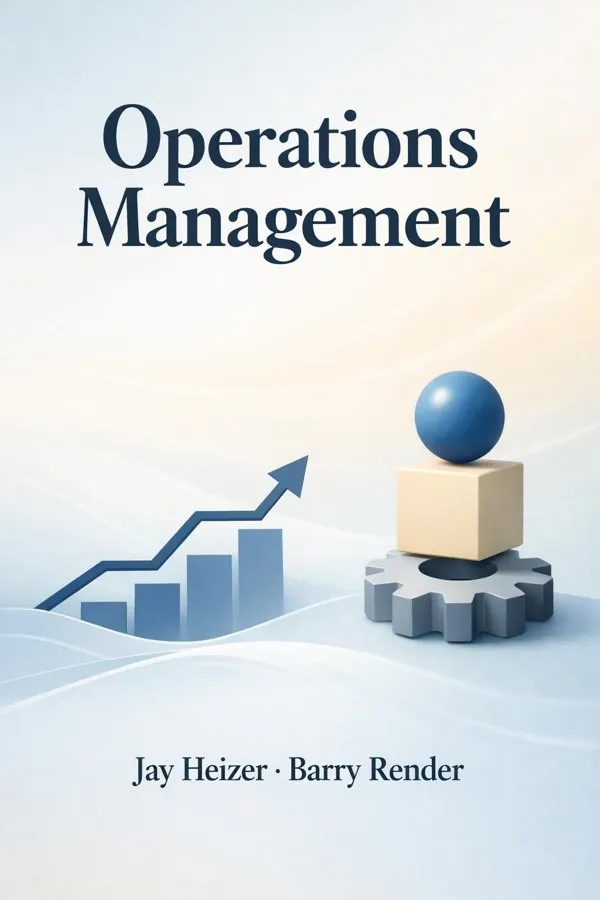
Operations Management: Summary & Key Insights
 10 min9 chaptersAudio available
Key Takeaways from Operations Management
A company rarely wins because of ambition alone; it wins because it can execute better than rivals, day after day.
Most operational failure begins long before the visible breakdown.
The future cannot be predicted perfectly, but refusing to forecast is simply choosing to be surprised.
Quality is not something you inspect into a product at the end; it is something you build into the process from the beginning.
Organizations often assume they have a people problem when they actually have a flow problem.
What Is Operations Management About?
Operations Management by Jay Heizer, Barry Render is a organization book spanning 3 pages. Operations Management by Jay Heizer and Barry Render is one of the most widely used and enduring guides to how organizations actually deliver value. While many business books focus on strategy, marketing, or leadership, this book turns attention to the system that makes promises real: operations. It explains how goods and services are designed, produced, improved, and delivered through smart decisions about process design, quality, capacity, inventory, supply chains, forecasting, and continuous improvement. What makes the book especially valuable is its broad relevance. It applies as much to hospitals, banks, retailers, airlines, and restaurants as it does to factories. Heizer and Render show that operational excellence is not a narrow technical concern but a strategic weapon that affects cost, speed, quality, flexibility, and customer satisfaction. Their authority comes from decades of teaching, research, and textbook development in operations, decision sciences, and production systems. The result is a practical, systematic framework for anyone who wants to understand how organizations convert resources into reliable performance and sustained competitive advantage.
This FizzRead summary covers all 9 key chapters of Operations Management in approximately 10 minutes, distilling the most important ideas, arguments, and takeaways from Jay Heizer, Barry Render's work. Also available as an audio summary and Key Quotes Podcast.
Operations Management
Operations Management by Jay Heizer and Barry Render is one of the most widely used and enduring guides to how organizations actually deliver value. While many business books focus on strategy, marketing, or leadership, this book turns attention to the system that makes promises real: operations. It explains how goods and services are designed, produced, improved, and delivered through smart decisions about process design, quality, capacity, inventory, supply chains, forecasting, and continuous improvement. What makes the book especially valuable is its broad relevance. It applies as much to hospitals, banks, retailers, airlines, and restaurants as it does to factories. Heizer and Render show that operational excellence is not a narrow technical concern but a strategic weapon that affects cost, speed, quality, flexibility, and customer satisfaction. Their authority comes from decades of teaching, research, and textbook development in operations, decision sciences, and production systems. The result is a practical, systematic framework for anyone who wants to understand how organizations convert resources into reliable performance and sustained competitive advantage.
Who Should Read Operations Management?
This book is perfect for anyone interested in organization and looking to gain actionable insights in a short read. Whether you're a student, professional, or lifelong learner, the key ideas from Operations Management by Jay Heizer, Barry Render will help you think differently.
- ✓Readers who enjoy organization and want practical takeaways
- ✓Professionals looking to apply new ideas to their work and life
- ✓Anyone who wants the core insights of Operations Management in just 10 minutes
Want the full summary?
Get instant access to this book summary and 100K+ more with Fizz Moment.
Get Free SummaryAvailable on App Store • Free to download
Key Chapters
A company rarely wins because of ambition alone; it wins because it can execute better than rivals, day after day. That is the central insight behind operations strategy. Heizer and Render argue that operations is not a back-office function concerned only with efficiency. It is a strategic capability that must align with what the business promises customers. If a firm competes on low price, operations must be designed for cost control, standardization, and scale. If it competes on speed, then lead times, layout, staffing, and supplier reliability become decisive. If it competes on customization, operations must support flexibility rather than maximum utilization.
The book explains that operations strategy should connect with the firm’s broader mission and competitive priorities: cost, quality, delivery, flexibility, and innovation. This means operational choices are never isolated. Facility location affects delivery speed. Process design influences quality consistency. Capacity decisions shape responsiveness during demand spikes. Even the workforce model reflects strategy: a luxury hotel and a discount warehouse require very different operating systems.
A practical example is fast fashion. A retailer that wants to respond quickly to trends cannot run the same supply chain as a low-cost basics manufacturer. It must choose shorter production cycles, closer suppliers, and more agile replenishment. Similarly, a hospital focused on emergency responsiveness must invest differently from one optimized for routine elective procedures.
The authors’ message is clear: strategy becomes credible only when operations supports it. Actionable takeaway: identify your organization’s top two competitive priorities and review whether your process design, capacity, suppliers, and performance metrics truly reinforce them.
Most operational failure begins long before the visible breakdown. Delays, waste, quality problems, and customer frustration often come from poor system design rather than poor effort. One of the book’s strongest lessons is that operations managers must think like architects, not just firefighters. Good operational performance depends on designing products, services, and workflows that are robust from the start.
Heizer and Render show how system design includes product and service design, process selection, capacity planning, location strategy, and layout decisions. These choices determine how efficiently resources flow through an organization. A poorly designed restaurant kitchen creates bottlenecks no matter how hardworking the staff is. A confusing patient intake process in a clinic increases waiting time even if doctors are highly skilled. A factory that chooses the wrong process type may either overinvest in flexibility or underdeliver on volume.
The book emphasizes designing for manufacturability and serviceability. Simpler designs often reduce defects, shorten training time, and cut cost. In services, thoughtful design can reduce variability by making customer interactions smoother and more predictable. Consider airport self-check-in systems: when designed well, they reduce queue pressure, improve accuracy, and free staff to solve exceptions.
The core idea is that effective design prevents recurring problems and creates a foundation for scale. Instead of treating operational issues as isolated incidents, managers should trace them back to structural causes. Actionable takeaway: map one core workflow in your organization from input to delivery and identify one design choice, not just one person, that is creating recurring friction.
The future cannot be predicted perfectly, but refusing to forecast is simply choosing to be surprised. Heizer and Render treat forecasting as a practical decision tool, not a crystal ball. Operations managers need estimates of future demand so they can make better choices about staffing, purchasing, scheduling, inventory, capacity, and budgeting. The value of forecasting lies less in perfect accuracy than in reducing costly misalignment between demand and resources.
The book covers both qualitative and quantitative forecasting methods. Qualitative approaches, such as expert judgment, sales force input, and market research, are useful when historical data is limited or when major change is expected. Quantitative methods, such as moving averages, exponential smoothing, and trend analysis, help organizations identify patterns in data and make more systematic projections. The authors also stress that forecast quality should be monitored using error measures, because every forecast contains uncertainty.
In practice, forecasting affects almost everything. A retailer forecasting holiday demand too conservatively loses sales and customer trust. A manufacturer forecasting too aggressively ties up cash in excess inventory. An airline uses forecasts to plan seat capacity, crew scheduling, and dynamic pricing. A university forecasts enrollment to allocate classrooms and instructors. Good forecasts also support contingency planning, allowing firms to prepare for best-case and worst-case scenarios.
The deeper lesson is that forecasting should be linked to operational decisions and regularly improved. Forecasts are only useful when they change action. Actionable takeaway: choose one important demand forecast in your organization, measure its historical error, and create a simple monthly review to update assumptions before they become expensive mistakes.
Quality is not something you inspect into a product at the end; it is something you build into the process from the beginning. This idea sits at the heart of the book’s treatment of quality management. Heizer and Render present quality not as a narrow compliance issue, but as a multidimensional concept tied directly to customer value, brand trust, operating cost, and long-term competitiveness.
They discuss major approaches such as total quality management, continuous improvement, statistical process control, and Six Sigma. The essential principle across these methods is prevention rather than correction. When organizations wait until final inspection to catch errors, they have already paid for scrap, rework, delays, and customer dissatisfaction. By contrast, organizations that define standards clearly, train employees properly, measure variation, and improve root causes can produce more reliable outcomes at lower total cost.
The book also reminds readers that quality means different things in different contexts. For one customer it may mean durability; for another, speed of service; for another, accuracy and responsiveness. A hotel’s quality includes cleanliness, check-in efficiency, and problem resolution. A software company’s quality includes usability, uptime, and bug frequency. A manufacturer’s quality may hinge on conformance, reliability, and performance.
One powerful practical implication is that quality should involve everyone, not just the quality department. Frontline employees, supervisors, designers, and suppliers all influence outcomes. Measurement matters, but culture matters too. Actionable takeaway: define the three quality attributes your customers care about most, then identify one upstream process change that would prevent defects instead of merely detecting them later.
Inventory looks like security when demand is uncertain, but it becomes expensive waste when it grows beyond real need. Heizer and Render present inventory management as one of the most important balancing acts in operations. Too little inventory causes stockouts, lost sales, production interruptions, and customer frustration. Too much inventory ties up cash, hides process problems, increases storage cost, and raises the risk of obsolescence.
The book explains why organizations hold inventory in the first place: to meet anticipated demand, buffer against uncertainty, decouple processes, and benefit from order economies. It then introduces tools such as economic order quantity, reorder points, safety stock, ABC analysis, and cycle counting. These techniques help managers decide how much to order, when to reorder, and which items deserve the closest attention.
The practical value is enormous. A grocery store must keep enough perishables to satisfy shoppers without creating spoilage. A manufacturer needs raw materials available when production starts, but excess components consume working capital. An e-commerce business must manage fast-moving and slow-moving SKUs differently. A hospital cannot risk stockouts of critical supplies, yet overstocking specialized items can be financially damaging.
The deeper insight is that inventory is not just a financial asset or a physical pile of goods; it is a reflection of process design, forecast accuracy, supplier reliability, and service strategy. When inventory is consistently too high, the root cause may lie elsewhere in the system. Actionable takeaway: classify your inventory by importance and uncertainty, then set different policies for high-value, high-risk items instead of managing every item the same way.
Competition increasingly happens not between individual firms, but between networks of suppliers, manufacturers, distributors, and service partners. That is why supply chain management is one of the book’s most important themes. Heizer and Render show that operational success depends not only on what happens inside the organization, but also on how effectively it coordinates with external partners across the flow of materials, information, and money.
The book examines sourcing decisions, supplier relationships, logistics, outsourcing, global operations, and distribution strategy. A supply chain performs well when the right product reaches the right place at the right time at the right cost. Achieving that requires visibility, trust, process alignment, and shared performance goals. If one part of the chain optimizes locally while harming the whole system, customer service declines and total cost rises.
The authors also discuss the complexity of global operations. Firms may source globally for lower cost, specialized expertise, or market access, but they also face longer lead times, exchange-rate risk, transportation disruptions, and geopolitical uncertainty. A business that chases the lowest unit cost without considering resilience may become fragile. Recent real-world disruptions, from port congestion to supplier shutdowns, make this lesson especially relevant.
A strong example is a consumer electronics company coordinating launches across component suppliers, assembly plants, logistics providers, and retailers. If any link fails, the product misses the market window. Effective supply chain management therefore requires partnership, data sharing, and contingency planning. Actionable takeaway: identify your three most critical supply dependencies and create a risk-and-response plan for each, including backup sourcing or inventory buffers where needed.
Many organizations are busy all day yet still fail to create enough value. Lean thinking begins with a challenging question: which activities truly matter to the customer, and which merely consume time, space, money, or attention? Heizer and Render use lean principles to show that operational excellence is often less about working harder and more about removing waste systematically.
The book highlights classic forms of waste such as overproduction, waiting, unnecessary transportation, excess motion, excess inventory, defects, overprocessing, and underused human talent. Lean systems aim to improve flow, reduce setup times, standardize work, simplify layouts, and produce in response to actual demand rather than forecasts alone. The goal is not minimal resources at any cost, but smoother value creation with fewer interruptions and less waste.
Lean applies beyond factories. In an office, it may mean reducing approvals, clarifying handoffs, and eliminating duplicate data entry. In healthcare, it can mean reorganizing supplies at the point of care to save staff time and reduce errors. In software, it may involve smaller batch releases and faster feedback loops. In restaurants, lean thinking may reduce walking distance, improve prep sequencing, and shorten ticket times.
Importantly, lean is not just a toolkit. It is a mindset of observation, experimentation, and respect for frontline knowledge. Employees closest to the work often see waste first. When leaders treat lean as a cost-cutting slogan, it fails. When they use it to solve problems and improve flow, it becomes transformative. Actionable takeaway: observe one routine process firsthand and list five activities the customer would not willingly pay for, then remove or reduce one of them this week.
One of the most expensive mistakes an organization can make is getting capacity wrong. Too little capacity leads to delays, lost revenue, stressed employees, and customer defection. Too much capacity inflates fixed costs and destroys productivity. Heizer and Render explain that capacity planning is not simply a technical calculation; it is a strategic choice about how much demand an organization is prepared to serve, how quickly it can respond, and how much uncertainty it can absorb.
The book distinguishes between design capacity, effective capacity, and actual output, helping readers see why nominal numbers can be misleading. A factory may be able to produce a certain volume on paper, but maintenance, changeovers, staffing limits, and quality losses reduce effective capacity. The same is true in services. A hotel may have 200 rooms, but staffing, seasonal demand, and housekeeping turnaround determine its true service capacity.
Capacity decisions affect facility size, technology investment, workforce planning, scheduling, and outsourcing choices. A cloud kitchen must decide how many orders it can process during peak dinner hours. A logistics company must size fleet capacity for both normal operations and seasonal surges. A university must decide whether to build classrooms for peak enrollment or use hybrid delivery to increase flexibility.
The authors emphasize that timing matters. Capacity added too late causes missed opportunities; capacity added too early burdens finances. Smart managers consider expansion alternatives, demand scenarios, and utilization tradeoffs before committing. Actionable takeaway: calculate where your operation is most constrained during peak demand and decide whether the best answer is added capacity, demand shifting, process redesign, or temporary external support.
All Chapters in Operations Management
About the Authors
Jay Heizer and Barry Render are prominent educators and textbook authors in the field of operations management. Jay Heizer has taught business and management subjects with a focus on production systems, operations strategy, and organizational performance. Barry Render, a longtime business professor, is widely known for his work in operations management, quantitative methods, decision sciences, and supply chain education. Together, they have coauthored some of the most widely adopted operations management textbooks used in universities and business schools worldwide. Their influence comes from their ability to combine analytical rigor with practical clarity, making complex ideas accessible to both students and professionals. Through their teaching and writing, they have helped generations of readers understand how operational decisions shape efficiency, quality, customer satisfaction, and competitive advantage.
Get This Summary in Your Preferred Format
Read or listen to the Operations Management summary by Jay Heizer, Barry Render anytime, anywhere. FizzRead offers multiple formats so you can learn on your terms — all free.
Available formats: App · Audio · PDF · EPUB — All included free with FizzRead
Download Operations Management PDF and EPUB Summary
Key Quotes from Operations Management
“A company rarely wins because of ambition alone; it wins because it can execute better than rivals, day after day.”
“Most operational failure begins long before the visible breakdown.”
“The future cannot be predicted perfectly, but refusing to forecast is simply choosing to be surprised.”
“Quality is not something you inspect into a product at the end; it is something you build into the process from the beginning.”
“Organizations often assume they have a people problem when they actually have a flow problem.”
Frequently Asked Questions about Operations Management
Operations Management by Jay Heizer, Barry Render is a organization book that explores key ideas across 9 chapters. Operations Management by Jay Heizer and Barry Render is one of the most widely used and enduring guides to how organizations actually deliver value. While many business books focus on strategy, marketing, or leadership, this book turns attention to the system that makes promises real: operations. It explains how goods and services are designed, produced, improved, and delivered through smart decisions about process design, quality, capacity, inventory, supply chains, forecasting, and continuous improvement. What makes the book especially valuable is its broad relevance. It applies as much to hospitals, banks, retailers, airlines, and restaurants as it does to factories. Heizer and Render show that operational excellence is not a narrow technical concern but a strategic weapon that affects cost, speed, quality, flexibility, and customer satisfaction. Their authority comes from decades of teaching, research, and textbook development in operations, decision sciences, and production systems. The result is a practical, systematic framework for anyone who wants to understand how organizations convert resources into reliable performance and sustained competitive advantage.
You Might Also Like
A Guide to the Project Management Body of Knowledge (PMBOK® Guide)
Project Management Institute
10 min
Organizational Behavior
Stephen P. Robbins
10 min
Accelerate: The Science of Lean Software and DevOps – Building and Scaling High Performing Technology Organizations
Nicole Forsgren, Jez Humble, Gene Kim
10 min
Awakening Compassion at Work: The Quiet Power That Elevates People and Organizations
Monica C. Worline, Jane E. Dutton
10 min
Building an Inclusive Organization: Leveraging the Power of a Diverse Workforce
Stephen Frost
10 min
Collaborative Intelligence: Thinking with People Who Think Differently
Dawna Markova, Angie McArthur
10 minBrowse by Category
Ready to read Operations Management?
Get the full summary and 100K+ more books with Fizz Moment.