
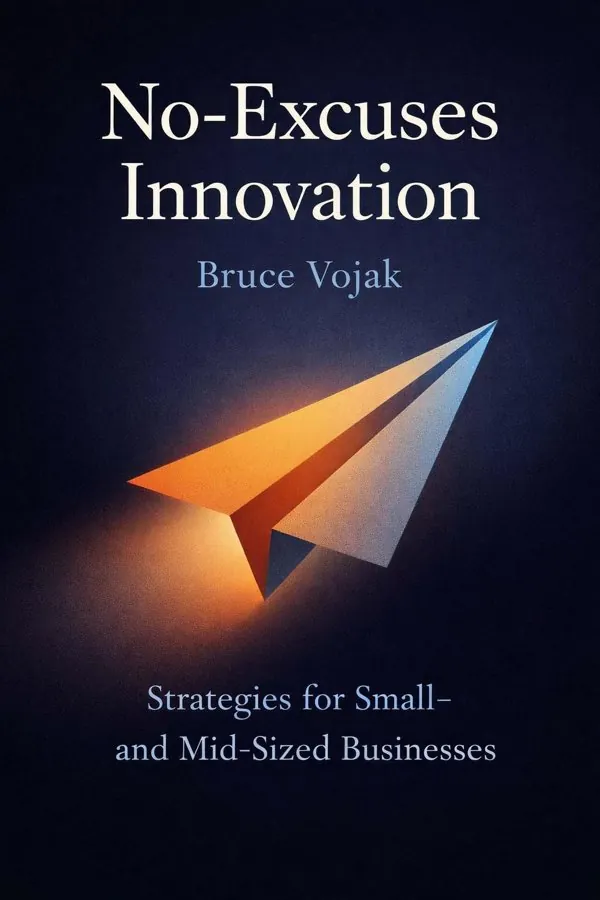
No-Excuses Innovation: Strategies for Small- and Mid-Sized Businesses: Summary & Key Insights
by Bruce Vojak
 10 min11 chaptersAudio available
What Is No-Excuses Innovation: Strategies for Small- and Mid-Sized Businesses About?
No-Excuses Innovation: Strategies for Small- and Mid-Sized Businesses by Bruce Vojak is a entrepreneurship book spanning 11 pages. No-Excuses Innovation offers practical guidance for leaders of small and mid-sized companies seeking to build a culture of innovation. Drawing on case studies and decades of experience, Bruce Vojak outlines how organizations can overcome resource constraints, foster creativity, and implement sustainable innovation strategies without relying on large corporate infrastructures.
This FizzRead summary covers all 11 key chapters of No-Excuses Innovation: Strategies for Small- and Mid-Sized Businesses in approximately 10 minutes, distilling the most important ideas, arguments, and takeaways from Bruce Vojak's work. Also available as an audio summary and Key Quotes Podcast.
No-Excuses Innovation: Strategies for Small- and Mid-Sized Businesses
No-Excuses Innovation offers practical guidance for leaders of small and mid-sized companies seeking to build a culture of innovation. Drawing on case studies and decades of experience, Bruce Vojak outlines how organizations can overcome resource constraints, foster creativity, and implement sustainable innovation strategies without relying on large corporate infrastructures.
Who Should Read No-Excuses Innovation: Strategies for Small- and Mid-Sized Businesses?
This book is perfect for anyone interested in entrepreneurship and looking to gain actionable insights in a short read. Whether you're a student, professional, or lifelong learner, the key ideas from No-Excuses Innovation: Strategies for Small- and Mid-Sized Businesses by Bruce Vojak will help you think differently.
- ✓Readers who enjoy entrepreneurship and want practical takeaways
- ✓Professionals looking to apply new ideas to their work and life
- ✓Anyone who wants the core insights of No-Excuses Innovation: Strategies for Small- and Mid-Sized Businesses in just 10 minutes
Want the full summary?
Get instant access to this book summary and 100K+ more with Fizz Moment.
Get Free SummaryAvailable on App Store • Free to download
Key Chapters
Innovation is often misunderstood as a glamorous act of invention. In reality, it’s a disciplined process of learning and application. In smaller organizations, innovation rarely begins with dramatic technological leaps; it often starts with recognizing pain points that others overlook. Throughout this section, I explain that innovation is not the same as creativity. Creativity is conceiving something new. Innovation is turning that idea into a result—into a better product, a more efficient process, or a new value proposition.
I distinguish between incremental and breakthrough innovation. Incremental innovation is the subtle improvement of what already exists—reducing manufacturing time, improving customer service, or enhancing reliability. Breakthrough innovation, by contrast, changes the rules of the game—introducing a category-defining product or a new revenue model. Both forms are necessary, and both have a place even in modestly resourced firms. The art is knowing when to pursue each.
In small and mid-sized businesses, incremental innovation provides the daily rhythm of progress, building confidence and demonstrating that new ideas can succeed. Breakthrough innovation, while riskier, defines the organization's future. I encourage leaders to align innovation with their mission—innovation for its own sake leads to confusion, but innovation guided by purpose leads to growth. By contextualizing innovation within the unique constraints of your organization, you move from vague ambition to practical capability.
Every organization faces barriers, but smaller firms often feel them more acutely. Limited budgets, overworked teams, and conservative cultures combine to build invisible fences around possibility. I have seen these fences take familiar forms: the assumption that ‘we don’t have time for that,’ or the fatalistic view that ‘we can’t compete with big companies.’ But the real barrier is not external—it is psychological.
Risk aversion, in particular, kills innovation faster than any lack of funds. Leaders often fear failure because in smaller organizations, there is little room for error. Yet the paradox is that innovation demands controlled failure—experiments that test assumptions before committing larger resources. When leaders treat each setback as evidence of incompetence, they teach their teams to stay quiet. My message is: invert the equation. Reward smart risk-taking. Treat missteps as data.
Another barrier I highlight is organizational inertia. Long-standing routines and unchallenged habits drain curiosity. The antidote is engagement. Invite voices from across the organization—production workers, sales staff, technicians. They often hold the most practical insights, seeing inefficiencies that upper management overlooks. Innovation becomes a shared responsibility only when hierarchy yields to collaboration.
Resource constraints, finally, can become advantages when managed correctly. Scarcity breeds focus. Constraints force prioritization, and prioritization drives responsibility. When everyone understands that innovation must serve a strategic objective, creativity sharpens. The key is to stop comparing your firm to giants and start competing according to your own agility.
+ 9 more chapters — available in the FizzRead app
All Chapters in No-Excuses Innovation: Strategies for Small- and Mid-Sized Businesses
About the Author
Bruce Vojak is an innovation consultant and former associate dean at the University of Illinois College of Engineering. He has extensive experience in technology management and product development, helping organizations of various sizes cultivate innovation capabilities.
Get This Summary in Your Preferred Format
Read or listen to the No-Excuses Innovation: Strategies for Small- and Mid-Sized Businesses summary by Bruce Vojak anytime, anywhere. FizzRead offers multiple formats so you can learn on your terms — all free.
Available formats: App · Audio · PDF · EPUB — All included free with FizzRead
Download No-Excuses Innovation: Strategies for Small- and Mid-Sized Businesses PDF and EPUB Summary
Key Quotes from No-Excuses Innovation: Strategies for Small- and Mid-Sized Businesses
“Innovation is often misunderstood as a glamorous act of invention.”
“Every organization faces barriers, but smaller firms often feel them more acutely.”
Frequently Asked Questions about No-Excuses Innovation: Strategies for Small- and Mid-Sized Businesses
No-Excuses Innovation: Strategies for Small- and Mid-Sized Businesses by Bruce Vojak is a entrepreneurship book that explores key ideas across 11 chapters. No-Excuses Innovation offers practical guidance for leaders of small and mid-sized companies seeking to build a culture of innovation. Drawing on case studies and decades of experience, Bruce Vojak outlines how organizations can overcome resource constraints, foster creativity, and implement sustainable innovation strategies without relying on large corporate infrastructures.
You Might Also Like
Lean Analytics
Alistair Croll, Benjamin Yoskovitz
10 min
21 Days To A Big Idea: Creating Breakthrough Business Concepts
Bryan Mattimore
10 min
Sam Walton: Made in America: My Story
Sam Walton
10 min
10x Is Easier Than 2x: How World-Class Entrepreneurs Achieve More by Doing Less
Dan Sullivan, Benjamin Hardy
10 min
12 Months to $1 Million: How to Pick a Winning Product, Build a Real Business, and Become a Seven-Figure Entrepreneur
Ryan Daniel Moran
10 min
24 Assets: Create a Digital, Scalable, Valuable Business
Daniel Priestley
10 minBrowse by Category
Ready to read No-Excuses Innovation: Strategies for Small- and Mid-Sized Businesses?
Get the full summary and 100K+ more books with Fizz Moment.