
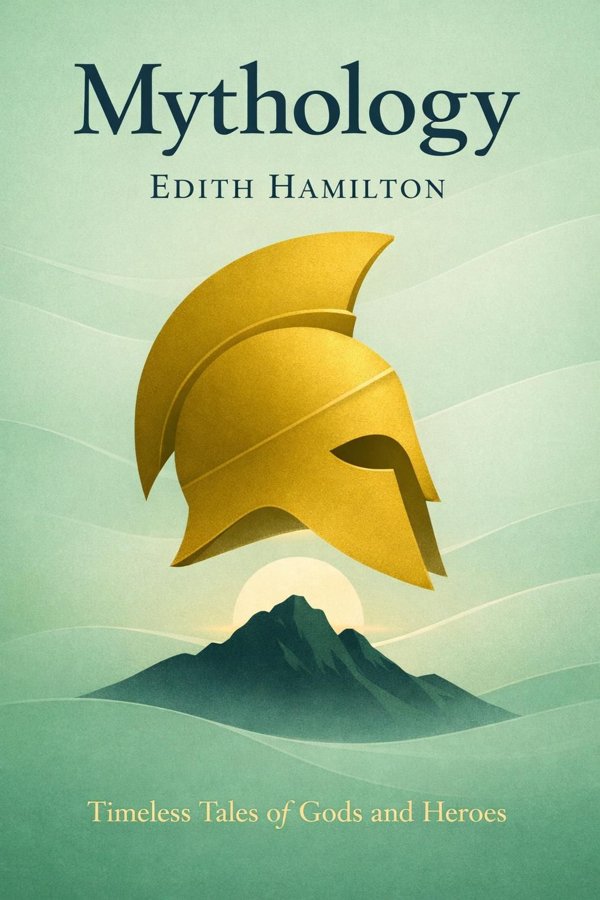
Mythology: Timeless Tales of Gods and Heroes: Summary & Key Insights
 10 min13 chapters
What Is Mythology: Timeless Tales of Gods and Heroes About?
Mythology: Timeless Tales of Gods and Heroes by Edith Hamilton is a classics book spanning 13 pages. A comprehensive retelling of classical Greek, Roman, and Norse myths, Edith Hamilton’s 'Mythology' brings to life the ancient stories of gods, heroes, and monsters. First published in 1942, the book synthesizes ancient sources into accessible narratives that have become a cornerstone of classical education. Hamilton’s elegant prose and scholarly insight make this work a definitive introduction to Western mythology.
This FizzRead summary covers all 13 key chapters of Mythology: Timeless Tales of Gods and Heroes in approximately 10 minutes, distilling the most important ideas, arguments, and takeaways from Edith Hamilton's work.
Mythology: Timeless Tales of Gods and Heroes
A comprehensive retelling of classical Greek, Roman, and Norse myths, Edith Hamilton’s 'Mythology' brings to life the ancient stories of gods, heroes, and monsters. First published in 1942, the book synthesizes ancient sources into accessible narratives that have become a cornerstone of classical education. Hamilton’s elegant prose and scholarly insight make this work a definitive introduction to Western mythology.
Who Should Read Mythology: Timeless Tales of Gods and Heroes?
This book is perfect for anyone interested in classics and looking to gain actionable insights in a short read. Whether you're a student, professional, or lifelong learner, the key ideas from Mythology: Timeless Tales of Gods and Heroes by Edith Hamilton will help you think differently.
- ✓Readers who enjoy classics and want practical takeaways
- ✓Professionals looking to apply new ideas to their work and life
- ✓Anyone who wants the core insights of Mythology: Timeless Tales of Gods and Heroes in just 10 minutes
Want the full summary?
Get instant access to this book summary and 100K+ more with Fizz Moment.
Get Free SummaryAvailable on App Store • Free to download
Key Chapters
In the beginning was chaos, a shapeless nothing. From this void came Night and Erebus, the mysterious regions of darkness. But soon love was born—and with love came order. From the union of Earth (Gaia) and Heaven (Uranus), life began to stir. Thus the Titans arose, those immense beings older than the gods, embodying nature’s raw forces. Among them were Cronus, who ruled for a time, and his sister-wife Rhea.
Yet in myth nothing stands still. The cycle of succession began when Cronus, fearing his children would overthrow him, swallowed each at birth. Only Zeus escaped, hidden by Rhea on Crete. When grown, Zeus fulfilled the prophecy, forcing Cronus to disgorge his brothers and sisters, and the new order—the Olympian world—was established.
This story, known across many traditions, represents the emergence of reason and beauty from primeval chaos. It was not mere allegory to the Greeks but a poetic expression of cosmic law: that even gods, if they defy harmony, must yield to a wiser power. In Zeus the Greeks embodied that principle. He overthrows tyranny not for vengeance but to establish a reign guided by justice and light. Thus creation, in these myths, mirrors the dawn of moral consciousness.
The twelve Olympians are the heart of Greek civilization’s imagination. They live not in some unreachable heaven but on Olympus, a shining peak above the clouds. Each god expresses a part of human nature elevated to divine clarity. Zeus, the thunder-bearing ruler, presides as father of gods and men, the guardian of order. Hera, his queen, represents both majesty and jealousy, noble yet vindictive when slighted. Athena, born from Zeus’s head, is wisdom incarnate—the embodiment of intellect and art. Apollo, the god of light, prophecy, and harmony, is perhaps the most purely Greek of all: radiant, disciplined, the very pattern of beauty formed through balance.
Beside them move Artemis the huntress, fierce yet chaste; Poseidon, lord of the seas, whose moods stir waves and tempests; Ares, red with the bloodlust of battle; and Aphrodite, born from sea foam, whose power of love is the most irresistible of all. Hermes, swift messenger and patron of travelers; Hephaestus, the god-smith; and Hestia, guardian of hearth and home, complete the sacred circle.
These gods lived with vivid personality, neither perfect nor remote. The Greeks dared to imagine their deities as moral partners in the drama of human life. Art, worship, and poetry were the means by which they entered into relationship with them. To know the Olympians, then, is to understand how the Greeks imagined existence itself—radiant with intelligence, yet shadowed by the passions that define humanity.
+ 11 more chapters — available in the FizzRead app
All Chapters in Mythology: Timeless Tales of Gods and Heroes
About the Author
Edith Hamilton (1867–1963) was an American educator and author known for her works on ancient Greek and Roman civilization. A pioneering classicist, she popularized classical literature for modern readers through books such as 'The Greek Way' and 'Mythology'.
Get This Summary in Your Preferred Format
Read or listen to the Mythology: Timeless Tales of Gods and Heroes summary by Edith Hamilton anytime, anywhere. FizzRead offers multiple formats so you can learn on your terms — all free.
Available formats: App · Audio · PDF · EPUB — All included free with FizzRead
Download Mythology: Timeless Tales of Gods and Heroes PDF and EPUB Summary
Key Quotes from Mythology: Timeless Tales of Gods and Heroes
“In the beginning was chaos, a shapeless nothing.”
“The twelve Olympians are the heart of Greek civilization’s imagination.”
Frequently Asked Questions about Mythology: Timeless Tales of Gods and Heroes
Mythology: Timeless Tales of Gods and Heroes by Edith Hamilton is a classics book that explores key ideas across 13 chapters. A comprehensive retelling of classical Greek, Roman, and Norse myths, Edith Hamilton’s 'Mythology' brings to life the ancient stories of gods, heroes, and monsters. First published in 1942, the book synthesizes ancient sources into accessible narratives that have become a cornerstone of classical education. Hamilton’s elegant prose and scholarly insight make this work a definitive introduction to Western mythology.
You Might Also Like






Browse by Category
Ready to read Mythology: Timeless Tales of Gods and Heroes?
Get the full summary and 100K+ more books with Fizz Moment.