
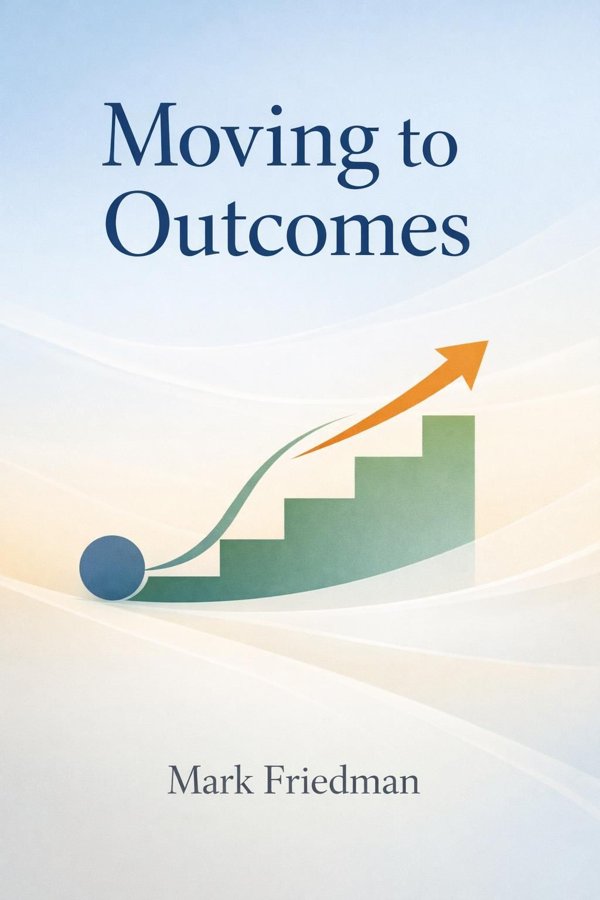
Moving to Outcomes: Transforming Social Systems Through Results-Based Accountability: Summary & Key Insights
 10 min3 chaptersAudio available
What Is Moving to Outcomes: Transforming Social Systems Through Results-Based Accountability About?
Moving to Outcomes: Transforming Social Systems Through Results-Based Accountability by Mark Friedman is a organization book spanning 3 pages. Moving to Outcomes presents a practical framework for improving the performance of social programs and public systems through results-based accountability (RBA). The book explains how organizations can shift from measuring activities to measuring outcomes, ensuring that public resources lead to tangible improvements in people's lives. It provides case studies, implementation strategies, and tools for policymakers, nonprofit leaders, and community organizations to create measurable social change.
This FizzRead summary covers all 3 key chapters of Moving to Outcomes: Transforming Social Systems Through Results-Based Accountability in approximately 10 minutes, distilling the most important ideas, arguments, and takeaways from Mark Friedman's work. Also available as an audio summary and Key Quotes Podcast.
Moving to Outcomes: Transforming Social Systems Through Results-Based Accountability
Moving to Outcomes presents a practical framework for improving the performance of social programs and public systems through results-based accountability (RBA). The book explains how organizations can shift from measuring activities to measuring outcomes, ensuring that public resources lead to tangible improvements in people's lives. It provides case studies, implementation strategies, and tools for policymakers, nonprofit leaders, and community organizations to create measurable social change.
Who Should Read Moving to Outcomes: Transforming Social Systems Through Results-Based Accountability?
This book is perfect for anyone interested in organization and looking to gain actionable insights in a short read. Whether you're a student, professional, or lifelong learner, the key ideas from Moving to Outcomes: Transforming Social Systems Through Results-Based Accountability by Mark Friedman will help you think differently.
- ✓Readers who enjoy organization and want practical takeaways
- ✓Professionals looking to apply new ideas to their work and life
- ✓Anyone who wants the core insights of Moving to Outcomes: Transforming Social Systems Through Results-Based Accountability in just 10 minutes
Want the full summary?
Get instant access to this book summary and 100K+ more with Fizz Moment.
Get Free SummaryAvailable on App Store • Free to download
Key Chapters
When I began working with public systems, I realized that most of our measurement frameworks were fundamentally misaligned with our goals. We were tracking procedures and budgets rather than the actual effects on people’s lives. Every day, staff were busy producing reports, writing grant proposals, and complying with process requirements. These activities, though important, didn’t guarantee success. They only proved effort. In Results-Based Accountability, we start by distinguishing between activity-based measures and outcome-based measures.
Traditional approaches ask, 'What did we do?' RBA asks, 'Is anyone better off?' This simple shift in language changes everything. It compels us to define success in terms of real-world improvement — children ready for school, people with jobs, families in stable housing, communities where citizens feel safe. Once we identify those outcomes, we can align our activities to serve them. RBA begins with results at the population level: the broad, community outcomes that reflect public well-being. From there, we cascade down to performance accountability, where the focus is on programs and agencies.
Understanding this two-part structure is crucial. Population accountability concerns entire communities, asking how all children, adults, or families fare within a jurisdiction. Performance accountability focuses on how well a specific program or agency contributes to those population results. By keeping these levels distinct yet connected, RBA ensures clarity and coordination. It prevents agencies from confusing isolated program metrics with community outcomes, and instead encourages collaboration to achieve shared goals.
To make this shift practical, RBA introduces clear definitions: results express the condition of well-being we seek; indicators track progress toward those results; performance measures assess how effectively programs achieve their specific objectives. Each measure flows logically from the fundamental principle that accountability must answer both how much we did, how well we did it, and whether anyone is better off.
Take, for example, a youth employment program. A traditional report might emphasize how many workshops were held or how many participants enrolled. RBA asks deeper questions: how many participants gained employment, sustained it for six months, or increased their income? Those are measures of real impact. Once you adopt this logic, your reporting stops being a routine exercise — it becomes a mirror that reflects the actual effectiveness of your work.
Through many years of implementation, I’ve seen that this clarity reshapes organizational culture. Staff begin to see data not as a compliance burden, but as a tool for storytelling and learning. Managers stop asking 'Did we meet our quota?' and start asking 'Did we change lives?' This shift, subtle yet profound, transforms accountability from a system of punishment into a system of progress.
In other words, Results-Based Accountability doesn’t reject performance measurement — it redeems it. It gives measurement meaning by reconnecting it with purpose.
One of the most practical and transformative components of RBA is what I call 'Turn the Curve thinking.' This process gives organizations and communities the ability to move from data observation to data-driven action. When we talk about turning the curve, we mean improving performance over time against a baseline. Every indicator and measure has a trend — a curve — that shows whether things are getting better, worse, or staying the same. The purpose of accountability is to turn that curve upward in the direction of improved well-being.
Let me walk you through the logic. First, we identify the baseline data for a given indicator — say, high school graduation rates or homelessness figures. Then, we engage stakeholders to understand what lies behind those numbers. Data is not cold; it carries stories. Turning the curve means digging into those stories, finding leverage points, and applying practical actions that can bend the trendline toward better outcomes.
The process is collaborative by nature. No single agency can turn a population-level curve alone. Change emerges when partners across education, health, housing, and community sectors come together around shared results. In workshops I’ve led, one of the most powerful experiences comes when teams see the baseline graph, point to the line that represents reality, and declare: 'We’re going to turn that curve.' That declaration creates hope, but also responsibility. It anchors ambition in measurable action.
The method follows common sense steps. Review the baseline, diagnose contributing factors, brainstorm what works elsewhere, and choose specific, doable actions that can accelerate progress. Importantly, the process doesn’t demand perfect data or massive resources; it thrives on clarity and focus. Participants leave with a plan built around evidence and commitment.
Consider one example from child welfare services. A department noticed its rate of repeat maltreatment cases was not declining despite extensive training and compliance programs. Using Turn the Curve sessions, staff examined the drivers — case load pressures, inconsistencies in follow-up, communication gaps between agencies. They looked at data from other jurisdictions with better curves and discovered that joint case reviews between agencies dramatically cut recurrence rates. They instituted that change, tracked progress, and within a year the curve genuinely turned downward. This wasn’t magic; it was disciplined accountability applied through partnership.
What makes the Turn the Curve process powerful is not its technical sophistication but its accessibility. Anyone in any community can use it. It democratizes data. It moves accountability out of administrative reports and into collective conversation where people can see, discuss, and act upon the evidence together. When you turn the curve, you’re not just changing numbers — you’re changing lives.
+ 1 more chapters — available in the FizzRead app
All Chapters in Moving to Outcomes: Transforming Social Systems Through Results-Based Accountability
About the Author
Mark Friedman is an American public policy expert and the creator of the Results-Based Accountability (RBA) framework. He has worked extensively with governments and nonprofit organizations worldwide to improve social outcomes through data-driven performance management.
Get This Summary in Your Preferred Format
Read or listen to the Moving to Outcomes: Transforming Social Systems Through Results-Based Accountability summary by Mark Friedman anytime, anywhere. FizzRead offers multiple formats so you can learn on your terms — all free.
Available formats: App · Audio · PDF · EPUB — All included free with FizzRead
Download Moving to Outcomes: Transforming Social Systems Through Results-Based Accountability PDF and EPUB Summary
Key Quotes from Moving to Outcomes: Transforming Social Systems Through Results-Based Accountability
“When I began working with public systems, I realized that most of our measurement frameworks were fundamentally misaligned with our goals.”
“One of the most practical and transformative components of RBA is what I call 'Turn the Curve thinking.”
Frequently Asked Questions about Moving to Outcomes: Transforming Social Systems Through Results-Based Accountability
Moving to Outcomes: Transforming Social Systems Through Results-Based Accountability by Mark Friedman is a organization book that explores key ideas across 3 chapters. Moving to Outcomes presents a practical framework for improving the performance of social programs and public systems through results-based accountability (RBA). The book explains how organizations can shift from measuring activities to measuring outcomes, ensuring that public resources lead to tangible improvements in people's lives. It provides case studies, implementation strategies, and tools for policymakers, nonprofit leaders, and community organizations to create measurable social change.
You Might Also Like

A Guide to the Project Management Body of Knowledge (PMBOK® Guide)
Project Management Institute
10 min
Organizational Behavior
Stephen P. Robbins
10 min
Accelerate: The Science of Lean Software and DevOps – Building and Scaling High Performing Technology Organizations
Nicole Forsgren, Jez Humble, Gene Kim
10 min
Awakening Compassion at Work: The Quiet Power That Elevates People and Organizations
Monica C. Worline, Jane E. Dutton
10 min
Building an Inclusive Organization: Leveraging the Power of a Diverse Workforce
Stephen Frost
10 min
Collaborative Intelligence: Thinking with People Who Think Differently
Dawna Markova, Angie McArthur
10 minBrowse by Category
Ready to read Moving to Outcomes: Transforming Social Systems Through Results-Based Accountability?
Get the full summary and 100K+ more books with Fizz Moment.