
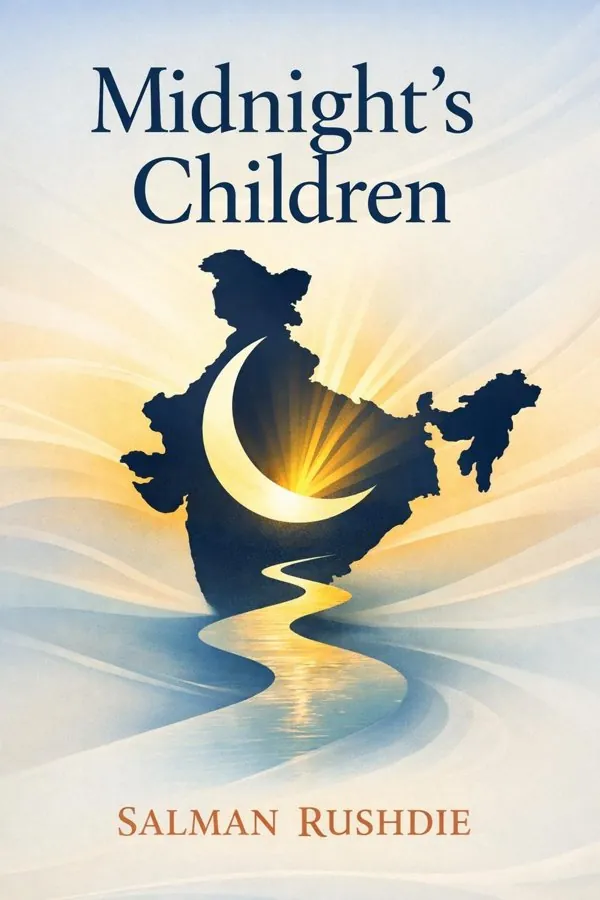
Midnight's Children: Summary & Key Insights
 10 min6 chaptersAudio available
What Is Midnight's Children About?
Midnight's Children by Salman Rushdie is a classics book spanning 6 pages. Midnight's Children is a novel by Salman Rushdie that tells the story of Saleem Sinai, who is born at the exact moment India gains independence from British rule. His life becomes intertwined with the fate of the nation, as he discovers that all children born in the first hour of independence possess special powers. Through Saleem’s magical and often chaotic experiences, the novel explores themes of identity, history, and the complex legacy of colonialism in post-independence India.
This FizzRead summary covers all 6 key chapters of Midnight's Children in approximately 10 minutes, distilling the most important ideas, arguments, and takeaways from Salman Rushdie's work. Also available as an audio summary and Key Quotes Podcast.
Midnight's Children
Midnight's Children is a novel by Salman Rushdie that tells the story of Saleem Sinai, who is born at the exact moment India gains independence from British rule. His life becomes intertwined with the fate of the nation, as he discovers that all children born in the first hour of independence possess special powers. Through Saleem’s magical and often chaotic experiences, the novel explores themes of identity, history, and the complex legacy of colonialism in post-independence India.
Who Should Read Midnight's Children?
This book is perfect for anyone interested in classics and looking to gain actionable insights in a short read. Whether you're a student, professional, or lifelong learner, the key ideas from Midnight's Children by Salman Rushdie will help you think differently.
- ✓Readers who enjoy classics and want practical takeaways
- ✓Professionals looking to apply new ideas to their work and life
- ✓Anyone who wants the core insights of Midnight's Children in just 10 minutes
Want the full summary?
Get instant access to this book summary and 100K+ more with Fizz Moment.
Get Free SummaryAvailable on App Store • Free to download
Key Chapters
To begin understanding myself, I must begin before myself—with my grandparents, Aadam Aziz, a doctor educated in Germany, and Naseem, a spirited woman from Kashmir whose marriage to him forms the seed of all that follows. Between their union and the first stirrings of India’s national awakening lies the quiet friction between two worlds: modern rationalism and traditional faith. Aadam’s secular skepticism cracks the orderly shell of his upbringing, while Naseem embodies a domestic realm rooted in custom and confinement. Their household oscillates between romantic tenderness and the widening tremors of political change. Here, Kashmir is more than a setting; it is Eden before the fall, a symbol of lost wholeness.
From their uneasy marriage arises a family destined to mirror the subcontinent’s fate. The wounds Aadam receives kneeling to pray—a nose that bleeds when India’s history turns violent—foreshadow my own inheritance. For even before I am conceived, lines of division are being drawn, not only across geography but across faith, language, and class. This prehistory reveals the novel’s beating core: personal identity is inseparable from historical rupture. The marriage that began in a veiled room in Kashmir becomes the first thread in the tapestry of a country learning, painfully, to see itself unveiled.
And then comes the moment of my arrival: August 15, 1947. Freedom and birth, chaos and celebration—India and I bursting into time together. My parents, Ahmed and Amina Sinai, had settled in Bombay, a city fevered with possibility and terror. The air that night trembled with fireworks, prayers, and confusion. At the very instant when the clock struck midnight, two cries entered the world—mine and another’s: Shiva, with his knees of strength and his destined anger. By the midwife’s sleight of hand, our fates are reversed: I, a poor man’s child, am claimed by privilege, and he, born to comfort, is handed to poverty. The nation, too, is born to confusion and exchange, its identities precariously swapped and remade.
From the moment of that miraculous birth, my existence becomes an allegory of the nation’s promises and deceits. My parents seek prosperity in a country intoxicated by its newfound voice; prophets and politicians rise and fall in rapid tempo; the scent of politics seeps even into the spice jars of our kitchen. Behind it all, I begin to notice something strange about myself—a sensitivity that allows me to hear, not through words but through an invisible network of thought, the multitude of children born in that magical first hour. We are the Midnight’s Children—each endowed with powers that seem to echo the hopes of a new land. And yet unity among us proves elusive. India, too, struggles to reconcile its diversity with its dream of being one.
+ 4 more chapters — available in the FizzRead app
All Chapters in Midnight's Children
About the Author
Salman Rushdie is a British-Indian novelist and essayist known for his richly imaginative and often controversial works blending magical realism with historical and political commentary. Born in Bombay (now Mumbai) in 1947, Rushdie gained international fame with Midnight's Children, which won the Booker Prize in 1981 and the Booker of Bookers in 1993. His later works include The Satanic Verses, The Moor’s Last Sigh, and The Golden House.
Get This Summary in Your Preferred Format
Read or listen to the Midnight's Children summary by Salman Rushdie anytime, anywhere. FizzRead offers multiple formats so you can learn on your terms — all free.
Available formats: App · Audio · PDF · EPUB — All included free with FizzRead
Download Midnight's Children PDF and EPUB Summary
Key Quotes from Midnight's Children
“Between their union and the first stirrings of India’s national awakening lies the quiet friction between two worlds: modern rationalism and traditional faith.”
“And then comes the moment of my arrival: August 15, 1947.”
Frequently Asked Questions about Midnight's Children
Midnight's Children by Salman Rushdie is a classics book that explores key ideas across 6 chapters. Midnight's Children is a novel by Salman Rushdie that tells the story of Saleem Sinai, who is born at the exact moment India gains independence from British rule. His life becomes intertwined with the fate of the nation, as he discovers that all children born in the first hour of independence possess special powers. Through Saleem’s magical and often chaotic experiences, the novel explores themes of identity, history, and the complex legacy of colonialism in post-independence India.
You Might Also Like
Browse by Category
Ready to read Midnight's Children?
Get the full summary and 100K+ more books with Fizz Moment.