
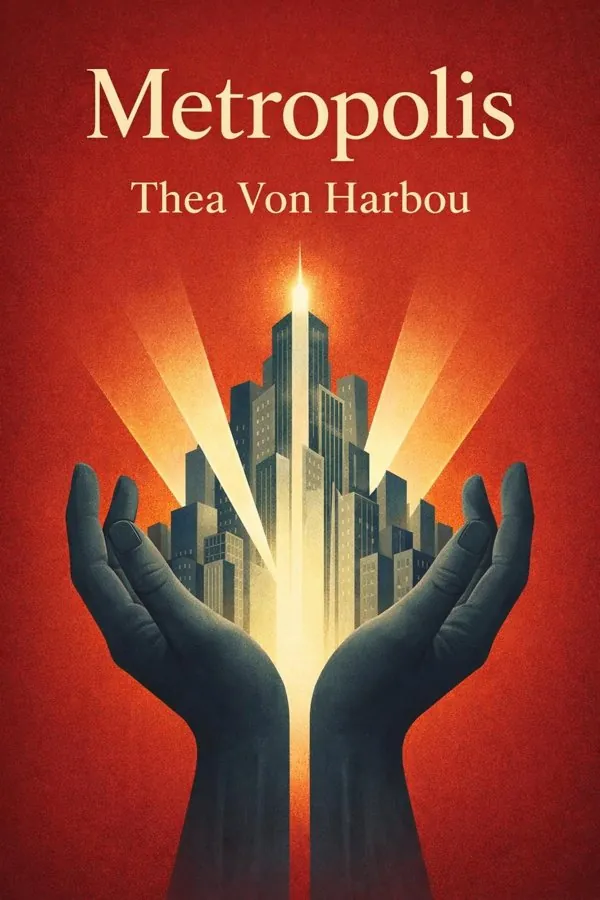
Metropolis: Summary & Key Insights
 10 min3 chaptersAudio available
What Is Metropolis About?
Metropolis by Thea Von Harbou is a classics book spanning 3 pages. Metropolis is a classic science fiction novel by Thea von Harbou, first published in 1925. Set in a futuristic dystopian city, the story explores the divide between the ruling elite and the oppressed working class. It delves into themes of social inequality, technological dependence, and the quest for reconciliation between intellect and humanity. The novel served as the basis for Fritz Lang’s iconic 1927 silent film of the same name.
This FizzRead summary covers all 3 key chapters of Metropolis in approximately 10 minutes, distilling the most important ideas, arguments, and takeaways from Thea Von Harbou's work. Also available as an audio summary and Key Quotes Podcast.
Metropolis
Metropolis is a classic science fiction novel by Thea von Harbou, first published in 1925. Set in a futuristic dystopian city, the story explores the divide between the ruling elite and the oppressed working class. It delves into themes of social inequality, technological dependence, and the quest for reconciliation between intellect and humanity. The novel served as the basis for Fritz Lang’s iconic 1927 silent film of the same name.
Who Should Read Metropolis?
This book is perfect for anyone interested in classics and looking to gain actionable insights in a short read. Whether you're a student, professional, or lifelong learner, the key ideas from Metropolis by Thea Von Harbou will help you think differently.
- ✓Readers who enjoy classics and want practical takeaways
- ✓Professionals looking to apply new ideas to their work and life
- ✓Anyone who wants the core insights of Metropolis in just 10 minutes
Want the full summary?
Get instant access to this book summary and 100K+ more with Fizz Moment.
Get Free SummaryAvailable on App Store • Free to download
Key Chapters
Freder begins his life in the gardens of delight, surrounded by music, sport, and laughter. His father, Joh Fredersen, built the city and rules it with precise efficiency. Every movement above corresponds to a calculation below. The elite pride themselves on intellect and innovation, believing they have overcome the chaos of nature. They live above in towers of glass, distant from the rumble of the machines. But this serenity is a façade, maintained by countless anonymous laborers buried in the depths.
It is in this sterile paradise that Freder first sees Maria. She arrives leading a group of exhausted children from the worker’s city — a moment of intrusion the upper realm cannot explain. Her compassionate eyes and quiet words pierce Freder’s indifference. In her, he sees not rebellion, but purity. When she tells him, “These are your brothers,” something collapses inside him. For the first time, he senses the falseness of his comfort, the injustice sustaining it.
Driven by that revelation, Freder leaves his marble halls and descends into the machine world. The air grows hot and suffocating; the walls pulse with iron rhythm. He witnesses a machine explode, flames engulfing men who are consumed by the gears they serve. In that vision, he sees the machine become Moloch, the ancient god of sacrifice, fed by living bodies. This moment marks his rebirth. He exchanges his fine clothes for a worker’s garb and joins them, determined to understand their suffering from within.
Through Freder’s eyes, the reader discovers the city anew — its beauty deformed by exploitation. Every lever, every turbine has a face behind it, a life crushed into silence. Yet even here, among oppression, there are whispers of hope. Maria, beloved among the workers, preaches that salvation will not come through violence but through understanding. Her message echoes in Freder’s conscience. He becomes the listener, the mediator in embryo, learning that any unity worth having must be forged by empathy. His descent is no longer punishment; it is initiation — a necessary passage toward wholeness.
Joh Fredersen, the architect of Metropolis, governs through reason and order. Everything can be planned, quantified, replaced. Yet his flaw lies in his conviction that intellect alone can sustain a city. He fears chaos as he fears feeling. His former rival, Rotwang, embodies what happens when intellect turns inward and bitter. Once colleagues, bound by a shared love for the deceased Hel — Freder’s mother — they became divided by ambition and grief. Fredersen seeks to control the city; Rotwang, in his madness, seeks to control creation itself.
Rotwang’s workshop stands apart from the sterile towers and ordered streets. Here, amid wires and shadows, the future takes grotesque shape. His greatest invention is a machine-man — a humanoid robot capable of perfect imitation. Originally fashioned to replace Hel, it becomes instead a weapon of revenge. When Fredersen consults Rotwang to quell the growing unrest, Rotwang sees an opportunity to destroy him. He transforms the machine into the image of Maria — the very symbol of hope for unity. This counterfeit will speak not peace, but frenzy.
The double begins her work. In the catacombs where the real Maria once preached harmony, the false one preaches destruction. Her beauty enslaves rather than liberates; her words burn instead of heal. The workers, entranced, abandon reason and rise against their oppressors. The machines fall silent as they are torn apart. But in this act of liberation, the city itself begins to die. Water floods the lower levels where children sleep. The revolution, without guidance of the heart, devours its own.
Rotwang’s vengeance is not just against Fredersen; it is against humanity’s hubris. In his creation — the false Maria — one witnesses the danger of progress without morality, of technology made godlike without compassion. The machine’s perfection mirrors the imperfection of its creators. What was meant to bridge the human and mechanical becomes the symbol of their irreconcilable rift. Through this chaos, I wanted to reveal an ancient truth in new clothing: that knowledge without love turns creation into destruction.
+ 1 more chapters — available in the FizzRead app
All Chapters in Metropolis
About the Author
Thea von Harbou (1888–1954) was a German novelist, screenwriter, and film director. She is best known for writing the novel and co-writing the screenplay for Fritz Lang’s film Metropolis. Her works often combine visionary technology with moral and philosophical symbolism.
Get This Summary in Your Preferred Format
Read or listen to the Metropolis summary by Thea Von Harbou anytime, anywhere. FizzRead offers multiple formats so you can learn on your terms — all free.
Available formats: App · Audio · PDF · EPUB — All included free with FizzRead
Download Metropolis PDF and EPUB Summary
Key Quotes from Metropolis
“Freder begins his life in the gardens of delight, surrounded by music, sport, and laughter.”
“Joh Fredersen, the architect of Metropolis, governs through reason and order.”
Frequently Asked Questions about Metropolis
Metropolis by Thea Von Harbou is a classics book that explores key ideas across 3 chapters. Metropolis is a classic science fiction novel by Thea von Harbou, first published in 1925. Set in a futuristic dystopian city, the story explores the divide between the ruling elite and the oppressed working class. It delves into themes of social inequality, technological dependence, and the quest for reconciliation between intellect and humanity. The novel served as the basis for Fritz Lang’s iconic 1927 silent film of the same name.
You Might Also Like





Browse by Category
Ready to read Metropolis?
Get the full summary and 100K+ more books with Fizz Moment.