
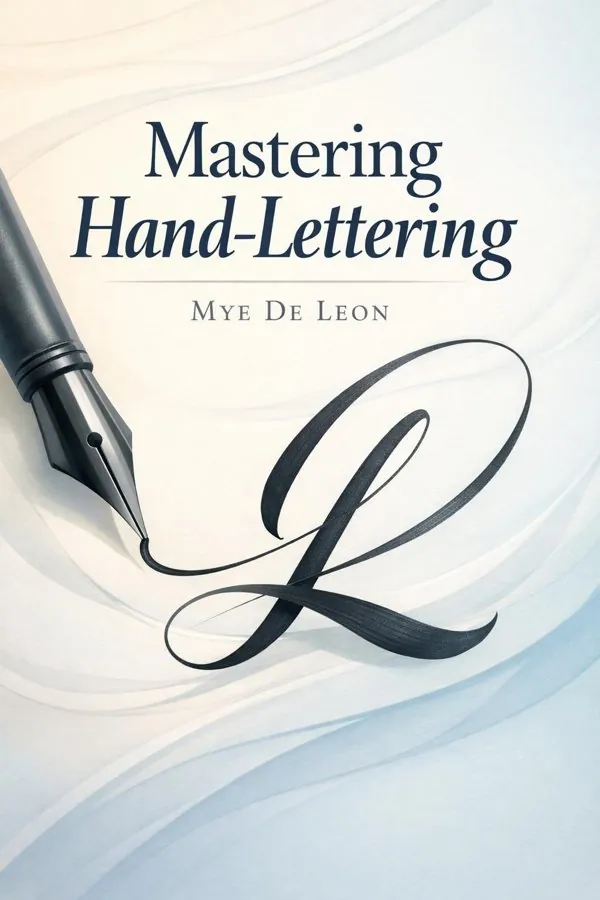
Mastering Hand-Lettering: Your Practical Guide to Creating and Styling Beautiful Letters: Summary & Key Insights
by Mye De Leon
 10 min4 chaptersAudio available
What Is Mastering Hand-Lettering: Your Practical Guide to Creating and Styling Beautiful Letters About?
Mastering Hand-Lettering: Your Practical Guide to Creating and Styling Beautiful Letters by Mye De Leon is a design book spanning 4 pages. Mastering Hand-Lettering is a comprehensive guide that teaches the art and craft of hand-lettering through practical exercises, design principles, and creative projects. Mye De Leon introduces readers to the fundamentals of letterforms, spacing, composition, and style development, helping both beginners and experienced artists refine their lettering skills and create expressive, professional-quality designs.
This FizzRead summary covers all 4 key chapters of Mastering Hand-Lettering: Your Practical Guide to Creating and Styling Beautiful Letters in approximately 10 minutes, distilling the most important ideas, arguments, and takeaways from Mye De Leon's work. Also available as an audio summary and Key Quotes Podcast.
Mastering Hand-Lettering: Your Practical Guide to Creating and Styling Beautiful Letters
Mastering Hand-Lettering is a comprehensive guide that teaches the art and craft of hand-lettering through practical exercises, design principles, and creative projects. Mye De Leon introduces readers to the fundamentals of letterforms, spacing, composition, and style development, helping both beginners and experienced artists refine their lettering skills and create expressive, professional-quality designs.
Who Should Read Mastering Hand-Lettering: Your Practical Guide to Creating and Styling Beautiful Letters?
This book is perfect for anyone interested in design and looking to gain actionable insights in a short read. Whether you're a student, professional, or lifelong learner, the key ideas from Mastering Hand-Lettering: Your Practical Guide to Creating and Styling Beautiful Letters by Mye De Leon will help you think differently.
- ✓Readers who enjoy design and want practical takeaways
- ✓Professionals looking to apply new ideas to their work and life
- ✓Anyone who wants the core insights of Mastering Hand-Lettering: Your Practical Guide to Creating and Styling Beautiful Letters in just 10 minutes
Want the full summary?
Get instant access to this book summary and 100K+ more with Fizz Moment.
Get Free SummaryAvailable on App Store • Free to download
Key Chapters
Every craft begins with understanding its materials and principles, and in hand-lettering, that foundation lies in both tools and the anatomy of letters. Before you draw a single line, I want you to feel comfortable with your instruments—pencils, pens, brush pens, markers, nibs, and papers. Each medium yields a different mood and texture. A brush pen, for instance, captures spontaneity with its thick-to-thin transitions, while a fine liner lends precision and uniformity. Choosing your tools is less about right or wrong and more about aligning with your intent. Paper surfaces can alter how ink flows; the smoother the paper, the cleaner the lines you’ll create.
Next, we move into the anatomy of letters. Think of letters as living shapes: each has a skeleton (the basic form), muscle (the weight added by strokes), and skin (the final style or texture). Understanding this anatomy helps you see structure instead of guessing it. The baseline, x-height, ascenders, and descenders all define a letter’s personality. You’ll start sketching simple shapes—ovals, rectangles, and lines—to realize how every letter can be broken down into these basic forms. Once you see letters as compositional units rather than random marks, you gain control over your design.
I emphasize practice with stroke order and direction because consistency builds rhythm. Muscle memory develops through repetition, and soon enough, your hand begins to anticipate curves and angles naturally. That’s when lettering turns from mechanical practice into meditation. Every stroke tells you something about your own patience and attention. You learn to slow down, refine your pressure, and enjoy the act of creating rather than rushing toward completion.
Once you’ve learned how letters are built, it’s time to dress them with style. In this part of the book, I reveal how countless lettering classifications—serif, sans serif, script, decorative, and illustrative—emerge from subtle variations in line and proportion. Serif letters exude elegance and tradition; sans serifs speak clarity and modernity; scripts dance with emotion and rhythm. I encourage you to experiment with these moods until you find what feels most natural to your hand.
But style doesn’t exist in isolation. Spacing and alignment are silent yet powerful forces that shape how your letters are read and felt. Good spacing allows letters to breathe, creating visual harmony. I teach you to evaluate the negative space as carefully as the strokes themselves, because balance lives in the relationship between what you draw and what you leave untouched. Alignment—both visual and structural—guides the viewer’s eye through your composition, while contrast and weight give emphasis where you want attention to linger.
To nurture creative voice, I ask you to experiment fearlessly. Try mixing scripts with block letters, play with exaggerated loops or compressed widths, and learn from the results. Through iteration, you’ll see how your preferences—your instinctive choice of lines, shapes, or embellishments—start to define your personal lettering identity. This individuality is what makes hand-lettering an artform rather than mere replication.
Throughout these chapters, I remind you that mastery is not achieved by replicating style sheets but by letting your letters tell your story. The more you observe real-world letters—on signs, packaging, and vintage postcards—the richer your visual memory becomes. Your influences will blend into something distinctly yours.
+ 2 more chapters — available in the FizzRead app
All Chapters in Mastering Hand-Lettering: Your Practical Guide to Creating and Styling Beautiful Letters
About the Author
Mye De Leon is a lettering artist, designer, and creative entrepreneur known for her distinctive hand-lettering style and educational resources for artists. She has worked with global brands and teaches workshops and online courses on lettering and design.
Get This Summary in Your Preferred Format
Read or listen to the Mastering Hand-Lettering: Your Practical Guide to Creating and Styling Beautiful Letters summary by Mye De Leon anytime, anywhere. FizzRead offers multiple formats so you can learn on your terms — all free.
Available formats: App · Audio · PDF · EPUB — All included free with FizzRead
Download Mastering Hand-Lettering: Your Practical Guide to Creating and Styling Beautiful Letters PDF and EPUB Summary
Key Quotes from Mastering Hand-Lettering: Your Practical Guide to Creating and Styling Beautiful Letters
“Every craft begins with understanding its materials and principles, and in hand-lettering, that foundation lies in both tools and the anatomy of letters.”
“Once you’ve learned how letters are built, it’s time to dress them with style.”
Frequently Asked Questions about Mastering Hand-Lettering: Your Practical Guide to Creating and Styling Beautiful Letters
Mastering Hand-Lettering: Your Practical Guide to Creating and Styling Beautiful Letters by Mye De Leon is a design book that explores key ideas across 4 chapters. Mastering Hand-Lettering is a comprehensive guide that teaches the art and craft of hand-lettering through practical exercises, design principles, and creative projects. Mye De Leon introduces readers to the fundamentals of letterforms, spacing, composition, and style development, helping both beginners and experienced artists refine their lettering skills and create expressive, professional-quality designs.
You Might Also Like
The Design of Everyday Things
Don Norman
10 min
The Better Angels of Our Nature
Steven Pinker
10 min
A Designer's Art
Paul Rand
10 min
Architects' Sketchbooks
Various Editors
10 min
Architectural Graphic Standards
The American Institute of Architects
10 min
Design Is Storytelling
Ellen Lupton
10 minBrowse by Category
Ready to read Mastering Hand-Lettering: Your Practical Guide to Creating and Styling Beautiful Letters?
Get the full summary and 100K+ more books with Fizz Moment.