
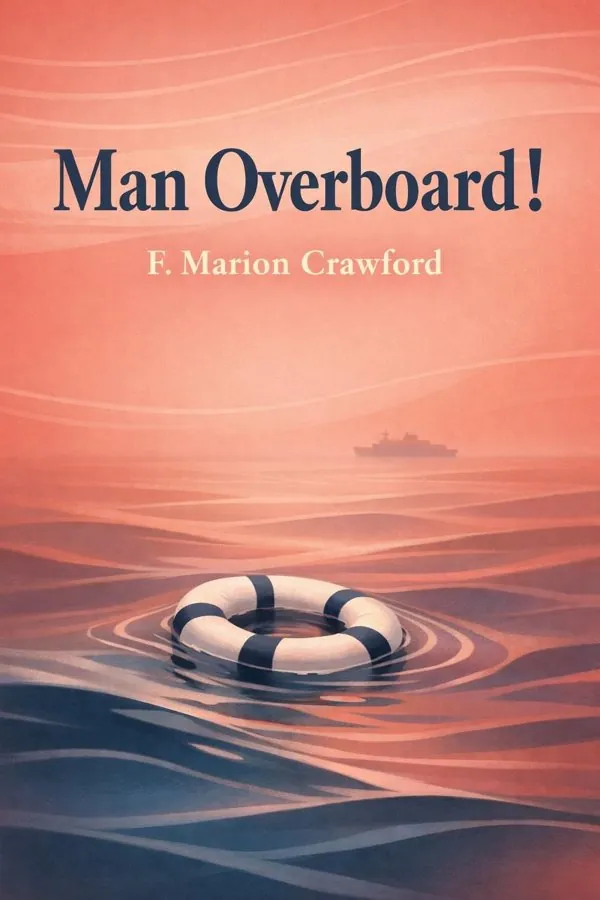
Man Overboard!: Summary & Key Insights
 10 min9 chaptersAudio available
Key Takeaways from Man Overboard!
Crisis does not create character so much as expose what was already there.
Isolation turns small actions into large moral events.
A deed may end in a moment, but guilt continues the action inside the mind.
The mind is least reliable precisely when it insists most strongly on its own control.
Ghosts in literature often matter less as monsters than as forms of truth that refuse burial.
What Is Man Overboard! About?
Man Overboard! by F. Marion Crawford is a classics book spanning 4 pages. First published in 1903, Man Overboard! is one of F. Marion Crawford’s most compact and unsettling works: a sea story that gradually reveals itself as a study of conscience. On the surface, it is a tale of command, discipline, and an ominous incident aboard a ship. At its core, however, it asks a much more disturbing question: what happens when a person escapes public judgment but cannot escape private guilt? Crawford transforms the closed world of a vessel at sea into a pressure chamber for moral fear, where routine becomes oppressive, memory turns accusatory, and reason itself begins to falter. What makes the novella enduring is the way it balances suspense with psychological insight. The sea is not merely a backdrop but an amplifier of isolation, responsibility, and dread. Crawford, a master of late Victorian supernatural fiction, excelled at stories in which the invisible may be either ghostly reality or the mind’s own punishment. That ambiguity gives Man Overboard! its lasting power. Readers come for the maritime mystery, but they stay for the haunting portrait of a man discovering that the most relentless pursuer is often his own conscience.
This FizzRead summary covers all 9 key chapters of Man Overboard! in approximately 10 minutes, distilling the most important ideas, arguments, and takeaways from F. Marion Crawford's work. Also available as an audio summary and Key Quotes Podcast.
Man Overboard!
First published in 1903, Man Overboard! is one of F. Marion Crawford’s most compact and unsettling works: a sea story that gradually reveals itself as a study of conscience. On the surface, it is a tale of command, discipline, and an ominous incident aboard a ship. At its core, however, it asks a much more disturbing question: what happens when a person escapes public judgment but cannot escape private guilt? Crawford transforms the closed world of a vessel at sea into a pressure chamber for moral fear, where routine becomes oppressive, memory turns accusatory, and reason itself begins to falter.
What makes the novella enduring is the way it balances suspense with psychological insight. The sea is not merely a backdrop but an amplifier of isolation, responsibility, and dread. Crawford, a master of late Victorian supernatural fiction, excelled at stories in which the invisible may be either ghostly reality or the mind’s own punishment. That ambiguity gives Man Overboard! its lasting power. Readers come for the maritime mystery, but they stay for the haunting portrait of a man discovering that the most relentless pursuer is often his own conscience.
Who Should Read Man Overboard!?
This book is perfect for anyone interested in classics and looking to gain actionable insights in a short read. Whether you're a student, professional, or lifelong learner, the key ideas from Man Overboard! by F. Marion Crawford will help you think differently.
- ✓Readers who enjoy classics and want practical takeaways
- ✓Professionals looking to apply new ideas to their work and life
- ✓Anyone who wants the core insights of Man Overboard! in just 10 minutes
Want the full summary?
Get instant access to this book summary and 100K+ more with Fizz Moment.
Get Free SummaryAvailable on App Store • Free to download
Key Chapters
Crisis does not create character so much as expose what was already there. At the opening of Man Overboard!, Crawford places us in a world of maritime order: hierarchy is clear, duties are assigned, and the officer at the center of the story takes pride in precision, routine, and rational command. He belongs to a professional culture built on control. A ship, after all, survives not by emotion but by discipline. In calm weather that discipline appears admirable; in a storm it becomes a test of identity.
The sea disturbance is more than a dramatic setting. It is the first rupture in a world that the officer believes can be governed by procedure alone. Storms strip away comfort and expose the limits of human mastery. Decisions must be made quickly, and in the confusion of danger, moral responsibility becomes harder to evade. Crawford uses this setting to show how external disorder can force hidden internal tensions to the surface.
In practical terms, this opening has relevance far beyond ships and officers. Many people build their self-image on competence: the manager who always has answers, the parent who never appears shaken, the professional who trusts systems more than feelings. Yet under pressure, the question is not merely whether one can perform, but whether one can remain morally clear. Stress reveals blind spots. It can also tempt us to justify actions we would condemn in calmer conditions.
Crawford’s brilliance lies in making the officer’s professionalism both impressive and ominous. His confidence in order may help him command men, but it also leaves little room for uncertainty, remorse, or human frailty. The storm therefore becomes not just meteorological turmoil but the opening act of a moral disturbance.
Actionable takeaway: examine the values you rely on in moments of pressure, and ask whether your sense of control is grounded in integrity or merely in habit and authority.
Isolation turns small actions into large moral events. One reason Man Overboard! feels so intense is that Crawford sets it aboard a ship, one of literature’s most effective enclosed worlds. At sea, there is no easy escape, no crowd into which one can disappear, and no social reset. Everyone remains in proximity to the consequences of what has happened. The ocean surrounding the vessel magnifies the sense that human beings are trapped not only physically but ethically.
In such a setting, every glance, silence, or unexplained absence acquires significance. A ship is built on interdependence. One person’s mistake can endanger many; one person’s secret can infect the atmosphere of the whole crew. Crawford understands that the environment itself deepens suspense. Land offers distraction and dispersal. The sea offers repetition, confinement, and the rhythm of thought returning again and again to the same unresolved point.
This idea matters because enclosed systems exist everywhere in modern life. A workplace team, a family, a military unit, a startup, even a friendship circle can function like a ship: tightly organized, reliant on trust, and vulnerable to hidden tensions. When something goes wrong in such environments, people often hope the issue will fade on its own. But in closed worlds, avoidance usually intensifies discomfort rather than dissolving it.
Crawford uses the vessel to illustrate a psychological truth: when there is nowhere to go outwardly, the mind is forced inward. The officer cannot simply outrun memory. The space around him becomes charged by what he knows and what he refuses to say. The sea seems vast, yet his moral universe becomes claustrophobic.
Actionable takeaway: in any close-knit environment, address difficult truths early, because silence in confined systems rarely protects peace; it usually breeds pressure, suspicion, and inner unrest.
A deed may end in a moment, but guilt continues the action inside the mind. After the storm, the outward world appears to regain its order. Duties resume, the ship continues on course, and routine attempts to reassert its authority. Yet for the officer, nothing feels truly restored. Crawford carefully traces the shift from external event to internal haunting. The air seems heavier, the ordinary sounds of the ship more ominous, and the silence between tasks more difficult to bear. The world has not objectively changed, but his experience of it has.
This is one of the novella’s central achievements: guilt is portrayed not as a theatrical outburst but as a slow poisoning of perception. The conscience alters what the senses receive. Neutral details become suggestive. Familiar spaces become charged with unease. The guilty person often begins by hoping to "move on," yet every attempt at normality only sharpens the contrast between outward composure and inward disturbance.
In everyday life, this pattern is recognizable. Someone who has betrayed a colleague may suddenly overread innocent emails. A person who has hidden the truth from a partner may find ordinary conversations exhausting. Guilt does not merely produce sadness; it creates vigilance. The mind scans the environment for exposure, judgment, or symbolic reminders of the concealed act.
Crawford refuses to sentimentalize this process. Guilt is painful, but it is also morally meaningful. It suggests that the inner life has not become fully numb. The officer’s suffering is not only punishment; it is evidence that conscience remains alive, however compromised. The trouble is that he initially treats guilt as an irritant to suppress rather than a truth to confront.
Actionable takeaway: when your peace disappears after a questionable action, resist the urge to simply distract yourself; instead, ask what your discomfort is trying to make you acknowledge.
The mind is least reliable precisely when it insists most strongly on its own control. As Man Overboard! progresses, Crawford blurs the boundary between psychological strain and supernatural visitation. The officer, trained to prize rationality, attempts to interpret events in orderly ways. Yet what he experiences resists simple explanation. The more he seeks to maintain intellectual command, the more unstable his inner world becomes.
This breakdown is compelling because Crawford does not present reason as worthless. Rather, he shows that reason alone cannot neutralize moral terror. Facts, procedures, and logical habits are useful when dealing with storms, navigation, and shipboard order. They are far less sufficient when the disturbance comes from within. The officer’s predicament is not merely that he may be haunted, but that his preferred tools for understanding reality are no longer equal to his experience.
That tension remains highly relevant. In modern life, many intelligent people respond to emotional or ethical crises by becoming more analytical. They over-explain, over-categorize, and over-manage. Someone wracked by regret may obsess over technicalities rather than face responsibility. A leader who has made a harmful choice may hide behind policy language. Analysis becomes a defense against recognition.
Crawford’s ambiguity deepens the effect. Is the officer encountering a ghost, or is guilt disintegrating his confidence in the visible world? The story gains power because the answer is never neatly reduced. Human beings often suffer both materially and imaginatively. Fear generates images; conscience gives them force. A rational worldview that excludes the moral imagination leaves people defenseless against precisely the experiences that most unsettle them.
Actionable takeaway: when logic stops bringing clarity, do not merely think harder; examine whether the real issue is emotional, moral, or relational, and address it at that level.
Ghosts in literature often matter less as monsters than as forms of truth that refuse burial. Crawford was one of the great practitioners of supernatural fiction because he understood that the eerie is most effective when it expresses a moral condition. In Man Overboard!, any haunting presence is inseparable from guilt. The uncanny does not descend randomly; it emerges where conscience has already been violated.
This matters because the story can be read in two equally fruitful ways. If the haunting is real, then the universe itself is morally responsive, and wrongdoing summons an external reckoning. If the haunting is psychological, then conscience is powerful enough to generate an experience as relentless as any ghost. Either way, the officer cannot simply seal off the past. The supernatural element, therefore, serves as pressure rather than ornament.
In practical terms, people still live with secular versions of hauntings. A compromised decision can return in dreams, in sudden flashes of memory, in bodily anxiety, or in repeated fears of exposure. We may not describe these experiences in supernatural language, but they function similarly: they are visitations from what has not been resolved. Crawford’s story gives symbolic form to this reality.
He also demonstrates restraint. The unease grows through suggestion, atmosphere, and recurrence rather than sensational spectacle. That subtlety makes the fear more intimate. Readers are not simply asked to fear a ghost; they are asked to consider whether unresolved guilt gives ordinary reality a ghostly quality.
Actionable takeaway: treat recurring dread not only as a feeling to manage but also as a message to interpret, because what returns persistently in the mind often points to what remains morally unfinished.
What we hide from others does not remain hidden from the self. A crucial dynamic in Man Overboard! is the officer’s reliance on silence. He does not immediately confess, clarify, or seek relief through truth. Instead, he attempts to contain the matter internally. Crawford shows why secrecy is so corrosive: it divides the self. One part continues performing competence; another part becomes consumed by guarding the concealed fact.
This split creates a form of self-punishment. The guilty person becomes both prisoner and jailer. Every interaction must be managed. Every ordinary question can feel dangerous. Even if no one accuses him, the officer lives as though under invisible interrogation. The hidden truth restructures his inner life. His suffering is intensified not just by what happened, but by the labor of concealment.
This pattern is common in daily life. An executive who misreports numbers may become paranoid about minor audits. A student who cheats may dread even casual remarks about honesty. A friend who withholds an important truth may become strangely irritable, not because others are attacking them, but because secrecy drains energy and distorts trust. Silence promises protection, yet often creates the very torment it seeks to avoid.
Crawford’s insight is that secrecy rarely preserves dignity. Instead, it narrows perception and pushes the individual toward isolation. The officer begins with authority, but secrecy erodes that authority from within. He may still command externally, but internally he is increasingly governed by fear.
There is also an ethical lesson here: private concealment often becomes a substitute for public accountability. We tell ourselves we can carry the burden alone, as though endurance were nobler than confession. But the burden grows precisely because it remains private.
Actionable takeaway: if a hidden truth is consuming disproportionate emotional energy, consider that disclosure, accountability, or honest conversation may be the beginning of freedom rather than the end of control.
Relief rarely comes from being innocent after the fact; it comes from finally ceasing to lie about guilt. In the culminating movement of Man Overboard!, Crawford brings the officer toward confession and revelation. This is not merely a plot resolution. It is the moral center of the story. The officer’s struggle has shown that one can survive an external crisis and still be undone by an inner one. Confession marks the turning point where concealment is no longer sustainable.
Crawford treats confession with seriousness rather than sentimentality. To confess is not magically to erase consequences. It does not undo the event, restore the lost, or guarantee forgiveness. What it does offer is a return to reality. The officer no longer has to maintain the exhausting fiction that he is untouched by what has happened. In that sense, confession is less about eloquence than alignment: the inner truth and the spoken truth begin, at last, to meet.
This has broad human application. People often delay honest admission because they imagine confession only in punitive terms. They think first of embarrassment, judgment, or fallout. Yet the story reminds us that silence also has costs: anxiety, fragmentation, sleeplessness, and the slow erosion of character. In many situations, whether personal or professional, acknowledgment is the first practical step toward repair.
Examples are everywhere. A team leader who admits a mistake early may still face consequences, but can regain trust. A partner who names a betrayal truthfully begins the difficult work of reconciliation or accountability. A person who apologizes sincerely may not control the response, but they reclaim moral agency.
Crawford’s revelation matters because it shows that truth may be painful, but falsehood is corrosive.
Actionable takeaway: when you know that concealment is distorting your life, choose honest acknowledgment before circumstances force it from you.
Nature in great fiction often reflects not our emotions directly, but the scale of forces we cannot master. In Man Overboard!, the sea is more than setting, more than danger, and more than atmosphere. It becomes a moral symbol: vast, impersonal, depthless to the eye, and indifferent to human rationalizations. Against such immensity, excuses sound small. The ocean suggests a reality larger than social appearances, one in which hidden things are not necessarily lost simply because they disappear from sight.
This symbolic use of the sea gives the novella philosophical weight. Water traditionally evokes uncertainty, unconscious depths, and the instability of human control. Crawford takes advantage of all of these associations. The officer may believe that what happened is behind him, swallowed by the event and the sea itself. Yet the story implies that moral reality is not so easily submerged. The ocean keeps the question alive: what is truly gone, and what merely lies beneath the surface?
Readers can apply this insight to ordinary life. Many people rely on distance to reduce accountability. They switch jobs, leave relationships, move cities, or bury themselves in busyness, hoping the passage of time will function like deep water. Sometimes distance helps. But when the issue is moral rather than logistical, relocation does not equal resolution. What has been submerged internally can still rise.
The sea also humbles human systems. Rank, routine, and procedure matter aboard ship, yet all remain fragile before elemental force. Crawford thereby reminds us that human order is necessary but limited. There are dimensions of experience, especially ethical ones, that cannot be fully controlled by mechanism.
Actionable takeaway: do not confuse disappearance from view with true resolution; if something morally significant has been pushed below the surface, bring it into language before it returns with greater force.
A short classic survives when it captures a permanent truth in a concentrated form. Man Overboard! endures because its central drama is timeless: a person tries to outmaneuver conscience and discovers that private guilt can become a more terrifying adversary than any visible threat. Crawford’s novella belongs to a late Victorian world of officers, ships, and supernatural suggestion, yet its emotional mechanics are unmistakably modern.
Today’s readers may not live under naval codes, but they understand performance, secrecy, anxiety, and the pressure to appear composed. They know what it is to maintain outward normalcy while inwardly unraveling. That is why the story continues to resonate. It is not only a ghostly maritime tale; it is a study of what happens when self-image collides with moral truth.
The novella also remains valuable because of its artistic restraint. Crawford does not overwhelm the reader with explanation. He allows atmosphere, repetition, and ambiguity to do the work. This invites reflection. Was the officer punished by a ghost, by memory, by God, or by his own mind? The best answer may be that Crawford intentionally leaves those categories overlapping. Human beings often experience moral distress through all of them at once.
For contemporary readers, the story offers both literary pleasure and practical wisdom. It demonstrates how compact fiction can illuminate ethics without becoming preachy, and suspense without becoming superficial. Book clubs can discuss its ambiguity; students can analyze its gothic techniques; general readers can appreciate its emotional honesty.
Actionable takeaway: read classic psychological fiction not as a museum piece but as a mirror, asking what hidden conflicts in your own life become visible when a story strips away distraction and convenience.
All Chapters in Man Overboard!
About the Author
Francis Marion Crawford (1854–1909) was an American novelist and short story writer celebrated for his vivid storytelling, cosmopolitan outlook, and unusual versatility. Born in Italy to an American family and educated across Europe and the United States, he developed an international sensibility that shaped much of his fiction. Crawford wrote prolifically, producing more than forty novels as well as historical romances, social fiction, and memorable supernatural tales. While he was widely admired in his lifetime for longer works such as Saracinesca, modern readers often return to him for his ghost stories, which combine elegant prose, psychological tension, and a subtle sense of dread. His supernatural fiction stands out for its ability to make the uncanny feel morally charged rather than merely sensational. Man Overboard! reflects these strengths in miniature, joining maritime suspense with an acute understanding of conscience and fear.
Get This Summary in Your Preferred Format
Read or listen to the Man Overboard! summary by F. Marion Crawford anytime, anywhere. FizzRead offers multiple formats so you can learn on your terms — all free.
Available formats: App · Audio · PDF · EPUB — All included free with FizzRead
Download Man Overboard! PDF and EPUB Summary
Key Quotes from Man Overboard!
“Crisis does not create character so much as expose what was already there.”
“Isolation turns small actions into large moral events.”
“A deed may end in a moment, but guilt continues the action inside the mind.”
“The mind is least reliable precisely when it insists most strongly on its own control.”
“Ghosts in literature often matter less as monsters than as forms of truth that refuse burial.”
Frequently Asked Questions about Man Overboard!
Man Overboard! by F. Marion Crawford is a classics book that explores key ideas across 9 chapters. First published in 1903, Man Overboard! is one of F. Marion Crawford’s most compact and unsettling works: a sea story that gradually reveals itself as a study of conscience. On the surface, it is a tale of command, discipline, and an ominous incident aboard a ship. At its core, however, it asks a much more disturbing question: what happens when a person escapes public judgment but cannot escape private guilt? Crawford transforms the closed world of a vessel at sea into a pressure chamber for moral fear, where routine becomes oppressive, memory turns accusatory, and reason itself begins to falter. What makes the novella enduring is the way it balances suspense with psychological insight. The sea is not merely a backdrop but an amplifier of isolation, responsibility, and dread. Crawford, a master of late Victorian supernatural fiction, excelled at stories in which the invisible may be either ghostly reality or the mind’s own punishment. That ambiguity gives Man Overboard! its lasting power. Readers come for the maritime mystery, but they stay for the haunting portrait of a man discovering that the most relentless pursuer is often his own conscience.
You Might Also Like






Browse by Category
Ready to read Man Overboard!?
Get the full summary and 100K+ more books with Fizz Moment.