
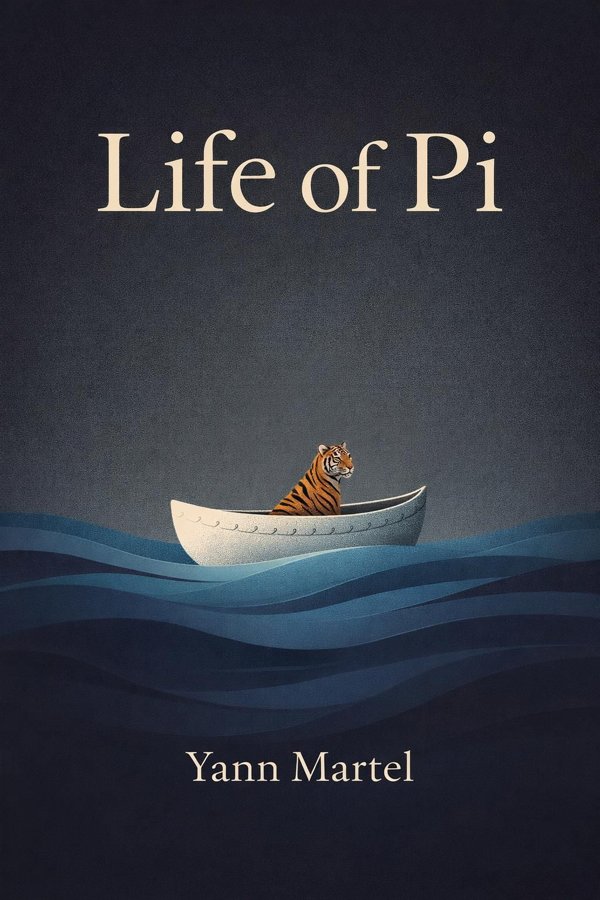
Life Of Pi: Summary & Key Insights
by Yann Martel
 10 min9 chaptersAudio available
Key Takeaways from Life Of Pi
A child’s first world often becomes the map for his deepest beliefs.
Belief becomes more alive when it is pursued with hunger instead of inherited by habit.
Migration often begins as a practical decision and becomes an emotional rupture.
Catastrophe does not create character from nothing; it reveals what habits, beliefs, and instincts were already there.
People often think survival is about strength, but endurance is more often a triumph of routine.
What Is Life Of Pi About?
Life Of Pi by Yann Martel is a classics book spanning 10 pages. Life Of Pi is a rare novel that works at once as a survival adventure, a spiritual meditation, and a challenge to how we decide what is true. First published in 2001, Yann Martel’s Booker Prize-winning novel follows Piscine Molitor Patel, known as Pi, a thoughtful boy raised in Pondicherry, India, where his family owns a zoo. When a cargo ship carrying Pi, his family, and many of the zoo animals sinks in the Pacific, Pi is left stranded on a lifeboat with an injured zebra, a hyena, an orangutan, and eventually a Bengal tiger named Richard Parker. What begins as a gripping story of endurance grows into something deeper: an inquiry into faith, storytelling, suffering, and the human need to find meaning in chaos. Martel writes with philosophical ambition but remarkable accessibility, combining vivid realism with fable-like symbolism. The novel matters because it does not merely ask what happened; it asks why one version of events satisfies us more than another. In doing so, it turns a tale of survival into a profound reflection on belief itself.
This FizzRead summary covers all 9 key chapters of Life Of Pi in approximately 10 minutes, distilling the most important ideas, arguments, and takeaways from Yann Martel's work. Also available as an audio summary and Key Quotes Podcast.
Life Of Pi
Life Of Pi is a rare novel that works at once as a survival adventure, a spiritual meditation, and a challenge to how we decide what is true. First published in 2001, Yann Martel’s Booker Prize-winning novel follows Piscine Molitor Patel, known as Pi, a thoughtful boy raised in Pondicherry, India, where his family owns a zoo. When a cargo ship carrying Pi, his family, and many of the zoo animals sinks in the Pacific, Pi is left stranded on a lifeboat with an injured zebra, a hyena, an orangutan, and eventually a Bengal tiger named Richard Parker. What begins as a gripping story of endurance grows into something deeper: an inquiry into faith, storytelling, suffering, and the human need to find meaning in chaos. Martel writes with philosophical ambition but remarkable accessibility, combining vivid realism with fable-like symbolism. The novel matters because it does not merely ask what happened; it asks why one version of events satisfies us more than another. In doing so, it turns a tale of survival into a profound reflection on belief itself.
Who Should Read Life Of Pi?
This book is perfect for anyone interested in classics and looking to gain actionable insights in a short read. Whether you're a student, professional, or lifelong learner, the key ideas from Life Of Pi by Yann Martel will help you think differently.
- ✓Readers who enjoy classics and want practical takeaways
- ✓Professionals looking to apply new ideas to their work and life
- ✓Anyone who wants the core insights of Life Of Pi in just 10 minutes
Want the full summary?
Get instant access to this book summary and 100K+ more with Fizz Moment.
Get Free SummaryAvailable on App Store • Free to download
Key Chapters
A child’s first world often becomes the map for his deepest beliefs. For Pi Patel, that world is Pondicherry, where his family owns a zoo and daily life unfolds among animals, routines, cages, instincts, and spectacle. This setting is not just colorful background; it shapes Pi’s entire understanding of life. In the zoo, he sees that nature is neither sentimental nor chaotic in the way people imagine. Animals seek territory, food, safety, and rhythm. They are not little humans in fur or feathers, and misunderstanding them can be dangerous. Pi’s father teaches this lesson harshly by showing his sons that a tiger is not a friend but a predator. At the same time, the zoo gives Pi a sense of wonder. He learns to observe closely, to respect difference, and to understand that survival depends on reading reality accurately.
This early education matters because it prepares Pi for the ordeal ahead. The practical knowledge he absorbs about animal behavior later helps him survive beside Richard Parker. Just as important, the zoo teaches him that living beings can adapt to confinement, routines can preserve sanity, and fear must be acknowledged rather than denied.
In ordinary life, we face our own smaller “zoos”: workplaces, families, schools, and social systems with visible and invisible rules. People often suffer because they assume comfort lies in total freedom, when in fact structure, boundaries, and observation often create security.
Actionable takeaway: Pay closer attention to the environments that shape you. Learn their rules, respect their dangers, and use structure not as a prison but as a foundation for resilience.
Belief becomes more alive when it is pursued with hunger instead of inherited by habit. One of the most memorable aspects of Life Of Pi is Pi’s spiritual curiosity. As a boy, he embraces Hinduism, then Christianity, then Islam, not because he is confused, but because he is captivated by different ways of loving God. He is moved by Hinduism’s richness, Christianity’s story of divine sacrifice, and Islam’s disciplined surrender. Adults around him find this contradictory. Pi does not. To him, religious devotion is not a competition between mutually exclusive brands but a sincere attempt to encounter the sacred through multiple languages.
Martel uses Pi’s spiritual life to explore a larger question: must reason and faith be enemies? Pi studies zoology and religion, symbolizing his refusal to choose between scientific observation and spiritual wonder. The novel suggests that a purely literal view of reality can become emotionally barren, while blind belief can become shallow if never tested. Pi’s faith is not simple certainty; it is practiced openness.
This idea applies far beyond religion. In work, relationships, and personal growth, people often assume they must choose one lens only: logic or intuition, discipline or compassion, skepticism or trust. Pi shows that mature understanding can hold tension without collapsing into confusion.
A practical example is how we approach difficult decisions. Data matters, but so do values. Facts tell us what is happening; meaning tells us what to do about it.
Actionable takeaway: Let your worldview grow wider. Instead of defending one narrow perspective, ask what different traditions, disciplines, or experiences might each reveal about the same human truth.
Migration often begins as a practical decision and becomes an emotional rupture. When Pi’s family decides to leave India and move to Canada, the choice is driven by political instability and economic concern. On the surface, it is a sensible transition: a family seeking a safer future. But Martel presents departure as more than relocation. It is the tearing away of identity from place, smell, custom, language, and memory. Pi leaves not only a country but an entire ecosystem of selfhood.
This transition matters because Life Of Pi is deeply concerned with what remains when familiar structures disappear. Before the ship sinks, Pi is already experiencing a subtler form of shipwreck: the loss of home. The zoo animals being transported abroad mirror the family’s own displacement. They too are uprooted, contained, and pushed toward an unknown world. The image is quietly unsettling. Humans like to imagine we are in control of our life transitions, but often we are simply better at naming them.
Many readers can recognize this experience even without crossing oceans. Graduating, changing careers, becoming a parent, losing a loved one, or moving cities all involve a break between the known self and the emerging one. In such moments, we are tempted to believe that uncertainty means failure. Pi’s story suggests otherwise. Uncertainty is often the necessary passage between one life and another.
A practical application is to treat transition periods with more respect. Instead of demanding immediate confidence, create rituals of continuity: keep a journal, maintain a few stable habits, or stay connected to meaningful traditions.
Actionable takeaway: When life forces you into a new chapter, do not expect instant clarity. Carry forward a few grounding practices and let identity rebuild itself gradually.
Catastrophe does not create character from nothing; it reveals what habits, beliefs, and instincts were already there. The shipwreck in Life Of Pi is sudden, terrifying, and irreversible. In one night, Pi loses his family, his security, and the world he thought he understood. The novel does not sentimentalize this event. It is chaotic, brutal, and indifferent. The sea does not care who deserves to live. This emotional honesty gives the story its force.
Yet the shipwreck also marks a turning point from passive identity to active survival. Once on the lifeboat, Pi can no longer live as observer, student, or son. He must become strategist, laborer, guardian, and creature among creatures. Martel shows how extreme crisis reduces life to essentials: water, food, shelter, vigilance, and hope. What previously seemed important disappears. Survival becomes a discipline of attention.
This idea resonates because most people experience smaller versions of shipwreck: sudden illness, job loss, divorce, financial collapse, or public failure. In these moments, abstraction becomes unbearable. You stop asking what sounds impressive and start asking what keeps you alive. The novel reminds us that clarity often arrives through hardship, though at a terrible cost.
A useful practical lesson is crisis preparation. Emotional resilience is easier to admire than to build, but habits matter: learning basic skills, managing panic, keeping emergency resources, and practicing mental flexibility can all make a difference when plans collapse.
Actionable takeaway: Identify your true essentials before crisis forces the question. Know what sustains your body, your mind, and your sense of purpose, so that when disruption comes, you are not starting from zero.
People often think survival is about strength, but endurance is more often a triumph of routine. On the lifeboat, Pi survives not through heroic bursts of courage alone but through careful systems. He gathers rainwater, rations food, studies the sea, secures tools, records observations, and establishes territory with Richard Parker. He learns that fear can either paralyze or organize. His answer is disciplined action.
One of the novel’s most brilliant insights is that imagination is not the opposite of practicality. Pi’s imagination helps him continue living. He improvises methods, reframes terror, and creates mental order in an environment designed to destroy it. He even trains Richard Parker using principles drawn from his zoo upbringing, turning impossible coexistence into a structured relationship. The tiger becomes both mortal threat and strange companion. By forcing Pi outward into constant vigilance, Richard Parker may be one reason Pi does not collapse into despair.
This dynamic has everyday applications. During prolonged stress, people often wait to “feel better” before acting. Pi demonstrates the reverse: meaningful action can create the conditions for emotional survival. A student under pressure, a caregiver managing exhaustion, or a founder facing uncertainty may not control the storm, but can build routines that preserve function and dignity.
Examples include breaking overwhelming problems into daily tasks, creating checklists during emotional overload, and using visible structure to reduce panic. Discipline does not remove suffering, but it gives suffering shape.
Actionable takeaway: When overwhelmed, do not chase motivation first. Build a simple routine around essentials, repeat it consistently, and let disciplined action generate stability.
A human being can starve in spirit long before starving in body. While stranded at sea, Pi does not survive on food and water alone. He prays, remembers, observes beauty, and maintains rituals of thought and devotion. These acts may seem secondary beside the raw mechanics of staying alive, but Martel suggests they are equally vital. Without ritual, Pi risks becoming only an animal reacting to threat. With ritual, he remains a person capable of meaning.
This is one of the novel’s deepest contributions. It refuses the modern assumption that practicality is enough. Pi’s prayers do not rescue him from the ocean, but they help him endure it without surrendering inner coherence. Ritual provides rhythm, and rhythm resists chaos. Whether religious or secular, repeated acts can protect identity during periods of extreme disorder.
Most readers know this instinctively. In grief, people light candles, attend services, walk familiar routes, cook inherited meals, or repeat words that anchor them. In times of stress, athletes rely on pre-performance habits, writers keep morning pages, and families preserve bedtime routines for children. These actions are powerful not because they solve every external problem but because they signal continuity when life feels shattered.
Martel also links ritual to attention. Pi notices the sea, the sky, the creatures around him. Awe becomes part of survival. Even in terror, beauty interrupts despair.
Actionable takeaway: Create small daily rituals that protect your inner life. Whether through prayer, journaling, exercise, reflection, or gratitude, repeat practices that remind you who you are when circumstances try to erase you.
Nature is most humbling when it refuses to fit our emotional needs. Throughout Pi’s ordeal, the Pacific is both magnificent and merciless. He encounters dazzling skies, luminous waters, flying fish, whales, storms, hunger, blindness, and near madness. The sea is not simply a backdrop; it is an active force that exposes the fragility of human control. Martel’s descriptions remind us that beauty and danger often arrive together.
This matters because many stories divide the world into comfort and threat, but Life Of Pi presents reality as mixed. The same ocean that offers rainwater also threatens to drown. The same animal that gives Pi purpose may kill him. The same imagination that sustains hope may blur into hallucination. Such complexity is psychologically honest. Human life is rarely one thing at a time.
A striking example is Pi’s encounter with the carnivorous island, a place that seems like miraculous salvation before revealing itself as deadly. The island functions as allegory as well as plot device. Not every refuge is safe. Some comforts consume us slowly. In modern terms, this could mean addictive habits, numbing distractions, shallow success, or environments that shelter us from growth while eroding vitality.
The practical application is discernment. We should not reject beauty because it is dangerous, nor trust safety simply because it feels pleasant. Mature living requires us to ask deeper questions: What is this environment doing to me over time? What looks nourishing but is actually corrosive?
Actionable takeaway: Practice holding two truths at once. Learn to appreciate beauty without becoming naive, and to recognize danger without losing your capacity for wonder.
Facts matter, but stories determine how facts live inside us. The final section of Life Of Pi transforms the novel from an extraordinary survival tale into a meditation on narrative itself. When Japanese officials investigate the sinking, Pi offers them two versions of events: the animal story readers have followed, and a second, starkly human story stripped of animals and wonder. Both account for the wreck. One is unbearable in its brutality; the other is mysterious, symbolic, and strangely redemptive. Pi then asks which story they prefer.
This question is the heart of the novel. Martel is not simply asking whether the tiger was real. He is asking why human beings choose certain narratives, and whether meaning depends only on literal verification. The “better story” is not merely prettier; it may be the form in which truth becomes emotionally survivable. Story, in this sense, is not falsehood but arrangement. It gives suffering shape, sequence, and significance.
This insight applies to personal life. People constantly narrate themselves: I failed, I was betrayed, I survived, I learned, I became stronger. The events may be fixed, but their meaning is not. A destructive story traps us in shame or cynicism. A wiser story does not deny pain; it frames pain within endurance, responsibility, and possibility.
This does not justify dishonesty. Rather, it challenges us to notice that all memory involves interpretation. The question is not whether we tell stories, but whether the stories we tell deepen truth or flatten it.
Actionable takeaway: Revisit the stories you tell about your life. Ask whether they merely replay pain, or whether they help you carry reality with courage, humility, and meaning.
In the end, Life Of Pi argues that belief is not only religious; it is existential. The novel closes on a provocative insight: when faced with competing explanations, people often choose not the one that is easiest to prove but the one that best reflects how they wish to inhabit the world. The officials choose the animal story because it is the better story. By extension, the reader must also choose. This is not a trick ending; it is a test of imagination, trust, and philosophical temperament.
Martel’s point is subtle. He does not say truth is irrelevant or that all stories are equal. He suggests that human beings live by acts of interpretation. Science explains mechanisms, but it does not exhaust meaning. Literal accuracy may satisfy the mind, while symbolic truth may nourish the soul. Pi’s story invites readers to ask what kind of world they are willing to live in: one reduced to brutality, or one in which suffering can be transformed through wonder, faith, and narrative.
In daily life, this choice appears constantly. Do you interpret setbacks as proof that life is hostile, or as difficult chapters in a larger journey? Do you view people only through suspicion, or allow room for mercy? Do you reduce yourself to your worst moments, or believe in the possibility of redemption?
Belief, then, is not passive assent. It is a discipline of choosing frameworks that make moral and emotional life possible.
Actionable takeaway: Notice the interpretive choices you make every day. Choose beliefs that remain honest about pain but expand your capacity for hope, compassion, and meaning.
All Chapters in Life Of Pi
About the Author
Yann Martel is a Canadian author born in 1963 in Salamanca, Spain, to Canadian diplomat parents. Because of his family’s international life, he spent parts of his childhood in countries across Europe, North America, and Central America, experiences that helped shape his broad cultural outlook. He studied philosophy at Trent University, an influence visible in the intellectual and spiritual questions woven through his fiction. Martel achieved international recognition with Life Of Pi, published in 2001, which won the 2002 Man Booker Prize and became a global bestseller. His other works include Beatrice and Virgil, The Facts Behind the Helsinki Roccamatios, and The High Mountains of Portugal. Martel is known for combining fable, allegory, and philosophical inquiry with emotionally compelling storytelling.
Get This Summary in Your Preferred Format
Read or listen to the Life Of Pi summary by Yann Martel anytime, anywhere. FizzRead offers multiple formats so you can learn on your terms — all free.
Available formats: App · Audio · PDF · EPUB — All included free with FizzRead
Download Life Of Pi PDF and EPUB Summary
Key Quotes from Life Of Pi
“A child’s first world often becomes the map for his deepest beliefs.”
“Belief becomes more alive when it is pursued with hunger instead of inherited by habit.”
“Migration often begins as a practical decision and becomes an emotional rupture.”
“Catastrophe does not create character from nothing; it reveals what habits, beliefs, and instincts were already there.”
“People often think survival is about strength, but endurance is more often a triumph of routine.”
Frequently Asked Questions about Life Of Pi
Life Of Pi by Yann Martel is a classics book that explores key ideas across 9 chapters. Life Of Pi is a rare novel that works at once as a survival adventure, a spiritual meditation, and a challenge to how we decide what is true. First published in 2001, Yann Martel’s Booker Prize-winning novel follows Piscine Molitor Patel, known as Pi, a thoughtful boy raised in Pondicherry, India, where his family owns a zoo. When a cargo ship carrying Pi, his family, and many of the zoo animals sinks in the Pacific, Pi is left stranded on a lifeboat with an injured zebra, a hyena, an orangutan, and eventually a Bengal tiger named Richard Parker. What begins as a gripping story of endurance grows into something deeper: an inquiry into faith, storytelling, suffering, and the human need to find meaning in chaos. Martel writes with philosophical ambition but remarkable accessibility, combining vivid realism with fable-like symbolism. The novel matters because it does not merely ask what happened; it asks why one version of events satisfies us more than another. In doing so, it turns a tale of survival into a profound reflection on belief itself.
You Might Also Like






Browse by Category
Ready to read Life Of Pi?
Get the full summary and 100K+ more books with Fizz Moment.