
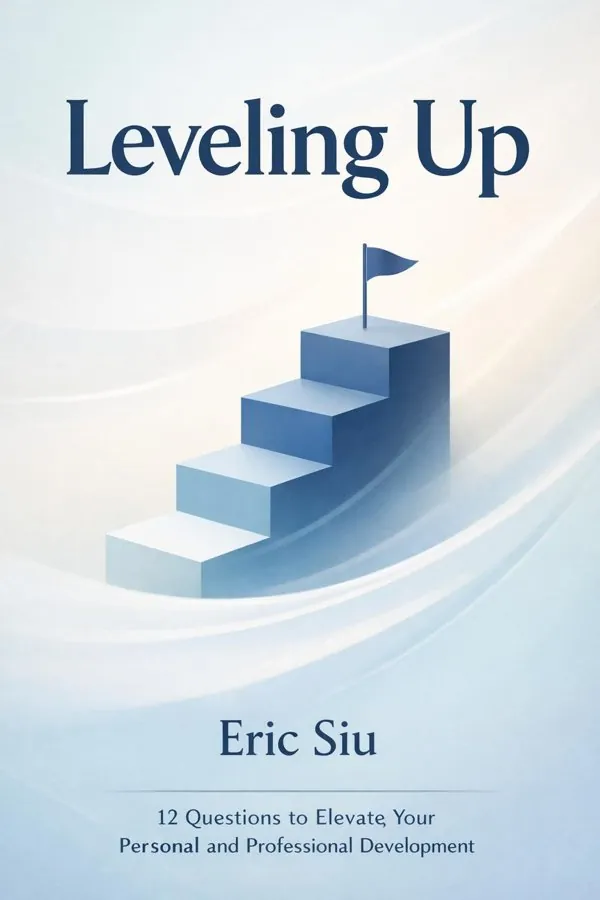
Leveling Up: 12 Questions to Elevate Your Personal and Professional Development: Summary & Key Insights
by Eric Siu
 10 min9 chaptersAudio available
Key Takeaways from Leveling Up: 12 Questions to Elevate Your Personal and Professional Development
The game is often decided before the first move, and Siu begins with the idea that mindset shapes every other result.
Ambition without direction is just motion, and Siu argues that vision functions like the map for your life.
Your life is not built by dramatic breakthroughs alone; it is constructed by repeated behaviors that eventually become automatic.
In a world where industries shift quickly and knowledge expires fast, the ability to learn may be the most durable advantage you can own.
Siu highlights relationships as a decisive force in both personal and professional development because growth is often social before it becomes visible.
What Is Leveling Up: 12 Questions to Elevate Your Personal and Professional Development About?
Leveling Up: 12 Questions to Elevate Your Personal and Professional Development by Eric Siu is a entrepreneurship book spanning 12 pages. What if personal growth worked less like a straight ladder and more like a game, with levels, setbacks, upgrades, and boss battles? In Leveling Up, entrepreneur and marketer Eric Siu uses that powerful metaphor to make self-improvement feel concrete, strategic, and surprisingly motivating. Rather than offering vague inspiration, he organizes growth around 12 essential questions that challenge readers to examine how they think, work, relate, create, and contribute. The result is a practical framework for building a stronger life and career one deliberate upgrade at a time. The book matters because many people want success but lack a system for developing it. Siu argues that progress does not come from random hustle alone; it comes from cultivating the inner and outer skills that make sustained achievement possible. His perspective carries weight because he has built businesses, led teams, invested in learning, and spent years studying performance in entrepreneurship and life. As the founder of Single Grain and host of influential business podcasts, Siu blends startup urgency with long-term wisdom. Leveling Up is especially useful for ambitious readers who want a more disciplined, purposeful, and resilient approach to personal and professional development.
This FizzRead summary covers all 9 key chapters of Leveling Up: 12 Questions to Elevate Your Personal and Professional Development in approximately 10 minutes, distilling the most important ideas, arguments, and takeaways from Eric Siu's work. Also available as an audio summary and Key Quotes Podcast.
Leveling Up: 12 Questions to Elevate Your Personal and Professional Development
What if personal growth worked less like a straight ladder and more like a game, with levels, setbacks, upgrades, and boss battles? In Leveling Up, entrepreneur and marketer Eric Siu uses that powerful metaphor to make self-improvement feel concrete, strategic, and surprisingly motivating. Rather than offering vague inspiration, he organizes growth around 12 essential questions that challenge readers to examine how they think, work, relate, create, and contribute. The result is a practical framework for building a stronger life and career one deliberate upgrade at a time.
The book matters because many people want success but lack a system for developing it. Siu argues that progress does not come from random hustle alone; it comes from cultivating the inner and outer skills that make sustained achievement possible. His perspective carries weight because he has built businesses, led teams, invested in learning, and spent years studying performance in entrepreneurship and life. As the founder of Single Grain and host of influential business podcasts, Siu blends startup urgency with long-term wisdom. Leveling Up is especially useful for ambitious readers who want a more disciplined, purposeful, and resilient approach to personal and professional development.
Who Should Read Leveling Up: 12 Questions to Elevate Your Personal and Professional Development?
This book is perfect for anyone interested in entrepreneurship and looking to gain actionable insights in a short read. Whether you're a student, professional, or lifelong learner, the key ideas from Leveling Up: 12 Questions to Elevate Your Personal and Professional Development by Eric Siu will help you think differently.
- ✓Readers who enjoy entrepreneurship and want practical takeaways
- ✓Professionals looking to apply new ideas to their work and life
- ✓Anyone who wants the core insights of Leveling Up: 12 Questions to Elevate Your Personal and Professional Development in just 10 minutes
Want the full summary?
Get instant access to this book summary and 100K+ more with Fizz Moment.
Get Free SummaryAvailable on App Store • Free to download
Key Chapters
The game is often decided before the first move, and Siu begins with the idea that mindset shapes every other result. In both gaming and life, two people can face the same obstacle and respond in completely different ways. One interprets difficulty as proof that they are not good enough. The other sees it as feedback, a sign that they have reached the next level of growth. That difference in interpretation changes behavior, persistence, confidence, and eventually outcomes.
Siu emphasizes that a growth-oriented mindset does not mean blind positivity. It means training yourself to view problems as playable challenges rather than permanent verdicts. In business, a failed launch can become market data. In a career, rejection can become sharpening. In relationships, conflict can become a chance to improve communication. The point is not to romanticize hardship, but to make hardship useful.
This mindset also affects identity. If you see yourself as someone who can learn, adapt, and improve, you will take more intelligent risks. You stop asking, “What if I fail?” and begin asking, “What will this teach me?” That subtle shift expands your range. Entrepreneurs need this especially badly, because uncertainty is built into the path. Every founder, manager, and creator eventually encounters losing streaks. The winners are not those who avoid setbacks, but those who recover quickly and keep iterating.
A practical way to apply this principle is to audit your self-talk. Notice whether you describe challenges with words like impossible, unfair, or hopeless, or whether you frame them as difficult, temporary, and solvable. Build rituals that reinforce resilience: journaling lessons after mistakes, reviewing wins weekly, and surrounding yourself with people who normalize growth.
Actionable takeaway: When something goes wrong this week, write down three interpretations of the event, then choose the one that turns the setback into a lesson and a next move.
Ambition without direction is just motion, and Siu argues that vision functions like the map for your life. Many people work hard, stay busy, and even achieve small wins, yet still feel scattered because they have not defined where they are trying to go. Vision turns activity into aligned progress. It helps you decide which missions matter, which distractions to ignore, and what kind of person you are becoming along the way.
In the book, vision is not merely a lofty dream board. It is a practical answer to questions such as: What am I building? Why does it matter? What does success look like in one year, five years, and beyond? For entrepreneurs, this may mean defining the business impact they want to create, the market they want to serve, and the kind of culture they want to build. For professionals, it may involve clarifying whether they want leadership, autonomy, creative mastery, financial freedom, or some combination of all four.
A clear vision also becomes a filter. Opportunities that once seemed exciting may no longer fit. You become better at saying no to projects, partnerships, and habits that pull you away from your chosen path. This is crucial because modern life rewards responsiveness, but real growth often requires selectivity. Vision prevents you from playing everyone else’s game.
Siu’s gaming metaphor makes the concept memorable: if you do not know the objective, every side quest can become a trap. You can spend years collecting points that do not matter. The discipline of vision keeps your daily actions connected to your bigger purpose.
To apply this, write a short personal vision statement covering impact, lifestyle, relationships, and growth. Revisit it monthly. Translate it into measurable goals and calendar commitments. If your schedule does not reflect your vision, your vision is still only a wish.
Actionable takeaway: Create a one-page “game map” for the next 12 months with your top three priorities, your reasons for pursuing them, and the habits that will move them forward.
In a world where industries shift quickly and knowledge expires fast, the ability to learn may be the most durable advantage you can own. Siu argues that high performers treat learning as a lifelong upgrade path, not a phase that ends with school. The best players keep studying the game. They analyze mistakes, absorb new strategies, and remain humble enough to evolve.
This principle matters especially in entrepreneurship, where markets, tools, and consumer behaviors change constantly. A founder who stops learning becomes dependent on old wins. A professional who stops learning becomes vulnerable to irrelevance. Siu’s point is simple but powerful: if you want outsized results, become the kind of person who can continuously update your thinking.
Learning here goes beyond passive consumption. Reading books, listening to podcasts, and taking courses are useful, but Siu’s larger message is about applied learning. Knowledge only becomes valuable when tested in action. If you study marketing, launch campaigns. If you study leadership, practice feedback and delegation. If you study negotiation, use it in real conversations. Experience turns information into skill.
Another key insight is that learning should be strategic. Not every piece of information deserves your attention. Focus on skills that produce leverage: communication, sales, decision-making, systems thinking, hiring, and emotional intelligence. These areas improve performance across many domains. Learning compounds best when it is both broad enough to transfer and deep enough to sharpen you.
A useful method is to create a personal curriculum. Decide what capabilities matter most in your current season, then structure deliberate practice around them. Seek mentors, review failures, and ask better questions. Curiosity is not enough by itself; it needs discipline.
Actionable takeaway: Pick one high-leverage skill to improve this quarter, define how you will study it, and schedule one real-world application every week so learning becomes capability rather than trivia.
No one truly levels up alone. Siu highlights relationships as a decisive force in both personal and professional development because growth is often social before it becomes visible. The people around you influence your standards, your emotional resilience, your opportunities, and even your sense of what is possible. In practical terms, your network is not just a contact list; it is an ecosystem that can either elevate or drain you.
Siu’s approach goes deeper than transactional networking. He emphasizes trust, generosity, and mutual value. Strong relationships are built over time through consistency, listening, contribution, and credibility. If you only reach out when you need something, people feel used. But when you invest in others without immediate expectation, you build goodwill that often opens doors organically.
This matters in business because partnerships, referrals, hiring, fundraising, and customer loyalty are all relationship-driven. It matters in life because emotional support, honest feedback, and shared growth make the journey more sustainable. A talented person with poor relationships often plateaus. A solid performer with a strong network can access better information, better opportunities, and better momentum.
Siu also points toward an uncomfortable truth: some relationships need boundaries. If certain people repeatedly normalize cynicism, distraction, or self-sabotage, staying close to them carries a cost. Leveling up sometimes means changing your social environment so your future is not held hostage by your past.
Practically, this can look like scheduling regular check-ins with mentors, giving public credit to collaborators, helping peers solve problems, and being intentional about community. Join rooms where people challenge you. Be the kind of person worth recommending.
Actionable takeaway: Identify five relationships that matter to your growth, then take one concrete step this week to strengthen each one through gratitude, support, follow-up, or a meaningful conversation.
Many people chase success while neglecting the very resources that make success possible. Siu connects health, wealth, and creativity as essential forms of capacity. If your body is depleted, your decision-making suffers. If your finances are chaotic, your freedom narrows. If your creativity is neglected, your problem-solving becomes stale. These are not side categories; they are core systems that support sustained performance.
Health is foundational because energy drives execution. Sleep, exercise, nutrition, and recovery may seem basic, but they directly affect focus, emotional regulation, and resilience. Entrepreneurs often glorify burnout, yet chronic exhaustion quietly destroys judgment. Siu’s framework encourages readers to see physical health not as vanity or luxury, but as strategic maintenance for a long game.
Wealth, in this context, is not just about accumulating money. It is about creating optionality. Savings, investments, and disciplined spending give you the ability to weather uncertainty, take calculated risks, and avoid making desperate choices. Financial intelligence is a form of freedom. It allows you to play a better game instead of merely surviving the current round.
Creativity ties these together because it is how you adapt, innovate, and find non-obvious solutions. Creativity is not reserved for artists. Founders use it to build products, leaders use it to solve team problems, and individuals use it to redesign their lives. It grows when you expose yourself to different ideas, create space for reflection, and make time for experimentation.
The deeper point is balance through integration. If one of these areas is collapsing, the others become harder to sustain. A healthy body supports creative thought. Financial stability reduces mental noise. Creative thinking improves how you generate value.
Actionable takeaway: Run a three-part audit of your energy, money, and idea flow, then make one upgrade in each area this month: one health routine, one financial habit, and one weekly creative practice.
Most meaningful goals take longer, cost more, and challenge you more deeply than expected. Siu’s emphasis on persistence recognizes that talent and strategy matter, but staying in the game long enough to improve often matters more. Persistence is not stubbornly repeating the same mistake. It is the willingness to keep moving while adjusting your approach.
This distinction is crucial. Some people quit too early and call it realism. Others refuse to change and call it grit. Siu pushes for adaptive persistence: learn, refine, continue. In a startup, this may mean testing multiple offers before finding product-market fit. In a career, it could mean applying for many roles while improving your skills and positioning. In personal growth, it may mean returning to a discipline after breaking consistency instead of concluding that you lack discipline altogether.
Failure plays an important role in this model. Siu reframes failure as one of the game’s built-in mechanics. You do not avoid it; you use it. Every failed attempt reveals something: weak assumptions, missing skills, timing problems, blind spots, or poor execution. Persistence ensures those lessons do not go to waste.
The emotional side matters too. Persistence requires managing discouragement, boredom, and ego. Progress is often uneven. You can work hard and still feel behind. This is where systems, perspective, and supportive relationships become essential. They help you survive the valley between effort and visible reward.
To practice persistence effectively, create review loops. After each setback, ask: What worked? What failed? What will I change next time? That process transforms disappointment into data. Over months and years, this becomes a major advantage because many competitors disappear before the compounding shows up.
Actionable takeaway: Choose one area where you have been tempted to quit, define the next experiment instead of the final outcome, and commit to three more informed attempts before reevaluating.
Achievement alone rarely satisfies for long. Siu broadens the conversation beyond performance by exploring contribution and spirituality as higher levels of development. Once people gain competence, income, or recognition, they often discover that external success does not automatically produce inner fulfillment. Meaning comes from connecting your growth to something larger than yourself.
Contribution is the outward expression of this insight. It asks: Who benefits from my work? How am I making other people better? In business, contribution may mean creating jobs, solving painful problems, mentoring others, or building products that genuinely improve lives. In personal life, it can look like service, generosity, presence, and using your experience to help someone else advance. Contribution transforms success from self-centered accumulation into value creation.
Spirituality, as Siu presents it, need not be limited to formal religion. It can refer to a deeper sense of alignment, reflection, humility, and connection to purpose. It is the dimension that helps people stay grounded when ambition intensifies. Without it, success can inflate ego or leave a person feeling strangely empty. With it, goals become anchored in values.
These themes matter because they protect against common traps: chasing status, comparing endlessly, and sacrificing what matters most in pursuit of what looks impressive. Contribution and spirituality remind readers that a well-leveled life is not merely productive, but meaningful. They invite a different question: not just “How far can I go?” but “What kind of impact do I want my life to have?”
A practical application is to build regular reflection into your schedule. Ask whether your work aligns with your values, where you can serve more intentionally, and what you want your success to stand for.
Actionable takeaway: Set aside 20 minutes this week to write a personal impact statement describing who you want to help, how you want to help them, and the values you refuse to compromise.
Mastery is not a finish line you cross once; it is a way of engaging with life. Siu closes his framework by showing that true leveling up is continuous. Every breakthrough reveals a new layer of complexity, responsibility, and possibility. The goal is not perfection. The goal is sustained refinement of your character, skills, and contribution over time.
This perspective is liberating because it removes the fantasy of arrival. Many people postpone satisfaction until they reach some imagined final level: a revenue milestone, a title, a lifestyle target, a public identity. But those achievements do not end the game. Mastery means embracing the process itself. You become someone who enjoys improvement, seeks feedback, and respects the discipline required to stay sharp.
Siu’s model suggests that mastery integrates all the earlier questions. Mindset keeps you open. Vision keeps you directed. Habits create consistency. Learning expands capacity. Relationships multiply opportunity. Health and wealth support sustainability. Creativity fuels adaptation. Persistence carries you through resistance. Contribution and spirituality add meaning. Mastery is what happens when these dimensions stop competing and start working together.
In practical life, this means regularly updating your standards. What worked at one stage may be insufficient at the next. A founder must evolve from doer to leader. A specialist must grow into a strategist. A high achiever must mature into someone who can build others. Mastery demands reinvention without losing core values.
One useful practice is seasonal review. Every quarter, assess what level you are on now, what this level requires, and what skills or mindset upgrades are needed. This keeps growth intentional rather than accidental.
Actionable takeaway: At the end of each month, ask yourself one question: “What does the next version of me need to do consistently that the current version still avoids?” Then design one behavior around the answer.
All Chapters in Leveling Up: 12 Questions to Elevate Your Personal and Professional Development
About the Author
Eric Siu is an American entrepreneur, marketing strategist, investor, and content creator best known for his work in digital growth and business education. He is the founder and CEO of Single Grain, a digital marketing agency that has helped companies scale through SEO, paid media, and content strategy. Siu is also widely recognized as the co-host of the popular Marketing School podcast with Neil Patel, where he shares concise lessons on marketing and entrepreneurship. Through his own Leveling Up podcast and writing, he explores leadership, personal development, and long-term success. His perspective combines startup experience, disciplined learning, and a strong belief in continuous improvement, making him a credible guide for readers seeking practical ways to grow in business and life.
Get This Summary in Your Preferred Format
Read or listen to the Leveling Up: 12 Questions to Elevate Your Personal and Professional Development summary by Eric Siu anytime, anywhere. FizzRead offers multiple formats so you can learn on your terms — all free.
Available formats: App · Audio · PDF · EPUB — All included free with FizzRead
Download Leveling Up: 12 Questions to Elevate Your Personal and Professional Development PDF and EPUB Summary
Key Quotes from Leveling Up: 12 Questions to Elevate Your Personal and Professional Development
“The game is often decided before the first move, and Siu begins with the idea that mindset shapes every other result.”
“Ambition without direction is just motion, and Siu argues that vision functions like the map for your life.”
“Your life is not built by dramatic breakthroughs alone; it is constructed by repeated behaviors that eventually become automatic.”
“In a world where industries shift quickly and knowledge expires fast, the ability to learn may be the most durable advantage you can own.”
“Siu highlights relationships as a decisive force in both personal and professional development because growth is often social before it becomes visible.”
Frequently Asked Questions about Leveling Up: 12 Questions to Elevate Your Personal and Professional Development
Leveling Up: 12 Questions to Elevate Your Personal and Professional Development by Eric Siu is a entrepreneurship book that explores key ideas across 9 chapters. What if personal growth worked less like a straight ladder and more like a game, with levels, setbacks, upgrades, and boss battles? In Leveling Up, entrepreneur and marketer Eric Siu uses that powerful metaphor to make self-improvement feel concrete, strategic, and surprisingly motivating. Rather than offering vague inspiration, he organizes growth around 12 essential questions that challenge readers to examine how they think, work, relate, create, and contribute. The result is a practical framework for building a stronger life and career one deliberate upgrade at a time. The book matters because many people want success but lack a system for developing it. Siu argues that progress does not come from random hustle alone; it comes from cultivating the inner and outer skills that make sustained achievement possible. His perspective carries weight because he has built businesses, led teams, invested in learning, and spent years studying performance in entrepreneurship and life. As the founder of Single Grain and host of influential business podcasts, Siu blends startup urgency with long-term wisdom. Leveling Up is especially useful for ambitious readers who want a more disciplined, purposeful, and resilient approach to personal and professional development.
You Might Also Like
Lean Analytics
Alistair Croll, Benjamin Yoskovitz
10 min
21 Days To A Big Idea: Creating Breakthrough Business Concepts
Bryan Mattimore
10 min
Sam Walton: Made in America: My Story
Sam Walton
10 min
10x Is Easier Than 2x: How World-Class Entrepreneurs Achieve More by Doing Less
Dan Sullivan, Benjamin Hardy
10 min
12 Months to $1 Million: How to Pick a Winning Product, Build a Real Business, and Become a Seven-Figure Entrepreneur
Ryan Daniel Moran
10 min
24 Assets: Create a Digital, Scalable, Valuable Business
Daniel Priestley
10 minBrowse by Category
Ready to read Leveling Up: 12 Questions to Elevate Your Personal and Professional Development?
Get the full summary and 100K+ more books with Fizz Moment.