
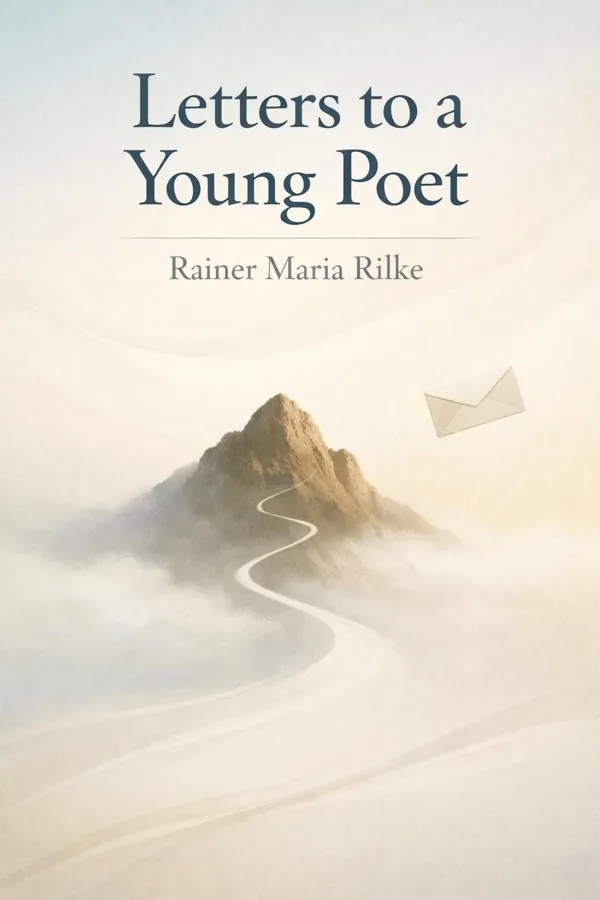
Letters to a Young Poet: Summary & Key Insights
 10 min4 chaptersAudio available
What Is Letters to a Young Poet About?
Letters to a Young Poet by Rainer Maria Rilke is a classics book spanning 4 pages. Letters to a Young Poet is a collection of ten letters written by Rainer Maria Rilke between 1903 and 1908 to Franz Xaver Kappus, a young officer cadet seeking advice on becoming a poet. In these letters, Rilke offers profound reflections on creativity, solitude, love, and the inner life of an artist. The work has become a timeless guide for writers and thinkers, celebrated for its lyrical insight and philosophical depth.
This FizzRead summary covers all 4 key chapters of Letters to a Young Poet in approximately 10 minutes, distilling the most important ideas, arguments, and takeaways from Rainer Maria Rilke's work. Also available as an audio summary and Key Quotes Podcast.
Letters to a Young Poet
Letters to a Young Poet is a collection of ten letters written by Rainer Maria Rilke between 1903 and 1908 to Franz Xaver Kappus, a young officer cadet seeking advice on becoming a poet. In these letters, Rilke offers profound reflections on creativity, solitude, love, and the inner life of an artist. The work has become a timeless guide for writers and thinkers, celebrated for its lyrical insight and philosophical depth.
Who Should Read Letters to a Young Poet?
This book is perfect for anyone interested in classics and looking to gain actionable insights in a short read. Whether you're a student, professional, or lifelong learner, the key ideas from Letters to a Young Poet by Rainer Maria Rilke will help you think differently.
- ✓Readers who enjoy classics and want practical takeaways
- ✓Professionals looking to apply new ideas to their work and life
- ✓Anyone who wants the core insights of Letters to a Young Poet in just 10 minutes
Want the full summary?
Get instant access to this book summary and 100K+ more with Fizz Moment.
Get Free SummaryAvailable on App Store • Free to download
Key Chapters
When I replied to Kappus’s first letter, my words were simple yet radical. I told him not to look to others for judgment, not to send his verses to critics for approval, not even to seek my own opinion. I urged him to turn inward, to ask himself whether he must write. This question—‘must I?’—is the only one that matters for an artist. If you feel compelled with such force that you cannot imagine living otherwise, then your calling is true. If not, refrain from writing; your life will offer other forms of expression.
I wanted him to see that creative necessity cannot come from ambition or from the wish to be admired. The world’s opinion is irrelevant. Genuine creation arises from the deepest necessity of the soul. When you write, you must write as if no one would ever read it, as if it were a natural act—like breathing, like praying. It must be born of that pure solitude where no measure exists but truth.
This inward turning is painful at first, because it requires stillness. We are accustomed to mirrors—others who reflect our worth to us. Yet art demands that we turn away from those reflections. Only in the silence of being alone with oneself does one begin to hear the inner voice that speaks without sound. There, we encounter the inner sources from which all art and meaning flow.
I wrote to Kappus that an artist must build his whole life on this inwardness, must find that any external circumstance, even loneliness or failure, can serve as soil for his growth. One must learn to love solitude, not as isolation but as a temple in which life’s mysteries slowly reveal themselves. In this silence, we find not answers but depth, not security but authenticity.
If you are to create, begin by asking yourself—not whether your art pleases anyone—but whether you are honest. The destiny of the poet is not to be understood; it is to be true to what he feels. Everything external distracts; only by looking inward does one find the pulse of being that gives birth to creation.
Solitude, I told Kappus, is not something to be feared. In our time, many flee from it, mistaking loneliness for emptiness. But solitude is the space in which the soul breathes freely. It is necessary not only for art but for life itself. Without solitude, no one can enter truly into themselves, and without that depth of self, there can be no creation.
In solitude we learn to bear ourselves, to meet what is dark and unresolved within us. This is not an easy task; it requires courage to stand before the silence where no comfort is given. Yet in that silence we begin to hear the language of our own existence. Only there do we recognize what we truly love and what we must become.
I advised Kappus to embrace his solitude as a gift—to cultivate it as a garden. In solitude we can experience the fullness of life, unmediated by other people’s thoughts. What appears barren to the world is, to the inward soul, fertile ground. When you are alone, even the seemingly smallest things—the movement of shadows, the whisper of wind—become immense. They speak directly to the imagination, awakening a sense of connection to all that is.
To live creatively is to live with solitude as one’s companion. It teaches patience, humility, and trust. It strips away illusions so that only what is essential remains. I told Kappus not to fear solitude’s severity; its seeming harshness is only the shell that protects its sacred interior. There, you will find your truth and your voice. Without solitude, the soul remains scattered among the noise of the world. With it, your inner life grows strong enough to bear both joy and sorrow.
+ 2 more chapters — available in the FizzRead app
All Chapters in Letters to a Young Poet
About the Author
Rainer Maria Rilke (1875–1926) was an Austrian poet and novelist, widely regarded as one of the most significant figures in modern literature. His works, including the Duino Elegies and the Sonnets to Orpheus, explore themes of spirituality, transformation, and the human condition through a deeply introspective and symbolic style.
Get This Summary in Your Preferred Format
Read or listen to the Letters to a Young Poet summary by Rainer Maria Rilke anytime, anywhere. FizzRead offers multiple formats so you can learn on your terms — all free.
Available formats: App · Audio · PDF · EPUB — All included free with FizzRead
Download Letters to a Young Poet PDF and EPUB Summary
Key Quotes from Letters to a Young Poet
“When I replied to Kappus’s first letter, my words were simple yet radical.”
“Solitude, I told Kappus, is not something to be feared.”
Frequently Asked Questions about Letters to a Young Poet
Letters to a Young Poet by Rainer Maria Rilke is a classics book that explores key ideas across 4 chapters. Letters to a Young Poet is a collection of ten letters written by Rainer Maria Rilke between 1903 and 1908 to Franz Xaver Kappus, a young officer cadet seeking advice on becoming a poet. In these letters, Rilke offers profound reflections on creativity, solitude, love, and the inner life of an artist. The work has become a timeless guide for writers and thinkers, celebrated for its lyrical insight and philosophical depth.
You Might Also Like
Browse by Category
Ready to read Letters to a Young Poet?
Get the full summary and 100K+ more books with Fizz Moment.