
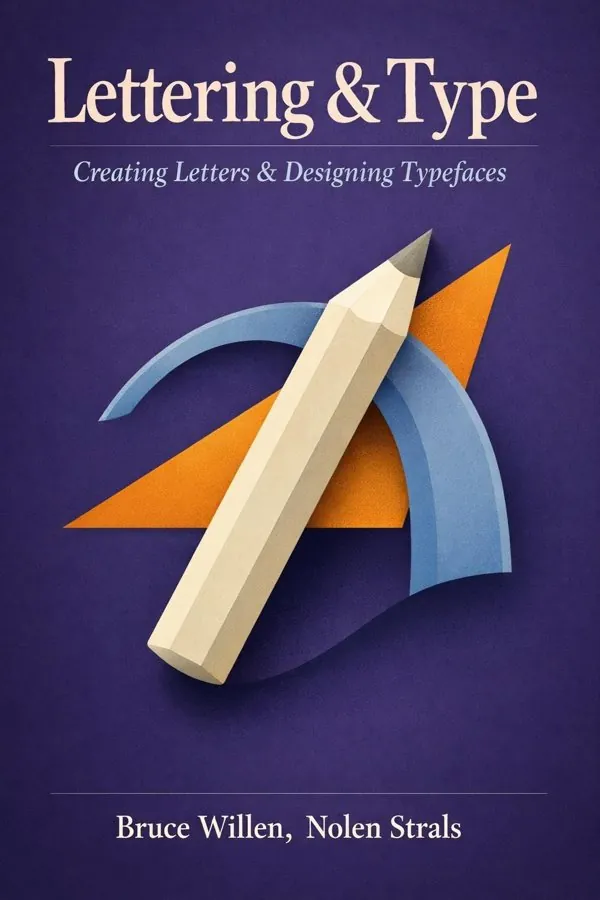
Lettering & Type: Creating Letters & Designing Typefaces: Summary & Key Insights
 10 min4 chaptersAudio available
What Is Lettering & Type: Creating Letters & Designing Typefaces About?
Lettering & Type: Creating Letters & Designing Typefaces by Bruce Willen, Nolen Strals is a design book spanning 4 pages. Lettering & Type es una guía práctica e inspiradora sobre cómo crear y diseñar tipos de letra originales. Los autores, Bruce Willen y Nolen Strals, exploran los fundamentos del diseño tipográfico, la historia de las letras y las técnicas para desarrollar estilos personalizados. El libro combina teoría y práctica, ofreciendo ejemplos visuales y consejos útiles para diseñadores gráficos y tipógrafos que buscan ir más allá de las fuentes existentes.
This FizzRead summary covers all 4 key chapters of Lettering & Type: Creating Letters & Designing Typefaces in approximately 10 minutes, distilling the most important ideas, arguments, and takeaways from Bruce Willen, Nolen Strals's work. Also available as an audio summary and Key Quotes Podcast.
Lettering & Type: Creating Letters & Designing Typefaces
Lettering & Type es una guía práctica e inspiradora sobre cómo crear y diseñar tipos de letra originales. Los autores, Bruce Willen y Nolen Strals, exploran los fundamentos del diseño tipográfico, la historia de las letras y las técnicas para desarrollar estilos personalizados. El libro combina teoría y práctica, ofreciendo ejemplos visuales y consejos útiles para diseñadores gráficos y tipógrafos que buscan ir más allá de las fuentes existentes.
Who Should Read Lettering & Type: Creating Letters & Designing Typefaces?
This book is perfect for anyone interested in design and looking to gain actionable insights in a short read. Whether you're a student, professional, or lifelong learner, the key ideas from Lettering & Type: Creating Letters & Designing Typefaces by Bruce Willen, Nolen Strals will help you think differently.
- ✓Readers who enjoy design and want practical takeaways
- ✓Professionals looking to apply new ideas to their work and life
- ✓Anyone who wants the core insights of Lettering & Type: Creating Letters & Designing Typefaces in just 10 minutes
Want the full summary?
Get instant access to this book summary and 100K+ more with Fizz Moment.
Get Free SummaryAvailable on App Store • Free to download
Key Chapters
One of the earliest distinctions we make in the book is between lettering, typefaces, and typography. The terms are often used interchangeably in the design world, yet each represents a unique discipline. Lettering is drawing letters—custom forms designed for a specific use, such as a logo or a poster. Every stroke is a deliberate, singular decision. Typefaces, in contrast, are systems: sets of letters designed to work together across countless texts and contexts. Typography then is the art of using those systems: arranging and manipulating type to communicate meaning.
Understanding these distinctions changes the way you approach design. When you create lettering, you’re telling a one-time story. When you design a typeface, you’re inventing a language. Typography is how that language is spoken in the world. Each discipline requires sensitivity to form, balance, and rhythm—but the scope of your decisions shifts. Our goal is to help you approach each one with the right mindset, appreciating their shared DNA and their unique challenges.
From here, we move into the living lineage of letterforms. We explore how early scribes developed conventions of proportion and spacing that still influence modern digital design. We look at Roman inscriptions, the calligraphic hands of medieval manuscripts, the mechanical precision of movable type, and the revolution of phototypesetting and computers. By grounding design practice in historical awareness, we realize that every innovation is also a conversation with the past.
Within these traditions, anatomy becomes a language of its own. As a designer, you learn to name what you see: stems, serifs, bowls, counters, ascenders, descenders. We show how these components interact, forming internal logic and rhythm that make letters legible and expressive. The anatomy chapter of the book was written to train your eye—to teach you to see the invisible rules that make one letter agree with another. Only when you can see structure can you redesign it.
Once the foundations are set, we turn to the question of what makes good letterforms. The principles of proportion, balance, rhythm, and consistency guide every decision in type and lettering. However, rather than presenting these as rigid formulas, we show how they live in practice. A good design balances harmony and tension—uniformity never means sameness. The slight optical corrections that make a curve feel even or a stem appear upright are acts of sensitivity, not mathematics alone.
Drawing letters, whether by hand or digitally, begins with seeing relationships—how weight distributes across forms, how negative space defines structure. We encourage readers to start sketching, to draw freely and observe how small changes shift tone and voice. Sketching isn’t about decoration; it’s about understanding structure. Whether you’re exploring condensed grotesques or whimsical scripts, pencil exploration reveals character before you ever touch digital tools.
Experimentation lies at the heart of our teaching. No great typeface was born perfect. Iteration—the endless cycle of adjusting, testing, and redrawing—is where design comes alive. This book walks you through methods of refining sketches: tracing, scaling, overlaying, and redrawing until weaknesses turn into strengths. In our own studio, many letterforms began as chaotic pencil marks that slowly evolved into clean, confident shapes. We wanted the book to show readers that rough beginnings are not failures but essential stages in the process.
The transition from hand to screen introduces new technical considerations. We explore the tools of digital rendering—vector drawing programs like FontLab and Illustrator—and the discipline required to translate the organic nature of drawing into crisp digital curves. Vector points are not just coordinates; they’re gestures frozen in precision. Understanding how Bézier curves work, how smooth joins relate to sharp angles, becomes a craft in itself.
At this midpoint of the book, the emphasis shifts from seeing and sketching to building. We discuss refinement techniques: aligning curves, standardizing stroke endings, and testing letter combinations to ensure cohesion. You begin to think not only of individual letters but of the alphabet as an ecosystem where every shape influences the others.
+ 2 more chapters — available in the FizzRead app
All Chapters in Lettering & Type: Creating Letters & Designing Typefaces
About the Authors
Bruce Willen y Nolen Strals son diseñadores gráficos y tipógrafos estadounidenses, conocidos por su trabajo en el estudio Post Typography. Han colaborado en proyectos de diseño editorial, identidad visual y tipografía experimental, y son reconocidos por su enfoque innovador y educativo en el diseño de letras.
Get This Summary in Your Preferred Format
Read or listen to the Lettering & Type: Creating Letters & Designing Typefaces summary by Bruce Willen, Nolen Strals anytime, anywhere. FizzRead offers multiple formats so you can learn on your terms — all free.
Available formats: App · Audio · PDF · EPUB — All included free with FizzRead
Download Lettering & Type: Creating Letters & Designing Typefaces PDF and EPUB Summary
Key Quotes from Lettering & Type: Creating Letters & Designing Typefaces
“One of the earliest distinctions we make in the book is between lettering, typefaces, and typography.”
“Once the foundations are set, we turn to the question of what makes good letterforms.”
Frequently Asked Questions about Lettering & Type: Creating Letters & Designing Typefaces
Lettering & Type: Creating Letters & Designing Typefaces by Bruce Willen, Nolen Strals is a design book that explores key ideas across 4 chapters. Lettering & Type es una guía práctica e inspiradora sobre cómo crear y diseñar tipos de letra originales. Los autores, Bruce Willen y Nolen Strals, exploran los fundamentos del diseño tipográfico, la historia de las letras y las técnicas para desarrollar estilos personalizados. El libro combina teoría y práctica, ofreciendo ejemplos visuales y consejos útiles para diseñadores gráficos y tipógrafos que buscan ir más allá de las fuentes existentes.
You Might Also Like
The Design of Everyday Things
Don Norman
10 min
The Better Angels of Our Nature
Steven Pinker
10 min
A Designer's Art
Paul Rand
10 min
Architects' Sketchbooks
Various Editors
10 min
Architectural Graphic Standards
The American Institute of Architects
10 min
Design Is Storytelling
Ellen Lupton
10 minBrowse by Category
Ready to read Lettering & Type: Creating Letters & Designing Typefaces?
Get the full summary and 100K+ more books with Fizz Moment.