
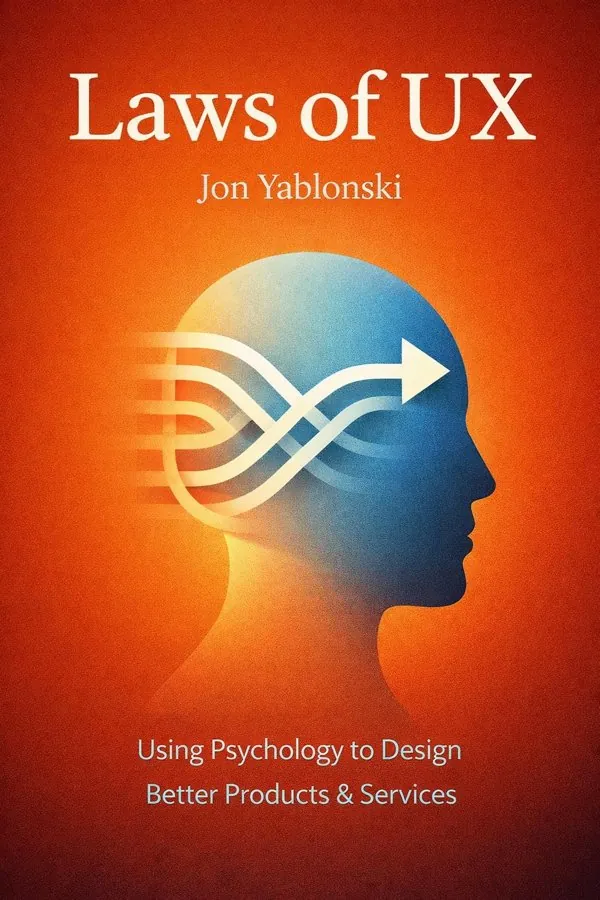
Laws of UX: Using Psychology to Design Better Products & Services: Summary & Key Insights
 10 min11 chaptersAudio available
What Is Laws of UX: Using Psychology to Design Better Products & Services About?
Laws of UX: Using Psychology to Design Better Products & Services by Jon Yablonski is a design book spanning 11 pages. Laws of UX explores how psychological principles can be applied to digital design to create more intuitive and user-friendly experiences. Jon Yablonski distills key concepts from cognitive psychology and behavioral science into practical design guidelines, helping designers make informed decisions that align with human behavior and perception.
This FizzRead summary covers all 11 key chapters of Laws of UX: Using Psychology to Design Better Products & Services in approximately 10 minutes, distilling the most important ideas, arguments, and takeaways from Jon Yablonski's work. Also available as an audio summary and Key Quotes Podcast.
Laws of UX: Using Psychology to Design Better Products & Services
Laws of UX explores how psychological principles can be applied to digital design to create more intuitive and user-friendly experiences. Jon Yablonski distills key concepts from cognitive psychology and behavioral science into practical design guidelines, helping designers make informed decisions that align with human behavior and perception.
Who Should Read Laws of UX: Using Psychology to Design Better Products & Services?
This book is perfect for anyone interested in design and looking to gain actionable insights in a short read. Whether you're a student, professional, or lifelong learner, the key ideas from Laws of UX: Using Psychology to Design Better Products & Services by Jon Yablonski will help you think differently.
- ✓Readers who enjoy design and want practical takeaways
- ✓Professionals looking to apply new ideas to their work and life
- ✓Anyone who wants the core insights of Laws of UX: Using Psychology to Design Better Products & Services in just 10 minutes
Want the full summary?
Get instant access to this book summary and 100K+ more with Fizz Moment.
Get Free SummaryAvailable on App Store • Free to download
Key Chapters
Before exploring the specific laws, I want to emphasize why psychology is indispensable to design. Every interaction between a user and a digital product is filtered through the mind’s architecture: perception, attention, and memory. When someone lands on a webpage, their visual system instantly begins organizing shapes and text into patterns. Attention acts as the selective spotlight, highlighting what seems important and dimming the rest. Memory then connects that perception to past experience, telling the user whether this feels familiar or not.
Perception is the foundation. The human brain is a pattern-seeking engine; it strives to simplify complexity. This underpins Gestalt theory—the idea that people perceive wholes before parts. A website’s navigation bar, for example, is not processed button by button; it’s seen as one coherent strip of interaction. When a designer violates this principle with inconsistent spacing or visual discordance, the user must exert extra cognitive effort to make sense of it.
Attention, by contrast, is a limited resource. Research shows that our brains are wired to filter massive amounts of sensory input, letting only what matters reach conscious awareness. Good design respects this limitation. It doesn’t demand constant focus—it guides it. A well-designed call to action stands out not because it flashes or distracts, but because visual hierarchy and simplicity let it emerge naturally from the interface’s structure.
Then comes memory. Short-term or working memory holds only a small amount of information—often cited as around seven items, though context matters. This limit explains why complex menu systems or long onboarding flows so often fail. The key is not to overload users, but to design with their cognitive constraints in mind. When we understand these limitations, we design systems that feel effortless, because they align with the way our minds naturally function.
Hick’s Law describes a principle that’s deceptively simple: the more choices a person has, the longer it takes them to decide. Early experiments by psychologists William Edmund Hick and Ray Hyman revealed that increasing the number of options raises decision time logarithmically—not linearly. In user experience design, this means that excessive choice leads to hesitation, confusion, or even abandonment.
I’ve seen this firsthand in digital products bloated with menus, filters, or onboarding steps. The intention is to offer flexibility, but the result is cognitive paralysis. People don’t want to analyze every possible route; they want to feel confident about the next step. A clear, minimal set of options increases a sense of control by reducing mental load.
Think about how Google’s homepage embodies Hick’s Law. One field, one button. That elegant restraint channels cognitive focus immediately toward action—searching. Or consider Netflix’s use of categories and tailored recommendations. The system reduces perceived choice complexity by surfacing content based on past behavior. The user feels like the platform “knows” them, when in fact it’s simply managing decision complexity behind the scenes.
Designing with Hick’s Law isn’t about restricting freedom; it’s about orchestrating focus. The best interfaces provide clarity first and flexibility second. When design aligns with the psychology of choice, users move seamlessly from thought to action without hesitation.
+ 9 more chapters — available in the FizzRead app
All Chapters in Laws of UX: Using Psychology to Design Better Products & Services
About the Author
Jon Yablonski is a designer, speaker, and author known for his work at the intersection of psychology and user experience design. He has contributed to major digital products and is recognized for creating the popular website lawsofux.com, which inspired this book.
Get This Summary in Your Preferred Format
Read or listen to the Laws of UX: Using Psychology to Design Better Products & Services summary by Jon Yablonski anytime, anywhere. FizzRead offers multiple formats so you can learn on your terms — all free.
Available formats: App · Audio · PDF · EPUB — All included free with FizzRead
Download Laws of UX: Using Psychology to Design Better Products & Services PDF and EPUB Summary
Key Quotes from Laws of UX: Using Psychology to Design Better Products & Services
“Before exploring the specific laws, I want to emphasize why psychology is indispensable to design.”
“Hick’s Law describes a principle that’s deceptively simple: the more choices a person has, the longer it takes them to decide.”
Frequently Asked Questions about Laws of UX: Using Psychology to Design Better Products & Services
Laws of UX: Using Psychology to Design Better Products & Services by Jon Yablonski is a design book that explores key ideas across 11 chapters. Laws of UX explores how psychological principles can be applied to digital design to create more intuitive and user-friendly experiences. Jon Yablonski distills key concepts from cognitive psychology and behavioral science into practical design guidelines, helping designers make informed decisions that align with human behavior and perception.
You Might Also Like
The Design of Everyday Things
Don Norman
10 min
The Better Angels of Our Nature
Steven Pinker
10 min
A Designer's Art
Paul Rand
10 min
Architects' Sketchbooks
Various Editors
10 min
Architectural Graphic Standards
The American Institute of Architects
10 min
Design Is Storytelling
Ellen Lupton
10 minBrowse by Category
Ready to read Laws of UX: Using Psychology to Design Better Products & Services?
Get the full summary and 100K+ more books with Fizz Moment.