
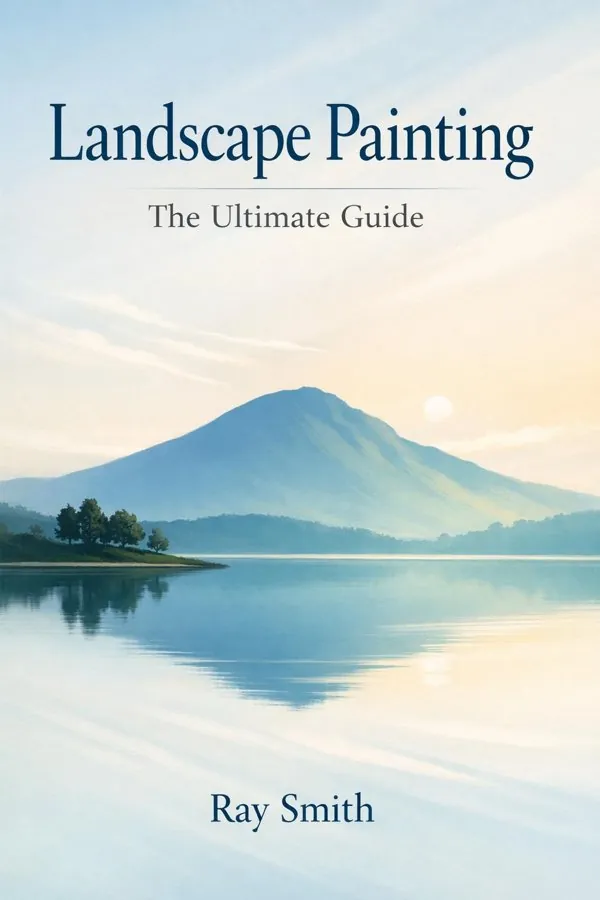
Landscape Painting: The Ultimate Guide: Summary & Key Insights
by Ray Smith
 10 min6 chaptersAudio available
What Is Landscape Painting: The Ultimate Guide About?
Landscape Painting: The Ultimate Guide by Ray Smith is a design book spanning 6 pages. This comprehensive guide by Ray Smith provides detailed instruction on landscape painting techniques, covering composition, color mixing, perspective, and brushwork. It includes step-by-step projects and full-color illustrations designed to help artists of all levels create realistic landscapes in various media.
This FizzRead summary covers all 6 key chapters of Landscape Painting: The Ultimate Guide in approximately 10 minutes, distilling the most important ideas, arguments, and takeaways from Ray Smith's work. Also available as an audio summary and Key Quotes Podcast.
Landscape Painting: The Ultimate Guide
This comprehensive guide by Ray Smith provides detailed instruction on landscape painting techniques, covering composition, color mixing, perspective, and brushwork. It includes step-by-step projects and full-color illustrations designed to help artists of all levels create realistic landscapes in various media.
Who Should Read Landscape Painting: The Ultimate Guide?
This book is perfect for anyone interested in design and looking to gain actionable insights in a short read. Whether you're a student, professional, or lifelong learner, the key ideas from Landscape Painting: The Ultimate Guide by Ray Smith will help you think differently.
- ✓Readers who enjoy design and want practical takeaways
- ✓Professionals looking to apply new ideas to their work and life
- ✓Anyone who wants the core insights of Landscape Painting: The Ultimate Guide in just 10 minutes
Want the full summary?
Get instant access to this book summary and 100K+ more with Fizz Moment.
Get Free SummaryAvailable on App Store • Free to download
Key Chapters
Composition is the heartbeat of landscape painting. Without it, even the most skillful color or brushwork feels flat. The first challenge for any artist is not where to start the painting, but how to construct its visual logic. When I approach a landscape, I do not first look for beautiful details—I look for structure. Think of composition as choreography: every tree, rock, and line of horizon is a dancer in a grand performance. The task is to arrange these visual movements so that the viewer’s eye travels naturally through the painting.
I begin with sketches that establish the major directional forces—the diagonals, horizontals, and curves. A successful landscape balances stability with motion. For instance, a strong horizontal foreground may ground the viewer, while an upward curve of hill or tree leads the eye toward the sky. Picture the invisible geometry that holds nature together. This isn’t an arbitrary formula—it mirrors how our minds like to perceive space. The human eye follows rhythm, seeking balance between tension and release. So, while symmetry can create calm, asymmetry creates dynamism. A landscape rarely stands still; it breathes with imbalance.
The placement of focal points matters deeply. I often choose a point of interest—not always the most obvious—and organize surrounding elements to lead toward it. Roads, rivers, or paths are excellent compositional devices. They guide the viewer’s gaze effortlessly through foreground to background. Even clouds or light can play that role; a shaft of sunlight can act as an unseen arrow directing attention. It’s essential to simplify nature’s overwhelming complexity into basic relationships of form and direction.
The real artistry lies in subtlety—creating visual hierarchy. Not every element should compete for attention. Foreground forms must relate to middle ground, middle to distance, each differing in tonal strength and edge definition. When composition succeeds, the viewer feels both order and freedom, as if walking through a real landscape. The mood of the painting springs from this structure. A low horizon conveys grandeur; a high one conveys intimacy. By mastering composition, you command the emotional impact of your painting.
Perspective is not a trick of mathematics—it’s a language of vision. In landscape painting, you must learn to translate three-dimensional space into two-dimensional illusion. I guide students first to *feel* depth before they measure it. When you look into distance, notice how clarity diminishes, colors fade toward blue or gray, and contrasts soften. This is aerial perspective—the subtle atmospheric effect that separates near from far. It’s more poetic than geometric, but understanding its science allows you to wield it deliberately.
Linear perspective serves equally well, especially where architecture or built forms enter the scene. The vanishing points, horizon line, and recession of planes organize spatial logic. Yet even in open fields and rolling hills, subtle converging lines help establish distance. The trick lies in moderation; too strict a perspective can make natural scenes feel artificial.
I often teach by using tonal sketches. When simplified to light and dark, perspective becomes clearer. The foreground carries strongest contrast and texture; mid-ground is quieter; background softens almost into mist. These gradations are the backbone of spatial depth. To test your painting, squint your eyes. The hierarchy of tone should guide your perception exactly as in nature—what stands near appears stronger, what lies far dissolves gently.
Rendering perspective also means understanding edges. Sharp edges move forward; soft edges recede. Our eyes recognize spatial relationships largely through edge clarity and tonal difference. Color follows the same rule: warm hues advance, cool hues retreat. So, when painting distant mountains, avoid high saturation—let them whisper with blues and grays.
When perspective succeeds, the viewer feels transported within the painting space. Your landscape opens like a window to another world. And once you master both linear and aerial perspective, you can manipulate them expressively. Some artists compress depth to emphasize pattern; others stretch it to evoke vastness. With practice, perspective becomes not an academic constraint but a creative instrument.
+ 4 more chapters — available in the FizzRead app
All Chapters in Landscape Painting: The Ultimate Guide
About the Author
Get This Summary in Your Preferred Format
Read or listen to the Landscape Painting: The Ultimate Guide summary by Ray Smith anytime, anywhere. FizzRead offers multiple formats so you can learn on your terms — all free.
Available formats: App · Audio · PDF · EPUB — All included free with FizzRead
Download Landscape Painting: The Ultimate Guide PDF and EPUB Summary
Key Quotes from Landscape Painting: The Ultimate Guide
“Composition is the heartbeat of landscape painting.”
“Perspective is not a trick of mathematics—it’s a language of vision.”
Frequently Asked Questions about Landscape Painting: The Ultimate Guide
Landscape Painting: The Ultimate Guide by Ray Smith is a design book that explores key ideas across 6 chapters. This comprehensive guide by Ray Smith provides detailed instruction on landscape painting techniques, covering composition, color mixing, perspective, and brushwork. It includes step-by-step projects and full-color illustrations designed to help artists of all levels create realistic landscapes in various media.
You Might Also Like

The Design of Everyday Things
Don Norman
10 min
The Better Angels of Our Nature
Steven Pinker
10 min
A Designer's Art
Paul Rand
10 min
Architects' Sketchbooks
Various Editors
10 min
Architectural Graphic Standards
The American Institute of Architects
10 min
Design Is Storytelling
Ellen Lupton
10 minBrowse by Category
Ready to read Landscape Painting: The Ultimate Guide?
Get the full summary and 100K+ more books with Fizz Moment.