
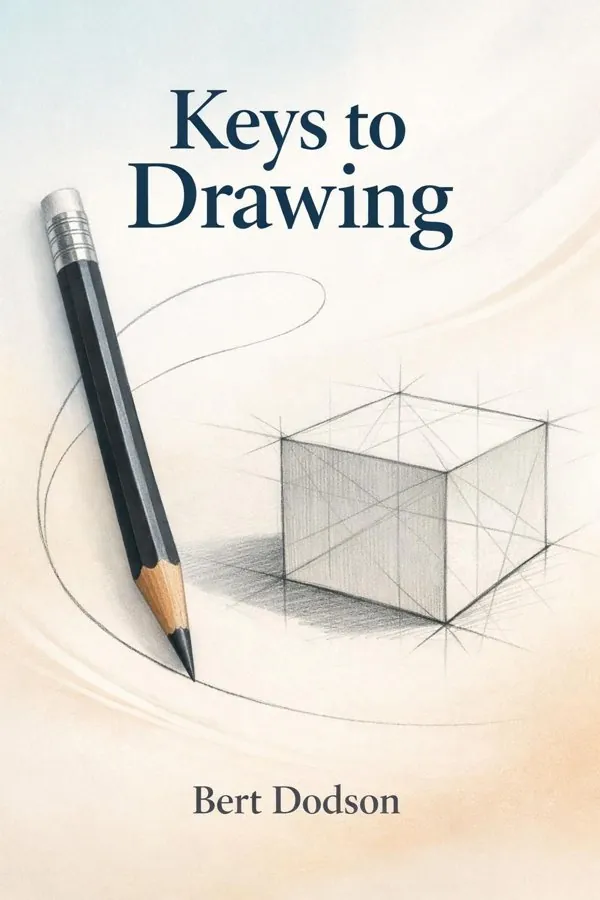
Keys to Drawing: Summary & Key Insights
by Bert Dodson
 10 min9 chaptersAudio available
Key Takeaways from Keys to Drawing
Most drawing problems begin long before the pencil touches the page: they begin in the mind’s habit of substituting symbols for observation.
Drawing feels overwhelming when treated as one giant talent, but it becomes manageable when broken into a handful of trainable skills.
A confident line is not only a matter of talent; it is evidence that the eye and hand have learned to cooperate.
One of the fastest ways to improve a drawing is to stop guessing and start comparing.
Flat paper can still suggest believable depth when the artist understands how space behaves.
What Is Keys to Drawing About?
Keys to Drawing by Bert Dodson is a design book spanning 11 pages. Keys to Drawing is one of the most practical and encouraging books ever written for people who want to learn how to draw what they actually see. Rather than treating drawing as a mysterious gift reserved for the naturally talented, Bert Dodson presents it as a learnable skill built on observation, coordination, and repeated practice. The book walks readers through the core abilities behind strong drawing, including seeing edges, judging proportion, understanding space, handling light and shadow, and organizing a composition. What makes it especially valuable is its tone: clear, generous, and deeply empowering. Dodson does not ask readers to imitate stiff academic formulas. Instead, he helps them train the eye, free the hand, and trust the process of looking closely. His authority comes not only from professional experience as an illustrator and teacher, but from his rare ability to explain visual thinking in simple, memorable ways. For beginners, the book removes fear. For experienced artists, it sharpens fundamentals. For anyone interested in design, illustration, or visual communication, it offers a durable foundation for seeing more clearly and drawing with greater confidence.
This FizzRead summary covers all 9 key chapters of Keys to Drawing in approximately 10 minutes, distilling the most important ideas, arguments, and takeaways from Bert Dodson's work. Also available as an audio summary and Key Quotes Podcast.
Keys to Drawing
Keys to Drawing is one of the most practical and encouraging books ever written for people who want to learn how to draw what they actually see. Rather than treating drawing as a mysterious gift reserved for the naturally talented, Bert Dodson presents it as a learnable skill built on observation, coordination, and repeated practice. The book walks readers through the core abilities behind strong drawing, including seeing edges, judging proportion, understanding space, handling light and shadow, and organizing a composition. What makes it especially valuable is its tone: clear, generous, and deeply empowering. Dodson does not ask readers to imitate stiff academic formulas. Instead, he helps them train the eye, free the hand, and trust the process of looking closely. His authority comes not only from professional experience as an illustrator and teacher, but from his rare ability to explain visual thinking in simple, memorable ways. For beginners, the book removes fear. For experienced artists, it sharpens fundamentals. For anyone interested in design, illustration, or visual communication, it offers a durable foundation for seeing more clearly and drawing with greater confidence.
Who Should Read Keys to Drawing?
This book is perfect for anyone interested in design and looking to gain actionable insights in a short read. Whether you're a student, professional, or lifelong learner, the key ideas from Keys to Drawing by Bert Dodson will help you think differently.
- ✓Readers who enjoy design and want practical takeaways
- ✓Professionals looking to apply new ideas to their work and life
- ✓Anyone who wants the core insights of Keys to Drawing in just 10 minutes
Want the full summary?
Get instant access to this book summary and 100K+ more with Fizz Moment.
Get Free SummaryAvailable on App Store • Free to download
Key Chapters
Most drawing problems begin long before the pencil touches the page: they begin in the mind’s habit of substituting symbols for observation. We think we know what an eye, a cup, or a tree looks like, so we draw a simplified version stored in memory. Bert Dodson argues that real drawing starts when we interrupt that habit and pay attention to what is actually in front of us. Instead of drawing “an eye,” we draw the strange tilt of this eyelid, the exact spacing around this pupil, the shadow shape beneath this brow. That shift from naming to noticing is the foundation of progress.
Dodson’s teaching emphasizes that perception is an active skill. To see well, an artist must compare angles, track curves, notice negative spaces, and stay curious about small differences. A chair leg is not just vertical; it may lean slightly. A face is not symmetrical; one side may sit higher than the other. When you stop drawing from assumption, your work becomes more believable and more alive.
In practice, this means slowing down and observing before marking the page. Draw a shoe and look for the unexpected: where the sole bends, where the laces bunch, where shadows flatten the form. Draw your hand and focus on the abstract shapes between the fingers instead of the fingers themselves. These exercises retrain the brain to favor direct evidence over mental shortcuts.
Actionable takeaway: before every drawing session, spend two full minutes only looking at the subject and listing five specific visual facts you would have missed if you relied on memory alone.
Drawing feels overwhelming when treated as one giant talent, but it becomes manageable when broken into a handful of trainable skills. Dodson identifies five essentials: edges, spaces, relationships, light and shadow, and the whole. Together, they form a complete framework for understanding what artists are really doing when they draw well.
Edges are the visible boundaries of forms, whether crisp or soft. Spaces include both positive shapes and the negative shapes around them. Relationships involve proportion, angle, alignment, and relative size. Light and shadow describe volume, depth, and atmosphere through value. The whole refers to composition: how all parts work together in a unified image. By separating these abilities, Dodson gives readers a clear path for practice. You do not need to “be artistic” all at once; you need to strengthen specific perceptions.
For example, if your drawings look flat, the issue may not be your line quality but your handling of value. If your figure feels awkward, the problem may be relational, such as poor angle comparison or proportion. If an object resembles the subject but still looks wrong, you may be ignoring negative space or the overall design. This diagnostic approach makes improvement faster and less emotional.
A designer can use the same framework beyond sketching. Edges matter in icon design, space matters in layouts, relationships matter in typography, value matters in interface hierarchy, and the whole matters in brand systems. Dodson’s method is ultimately about visual intelligence.
Actionable takeaway: choose one of the five skills per practice session and build a short exercise around it, rather than trying to improve everything at once.
A confident line is not only a matter of talent; it is evidence that the eye and hand have learned to cooperate. One of Dodson’s most important lessons is that drawing depends on hand-eye coordination that can be developed through repetition. Many beginners look at the page too much, second-guess every mark, and produce hesitant, broken lines. Dodson encourages artists to let observation guide movement more directly, so the hand becomes an instrument of seeing instead of a nervous editor.
This is why exercises such as contour drawing are so valuable. When you slowly trace the edge of a subject with your eyes and allow your hand to follow that movement, you strengthen coordination between perception and mark-making. The goal is not a perfect finished picture. The goal is building trust: if I look carefully, my hand can respond. Over time, this reduces stiffness and increases fluency.
Imagine drawing a bicycle. If you keep stopping to correct every wheel spoke, the drawing becomes mechanical. But if you first establish the large arcs and directional lines with steady movements, you preserve energy and structure. The same principle applies in product design sketching, fashion drawing, and storyboarding. Quick, committed marks often communicate form better than cautious overworking.
Dodson also reminds readers that mistakes are part of training. A line that misses slightly still teaches coordination. Erasing too early can interrupt learning. Better to draw lightly, compare what you made to what you see, and then adjust with additional lines.
Actionable takeaway: practice ten minutes of continuous contour or blind contour drawing several times a week to build smoother coordination and reduce fear of imperfect lines.
One of the fastest ways to improve a drawing is to stop guessing and start comparing. Dodson treats proportion not as a mysterious instinct but as a practical discipline of measurement and visual relationships. A drawing looks convincing when sizes, distances, and alignments feel internally consistent. That means asking questions constantly: How tall is this object compared with its width? Where does the top of the ear align relative to the eyebrow? How much of the vase is occupied by shadow versus light?
Dodson offers simple methods for checking proportion, such as using a pencil at arm’s length to compare lengths and angles, or judging one shape relative to another before committing to details. These techniques are especially useful because beginners often focus on isolated features rather than relational structure. A portrait may fail not because the nose is poorly drawn, but because the nose sits too low relative to the eyes and mouth. Once relational errors enter a drawing early, they multiply.
In everyday practice, start with the big envelope shape of the subject. If you are drawing a standing figure, mark the total height and width before placing the head, torso, and legs. If you are sketching a room interior, locate the largest furniture masses before textures and decorations. In design contexts, this mindset helps with layout balance, logo construction, and object visualization: every part must be judged in relation to the whole.
Proportion improves when artists compare more than they assume. The eye becomes sharper each time it asks, “Compared to what?” rather than “What do I think this should look like?”
Actionable takeaway: begin each drawing by measuring three major relationships—height to width, largest angle, and key alignment—before adding any detail.
Flat paper can still suggest believable depth when the artist understands how space behaves. Dodson presents perspective not as a rigid technical system to fear, but as a way to observe and organize spatial relationships. Perspective helps us explain why parallel lines appear to converge, why distant objects shrink, and why overlapping forms create a sense of placement in space. Even when drawing intuitively, these principles influence whether an image feels solid or confusing.
A common beginner mistake is to draw objects independently, as if each exists in its own separate world. Perspective forces connection. A table, chair, and window belong to the same spatial system. Their angles and proportions must agree. Dodson’s approach encourages artists to use perspective as a practical tool rather than a purely academic exercise. You do not need elaborate grids for every sketch, but you do need awareness of eye level, vanishing direction, overlap, scale change, and foreshortening.
Consider drawing a street scene. Cars become smaller as they recede, building edges move toward common vanishing points, and figures near the horizon line align in ways that reflect shared space. In product concept sketches, perspective helps communicate volume and usability. In environment design, it establishes immersion. In editorial illustration, even loose perspective can anchor a dramatic composition.
Dodson also ties perspective to perception: when you look carefully, you discover that depth can be shown not only through linear systems but through value contrast, detail density, edge softness, and placement on the page. Space is built by many cues working together.
Actionable takeaway: in your next drawing, identify the eye level first and use it to check how at least three objects relate spatially before refining the scene.
A technically accurate drawing can still feel dull if it lacks design. Dodson emphasizes that drawing is not only about recording appearances; it is about arranging visual elements so the image has clarity, rhythm, and impact. Composition is the difference between a page full of information and a picture that holds attention. It concerns placement, balance, contrast, emphasis, movement, and the relationship between parts and whole.
This matters because beginners often treat composition as something to worry about later, after they have “learned to draw.” Dodson shows that design awareness should be present from the start. Where the subject sits on the page changes the viewer’s experience. Cropping can create drama. Large empty areas can produce calm or tension. Repetition can unify forms, while contrast can create focal points. Even a simple still life becomes more engaging when shapes interact dynamically.
For instance, if you draw three objects of similar size spaced evenly across the page, the result may feel static. Shift one object closer, overlap another, and allow one form to dominate; suddenly the arrangement feels more intentional. In design fields, these same principles govern poster layouts, interface hierarchy, product presentation, and visual branding. Good composition guides attention.
Dodson encourages thumbnail sketches as a low-risk way to test alternatives before committing. A few tiny value studies can reveal whether the focal point reads clearly, whether the page feels balanced, and whether the design supports the mood you want.
Actionable takeaway: create three quick thumbnails before each serious drawing and choose the version with the clearest focal point and the strongest balance of positive and negative space.
What makes a drawing feel dimensional is not detail alone, but the convincing organization of light and dark. Dodson teaches that value is one of the artist’s strongest tools for turning flat outlines into solid form. When light strikes an object, it creates highlights, halftones, core shadows, cast shadows, and reflected light. Learning to see these patterns allows the artist to describe volume more persuasively than line alone ever could.
This becomes especially important because many beginners shade symbolically. They darken the “shadow side” in a general way without noticing the actual structure of value shapes. Dodson redirects attention from object labels to tonal design. Instead of thinking, “I am shading an apple,” think, “I am drawing a curved light area interrupted by a crescent-shaped shadow and grounded by a cast shadow.” This abstraction leads to more accurate and expressive results.
Texture enters when value and mark-making begin to suggest surface character. Glass, denim, bark, metal, skin, and stone do not require random detail; they require selective clues. A few sharp highlights can suggest polished metal. Broken, irregular marks can imply rough wood. Smooth transitions can communicate skin or ceramic. The artist chooses marks based on form and material, not habit.
In practical terms, squinting at the subject can simplify values into larger masses. Grouping similar darks together can make a drawing stronger and more readable. In design work, value contrast also improves hierarchy and usability, making this skill relevant beyond fine art.
Actionable takeaway: practice rendering one simple object under a single light source using only five values, focusing on large shadow shapes before adding texture details.
Good drawing is not only accurate; it is alive. Dodson understands that if artists focus exclusively on precision, they can lose movement, energy, and personal expression. Gesture drawing addresses this by capturing the action, rhythm, and essential flow of a subject before details settle in. A figure leaning forward, a dog about to jump, or a tree bending in the wind all contain directional forces that should be felt early in the drawing. Gesture preserves vitality.
This idea connects naturally to drawing from memory and imagination. Observational skill gives you raw material, but internalizing forms allows you to invent, simplify, and reinterpret them. Dodson does not separate realism from creativity. Instead, he shows that the more deeply you observe, the more convincingly you can later draw without direct reference. Memory stores structural patterns; imagination recombines them.
For example, after sketching many hands from life, you become better at inventing a believable hand gesture in a character design. After studying city streets, you can build an imagined environment with more authority. Gesture helps because it captures essence rather than getting trapped in static surface detail. A moving person drawn with a few flowing lines may feel more convincing than a carefully rendered but lifeless figure.
This process also supports the emergence of personal style. Style is not something pasted on top of weak fundamentals. It grows out of repeated choices about emphasis, simplification, rhythm, and interpretation. Artists who observe deeply gain more freedom in how they translate what they know.
Actionable takeaway: include a short practice cycle in your routine—two minutes observing a subject, two minutes drawing it from life, then two minutes redrawing it from memory to strengthen both gesture and visual recall.
Perhaps the most liberating message in Keys to Drawing is that improvement comes from practice shaped by attention, not from inborn talent. Dodson repeatedly lowers the psychological barrier that keeps people from drawing: the belief that early awkwardness is proof of inability. In reality, awkwardness is evidence of learning. Every artist passes through it. Confidence grows when readers stop treating each sketch as a verdict on their worth and start treating it as a step in visual training.
Dodson’s exercises work because they encourage experimentation over performance. By drawing common objects, testing different approaches, and accepting imperfect outcomes, readers build a resilient relationship with the process. This matters enormously for designers and creative professionals, who often need to sketch ideas quickly without the luxury of perfectionism. A rough but clear drawing can solve problems, communicate concepts, and unlock better thinking.
Over time, repeated practice also reveals personal style. Some artists favor bold line and simplified shape. Others lean toward tonal subtlety or expressive distortion. Dodson suggests that style should emerge from honest engagement with the subject and materials, not from imitation alone. When your observation becomes trustworthy, your preferences become visible. You begin to choose what to emphasize, what to omit, and how to communicate mood.
The deeper contribution of the book is motivational: it replaces intimidation with agency. Drawing becomes available to anyone willing to look carefully and practice consistently. That mindset is often more transformative than any single technical lesson.
Actionable takeaway: set a modest but non-negotiable drawing habit—fifteen minutes a day for thirty days—and track progress by saving every sketch rather than judging each one in isolation.
All Chapters in Keys to Drawing
About the Author
Bert Dodson is an American illustrator, painter, and art educator known for his clear, encouraging approach to teaching drawing. Over the course of his career, he has illustrated more than 70 children’s books and contributed to a wide range of visual education projects. His professional background in illustration gave him a strong understanding of how drawing functions both as observation and communication, and that practical mindset shapes his teaching. Dodson is especially respected for making drawing feel accessible to beginners without watering down essential principles. Rather than treating artistic ability as an inborn gift, he emphasizes trainable skills such as perception, proportion, composition, and hand-eye coordination. Through Keys to Drawing, he helped generations of readers approach drawing with greater confidence, discipline, and curiosity.
Get This Summary in Your Preferred Format
Read or listen to the Keys to Drawing summary by Bert Dodson anytime, anywhere. FizzRead offers multiple formats so you can learn on your terms — all free.
Available formats: App · Audio · PDF · EPUB — All included free with FizzRead
Download Keys to Drawing PDF and EPUB Summary
Key Quotes from Keys to Drawing
“Most drawing problems begin long before the pencil touches the page: they begin in the mind’s habit of substituting symbols for observation.”
“Drawing feels overwhelming when treated as one giant talent, but it becomes manageable when broken into a handful of trainable skills.”
“A confident line is not only a matter of talent; it is evidence that the eye and hand have learned to cooperate.”
“One of the fastest ways to improve a drawing is to stop guessing and start comparing.”
“Flat paper can still suggest believable depth when the artist understands how space behaves.”
Frequently Asked Questions about Keys to Drawing
Keys to Drawing by Bert Dodson is a design book that explores key ideas across 9 chapters. Keys to Drawing is one of the most practical and encouraging books ever written for people who want to learn how to draw what they actually see. Rather than treating drawing as a mysterious gift reserved for the naturally talented, Bert Dodson presents it as a learnable skill built on observation, coordination, and repeated practice. The book walks readers through the core abilities behind strong drawing, including seeing edges, judging proportion, understanding space, handling light and shadow, and organizing a composition. What makes it especially valuable is its tone: clear, generous, and deeply empowering. Dodson does not ask readers to imitate stiff academic formulas. Instead, he helps them train the eye, free the hand, and trust the process of looking closely. His authority comes not only from professional experience as an illustrator and teacher, but from his rare ability to explain visual thinking in simple, memorable ways. For beginners, the book removes fear. For experienced artists, it sharpens fundamentals. For anyone interested in design, illustration, or visual communication, it offers a durable foundation for seeing more clearly and drawing with greater confidence.
You Might Also Like

The Design of Everyday Things
Don Norman
10 min
The Better Angels of Our Nature
Steven Pinker
10 min
A Designer's Art
Paul Rand
10 min
Architects' Sketchbooks
Various Editors
10 min
Architectural Graphic Standards
The American Institute of Architects
10 min
Design Is Storytelling
Ellen Lupton
10 minBrowse by Category
Ready to read Keys to Drawing?
Get the full summary and 100K+ more books with Fizz Moment.