
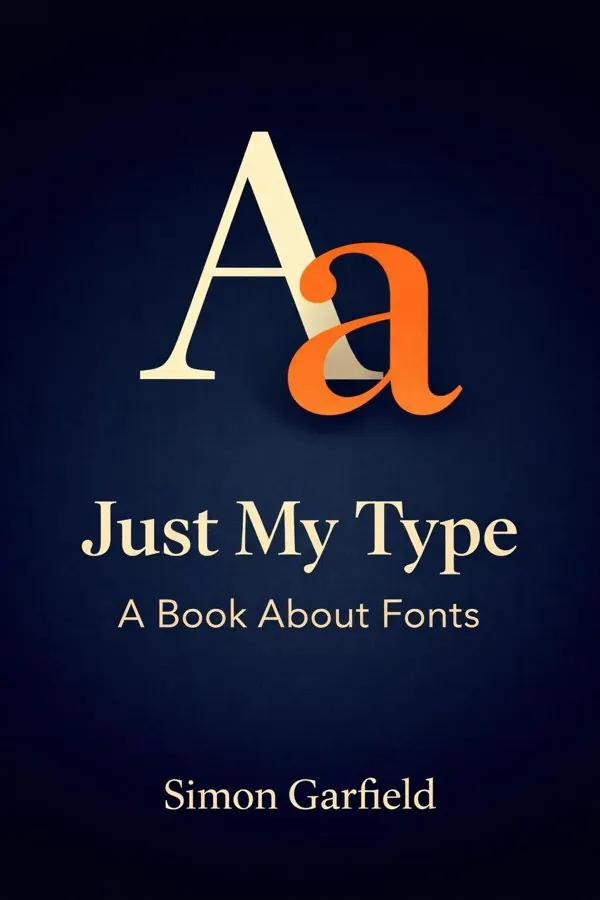
Just My Type: A Book About Fonts: Summary & Key Insights
 10 min11 chaptersAudio available
What Is Just My Type: A Book About Fonts About?
Just My Type: A Book About Fonts by Simon Garfield is a design book spanning 11 pages. Just My Type: A Book About Fonts is a witty and engaging exploration of typography and the cultural stories behind the fonts we use every day. Simon Garfield delves into the history, design, and psychology of typefaces, from Helvetica to Comic Sans, revealing how fonts shape our perception and communication. The book combines historical anecdotes, design insights, and human stories to illuminate the hidden world of typography.
This FizzRead summary covers all 11 key chapters of Just My Type: A Book About Fonts in approximately 10 minutes, distilling the most important ideas, arguments, and takeaways from Simon Garfield's work. Also available as an audio summary and Key Quotes Podcast.
Just My Type: A Book About Fonts
Just My Type: A Book About Fonts is a witty and engaging exploration of typography and the cultural stories behind the fonts we use every day. Simon Garfield delves into the history, design, and psychology of typefaces, from Helvetica to Comic Sans, revealing how fonts shape our perception and communication. The book combines historical anecdotes, design insights, and human stories to illuminate the hidden world of typography.
Who Should Read Just My Type: A Book About Fonts?
This book is perfect for anyone interested in design and looking to gain actionable insights in a short read. Whether you're a student, professional, or lifelong learner, the key ideas from Just My Type: A Book About Fonts by Simon Garfield will help you think differently.
- ✓Readers who enjoy design and want practical takeaways
- ✓Professionals looking to apply new ideas to their work and life
- ✓Anyone who wants the core insights of Just My Type: A Book About Fonts in just 10 minutes
Want the full summary?
Get instant access to this book summary and 100K+ more with Fizz Moment.
Get Free SummaryAvailable on App Store • Free to download
Key Chapters
Typography begins with Gutenberg—the man who transformed the world with movable type. When I traced his story, I found not a simple inventor but a man working at the intersection of faith, commerce, and art. The arrival of the printing press in the mid-fifteenth century did more than mechanize writing; it democratized thought. Gutenberg’s type was not crude replication but craftsmanship encoded in metal. His typeface resembled the ornate handwritten scripts of the time, carrying a reverence for the Church and scholarship. And that’s where the paradox lies—the technology that spread literacy and individuality began with a visual homage to authority.
Gutenberg’s influence ushered in a typographic lineage that evolved through centuries. The blackletter of his Bible soon gave way to Roman type, whose cleaner forms mirrored the Renaissance spirit—humanist, balanced, and precise. In chronicling these developments, I found typography mirrored the aims of its age. The elegance of Garamond reflected the harmony of classical ideals; Baskerville’s refined designs spoke of Enlightenment clarity and reason; and Bodoni’s crisp lines heralded industrial precision.
What I discovered is that typography has always been more than the art of making words legible—it’s a portrait of humanity at each historical moment. The movement from Gutenberg’s dense letters to Bodoni’s dazzling contrasts encapsulates the shift from collective faith to individual expression. When you look closely, you see history stretching across every serif.
Each classic typeface tells a story of its creator’s worldview. Claude Garamond worked in sixteenth-century Paris, crafting letters that embodied balance, grace, and education. His type was humanist—an expression of Renaissance ideals and the belief that beauty in form reflects beauty in thought. Using Garamond feels like inviting a conversation with history; it carries a subtle confidence, neither shouting nor decoratively competing.
Then came John Baskerville, an amateur printer obsessed with perfection. His eighteenth-century type broke with convention, incorporating sharp contrast and fine detail that mirrored Enlightenment precision. His contemporaries found Baskerville’s prints almost too clean—too modern for their comfort. Yet, he redefined what refinement looked like. I’ve always admired Baskerville’s stubbornness; he risked everything for the clarity of words. His type represents rational elegance—a harmony of scientific inquiry and art.
Giambattista Bodoni, working in Parma, brought typography into the neoclassical age, stripping away the organic softness of earlier forms and replacing them with geometric rigor. His letters shimmer with contrast, celebrating modernity’s polished sheen. Bodoni’s typefaces are the visual twin of classical marble—hard, cold, yet undeniably perfect.
Together, Garamond, Baskerville, and Bodoni embody the evolution of taste and technological ambition. When you read their letters, you’re not simply seeing old fonts; you’re witnessing the birth of aesthetic self-consciousness. Typography ceased to be invisible—it became art.
+ 9 more chapters — available in the FizzRead app
All Chapters in Just My Type: A Book About Fonts
About the Author
Simon Garfield is a British journalist and author known for his engaging nonfiction works that explore culture, history, and human curiosity. His books include 'Mauve: How One Man Invented a Color That Changed the World' and 'On the Map: Why the World Looks the Way It Does.' Garfield’s writing is celebrated for its humor, accessibility, and depth of research.
Get This Summary in Your Preferred Format
Read or listen to the Just My Type: A Book About Fonts summary by Simon Garfield anytime, anywhere. FizzRead offers multiple formats so you can learn on your terms — all free.
Available formats: App · Audio · PDF · EPUB — All included free with FizzRead
Download Just My Type: A Book About Fonts PDF and EPUB Summary
Key Quotes from Just My Type: A Book About Fonts
“Typography begins with Gutenberg—the man who transformed the world with movable type.”
“Each classic typeface tells a story of its creator’s worldview.”
Frequently Asked Questions about Just My Type: A Book About Fonts
Just My Type: A Book About Fonts by Simon Garfield is a design book that explores key ideas across 11 chapters. Just My Type: A Book About Fonts is a witty and engaging exploration of typography and the cultural stories behind the fonts we use every day. Simon Garfield delves into the history, design, and psychology of typefaces, from Helvetica to Comic Sans, revealing how fonts shape our perception and communication. The book combines historical anecdotes, design insights, and human stories to illuminate the hidden world of typography.
You Might Also Like

The Design of Everyday Things
Don Norman
10 min
The Better Angels of Our Nature
Steven Pinker
10 min
A Designer's Art
Paul Rand
10 min
Architects' Sketchbooks
Various Editors
10 min
Architectural Graphic Standards
The American Institute of Architects
10 min
Design Is Storytelling
Ellen Lupton
10 minBrowse by Category
Ready to read Just My Type: A Book About Fonts?
Get the full summary and 100K+ more books with Fizz Moment.