
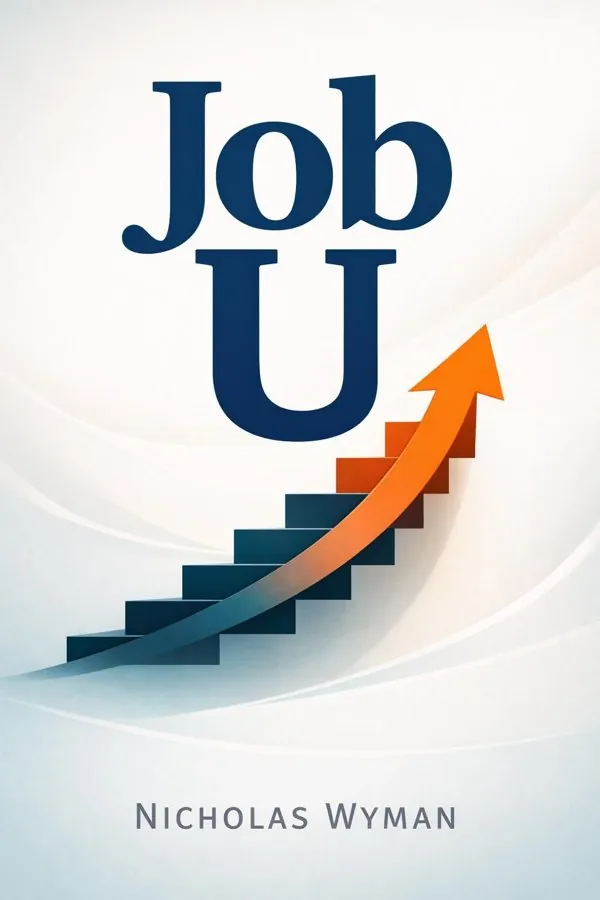
Job U: How to Find Wealth and Success by Developing the Skills Companies Actually Need: Summary & Key Insights
 10 min8 chaptersAudio available
What Is Job U: How to Find Wealth and Success by Developing the Skills Companies Actually Need About?
Job U: How to Find Wealth and Success by Developing the Skills Companies Actually Need by Nicholas Wyman is a career book spanning 8 pages. Job U explains how individuals can achieve career success and financial stability by acquiring practical, in-demand skills rather than relying solely on traditional four-year college degrees. Drawing on real-world examples and labor market data, Nicholas Wyman highlights alternative education paths such as apprenticeships, technical training, and community college programs that align with employer needs.
This FizzRead summary covers all 8 key chapters of Job U: How to Find Wealth and Success by Developing the Skills Companies Actually Need in approximately 10 minutes, distilling the most important ideas, arguments, and takeaways from Nicholas Wyman's work. Also available as an audio summary and Key Quotes Podcast.
Job U: How to Find Wealth and Success by Developing the Skills Companies Actually Need
Job U explains how individuals can achieve career success and financial stability by acquiring practical, in-demand skills rather than relying solely on traditional four-year college degrees. Drawing on real-world examples and labor market data, Nicholas Wyman highlights alternative education paths such as apprenticeships, technical training, and community college programs that align with employer needs.
Who Should Read Job U: How to Find Wealth and Success by Developing the Skills Companies Actually Need?
This book is perfect for anyone interested in career and looking to gain actionable insights in a short read. Whether you're a student, professional, or lifelong learner, the key ideas from Job U: How to Find Wealth and Success by Developing the Skills Companies Actually Need by Nicholas Wyman will help you think differently.
- ✓Readers who enjoy career and want practical takeaways
- ✓Professionals looking to apply new ideas to their work and life
- ✓Anyone who wants the core insights of Job U: How to Find Wealth and Success by Developing the Skills Companies Actually Need in just 10 minutes
Want the full summary?
Get instant access to this book summary and 100K+ more with Fizz Moment.
Get Free SummaryAvailable on App Store • Free to download
Key Chapters
If there’s one topic that defines our current labor economy, it’s the skills gap—the disturbing disconnect between the abilities that employers require and the ones job seekers actually bring to the table. In researching *Job U*, I was struck by the sheer magnitude of this mismatch. In industry after industry, I found openings that went unfilled not because there were no willing workers, but because the available workers weren’t prepared with the right competencies.
Employers across the United States have consistently reported difficulty hiring people with skills in advanced manufacturing, information technology, healthcare support, and technical trades. Meanwhile, millions of young people complete degrees that leave them unemployed, underemployed, or saddled with debt. The tragedy is not simply economic—it’s personal. Talented individuals are underutilized, while businesses constrain their growth for lack of qualified staff.
What makes this gap so persistent? Part of the reason lies in the social hierarchy we’ve created around education. We’ve glorified college as the universal gateway to success, while undervaluing the kinds of technical education that keep our economies running. Parents, understandably wanting the best for their children, push them toward universities and white-collar aspirations even when their talents might flourish in practical, hands-on fields. Simultaneously, many schools measure their success by college admissions rather than career outcomes.
Addressing the skills gap starts with a change in perception. We need to redefine what counts as a good education. A good education is one that leads to independence, contribution, and fulfillment—not merely a framed diploma. Across the U.S. and beyond, employers are recognizing this. Companies like Siemens, Toyota, and Harley-Davidson are developing their own training programs precisely because they can no longer wait for colleges to deliver job-ready graduates. The modern workplace demands flexibility, problem solving, and technical knowledge that can only be acquired through direct, applied learning.
When we begin to see education as a continuum of skill building rather than a single four-year experience, the gap starts to close. *Job U* is about fueling that new perception—helping both individuals and institutions design learning that works.
Work itself has transformed in ways few anticipated. Automation, digitization, and global competition are reshaping industries daily. Yet, these forces have not erased opportunity; they’ve merely redefined it. As robots assemble products and algorithms process data, human value has shifted toward creativity, problem-solving, and adaptability.
In my travels, I’ve seen factories that resemble clean, high-tech laboratories more than the gritty workshops of old. Manufacturing today requires computer skills, mechanical knowledge, and an understanding of data systems. Health care assistants operate sophisticated diagnostic tools; IT specialists troubleshoot remotely from across continents. Even jobs we once considered “blue-collar” now require substantial technical acumen. The old color distinctions between white- and blue-collar work are dissolving into something hybrid—a new class of “new collar” professions defined by skill, not status.
The challenge—and the promise—is that we can all adapt to this transformation if we train appropriately. The danger for individuals isn’t automation itself but failing to evolve with it. Workers who embrace learning and technical upskilling find themselves in demand; those who rely solely on outdated credentials risk obsolescence. The same holds true for businesses that invest in people: their productivity rises, turnover falls, and innovation accelerates.
To thrive in this new environment, we must accept that careers are no longer linear. The notion of studying for four years, earning a degree, and coasting for four decades is obsolete. Instead, success now depends on continuously updating your toolkit. The modern worker is an ongoing learner, a professional-in-progress. This new reality is liberating, not limiting, because it opens the door to reinvention at any stage of life.
+ 6 more chapters — available in the FizzRead app
All Chapters in Job U: How to Find Wealth and Success by Developing the Skills Companies Actually Need
About the Author
Nicholas Wyman is an Australian-born workforce development expert, entrepreneur, and author. He is the CEO of the Institute for Workplace Skills and Innovation and a recognized advocate for vocational education and skills-based training worldwide.
Get This Summary in Your Preferred Format
Read or listen to the Job U: How to Find Wealth and Success by Developing the Skills Companies Actually Need summary by Nicholas Wyman anytime, anywhere. FizzRead offers multiple formats so you can learn on your terms — all free.
Available formats: App · Audio · PDF · EPUB — All included free with FizzRead
Download Job U: How to Find Wealth and Success by Developing the Skills Companies Actually Need PDF and EPUB Summary
Key Quotes from Job U: How to Find Wealth and Success by Developing the Skills Companies Actually Need
“In researching *Job U*, I was struck by the sheer magnitude of this mismatch.”
“Work itself has transformed in ways few anticipated.”
Frequently Asked Questions about Job U: How to Find Wealth and Success by Developing the Skills Companies Actually Need
Job U: How to Find Wealth and Success by Developing the Skills Companies Actually Need by Nicholas Wyman is a career book that explores key ideas across 8 chapters. Job U explains how individuals can achieve career success and financial stability by acquiring practical, in-demand skills rather than relying solely on traditional four-year college degrees. Drawing on real-world examples and labor market data, Nicholas Wyman highlights alternative education paths such as apprenticeships, technical training, and community college programs that align with employer needs.
More by Nicholas Wyman
You Might Also Like

60 Seconds & You're Hired!
Robin Ryan
10 min
A New Way for Mothers: A Revolutionary Approach for Mothers to Use Their Skills and Talents While Their Children Are at School
Louise Webster
10 min
Betting on You: How to Put Yourself First and (Finally) Take Control of Your Career
Laurie Ruettimann
10 min
Born for This: How to Find the Work You Were Meant to Do
Chris Guillebeau
10 min
Brag Better: Master the Art of Fearless Self-Promotion
Meredith Fineman
10 min
Build for Tomorrow: An Action Plan for Embracing Change, Adapting Fast, and Future-Proofing Your Career
Jason Feifer
10 minBrowse by Category
Ready to read Job U: How to Find Wealth and Success by Developing the Skills Companies Actually Need?
Get the full summary and 100K+ more books with Fizz Moment.