
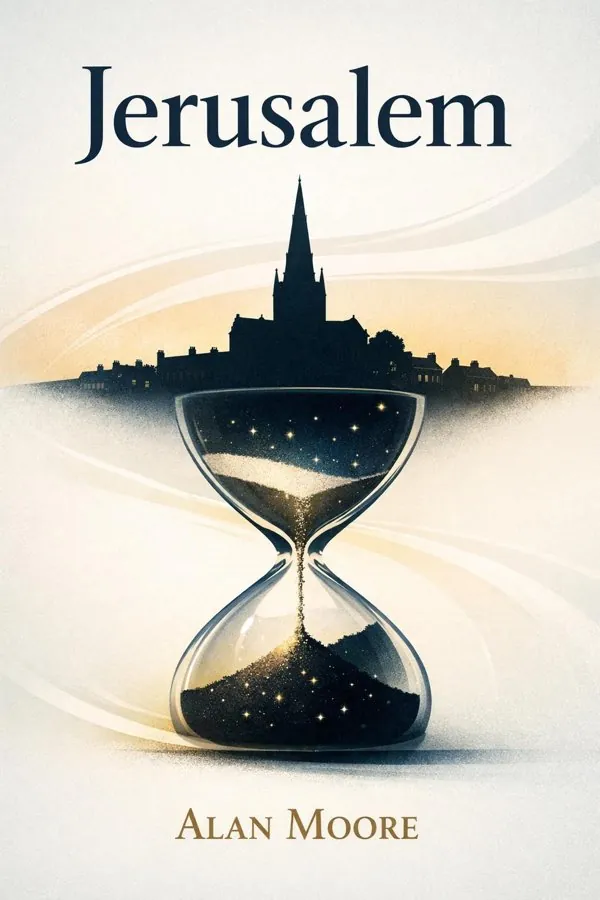
Jerusalem: Summary & Key Insights
by Alan Moore
 10 min9 chaptersAudio available
Key Takeaways from Jerusalem
One of Jerusalem’s boldest suggestions is that time may not be something we move through, but something that already exists all at once.
Art in Jerusalem is not decoration; it is a mode of seeing.
Cities are often described through institutions, landmarks, or famous events, but Jerusalem insists that a city is really made of overlapping human stories.
Jerusalem’s afterlife is striking because it is not a distant heaven of abstraction but an extension of local existence.
Most of us imagine time as a line moving from past to future, but Jerusalem repeatedly proposes a more radical model: time as a fixed architecture in which all moments coexist.
What Is Jerusalem About?
Jerusalem by Alan Moore is a classics book spanning 11 pages. Alan Moore’s Jerusalem is not simply a novel about Northampton; it is an immense act of imaginative reclamation. Spanning centuries, voices, genres, and states of existence, the book turns one English town into a universe where history, family memory, poverty, myth, art, and the afterlife all coexist. At its center is the idea that ordinary places are never truly ordinary. Every street contains buried time, every family carries invisible inheritances, and every life is part of a much larger pattern than it can usually perceive. Moore follows generations of residents, especially the Vernall and Warren families, while moving between the living world and the spectral realm of Mansoul. The result is a work that combines social realism with visionary metaphysics. It matters because it refuses the notion that grandeur belongs only to kings, capitals, or epic battlefields. Instead, Moore finds the sacred in council estates, alleyways, childhood memories, and overlooked lives. Few writers are better equipped for such a project: born in Northampton and celebrated for narrative ambition in works like Watchmen and From Hell, Moore brings unmatched authority, love, and imaginative force to this monumental portrait of place.
This FizzRead summary covers all 9 key chapters of Jerusalem in approximately 10 minutes, distilling the most important ideas, arguments, and takeaways from Alan Moore's work. Also available as an audio summary and Key Quotes Podcast.
Jerusalem
Alan Moore’s Jerusalem is not simply a novel about Northampton; it is an immense act of imaginative reclamation. Spanning centuries, voices, genres, and states of existence, the book turns one English town into a universe where history, family memory, poverty, myth, art, and the afterlife all coexist. At its center is the idea that ordinary places are never truly ordinary. Every street contains buried time, every family carries invisible inheritances, and every life is part of a much larger pattern than it can usually perceive. Moore follows generations of residents, especially the Vernall and Warren families, while moving between the living world and the spectral realm of Mansoul. The result is a work that combines social realism with visionary metaphysics. It matters because it refuses the notion that grandeur belongs only to kings, capitals, or epic battlefields. Instead, Moore finds the sacred in council estates, alleyways, childhood memories, and overlooked lives. Few writers are better equipped for such a project: born in Northampton and celebrated for narrative ambition in works like Watchmen and From Hell, Moore brings unmatched authority, love, and imaginative force to this monumental portrait of place.
Who Should Read Jerusalem?
This book is perfect for anyone interested in classics and looking to gain actionable insights in a short read. Whether you're a student, professional, or lifelong learner, the key ideas from Jerusalem by Alan Moore will help you think differently.
- ✓Readers who enjoy classics and want practical takeaways
- ✓Professionals looking to apply new ideas to their work and life
- ✓Anyone who wants the core insights of Jerusalem in just 10 minutes
Want the full summary?
Get instant access to this book summary and 100K+ more with Fizz Moment.
Get Free SummaryAvailable on App Store • Free to download
Key Chapters
One of Jerusalem’s boldest suggestions is that time may not be something we move through, but something that already exists all at once. Moore explores this idea through the Vernall family, whose members across generations seem connected by a strange sensitivity to hidden dimensions of experience. Their lives imply that ancestry is not merely biological inheritance but metaphysical inheritance as well. Visions, intuitions, artistic gifts, and spiritual susceptibilities do not appear randomly; they travel through bloodlines, stories, and places.
For Moore, the Vernalls become a way of dramatizing eternal simultaneity: the notion that past, present, and future are not separate rooms but one structure seen from different angles. A child’s experience may echo an ancestor’s revelation, and a dead person’s perspective may illuminate events still unfolding among the living. This does not erase individuality, but it enlarges it. Each person becomes a node in a much wider human pattern.
Practically, this idea changes how we think about family and memory. We often treat our lives as self-contained projects, but Moore invites us to ask what emotional habits, fears, longings, and talents were handed to us long before we could name them. In real life, family myths, inherited traumas, recurring creative impulses, and repeated life patterns often shape us more than we recognize.
The takeaway is simple but profound: look at your life genealogically. Ask what stories, beliefs, and unfinished meanings you may be carrying from the people and places that formed you.
Art in Jerusalem is not decoration; it is a mode of seeing. Alma Warren embodies this idea most fully. As a modern descendant of Northampton’s visionary tradition, she translates mystical perception into artistic practice. Where earlier generations might have understood revelation through religion or folklore, Alma understands it through painting, form, and image. Her work becomes a bridge between the visible city and the invisible structures underneath it.
Alma matters because she shows that imagination is not escapism. In Moore’s hands, artistic creation is a disciplined attempt to perceive reality more completely. Alma does not invent meaning out of thin air; she uncovers it. Her paintings gather fragments of history, domestic life, local myth, and metaphysical intuition into a larger whole. Through her, the novel argues that the artist’s task is to reveal depth in what others dismiss as ordinary.
This has practical value beyond literature. Many people separate creativity from everyday life, treating art as something secondary to work, responsibility, or public importance. Moore resists that hierarchy. A painting, a diary, a story, a song, or even a family photo archive can become a method of preserving hidden truth. Artistic attention dignifies places and lives that official history ignores.
The actionable lesson is to use creativity as investigation. Record your neighborhood, your family stories, or your recurring dreams in some form. You may discover that expression is not merely self-display, but a way of understanding reality more deeply.
Cities are often described through institutions, landmarks, or famous events, but Jerusalem insists that a city is really made of overlapping human stories. Moore builds Northampton not as a backdrop but as a living network of residents, each carrying private griefs, comic absurdities, aspirations, and myths. The boroughs become dense with voices from different eras and social positions, reminding us that no place can be understood from a single point of view.
This mosaic structure matters because it rejects simplified narratives about communities. Northampton is neither romanticized nor dismissed. It contains tenderness and brutality, banality and wonder, neglect and holiness. Moore pays close attention to people who are often absent from grand literary treatments: children, working-class families, local eccentrics, the forgotten dead, and the socially invisible. Through them, the novel demonstrates that collective life is built from countless partial perspectives.
In practical terms, this idea helps us read our own environments more generously. It is easy to flatten neighborhoods into stereotypes: dangerous, boring, respectable, deprived, trendy. Moore shows that every such label conceals multitudes. The postal worker, the struggling parent, the shopkeeper, the elderly neighbor, and the child on the corner are all contributing to a place’s true identity.
The takeaway is to practice narrative curiosity. When you think about your town or community, move beyond official descriptions and ask whose stories are missing. A richer understanding of place begins when we recognize the dignity and complexity of the lives intertwined around us.
Jerusalem’s afterlife is striking because it is not a distant heaven of abstraction but an extension of local existence. In Mansoul, the dead continue in forms shaped by memory, personality, and place. This spectral Northampton does not cancel earthly life; it reframes it. The dead are not simply gone, and the past is not inert. Instead, history remains populated, emotionally active, and spatially near.
Moore uses Mansoul to challenge modern habits of thinking about death as a total rupture. The dead retain voices, perspectives, and attachments. Their presence suggests that human life leaves impressions that endure beyond biological ending. This is not a conventional theological doctrine so much as a poetic-metaphysical claim: places remember us, communities are haunted by what they have lost, and identity may extend beyond one lifetime’s narrow frame.
In everyday life, we experience milder versions of this continuously. A childhood home still contains the atmosphere of those who lived there. A neighborhood corner can trigger vivid contact with someone gone. Families often speak with the dead in memory, ritual, or recurring story. Moore magnifies that familiar phenomenon into a full cosmology.
The actionable lesson is to engage memory actively rather than fearfully. Revisit family histories, preserve voices, mark significant places, and treat remembrance as a living practice. Jerusalem suggests that honoring the dead is not nostalgia; it is participation in a wider continuity of human meaning.
Most of us imagine time as a line moving from past to future, but Jerusalem repeatedly proposes a more radical model: time as a fixed architecture in which all moments coexist. This nonlinear vision is one of the novel’s central philosophical engines. It allows Moore to shift between centuries, perspectives, and ontological states while implying that every event remains eternally present somewhere within the total design.
Why does this matter? Because linear time encourages a narrow understanding of selfhood. We feel trapped by regret behind us and uncertainty ahead of us. Moore’s alternative view does not erase suffering, but it changes its frame. If all moments exist simultaneously, then childhood, loss, joy, artistic creation, and death are not sequentially discarded; they are enduring dimensions of being. Life becomes less like a vanishing stream and more like an intricately connected city of moments.
There are practical echoes of this in ordinary experience. A smell can collapse decades instantly. A street can make the past feel present. Trauma and love alike often refuse chronology, surfacing as if no time had passed at all. Moore transforms these familiar psychological truths into a full metaphysical system.
The takeaway is to treat time with less haste. Instead of seeing your past as merely over or your future as the only meaningful horizon, revisit pivotal moments thoughtfully. Journaling, reflection, and memory work can help you recognize that your life is not disappearing behind you; it remains part of the structure that made you.
Jerusalem refuses to separate metaphysics from politics. Northampton’s visionary dimensions are inseparable from its social realities: poverty, class structure, labor, neglect, violence, civic change, and historical pressure. Moore layers Roman remnants, medieval memory, industrial transformation, and modern urban struggle into one densely inhabited space. The result is a portrait of history not as textbook chronology but as sediment embedded in everyday streets.
This is one of the novel’s most important contributions. It insists that spiritual imagination does not excuse material injustice. The boroughs are sacred, but they are also marked by deprivation and exclusion. Moore’s love for Northampton is not sentimental; it is attentive to the forces that shape who gets remembered, who gets discarded, and how power writes itself onto architecture and opportunity.
This perspective is useful in real life because we often discuss neighborhoods either aesthetically or economically, but rarely both at once. Moore asks us to see place as a conjunction of story and structure. A neglected block is not merely unattractive; it is the result of policy, class, memory, and abandonment. A local legend may sit beside a history of institutional failure.
The actionable lesson is to read your environment historically. Learn what economic, political, and cultural forces shaped your street, town, or district. Doing so deepens both empathy and civic awareness, and it prevents beauty from becoming a way of ignoring injustice.
In Jerusalem, supernatural beings are not simply fantasy ornaments. Angels, demons, and other presences represent the moral and symbolic intensity of urban life. They dramatize forces that are otherwise difficult to name: inspiration, corruption, innocence, predation, awe, and dread. Moore’s city feels spiritually crowded because human places are never made only of material facts; they are charged with moods, archetypes, and recurring patterns of meaning.
This supernatural layer works on several levels. It enriches the novel’s mythic texture, but it also externalizes psychological and social realities. A demonic presence may signify more than literal evil; it can embody the accumulated violence, fear, or degradation within a place. Likewise, an angelic vision may point to moments when perception widens and the ordinary world becomes radiant with significance.
In practical terms, readers do not need to share Moore’s mystical framework to recognize the truth beneath it. We speak all the time of spaces having a bad energy, a protective feeling, a haunted atmosphere, or a sense of grace. Offices, homes, streets, and schools can feel oppressive or uplifting in ways that exceed measurable data. Moore gives these atmospheres narrative form.
The takeaway is to become more attentive to the moral atmosphere of your surroundings. Notice which spaces sharpen your empathy, creativity, and calm, and which produce numbness or harm. Such awareness can guide where you spend time, how you shape environments, and what kinds of presence you contribute to others.
Few parts of Jerusalem are as moving as its treatment of children and death, and Lucia’s journey through the afterlife crystallizes the novel’s emotional core. Her passage into Mansoul is not handled as simple tragedy or sentimentality. Instead, Moore presents it as a profound shift in perspective, where vulnerability, wonder, fear, and revelation coexist. Through Lucia, the novel explores what it means for innocence to encounter mortality without reducing that encounter to despair.
Lucia’s importance lies in how she humanizes the book’s grand metaphysics. Ideas about eternity, simultaneity, and the persistence of consciousness could remain abstract, but her story gives them emotional weight. Death becomes not just a philosophical subject but a lived, bewildering transition. Her experience asks whether love, identity, and perception can survive bodily loss, and whether a child’s point of view may grasp truths adults obscure with habit.
For readers, this has practical relevance because bereavement often fractures language. Moore offers an alternative vocabulary: one that neither denies pain nor imagines the dead as simply erased. The emotional lesson is not certainty about doctrine, but permission to treat grief as relationship rather than termination.
The actionable takeaway is to make room for complex remembrance. When facing loss, allow memory, imagination, ritual, and storytelling to coexist. Lucia’s journey suggests that honoring the dead may involve continuing conversation with their meaning, not just accepting their absence.
Jerusalem ultimately argues that creation is one of the deepest ways human beings participate in eternity. Across its final movements, visions of the afterlife, returns to the living world, and Alma’s artistic culmination all converge on a central realization: making meaning is itself a sacred act. To create is to gather fragments of time, memory, suffering, and beauty into a form that can outlast the moment.
This final idea ties the novel’s vast components together. The living and the dead, the historical and the visionary, the local and the cosmic are not separate domains but collaborators in one act of ongoing world-making. Alma’s completion is therefore not just personal fulfillment. It demonstrates that art can hold a city’s contradictions without reducing them. It can make a whole from dispersal, not by simplifying reality but by honoring its multiplicity.
There is a practical lesson here for anyone who feels their life is too ordinary to matter. Moore insists that every act of careful attention contributes to reality’s intelligibility. A mural, memoir, family archive, neighborhood history project, song, or photograph can become a vessel for preserving worlds that would otherwise vanish from cultural memory.
The takeaway is to finish something that bears witness to your place and your life. Do not wait for perfect confidence. Creation is one way we resist erasure, and Jerusalem suggests that completed attention is a form of redemption.
All Chapters in Jerusalem
About the Author
Alan Moore is an English writer born in Northampton in 1953, widely regarded as one of the most original storytellers of the past half-century. He first achieved international recognition through comics and graphic novels, reshaping the medium with works such as Watchmen, V for Vendetta, From Hell, and his acclaimed run on Swamp Thing. Moore is known for intricate plotting, philosophical ambition, political awareness, and formal experimentation. His writing often blends history, myth, occult ideas, and close attention to place. Northampton has remained central to his imagination throughout his career, serving as both setting and symbolic landscape. Jerusalem, his sprawling prose masterpiece, draws together his lifelong fascinations with memory, class, art, mysticism, and the hidden meanings embedded in everyday life.
Get This Summary in Your Preferred Format
Read or listen to the Jerusalem summary by Alan Moore anytime, anywhere. FizzRead offers multiple formats so you can learn on your terms — all free.
Available formats: App · Audio · PDF · EPUB — All included free with FizzRead
Download Jerusalem PDF and EPUB Summary
Key Quotes from Jerusalem
“One of Jerusalem’s boldest suggestions is that time may not be something we move through, but something that already exists all at once.”
“Art in Jerusalem is not decoration; it is a mode of seeing.”
“Cities are often described through institutions, landmarks, or famous events, but Jerusalem insists that a city is really made of overlapping human stories.”
“Jerusalem’s afterlife is striking because it is not a distant heaven of abstraction but an extension of local existence.”
“Most of us imagine time as a line moving from past to future, but Jerusalem repeatedly proposes a more radical model: time as a fixed architecture in which all moments coexist.”
Frequently Asked Questions about Jerusalem
Jerusalem by Alan Moore is a classics book that explores key ideas across 9 chapters. Alan Moore’s Jerusalem is not simply a novel about Northampton; it is an immense act of imaginative reclamation. Spanning centuries, voices, genres, and states of existence, the book turns one English town into a universe where history, family memory, poverty, myth, art, and the afterlife all coexist. At its center is the idea that ordinary places are never truly ordinary. Every street contains buried time, every family carries invisible inheritances, and every life is part of a much larger pattern than it can usually perceive. Moore follows generations of residents, especially the Vernall and Warren families, while moving between the living world and the spectral realm of Mansoul. The result is a work that combines social realism with visionary metaphysics. It matters because it refuses the notion that grandeur belongs only to kings, capitals, or epic battlefields. Instead, Moore finds the sacred in council estates, alleyways, childhood memories, and overlooked lives. Few writers are better equipped for such a project: born in Northampton and celebrated for narrative ambition in works like Watchmen and From Hell, Moore brings unmatched authority, love, and imaginative force to this monumental portrait of place.
More by Alan Moore
You Might Also Like

Browse by Category
Ready to read Jerusalem?
Get the full summary and 100K+ more books with Fizz Moment.