
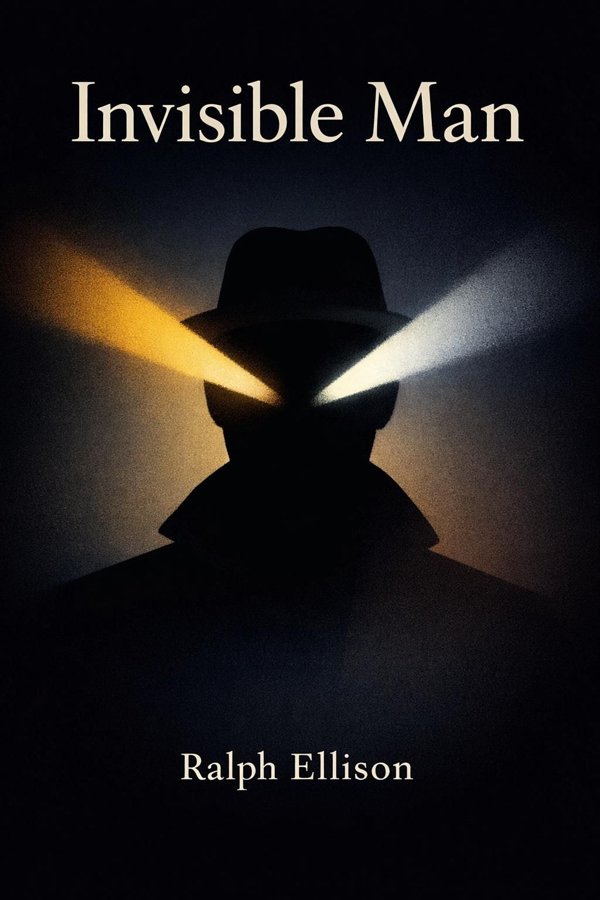
Invisible Man: Summary & Key Insights
 10 min3 chaptersAudio available
What Is Invisible Man About?
Invisible Man by Ralph Ellison is a classics book spanning 3 pages. Invisible Man is a seminal American novel that explores the African American experience in the early 20th century through the eyes of an unnamed Black narrator who feels socially invisible. The story follows his journey from the South to Harlem, confronting racism, identity, and disillusionment with both white and Black institutions. Ellison’s work combines realism, surrealism, and symbolism to depict the search for personal and social meaning in a racially divided society.
This FizzRead summary covers all 3 key chapters of Invisible Man in approximately 10 minutes, distilling the most important ideas, arguments, and takeaways from Ralph Ellison's work. Also available as an audio summary and Key Quotes Podcast.
Invisible Man
Invisible Man is a seminal American novel that explores the African American experience in the early 20th century through the eyes of an unnamed Black narrator who feels socially invisible. The story follows his journey from the South to Harlem, confronting racism, identity, and disillusionment with both white and Black institutions. Ellison’s work combines realism, surrealism, and symbolism to depict the search for personal and social meaning in a racially divided society.
Who Should Read Invisible Man?
This book is perfect for anyone interested in classics and looking to gain actionable insights in a short read. Whether you're a student, professional, or lifelong learner, the key ideas from Invisible Man by Ralph Ellison will help you think differently.
- ✓Readers who enjoy classics and want practical takeaways
- ✓Professionals looking to apply new ideas to their work and life
- ✓Anyone who wants the core insights of Invisible Man in just 10 minutes
Want the full summary?
Get instant access to this book summary and 100K+ more with Fizz Moment.
Get Free SummaryAvailable on App Store • Free to download
Key Chapters
The narrator’s journey begins underground, in a small basement filled with lightbulbs he’s stolen to illuminate his secret dwelling. Here, he speaks directly to you, insisting upon his invisibility. He isn’t a ghost but a man whose society refuses to see him as one. That subterranean setting is no mere hideout—it’s a metaphorical womb, a space between death and rebirth. As he reflects on his past, we are drawn into the long arc of his awakening.
He recalls his youth in the segregated South, where he was taught that success depended on conformity. After graduating high school, he delivers an earnest speech praising humility and obedience to white power. His reward is a grotesque initiation: the so-called “battle royal,” where young Black men are forced to fight blindfolded for the entertainment of drunken white patrons. Bloodied but still full of faith, he speaks his lines and receives a scholarship to a Black college—his first glimpse of what appears to be salvation. But even then, a deeper irony is at play. His eloquence, meant to express his dignity, becomes another performance for white approval. Each victory he gains only tightens the cords of invisibility around him.
At the Black college, he finds purpose and pride. The institution, modeled after the aspirations of the Tuskegee ideal, preaches thrift, patience, and service. He believes in Dr. Bledsoe, the college president, who preaches racial uplift within a white-dominated order. But idealism proves fragile. When he takes a white trustee, Mr. Norton, on a tour, their encounter with a destitute Black man—the ex-slave Jim Trueblood—and later with the chaotic veterans in the Golden Day bar demolishes Mr. Norton’s illusions of moral control. The narrator learns the dreadful cost of honesty: Dr. Bledsoe betrays him, claiming he has endangered the school’s standing. Bledsoe’s hypocrisy exposes a truth more painful than open racism—the exploitation of racial deference for personal survival. In that betrayal, the narrator’s second illusion dies: that Black institutions could fully protect their own against the world’s demands.
When the narrator arrives in New York, he carries letters from Dr. Bledsoe—believing they will secure him employment. But when he discovers the letters are designed to keep him out of work, the last thread of his naive trust snaps. Hungry and desperate, he takes a job at Liberty Paints, where the company’s slogan proclaims it produces the purest white paint on earth—made, ironically, with black chemicals. In the plant’s machinery and slogans, he encounters the madness of American industrial life: efficiency masking exploitation, whiteness depending upon what it denies. When the factory explodes, he wakes in a hospital, subjected to cruel medical experiments that erase his sense of identity, turning him into an object rather than a man.
Out of this rebirth, he gravitates toward Harlem, drawn to its charged energy. There, after a street incident defending an elderly Black man from eviction, a group calling itself the Brotherhood recruits him. They offer him purpose—organization, ideology, and most dangerously, recognition. Under their tutelage, he becomes a powerful orator, moving crowds with his voice, believing he’s finally being seen. But soon he learns that even praise can mask manipulation. The Brotherhood, for all its abstract talk of equality and science, is just another system of control. They study him, manage his popularity, and finally abandon him when his speeches arouse too much genuine emotion. This second disillusionment cuts deeper: he has given his body, voice, and soul to causes that use him as symbol rather than citizen. Every ideology he touches becomes a mask hiding another face of invisibility.
As he drifts away from the Brotherhood’s cold embrace, he meets Ras the Exhorter, a charismatic Black nationalist who calls for violent rebellion. Ras mocks the narrator for collaborating with white leaders, calling him a 'traitor to his race.' Their confrontation dramatizes the extremes of Black political life at mid-century—the seduction of militancy versus the paralysis of theory. Both claim to offer visibility, yet both demand surrender. Dorcas, Mary, Sybil—each woman he meets touches his awareness, but none can rescue him from the fundamental solitude of invisibility. By now he’s wearing literal disguises, changing his looks and names, each new identity crumbling until he no longer knows where his own begins. His descent into Harlem’s chaos mirrors his inner collapse: truth and illusion become inseparable.
+ 1 more chapters — available in the FizzRead app
All Chapters in Invisible Man
About the Author
Ralph Ellison (1914–1994) was an American novelist, literary critic, and scholar best known for his novel Invisible Man, which won the National Book Award in 1953. Born in Oklahoma City, Ellison studied at Tuskegee Institute and became a major voice in American literature, exploring themes of race, identity, and individuality. His essays and posthumously published works further cemented his influence on 20th-century American thought.
Get This Summary in Your Preferred Format
Read or listen to the Invisible Man summary by Ralph Ellison anytime, anywhere. FizzRead offers multiple formats so you can learn on your terms — all free.
Available formats: App · Audio · PDF · EPUB — All included free with FizzRead
Download Invisible Man PDF and EPUB Summary
Key Quotes from Invisible Man
“The narrator’s journey begins underground, in a small basement filled with lightbulbs he’s stolen to illuminate his secret dwelling.”
“When the narrator arrives in New York, he carries letters from Dr.”
Frequently Asked Questions about Invisible Man
Invisible Man by Ralph Ellison is a classics book that explores key ideas across 3 chapters. Invisible Man is a seminal American novel that explores the African American experience in the early 20th century through the eyes of an unnamed Black narrator who feels socially invisible. The story follows his journey from the South to Harlem, confronting racism, identity, and disillusionment with both white and Black institutions. Ellison’s work combines realism, surrealism, and symbolism to depict the search for personal and social meaning in a racially divided society.
You Might Also Like




Browse by Category
Ready to read Invisible Man?
Get the full summary and 100K+ more books with Fizz Moment.