
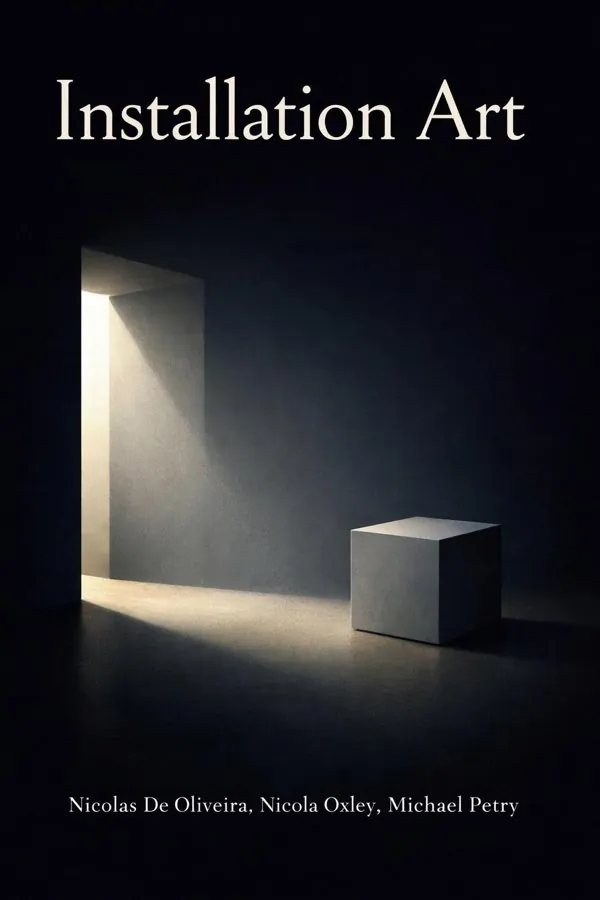
Installation Art: Summary & Key Insights
by Nicolas De Oliveira, Nicola Oxley, Michael Petry
 10 min9 chaptersAudio available
Key Takeaways from Installation Art
A defining insight of installation art is that art no longer has to be an object you stand in front of; it can be a situation you enter.
Installation art did not appear out of nowhere; it grew from a cultural moment when artists were rethinking almost every rule of art.
One of the book’s most important claims is that space in installation art is not a backdrop but the material of the work itself.
Materials in installation art are rarely chosen only for appearance; they carry conceptual, sensory, and cultural weight.
Installation art insists on a simple but radical truth: without the viewer’s body, the work is incomplete.
What Is Installation Art About?
Installation Art by Nicolas De Oliveira, Nicola Oxley, Michael Petry is a design book spanning 11 pages. Installation Art by Nicolas De Oliveira, Nicola Oxley, and Michael Petry is a lucid and wide-ranging guide to one of the most transformative forms in contemporary art. Rather than treating artworks as isolated objects, the book shows how installation art creates environments, orchestrates movement, and turns the viewer’s presence into part of the work itself. Tracing the field from its experimental roots in the 1960s through later conceptual, architectural, and multimedia developments, the authors explain how artists began to challenge the limits of sculpture, gallery display, and conventional spectatorship. What makes this book especially valuable is its combination of historical overview, critical analysis, and close attention to specific works and exhibitions. De Oliveira, Oxley, and Petry write not only as scholars but as curators deeply engaged with contemporary practice, which gives the book both authority and immediacy. For readers interested in design, art history, museum studies, or spatial experience, Installation Art matters because it reveals how artworks can reshape perception, social relations, and even the meaning of a place. It is both an introduction to the genre and a framework for seeing space itself as an artistic medium.
This FizzRead summary covers all 9 key chapters of Installation Art in approximately 10 minutes, distilling the most important ideas, arguments, and takeaways from Nicolas De Oliveira, Nicola Oxley, Michael Petry's work. Also available as an audio summary and Key Quotes Podcast.
Installation Art
Installation Art by Nicolas De Oliveira, Nicola Oxley, and Michael Petry is a lucid and wide-ranging guide to one of the most transformative forms in contemporary art. Rather than treating artworks as isolated objects, the book shows how installation art creates environments, orchestrates movement, and turns the viewer’s presence into part of the work itself. Tracing the field from its experimental roots in the 1960s through later conceptual, architectural, and multimedia developments, the authors explain how artists began to challenge the limits of sculpture, gallery display, and conventional spectatorship. What makes this book especially valuable is its combination of historical overview, critical analysis, and close attention to specific works and exhibitions. De Oliveira, Oxley, and Petry write not only as scholars but as curators deeply engaged with contemporary practice, which gives the book both authority and immediacy. For readers interested in design, art history, museum studies, or spatial experience, Installation Art matters because it reveals how artworks can reshape perception, social relations, and even the meaning of a place. It is both an introduction to the genre and a framework for seeing space itself as an artistic medium.
Who Should Read Installation Art?
This book is perfect for anyone interested in design and looking to gain actionable insights in a short read. Whether you're a student, professional, or lifelong learner, the key ideas from Installation Art by Nicolas De Oliveira, Nicola Oxley, Michael Petry will help you think differently.
- ✓Readers who enjoy design and want practical takeaways
- ✓Professionals looking to apply new ideas to their work and life
- ✓Anyone who wants the core insights of Installation Art in just 10 minutes
Want the full summary?
Get instant access to this book summary and 100K+ more with Fizz Moment.
Get Free SummaryAvailable on App Store • Free to download
Key Chapters
A defining insight of installation art is that art no longer has to be an object you stand in front of; it can be a situation you enter. This shift is central to the book’s argument. De Oliveira, Oxley, and Petry trace how artists from the 1960s onward began moving away from self-contained paintings and sculptures toward works that occupied whole rooms, altered environments, and required bodily engagement. Installation art emerged from dissatisfaction with traditional hierarchies of modernism, especially the assumption that art should be autonomous, permanent, and viewed at a distance. Instead, artists made works that were site-aware, unstable, and experiential.
The result was a new relationship between artwork and audience. Viewers were no longer passive observers. They became participants whose movement, attention, and interpretation completed the work. This had major implications for design and exhibition-making. A gallery was no longer a neutral box; it was part of the meaning. Lighting, circulation, sound, scale, and placement became expressive tools. In practical terms, this can be seen in installations that guide people through narrow corridors, confront them with unexpected materials, or immerse them in projections, mirrors, or scent. The work unfolds over time, not in a single glance.
For designers, curators, and artists, this idea broadens what creative practice can be. A retail environment, memorial space, or museum exhibition can be conceived not just as a container but as a narrative sequence. The actionable takeaway is simple: when evaluating or creating a space, ask not only what people will see, but what they will physically and emotionally experience as they move through it.
Installation art did not appear out of nowhere; it grew from a cultural moment when artists were rethinking almost every rule of art. The book emphasizes the ferment of the 1960s as a decisive turning point. Happenings, performance, conceptual art, minimalism, and land art all contributed to an atmosphere in which the fixed art object began to lose its dominance. Artists such as Allan Kaprow questioned whether art needed to be a durable thing at all, while others explored environments, actions, and events that blurred distinctions between art and life.
This period also mattered because institutions themselves became targets of critique. If museums framed meaning through display conventions, then changing the space could change the artwork’s significance. Installation became a way to reject conventional modes of consumption and to challenge the authority of the white cube. Instead of isolated masterpieces, artists created total environments, accumulations of found materials, or temporary interventions that emphasized context and process. The influence of social change, political unrest, and expanded media culture also shaped these experiments. Installation art was not just formally innovative; it responded to a broader desire for participation, immediacy, and critical engagement.
Understanding these roots helps readers avoid seeing installation as merely decorative spectacle. Its history is bound up with rebellion, experimentation, and institutional critique. A practical application of this idea is to examine any installation by asking what tradition it resists: object-based art, passive viewing, commercial display, or architectural neutrality. The actionable takeaway is to place every immersive artwork in historical context, because its power often lies in the conventions it is trying to overturn.
One of the book’s most important claims is that space in installation art is not a backdrop but the material of the work itself. This changes everything. In painting, a canvas carries an image; in installation, the room, site, or environment becomes part of the composition. Walls, ceilings, floor plans, entry points, and sightlines are not incidental. They determine how the work is perceived and often what it means. The viewer does not simply look at form; the viewer inhabits a spatial logic.
De Oliveira, Oxley, and Petry show that artists use space to produce disorientation, intimacy, monumentality, or reflection. A cramped passage can induce vulnerability. A vast empty chamber can heighten self-awareness. A mirrored room can destabilize perception and multiply presence. Even silence, shadow, temperature, or texture can become spatial tools. This is why installation art often enters into dialogue with architecture. It may reinforce a building’s structure, expose hidden features, or work against the intended use of a site. A staircase, corridor, threshold, or window may become central expressive devices.
This insight is highly relevant beyond fine art. Architects, interior designers, exhibition planners, and experience designers all shape meaning through spatial sequencing. A hospital waiting room, flagship store, or public installation can be arranged to calm, direct, or provoke users. The lesson is to think of space as active rather than neutral. The actionable takeaway is to map how movement, scale, and sensory transitions affect interpretation before finalizing any spatial design or exhibition plan.
Materials in installation art are rarely chosen only for appearance; they carry conceptual, sensory, and cultural weight. The book highlights how installation artists frequently use unconventional media such as found objects, industrial debris, video, fabric, light, sound, earth, or organic matter. These materials often resist traditional art values like permanence, polish, and collectible form. Their significance lies as much in association and process as in visual impact.
This focus on materiality makes installation art especially rich for interpretation. A room filled with discarded furniture may evoke memory, class, or domestic collapse. Wax, dust, water, or neon can suggest fragility, decay, technological saturation, or ritual. Because installations are often assembled on site, the act of making becomes part of the work’s logic. Construction, accumulation, layering, and adaptation all matter. The finished environment may bear traces of labor, improvisation, and temporal change, which gives the work an open, living quality.
The authors also point out that process influences reception. Unlike a static sculpture fabricated elsewhere and placed on a pedestal, an installation often responds to site conditions during setup. Curators, technicians, and artists collaborate, and the final form may shift depending on budget, architecture, and audience flow. This has implications for anyone working in design or curation: materials communicate values, and process shapes experience. Practical examples include using recycled materials to comment on waste, or using translucent partitions to choreograph uncertainty and discovery. The actionable takeaway is to choose materials not only for function or beauty, but for the ideas, histories, and sensory reactions they will activate in the viewer.
Installation art insists on a simple but radical truth: without the viewer’s body, the work is incomplete. This is one of the genre’s most transformative features. The book explains that installation redefines spectatorship by making presence, movement, and perception central components of meaning. Instead of standing outside the artwork, the audience enters it, activates it, and sometimes even alters it through touch, sound, or participation.
This participatory dimension exists on a spectrum. In some works, the viewer’s role is primarily phenomenological: walking through the space changes what can be seen, heard, or felt. In others, interaction is more direct, requiring decisions, manipulation, or social engagement. Even when no physical participation is requested, the viewer’s bodily awareness becomes heightened. Installation often makes people conscious of their scale, pace, and relation to others. It can generate empathy, discomfort, collective attention, or private introspection.
The practical significance is enormous. Experience design, museum education, public art, and digital environments all rely on understanding how users co-create meaning. A successful installation does not simply present information; it stages a relationship. For example, an immersive historical exhibition may use sound and spatial progression to deepen emotional understanding, while a participatory artwork may encourage strangers to collaborate, exposing social dynamics in real time.
The key lesson is that audience behavior is not an afterthought but a design material. The actionable takeaway is to anticipate how bodies will move, pause, hesitate, and interact, and then build those responses into the conceptual structure of the work.
Installation art can be visually overwhelming, but the book makes clear that its real force often lies in ideas rather than spectacle. Many installations are grounded in conceptual concerns: memory, identity, power, displacement, ecology, ritual, technology, or institutional critique. The arrangement of objects and spaces is meaningful not because it is unusual, but because it embodies a way of thinking. Without attention to concept, installation risks becoming mere theatrical display.
De Oliveira, Oxley, and Petry show how installations frequently operate like arguments in spatial form. They can question how museums frame culture, how architecture organizes behavior, or how personal histories inhabit domestic spaces. A sparse room may address absence and loss; a chaotic accumulation may reflect media overload or political crisis. The point is not simply to impress the senses, but to organize perception around an intellectual and emotional proposition.
This is especially relevant in contemporary design culture, where immersive environments are often used for branding or entertainment. The book reminds readers that immersion becomes more powerful when it is tied to a strong conceptual framework. In practice, that means every material and spatial decision should connect to a central idea. A sound installation about migration might use fragmentation and overlapping voices; a memorial installation might rely on repetition, emptiness, or delayed revelation.
For creators and interpreters alike, the takeaway is to ask what problem, question, or theme an installation is staging. The actionable takeaway is to identify a single governing concept first, then ensure that layout, materials, pacing, and sensory effects all reinforce that intellectual core.
Installation art does not only occupy space; it often exposes time. The book underscores how installations are deeply temporal, unfolding through duration, change, and impermanence. Unlike traditional artworks designed for long-term preservation, many installations are temporary by nature. They may exist only for a specific exhibition, respond to a fleeting social context, or physically transform over time through melting, decay, exhaustion, or audience interaction.
This temporality creates a productive tension with architecture. Buildings suggest stability and use; installations can interrupt, reframe, or temporarily rewrite those expectations. A work may convert a lobby into a contemplative zone, turn a warehouse into a labyrinth, or reveal neglected architectural features through light, sound, or obstruction. Time is also embedded in the viewer’s experience. An installation often requires walking, waiting, repetition, or return. Meaning emerges gradually, not instantly.
The ephemeral nature of the form also raises important questions. If a work is dismantled after an exhibition, what remains? Is the essence of the piece its concept, its layout, its materials, or its lived experience? These issues are especially important for curators and institutions, but they also matter for designers working with pop-up environments, scenography, and temporary public interventions. Ephemerality can be a strength rather than a weakness, allowing work to respond acutely to the present.
A practical application is to design installations or exhibitions that acknowledge lifecycle from the start: setup, duration, transformation, and dismantling. The actionable takeaway is to treat time as a design element by considering how a work changes across hours, days, and audience encounters, not just how it appears at opening.
One of the most practical and often overlooked issues in installation art is that many works cannot be fully preserved, only reinterpreted. The book addresses documentation, conservation, and curatorial practice as central concerns rather than administrative afterthoughts. Because installations are site-specific, temporary, and materially complex, traditional methods of collecting and archiving are often inadequate. Photographs, floor plans, artist instructions, video walkthroughs, interviews, and installation notes all become essential records.
Yet documentation is never neutral. A photograph may flatten a spatial experience; a floor plan may miss atmosphere; a written score may leave room for significant variation in future restagings. Curators therefore play a creative role. They do not simply display installation art; they mediate between concept, space, institutional constraints, and public encounter. Reinstalling a work may require interpretation rather than replication, especially when materials are obsolete, perishable, or context-dependent.
The book’s contemporary relevance is clear. Today’s installations often incorporate digital media, networked systems, live performance, or participatory components, which make preservation even more complex. Designers and institutions can learn from this by developing process documentation early, clarifying artist intent, and deciding what aspects of a work are essential versus adaptable. This principle also applies to experiential design more broadly, where temporary environments often disappear without leaving usable knowledge behind.
The actionable takeaway is to document every immersive project as a system: concept, sensory conditions, visitor pathways, materials, technical setup, and intended effects. Doing so preserves not just appearance, but the logic needed for future understanding or reconstruction.
All Chapters in Installation Art
About the Authors
Nicolas De Oliveira, Nicola Oxley, and Michael Petry are respected curators, writers, and art historians whose work has focused extensively on contemporary visual culture, especially installation and conceptual art. Their collaboration reflects a rare blend of scholarly analysis and hands-on curatorial experience, allowing them to address installation art as both a historical development and a living practice. Across exhibitions, publications, and critical projects, they have helped clarify how contemporary artists use space, material, and participation to challenge conventional categories of art. Their expertise is especially valuable because installation art often demands an understanding not just of theory, but of display, audience experience, and institutional context. In Installation Art, they bring that combined authority to a field that is complex, interdisciplinary, and central to understanding contemporary artistic practice.
Get This Summary in Your Preferred Format
Read or listen to the Installation Art summary by Nicolas De Oliveira, Nicola Oxley, Michael Petry anytime, anywhere. FizzRead offers multiple formats so you can learn on your terms — all free.
Available formats: App · Audio · PDF · EPUB — All included free with FizzRead
Download Installation Art PDF and EPUB Summary
Key Quotes from Installation Art
“A defining insight of installation art is that art no longer has to be an object you stand in front of; it can be a situation you enter.”
“Installation art did not appear out of nowhere; it grew from a cultural moment when artists were rethinking almost every rule of art.”
“One of the book’s most important claims is that space in installation art is not a backdrop but the material of the work itself.”
“Materials in installation art are rarely chosen only for appearance; they carry conceptual, sensory, and cultural weight.”
“Installation art insists on a simple but radical truth: without the viewer’s body, the work is incomplete.”
Frequently Asked Questions about Installation Art
Installation Art by Nicolas De Oliveira, Nicola Oxley, Michael Petry is a design book that explores key ideas across 9 chapters. Installation Art by Nicolas De Oliveira, Nicola Oxley, and Michael Petry is a lucid and wide-ranging guide to one of the most transformative forms in contemporary art. Rather than treating artworks as isolated objects, the book shows how installation art creates environments, orchestrates movement, and turns the viewer’s presence into part of the work itself. Tracing the field from its experimental roots in the 1960s through later conceptual, architectural, and multimedia developments, the authors explain how artists began to challenge the limits of sculpture, gallery display, and conventional spectatorship. What makes this book especially valuable is its combination of historical overview, critical analysis, and close attention to specific works and exhibitions. De Oliveira, Oxley, and Petry write not only as scholars but as curators deeply engaged with contemporary practice, which gives the book both authority and immediacy. For readers interested in design, art history, museum studies, or spatial experience, Installation Art matters because it reveals how artworks can reshape perception, social relations, and even the meaning of a place. It is both an introduction to the genre and a framework for seeing space itself as an artistic medium.
You Might Also Like
The Design of Everyday Things
Don Norman
10 min
The Better Angels of Our Nature
Steven Pinker
10 min
A Designer's Art
Paul Rand
10 min
Architects' Sketchbooks
Various Editors
10 min
Architectural Graphic Standards
The American Institute of Architects
10 min
Design Is Storytelling
Ellen Lupton
10 minBrowse by Category
Ready to read Installation Art?
Get the full summary and 100K+ more books with Fizz Moment.