
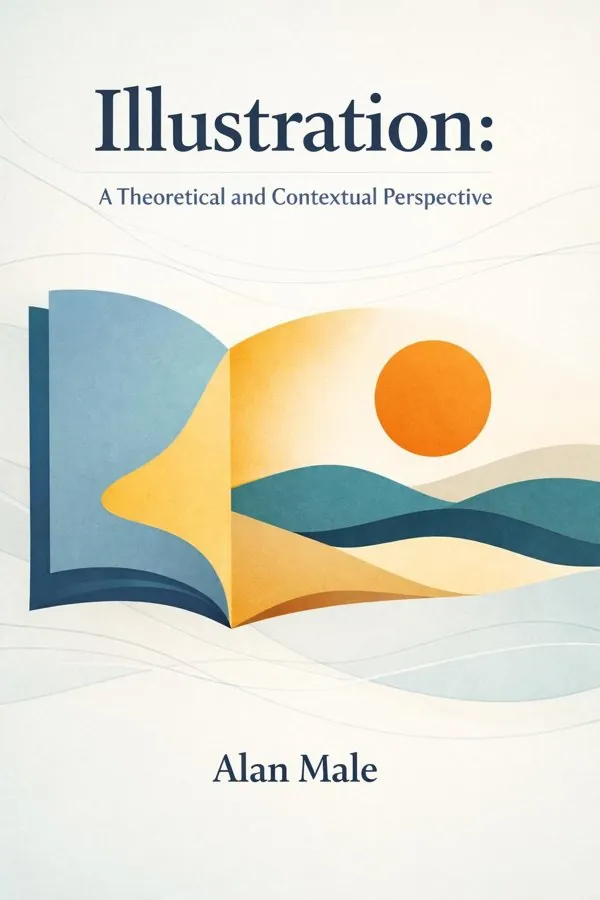
Illustration: A Theoretical and Contextual Perspective: Summary & Key Insights
by Alan Male
 10 min9 chaptersAudio available
Key Takeaways from Illustration: A Theoretical and Contextual Perspective
The most effective illustrations do not simply show something; they think for the viewer.
An image never speaks in a vacuum; its meaning changes with where, why, and for whom it appears.
A memorable visual style may attract attention, but concept is what gives illustration lasting value.
One reason illustration remains so vital is that it can perform many jobs at once.
An illustration succeeds when it meets viewers where they are without underestimating their intelligence.
What Is Illustration: A Theoretical and Contextual Perspective About?
Illustration: A Theoretical and Contextual Perspective by Alan Male is a design book. Illustration: A Theoretical and Contextual Perspective is far more than a guide to drawing images for publication. Alan Male presents illustration as a rich visual language shaped by culture, technology, commerce, politics, and communication. The book examines how illustration works across contexts—from editorial and advertising to education, publishing, information design, and digital media—and asks readers to think seriously about why images persuade, explain, delight, and endure. Rather than treating illustration as decoration, Male positions it as a discipline with its own theories, histories, methods, and social responsibilities. What makes this book especially valuable is its balance of academic rigor and practical relevance. Male explores conceptual development, audience awareness, visual rhetoric, professional practice, and changing industry conditions, helping readers see both the ideas behind the work and the realities of making it. His authority comes from deep experience as an illustrator, educator, and commentator on visual communication. For students, designers, illustrators, and creative professionals, this book offers a framework for understanding illustration not just as an art form, but as a purposeful act of communication embedded in real-world contexts.
This FizzRead summary covers all 9 key chapters of Illustration: A Theoretical and Contextual Perspective in approximately 10 minutes, distilling the most important ideas, arguments, and takeaways from Alan Male's work. Also available as an audio summary and Key Quotes Podcast.
Illustration: A Theoretical and Contextual Perspective
Illustration: A Theoretical and Contextual Perspective is far more than a guide to drawing images for publication. Alan Male presents illustration as a rich visual language shaped by culture, technology, commerce, politics, and communication. The book examines how illustration works across contexts—from editorial and advertising to education, publishing, information design, and digital media—and asks readers to think seriously about why images persuade, explain, delight, and endure. Rather than treating illustration as decoration, Male positions it as a discipline with its own theories, histories, methods, and social responsibilities.
What makes this book especially valuable is its balance of academic rigor and practical relevance. Male explores conceptual development, audience awareness, visual rhetoric, professional practice, and changing industry conditions, helping readers see both the ideas behind the work and the realities of making it. His authority comes from deep experience as an illustrator, educator, and commentator on visual communication. For students, designers, illustrators, and creative professionals, this book offers a framework for understanding illustration not just as an art form, but as a purposeful act of communication embedded in real-world contexts.
Who Should Read Illustration: A Theoretical and Contextual Perspective?
This book is perfect for anyone interested in design and looking to gain actionable insights in a short read. Whether you're a student, professional, or lifelong learner, the key ideas from Illustration: A Theoretical and Contextual Perspective by Alan Male will help you think differently.
- ✓Readers who enjoy design and want practical takeaways
- ✓Professionals looking to apply new ideas to their work and life
- ✓Anyone who wants the core insights of Illustration: A Theoretical and Contextual Perspective in just 10 minutes
Want the full summary?
Get instant access to this book summary and 100K+ more with Fizz Moment.
Get Free SummaryAvailable on App Store • Free to download
Key Chapters
The most effective illustrations do not simply show something; they think for the viewer. One of Alan Male’s central contributions is to define illustration as a form of purposeful visual communication rather than a secondary craft attached to text. In this view, illustration is not merely decorative styling. It interprets, frames, condenses, questions, and often transforms information into a visual form that can be grasped emotionally and intellectually at once.
Male emphasizes that illustration sits at the intersection of concept, audience, message, and context. A single image can summarize a complex argument, create atmosphere, reveal hidden relationships, or persuade someone to pay attention. Consider an editorial illustration about climate policy. A literal image of smoke stacks may be competent, but a more concept-driven image—such as a melting balance scale weighing profit against survival—creates argument, not just description. That shift from depiction to interpretation is where illustration becomes powerful.
This idea matters because many beginning illustrators focus first on style, technique, or visual polish. Male pushes readers to ask a more important question: what is the image doing? Is it clarifying a concept, provoking reflection, reinforcing a brand, guiding a user, or challenging assumptions? In professional contexts, the answer shapes every creative choice, from composition and metaphor to medium and tone.
In practice, this means that illustrators should begin with communication goals before visual execution. For a children’s educational book, clarity and engagement may matter most. For a newspaper opinion page, ambiguity and conceptual tension may be more useful. For a medical diagram, accuracy and hierarchy are essential.
Actionable takeaway: before starting any illustration, write a one-sentence purpose statement that defines what the image must make the audience understand, feel, or do.
An image never speaks in a vacuum; its meaning changes with where, why, and for whom it appears. Male repeatedly stresses the contextual nature of illustration, showing that visuals derive much of their power from the environments in which they are used. The same image can read as playful in a children’s book, ironic in a magazine, persuasive in an ad campaign, or instructional in a museum panel. Context is not a background detail—it is part of the message itself.
This insight helps explain why illustration must be studied as a contextual discipline, not only as a set of techniques. Editorial illustration responds to current events, public discourse, and publication tone. Packaging illustration must compete in crowded commercial spaces while signaling product identity and audience expectations. Educational illustration often serves comprehension and retention. Digital illustration may also need to function interactively, across screen sizes, and within user journeys.
Male’s framework encourages readers to think beyond image-making and into systems of meaning. For example, an illustration for a luxury brand may use restrained composition, refined line, and spacious layout to communicate exclusivity. The same artistic treatment might fail completely in a public health campaign, where urgency and accessibility are more important than elegance. The context governs readability, appropriateness, and effectiveness.
This also means that illustrators are problem-solvers. They need to understand publication formats, deadlines, budgets, reproduction constraints, audience literacy, cultural sensitivity, and platform behavior. A beautifully drawn image that ignores context can miss its purpose. A simpler image that fits the context can succeed brilliantly.
Actionable takeaway: when planning an illustration, define the platform, audience, purpose, and setting before developing concepts, and test whether the image still works when placed in its actual context.
A memorable visual style may attract attention, but concept is what gives illustration lasting value. Male does not dismiss style—far from it. He recognizes that stylistic choices shape tone, identity, and recognizability. Yet he argues that style becomes truly meaningful only when it serves the communication task. This is an important corrective in a creative culture that often rewards surface distinction over conceptual depth.
Illustrators are frequently identified by how their work looks: minimal, expressive, surreal, geometric, collage-based, painterly, digital, hand-drawn. But Male asks readers to consider what happens when style becomes habitual shorthand rather than a responsive tool. If every brief receives the same visual treatment regardless of message, the work risks becoming formulaic. Strong illustration requires a fit between idea and form.
For instance, a loose, humorous line style might be perfect for an article on workplace absurdities, while a sharper, more controlled visual language may better serve financial journalism or scientific explanation. Likewise, metaphor-heavy collage may be ideal for conceptual editorial work but less suitable for instructional sequences where clarity is paramount. The point is not to abandon personal style, but to develop it as a flexible system that can carry different meanings.
Male’s perspective also helps students avoid a common mistake: building portfolios around imitation. Technique can be learned quickly, but conceptual agility takes reflection, research, and iteration. Clients and audiences ultimately respond not only to visual flair, but to relevance, insight, and appropriateness.
Actionable takeaway: for every project, generate at least three different conceptual approaches before choosing a style, and make sure the selected visual treatment strengthens the idea rather than merely decorating it.
One reason illustration remains so vital is that it can perform many jobs at once. Male presents illustration as a versatile discipline that can inform, persuade, narrate, identify, interpret, entertain, and organize knowledge. This multifunctional quality helps explain why illustration appears across so many industries and media forms. It is not limited to publishing or gallery contexts; it is embedded in everyday communication.
An infographic can simplify complex data. A textbook diagram can make abstract science visible. A branded character can build recognition and emotional connection. An editorial image can add critique to a written argument. A storyboard can pre-visualize motion and narrative. A map can orient users in physical or digital space. In each case, the illustration is doing more than adding beauty. It is shaping understanding and behavior.
Male’s broader theoretical framing is useful because it prevents narrow definitions of the field. Many people still associate illustration primarily with books or magazines, but contemporary practice stretches into app interfaces, animation pipelines, games, exhibitions, healthcare communication, environmental graphics, and social campaigns. The illustrator’s role can therefore shift from image-maker to collaborator, strategist, educator, or visual interpreter.
Recognizing multiple functions also encourages better design decisions. If an image must both engage and instruct, then charm alone is not enough; sequencing, labeling, hierarchy, and accessibility become essential. If an image must persuade, rhetorical devices such as contrast, exaggeration, symbolism, and framing matter more. Thinking in functions makes creative work more precise.
Actionable takeaway: define the primary and secondary functions of each illustration—such as explain, persuade, narrate, or brand—so your creative choices support the actual job the image needs to do.
An illustration succeeds when it meets viewers where they are without underestimating their intelligence. Male underscores the importance of audience as a foundational factor in illustration practice. Every image assumes a viewer with particular expectations, cultural references, emotional needs, and levels of knowledge. Ignoring the audience can turn a clever image into a confusing one, or an informative image into an alienating one.
This does not mean reducing work to the lowest common denominator. Rather, it means designing meaning with intention. A health brochure for the general public needs different visual strategies than a specialist medical manual. A children’s picture book requires different pacing, color use, and narrative cues than an annual report. A political editorial illustration may rely on satire and symbolism, but those devices only work if the target audience can decode them.
Male’s contextual approach also suggests that audiences are not static. They are shaped by media habits, social climate, and visual culture. Contemporary viewers may be visually sophisticated in some areas, such as meme logic or digital iconography, yet unfamiliar with historical symbolism or print conventions. Illustrators must therefore consider legibility, cultural specificity, inclusivity, and potential misreading.
Practical audience awareness often includes research: understanding age group, literacy level, professional background, visual preferences, and emotional context. An image about grief, illness, or crisis demands different sensitivity than one selling a lifestyle product. In global communication, the same symbol may carry different meanings across regions.
Actionable takeaway: create a brief audience profile before developing ideas, including what the viewers already know, what they need to understand, and what visual references they are most likely to recognize.
New tools may transform how illustrations are produced and distributed, but they do not erase the underlying principles of visual communication. Male treats technological change as an important force in the development of illustration, yet he avoids the simplistic idea that technology alone defines progress. Whether created with pen and ink, collage, vector software, 3D modeling, or digital painting, illustration still depends on concept, audience, clarity, and context.
This perspective is especially useful in periods of rapid media change. As illustration moves across print, web, motion, interactive platforms, and hybrid environments, practitioners can feel pressure to chase every new technique. Male’s framework reminds readers that the medium should support the message, not replace it. A technically advanced image that lacks communicative purpose is less effective than a modest one with strong conceptual focus.
At the same time, technology does expand possibilities. Digital workflows allow fast revision, layered experimentation, scalable outputs, and cross-platform adaptation. Motion and interactive features can reveal process, sequence information, or respond to user input. Social platforms can also alter how illustration circulates, builds audiences, and participates in public discourse. These developments change professional practice, deadlines, collaboration, and visibility.
Still, the same questions remain: What is being communicated? To whom? In what environment? Why this form? A successful illustrator adapts to tools without becoming ruled by them. Technical versatility matters most when it increases strategic choice.
Actionable takeaway: when adopting a new tool or medium, identify one communication problem it solves better than your current method, and use it intentionally rather than simply because it is new.
Images persuade not only through beauty, but through structure, symbolism, and strategy. Male’s approach to illustration highlights the rhetorical dimension of image-making: the way visual choices frame an argument, evoke emotion, establish credibility, and guide interpretation. This is especially important in editorial, advertising, political, and institutional settings, where illustration often works as condensed persuasion.
Visual rhetoric operates through devices such as metaphor, juxtaposition, scale distortion, irony, repetition, contrast, and simplification. For example, an editorial illustration showing a politician as a puppet communicates dependency and manipulation instantly. An image of a maze shaped like a tax form conveys complexity and frustration without lengthy explanation. These are rhetorical constructions, not neutral representations.
Male’s contribution is to connect such techniques to context and intention. Persuasive imagery is not simply clever. It must be appropriate to audience, medium, and purpose. A bold satirical metaphor might energize an opinion page but undermine trust in a public safety notice. Likewise, emotional persuasion can be powerful in fundraising campaigns, but manipulative if disconnected from truthful representation.
Understanding visual rhetoric also strengthens collaboration. When illustrators can explain why a certain metaphor or composition communicates more effectively, they become strategic contributors rather than just image suppliers. This is particularly valuable in client presentations, teaching contexts, and interdisciplinary teams.
In everyday practice, thinking rhetorically means asking what claim the image is making and how its form supports that claim. Composition, color, symbol, gesture, and point of view all matter.
Actionable takeaway: after sketching a concept, state the argument of the image in one sentence and identify the visual device—metaphor, contrast, irony, or symbolism—that delivers its persuasive force.
The best illustrators do not only make images; they examine how and why those images work. One of the strongest aspects of Male’s book is its insistence on reflective practice. He encourages readers to analyze illustration historically, theoretically, and professionally so that making becomes more conscious, adaptable, and informed. This is especially important in education, where students can otherwise mistake production speed for understanding.
Critical reflection involves looking at precedents, questioning assumptions, articulating intentions, and evaluating outcomes. Why does one image communicate more effectively than another? How did cultural context shape a visual trend? What values are embedded in a particular style? What are the ethical consequences of a representation? These questions deepen practice beyond technical proficiency.
Male’s perspective is valuable for working professionals as well. In a fast-paced industry, it is easy to repeat familiar solutions. Reflection interrupts that automation. A freelancer reviewing past projects may notice that their strongest work came from well-researched briefs and collaborative dialogue. A student may realize that their portfolio emphasizes aesthetic consistency but lacks audience range. A creative team may discover that certain visuals unintentionally exclude or confuse viewers.
This reflective habit also supports resilience. Trends shift, tools evolve, and markets change. Practitioners who understand principles, history, and context are better equipped to adapt than those relying only on a fixed style. Reflection turns experience into judgment.
Actionable takeaway: after every completed project, conduct a brief review of what the illustration was meant to achieve, what actually worked, what was misunderstood, and what you would change next time.
All Chapters in Illustration: A Theoretical and Contextual Perspective
About the Author
Alan Male is a British illustrator, writer, and educator known for his contributions to the study of illustration as a form of visual communication. His work stands out for connecting professional practice with theory, helping students and practitioners understand how illustration functions across editorial, publishing, advertising, branding, and digital contexts. In addition to working as an illustrator, Male has taught and written extensively about the discipline, giving him a perspective that is both practical and academic. He is especially respected for arguing that illustration should be understood not as decoration, but as a purposeful, context-sensitive medium shaped by audience, culture, technology, and industry. His books are widely used by design and illustration students seeking a deeper foundation for creative practice.
Get This Summary in Your Preferred Format
Read or listen to the Illustration: A Theoretical and Contextual Perspective summary by Alan Male anytime, anywhere. FizzRead offers multiple formats so you can learn on your terms — all free.
Available formats: App · Audio · PDF · EPUB — All included free with FizzRead
Download Illustration: A Theoretical and Contextual Perspective PDF and EPUB Summary
Key Quotes from Illustration: A Theoretical and Contextual Perspective
“The most effective illustrations do not simply show something; they think for the viewer.”
“An image never speaks in a vacuum; its meaning changes with where, why, and for whom it appears.”
“A memorable visual style may attract attention, but concept is what gives illustration lasting value.”
“One reason illustration remains so vital is that it can perform many jobs at once.”
“An illustration succeeds when it meets viewers where they are without underestimating their intelligence.”
Frequently Asked Questions about Illustration: A Theoretical and Contextual Perspective
Illustration: A Theoretical and Contextual Perspective by Alan Male is a design book that explores key ideas across 9 chapters. Illustration: A Theoretical and Contextual Perspective is far more than a guide to drawing images for publication. Alan Male presents illustration as a rich visual language shaped by culture, technology, commerce, politics, and communication. The book examines how illustration works across contexts—from editorial and advertising to education, publishing, information design, and digital media—and asks readers to think seriously about why images persuade, explain, delight, and endure. Rather than treating illustration as decoration, Male positions it as a discipline with its own theories, histories, methods, and social responsibilities. What makes this book especially valuable is its balance of academic rigor and practical relevance. Male explores conceptual development, audience awareness, visual rhetoric, professional practice, and changing industry conditions, helping readers see both the ideas behind the work and the realities of making it. His authority comes from deep experience as an illustrator, educator, and commentator on visual communication. For students, designers, illustrators, and creative professionals, this book offers a framework for understanding illustration not just as an art form, but as a purposeful act of communication embedded in real-world contexts.
You Might Also Like

The Design of Everyday Things
Don Norman
10 min
The Better Angels of Our Nature
Steven Pinker
10 min
A Designer's Art
Paul Rand
10 min
Architects' Sketchbooks
Various Editors
10 min
Architectural Graphic Standards
The American Institute of Architects
10 min
Design Is Storytelling
Ellen Lupton
10 minBrowse by Category
Ready to read Illustration: A Theoretical and Contextual Perspective?
Get the full summary and 100K+ more books with Fizz Moment.