
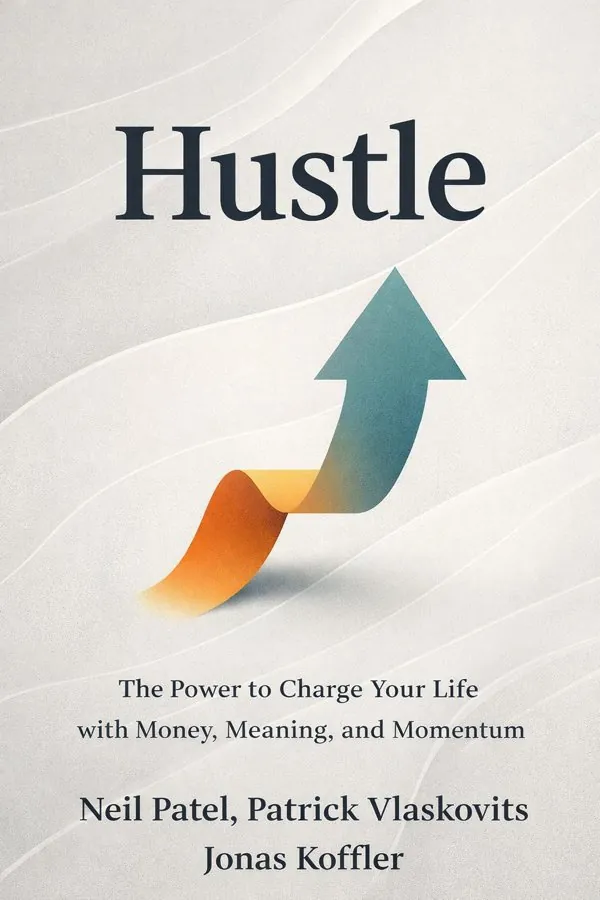
Hustle: The Power to Charge Your Life with Money, Meaning, and Momentum: Summary & Key Insights
by Neil Patel, Patrick Vlaskovits, Jonas Koffler
 10 min9 chaptersAudio available
Key Takeaways from Hustle: The Power to Charge Your Life with Money, Meaning, and Momentum
One of the book’s sharpest insights is that the biggest career risk today may be trusting the old rules.
Sustainable hustle is not powered by effort alone; it rests on the interaction of emotion, strategy, and repetition.
The authors make an important distinction: real hustle begins with emotional truth, not external pressure.
Ambition without direction is expensive.
If Heart provides energy and Head provides direction, Habits provide motion.
What Is Hustle: The Power to Charge Your Life with Money, Meaning, and Momentum About?
Hustle: The Power to Charge Your Life with Money, Meaning, and Momentum by Neil Patel, Patrick Vlaskovits, Jonas Koffler is a entrepreneurship book spanning 11 pages. Hustle is a practical and motivating guide to succeeding in a world where the old promises of security no longer reliably hold. Neil Patel, Patrick Vlaskovits, and Jonas Koffler argue that waiting for permission, following a rigid career script, or depending on a single employer is increasingly risky. Instead, they propose a new model of work and life built around initiative, experimentation, adaptability, and self-directed value creation. Importantly, their definition of hustle is not blind overwork or burnout-driven ambition. It is the ability to generate money, meaning, and momentum by combining emotional drive, strategic thinking, and consistent action. The book matters because it speaks directly to modern uncertainty: unstable industries, shifting technologies, side hustles, freelance careers, and the growing need to reinvent oneself. Patel brings entrepreneurial and marketing expertise, Vlaskovits contributes startup and innovation thinking, and Koffler adds insight into creativity and personal growth. Together, they present hustle as a learnable framework for building a more resilient, energized, and opportunity-rich life.
This FizzRead summary covers all 9 key chapters of Hustle: The Power to Charge Your Life with Money, Meaning, and Momentum in approximately 10 minutes, distilling the most important ideas, arguments, and takeaways from Neil Patel, Patrick Vlaskovits, Jonas Koffler's work. Also available as an audio summary and Key Quotes Podcast.
Hustle: The Power to Charge Your Life with Money, Meaning, and Momentum
Hustle is a practical and motivating guide to succeeding in a world where the old promises of security no longer reliably hold. Neil Patel, Patrick Vlaskovits, and Jonas Koffler argue that waiting for permission, following a rigid career script, or depending on a single employer is increasingly risky. Instead, they propose a new model of work and life built around initiative, experimentation, adaptability, and self-directed value creation. Importantly, their definition of hustle is not blind overwork or burnout-driven ambition. It is the ability to generate money, meaning, and momentum by combining emotional drive, strategic thinking, and consistent action. The book matters because it speaks directly to modern uncertainty: unstable industries, shifting technologies, side hustles, freelance careers, and the growing need to reinvent oneself. Patel brings entrepreneurial and marketing expertise, Vlaskovits contributes startup and innovation thinking, and Koffler adds insight into creativity and personal growth. Together, they present hustle as a learnable framework for building a more resilient, energized, and opportunity-rich life.
Who Should Read Hustle: The Power to Charge Your Life with Money, Meaning, and Momentum?
This book is perfect for anyone interested in entrepreneurship and looking to gain actionable insights in a short read. Whether you're a student, professional, or lifelong learner, the key ideas from Hustle: The Power to Charge Your Life with Money, Meaning, and Momentum by Neil Patel, Patrick Vlaskovits, Jonas Koffler will help you think differently.
- ✓Readers who enjoy entrepreneurship and want practical takeaways
- ✓Professionals looking to apply new ideas to their work and life
- ✓Anyone who wants the core insights of Hustle: The Power to Charge Your Life with Money, Meaning, and Momentum in just 10 minutes
Want the full summary?
Get instant access to this book summary and 100K+ more with Fizz Moment.
Get Free SummaryAvailable on App Store • Free to download
Key Chapters
One of the book’s sharpest insights is that the biggest career risk today may be trusting the old rules. For generations, people were told that if they studied hard, got a respectable job, stayed loyal, and climbed steadily, they would eventually earn security and success. The authors call this belief system the Hustle Fallacy: the comforting but outdated idea that compliance guarantees stability. In reality, markets change quickly, industries disappear, layoffs happen without warning, and credentials alone no longer protect people from disruption.
The authors do not dismiss education, hard work, or professional discipline. Instead, they argue that these qualities must now be paired with initiative. Rather than relying on institutions to create opportunities, individuals need to learn how to create their own. That could mean freelancing while employed, building a personal brand, testing a business idea, developing digital skills, or cultivating a network beyond one’s company. Hustle, in this sense, is not rebellion for its own sake. It is an adaptive response to a changing economy.
A practical example is the employee who notices demand for a skill outside their job description—such as copywriting, design, coding, or coaching—and starts offering that skill independently. Over time, they become less dependent on a single paycheck and more capable of navigating change.
Actionable takeaway: stop assuming stability will be handed to you. Identify one area where you rely too heavily on a system, employer, or credential, and begin building a parallel source of skill, income, or opportunity.
Sustainable hustle is not powered by effort alone; it rests on the interaction of emotion, strategy, and repetition. The authors frame this through three unseen laws: Heart, Head, and Habits. Heart is your emotional fuel—the desire, conviction, and personal meaning behind what you pursue. Head is your decision-making ability—how clearly you assess risk, identify opportunities, and choose where to focus. Habits are the systems of execution that turn intentions into results.
This framework matters because many people fail by overinvesting in only one dimension. Someone with Heart but no Head may chase exciting ideas without discipline. Someone with Head but no Heart may make rational choices that feel empty and impossible to sustain. Someone with both but weak Habits may remain trapped in planning mode. Hustle works when all three reinforce one another.
Imagine someone who wants to leave a stagnant job and build a consulting business. Heart gives them the reason: more autonomy, better income, and work they care about. Head helps them choose a viable niche, validate demand, and price intelligently. Habits ensure they spend an hour each day prospecting, writing, and refining their offer.
The brilliance of the model is its simplicity. It helps readers diagnose what is missing rather than assume they need more motivation. If progress feels slow, the answer may not be “work harder,” but “strengthen the weak link.”
Actionable takeaway: evaluate your current goal through the Heart-Head-Habits lens. Ask: do I deeply want this, am I pursuing it intelligently, and do my daily routines support it?
The authors make an important distinction: real hustle begins with emotional truth, not external pressure. Heart is the internal engine that gives hustle depth and durability. It is the answer to why you are willing to put in the effort when results are uncertain. Without Heart, work becomes mechanical. With it, effort becomes energizing rather than purely exhausting.
Heart is not just passion in the romantic sense. It includes identity, values, urgency, and the personal stakes behind your goals. You may want to support your family, gain independence, prove something to yourself, solve a problem you deeply understand, or escape work that leaves you numb. These motivations matter because they determine whether you will keep going through discomfort, rejection, and ambiguity.
In practice, Heart helps people choose pursuits worth sustaining. A side business built only because it seems trendy may lose momentum quickly. But a project connected to lived experience or strong values often survives the inevitable setbacks. For example, someone who struggled with student debt may be highly motivated to build a financial education platform for young professionals. Their emotional connection gives them persistence and authenticity.
The authors also suggest that Heart creates clarity by eliminating borrowed ambitions. Many people chase titles, money, or prestige because they think they should. Hustle asks a harder question: what actually matters to you?
Actionable takeaway: write a one-sentence purpose statement for your current hustle. If you cannot explain why it matters to you personally, refine the goal until it reflects a motivation strong enough to carry you through resistance.
Ambition without direction is expensive. That is why the second law, Head, is so essential. Head is the strategic compass of hustle: the ability to think clearly, spot leverage, assess tradeoffs, and make smart choices under uncertainty. The authors argue that in a fast-changing world, success comes less from having all the answers upfront and more from learning how to think experimentally.
Head means asking better questions. Is there a real problem here? Who will pay for this? What assumptions am I making? What is the smallest version I can test? Instead of treating ideas as personal expressions that must be defended, the hustler treats them as hypotheses to be examined. This mindset reduces wasted time and improves adaptability.
A useful example is launching a service. Rather than spending months building a website, logo, and detailed business plan, a strategic hustler might first talk to ten potential customers, offer a simple paid pilot, and learn from direct feedback. This approach saves money and reveals whether demand actually exists.
Head also includes risk management. Smart hustlers do not avoid risk altogether, but they avoid reckless, ego-driven bets. They diversify income sources, keep learning, maintain relationships, and make reversible experiments before committing fully.
Actionable takeaway: choose one idea you are considering and list its top three assumptions. Then design one low-cost test you can run this week to replace guesswork with evidence.
If Heart provides energy and Head provides direction, Habits provide motion. The authors emphasize that hustle is not built on occasional bursts of inspiration but on repeatable behaviors that compound over time. This matters because people often overestimate what one big breakthrough can do and underestimate what consistent action can build.
Habits are especially powerful in uncertain environments because they reduce friction. You do not need to renegotiate your commitment every day if your actions are scheduled, measurable, and embedded in your routine. Writing for 30 minutes each morning, reaching out to two new contacts daily, reviewing metrics every Friday, or shipping one small improvement weekly may seem modest, but these actions create cumulative advantages.
The book’s deeper point is that momentum is often mechanical before it becomes emotional. Many people wait to feel motivated before acting. Hustlers reverse that sequence: they act first, and the evidence of progress generates motivation. Someone building an online business, for instance, may not feel confident at the start. But after publishing content consistently for two months, speaking to customers, and making their first sales, confidence grows from visible traction.
Good habits also protect against burnout because they replace chaotic overwork with disciplined rhythm. The goal is not frantic activity but sustainable consistency.
Actionable takeaway: define a minimum viable hustle routine. Pick one daily habit and one weekly habit directly tied to your goal, make them easy to track, and commit to them for the next 30 days without judging results too early.
A powerful idea in the book is that modern resilience comes from a portfolio mindset. Instead of tying your entire identity, income, and future to one job or one institution, the authors encourage readers to build multiple forms of value. That portfolio can include skills, relationships, side projects, digital assets, income streams, reputation, and learning experiences. The aim is not constant diversification for its own sake, but strategic independence.
This shift changes how you think about work. A job becomes one component of your ecosystem, not the sole foundation of your security. For example, a graphic designer might keep a full-time role while also building freelance clients, publishing educational content, learning motion design, and developing a niche in nonprofit branding. Over time, those pieces reinforce one another. If one source weakens, the others remain.
The portfolio mindset also encourages experimentation. You do not need one perfect, all-defining opportunity. You can test several small bets and allow the strongest one to grow. This reduces fear and makes career development more dynamic. It also helps people discover strengths they would never uncover inside a narrow role.
Importantly, a portfolio is not just financial. A robust network, a trusted reputation, and transferable skills can be as valuable as direct income. In a volatile economy, optionality is an asset.
Actionable takeaway: map your current opportunity portfolio. List your active skills, contacts, projects, platforms, and income sources. Then strengthen the weakest category by starting one small asset this month, such as a side service, newsletter, course, or strategic relationship.
People often talk about luck as if it strikes randomly, but the authors show that serendipity is frequently the byproduct of action. Hustlers do not passively wait for opportunities; they increase the surface area on which opportunities can land. The more people you meet, experiments you run, work you publish, and conversations you start, the more likely you are to encounter useful chance events.
This perspective is empowering because it reframes luck from a mysterious force into something partially influenceable. You cannot control whether a particular investor responds, whether a chance meeting leads to a partnership, or whether the market suddenly shifts in your favor. But you can control your exposure. Someone who shares thoughtful content online, attends events, asks for introductions, and launches small projects creates many more points of contact with possibility than someone who stays hidden while waiting for certainty.
Consider a writer who begins publishing regularly on a niche topic. Months later, a client discovers their work, a podcast invites them on, and a collaboration emerges. From the outside, this may look like lucky timing. In reality, that luck was made possible by consistent visibility and output.
The authors do not suggest magical thinking. Luck still includes randomness. Their point is that motion generates more favorable randomness than passivity.
Actionable takeaway: increase your luck surface area. This week, publish one piece of work, reach out to three new people, and say yes to one event, conversation, or experiment that expands your exposure to opportunity.
A central operating model in the book is the Hustle Loop: act, learn, build, and repeat. Rather than treating success as a straight line from idea to mastery, the authors present it as an iterative cycle. You try something, gather feedback, adjust your approach, improve your offer, and continue moving. This loop creates momentum because each pass through it increases experience, insight, and effectiveness.
The Hustle Loop is especially useful for overcoming perfectionism. Many people delay because they want the perfect product, perfect timing, or perfect plan. But perfection delays contact with reality. The loop pushes you toward real-world learning. Launch the rough version. Make the call. Offer the pilot. Then use what happens to get better.
For example, someone starting a coaching practice might begin with a low-cost beta offer to five clients. Through those sessions, they learn which problems clients care most about, where their process is confusing, and what language resonates. The next version becomes stronger. Then stronger again. This creates progress rooted in feedback rather than fantasy.
The loop also helps maintain morale. When a result disappoints, it is not evidence that you failed as a person. It is simply data for the next iteration. This mindset turns setbacks into input.
Actionable takeaway: stop waiting for a final answer. Choose one project and define the next loop: one action to take, one metric or feedback signal to observe, and one adjustment you will make based on what you learn.
One of the book’s most appealing contributions is its refusal to separate practical success from personal fulfillment. The authors argue that a strong hustle aligns three outcomes: money, meaning, and momentum. Money matters because it creates freedom, validates value, and expands choices. Meaning matters because empty success is hard to sustain. Momentum matters because progress itself is energizing and opens further doors.
Many people optimize for only one of these. Some chase money while feeling disconnected from their work. Others pursue meaning but ignore economic reality and burn out. Still others remain busy without direction, mistaking movement for momentum. The book proposes a more integrated standard: build work that pays, matters, and grows.
This does not mean every project must satisfy all three equally at the start. Early on, you may choose a financially useful project that funds a more meaningful long-term path. Or you may begin with deeply meaningful work and gradually strengthen its business model. The key is to stay conscious of the balance and adjust over time.
The authors reinforce this idea with examples of people who create opportunity by combining personal interest with market need, then using small wins to generate confidence and speed. That is momentum: not just activity, but compounding progress that makes the next step easier.
Actionable takeaway: assess your current work on three scales from 1 to 10: money, meaning, and momentum. Identify the weakest area and make one concrete change that improves it without sacrificing the other two.
All Chapters in Hustle: The Power to Charge Your Life with Money, Meaning, and Momentum
About the Authors
Neil Patel is a digital marketing entrepreneur, investor, and co-founder of several analytics and growth-focused companies. He is widely known for helping businesses increase traffic, visibility, and revenue through data-driven online marketing. Patrick Vlaskovits is an entrepreneur, consultant, and author best known for his work on lean startup methods, customer development, and innovation strategy. He has advised startups and organizations on how to test ideas quickly and build products around real market demand. Jonas Koffler is a writer, editor, and creative strategist whose work explores entrepreneurship, personal reinvention, and modern work culture. Together, Patel, Vlaskovits, and Koffler combine practical business expertise, startup thinking, and motivational insight, giving Hustle a voice that is both actionable and inspiring.
Get This Summary in Your Preferred Format
Read or listen to the Hustle: The Power to Charge Your Life with Money, Meaning, and Momentum summary by Neil Patel, Patrick Vlaskovits, Jonas Koffler anytime, anywhere. FizzRead offers multiple formats so you can learn on your terms — all free.
Available formats: App · Audio · PDF · EPUB — All included free with FizzRead
Download Hustle: The Power to Charge Your Life with Money, Meaning, and Momentum PDF and EPUB Summary
Key Quotes from Hustle: The Power to Charge Your Life with Money, Meaning, and Momentum
“One of the book’s sharpest insights is that the biggest career risk today may be trusting the old rules.”
“Sustainable hustle is not powered by effort alone; it rests on the interaction of emotion, strategy, and repetition.”
“The authors make an important distinction: real hustle begins with emotional truth, not external pressure.”
“Ambition without direction is expensive.”
“If Heart provides energy and Head provides direction, Habits provide motion.”
Frequently Asked Questions about Hustle: The Power to Charge Your Life with Money, Meaning, and Momentum
Hustle: The Power to Charge Your Life with Money, Meaning, and Momentum by Neil Patel, Patrick Vlaskovits, Jonas Koffler is a entrepreneurship book that explores key ideas across 9 chapters. Hustle is a practical and motivating guide to succeeding in a world where the old promises of security no longer reliably hold. Neil Patel, Patrick Vlaskovits, and Jonas Koffler argue that waiting for permission, following a rigid career script, or depending on a single employer is increasingly risky. Instead, they propose a new model of work and life built around initiative, experimentation, adaptability, and self-directed value creation. Importantly, their definition of hustle is not blind overwork or burnout-driven ambition. It is the ability to generate money, meaning, and momentum by combining emotional drive, strategic thinking, and consistent action. The book matters because it speaks directly to modern uncertainty: unstable industries, shifting technologies, side hustles, freelance careers, and the growing need to reinvent oneself. Patel brings entrepreneurial and marketing expertise, Vlaskovits contributes startup and innovation thinking, and Koffler adds insight into creativity and personal growth. Together, they present hustle as a learnable framework for building a more resilient, energized, and opportunity-rich life.
You Might Also Like
Lean Analytics
Alistair Croll, Benjamin Yoskovitz
10 min
21 Days To A Big Idea: Creating Breakthrough Business Concepts
Bryan Mattimore
10 min
Sam Walton: Made in America: My Story
Sam Walton
10 min
10x Is Easier Than 2x: How World-Class Entrepreneurs Achieve More by Doing Less
Dan Sullivan, Benjamin Hardy
10 min
12 Months to $1 Million: How to Pick a Winning Product, Build a Real Business, and Become a Seven-Figure Entrepreneur
Ryan Daniel Moran
10 min
24 Assets: Create a Digital, Scalable, Valuable Business
Daniel Priestley
10 minBrowse by Category
Ready to read Hustle: The Power to Charge Your Life with Money, Meaning, and Momentum?
Get the full summary and 100K+ more books with Fizz Moment.