
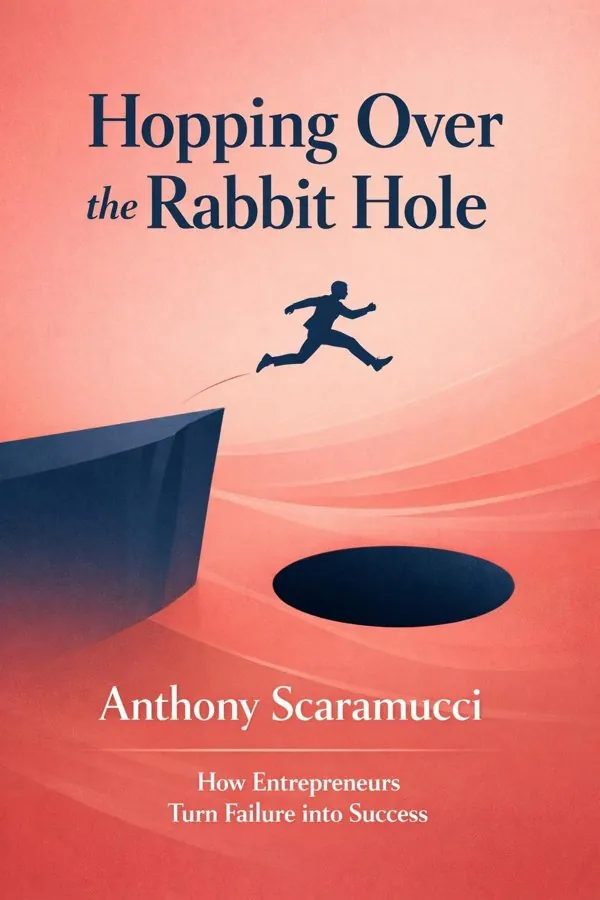
Hopping Over the Rabbit Hole: How Entrepreneurs Turn Failure into Success: Summary & Key Insights
 10 min9 chaptersAudio available
Key Takeaways from Hopping Over the Rabbit Hole: How Entrepreneurs Turn Failure into Success
One of the most useful advantages in business can come from feeling like you do not fully belong.
Most people experience failure as a verdict; Scaramucci treats it as data.
Optimism is often mistaken for naivety, but in Scaramucci’s view it is closer to fuel.
A business is tested less by its ambition than by its behavior during stress.
Anyone can look competent in favorable conditions; crisis shows what kind of operator you really are.
What Is Hopping Over the Rabbit Hole: How Entrepreneurs Turn Failure into Success About?
Hopping Over the Rabbit Hole: How Entrepreneurs Turn Failure into Success by Anthony Scaramucci is a entrepreneurship book spanning 13 pages. Hopping Over the Rabbit Hole is a frank, energetic guide to entrepreneurship built around a simple but powerful idea: failure is not the opposite of success, but one of its raw materials. In this book, Anthony Scaramucci draws on his rise from a middle-class background to the upper ranks of Wall Street and the founding of SkyBridge Capital to show how careers and companies are shaped by setbacks, bad calls, market shocks, and the ability to recover faster than others. Rather than presenting a polished success story, he focuses on the messy middle: the missteps, humiliations, doubts, and reinventions that most entrepreneurs experience but few discuss honestly. What makes the book matter is its combination of hard-earned business lessons and personal candor. Scaramucci writes as someone who has operated in high-pressure environments where reputation, timing, relationships, and resilience all carry real financial consequences. His experience in investment banking, hedge funds, and leadership gives him credibility, but his central message extends far beyond finance. For founders, operators, professionals, and anyone navigating uncertainty, this book offers a practical mindset for turning adversity into momentum instead of paralysis.
This FizzRead summary covers all 9 key chapters of Hopping Over the Rabbit Hole: How Entrepreneurs Turn Failure into Success in approximately 10 minutes, distilling the most important ideas, arguments, and takeaways from Anthony Scaramucci's work. Also available as an audio summary and Key Quotes Podcast.
Hopping Over the Rabbit Hole: How Entrepreneurs Turn Failure into Success
Hopping Over the Rabbit Hole is a frank, energetic guide to entrepreneurship built around a simple but powerful idea: failure is not the opposite of success, but one of its raw materials. In this book, Anthony Scaramucci draws on his rise from a middle-class background to the upper ranks of Wall Street and the founding of SkyBridge Capital to show how careers and companies are shaped by setbacks, bad calls, market shocks, and the ability to recover faster than others. Rather than presenting a polished success story, he focuses on the messy middle: the missteps, humiliations, doubts, and reinventions that most entrepreneurs experience but few discuss honestly.
What makes the book matter is its combination of hard-earned business lessons and personal candor. Scaramucci writes as someone who has operated in high-pressure environments where reputation, timing, relationships, and resilience all carry real financial consequences. His experience in investment banking, hedge funds, and leadership gives him credibility, but his central message extends far beyond finance. For founders, operators, professionals, and anyone navigating uncertainty, this book offers a practical mindset for turning adversity into momentum instead of paralysis.
Who Should Read Hopping Over the Rabbit Hole: How Entrepreneurs Turn Failure into Success?
This book is perfect for anyone interested in entrepreneurship and looking to gain actionable insights in a short read. Whether you're a student, professional, or lifelong learner, the key ideas from Hopping Over the Rabbit Hole: How Entrepreneurs Turn Failure into Success by Anthony Scaramucci will help you think differently.
- ✓Readers who enjoy entrepreneurship and want practical takeaways
- ✓Professionals looking to apply new ideas to their work and life
- ✓Anyone who wants the core insights of Hopping Over the Rabbit Hole: How Entrepreneurs Turn Failure into Success in just 10 minutes
Want the full summary?
Get instant access to this book summary and 100K+ more with Fizz Moment.
Get Free SummaryAvailable on App Store • Free to download
Key Chapters
One of the most useful advantages in business can come from feeling like you do not fully belong. Scaramucci’s early years on Wall Street taught him that starting without elite connections or inherited confidence can be uncomfortable, but it can also sharpen awareness, discipline, and hunger. At Goldman Sachs in the late 1980s, he entered a world that was glamorous on the surface and unforgiving underneath. He had to learn quickly, absorb pressure, and earn credibility in a culture that rewarded performance more than excuses. That experience shaped his belief that outsiders often succeed because they cannot afford complacency.
This idea matters for entrepreneurs because many founders begin with some form of disadvantage: limited capital, thin networks, lack of pedigree, or experience gaps. The instinctive response is to see these as liabilities. Scaramucci argues the opposite. When you are not protected by status, you tend to prepare more thoroughly, listen more carefully, and value every relationship. You become more coachable and more resilient because you know nothing is guaranteed.
A practical application is to convert insecurity into preparation. If you are pitching investors without a famous background, know your numbers better than anyone in the room. If you are entering a crowded market, understand your customer more deeply than incumbents do. If you lack polish, overdeliver on responsiveness and reliability.
The deeper lesson is that confidence should be built from competence, not image. Many people look powerful before they have earned the right to feel secure. Outsiders often build that right the hard way, and that gives them staying power.
Actionable takeaway: Identify one area where you feel disadvantaged, then turn it into a preparation edge by developing a stronger habit, sharper expertise, or more disciplined execution than your competitors.
Most people experience failure as a verdict; Scaramucci treats it as data. Before launching SkyBridge Capital, he had already taken risks, left established institutions, and seen earlier efforts fall short of expectations. Instead of romanticizing the eventual success of SkyBridge, he emphasizes that the venture was built partly from previous mistakes. Failed strategies, wrong assumptions, and painful disappointments revealed what kind of business he actually wanted to create and what kind of leader he needed to become.
This is a core entrepreneurial insight: your first attempt rarely deserves to be your final model. The companies that endure are often shaped by post-failure clarity. A product launch that flops may expose weak positioning. A partnership that collapses may reveal poor incentives. A hire who underperforms may show that the role itself was never defined correctly. Failure is expensive, but it is often precise.
Scaramucci’s experience founding SkyBridge illustrates how entrepreneurs can move from reaction to redesign. Rather than merely trying harder, they can ask better questions: What exactly broke? Was the problem the market, the business model, the team, or my own judgment? What assumptions did I make because they were convenient rather than true?
In practice, founders can build postmortems into their culture. After a failed campaign or missed quarter, separate shame from analysis. Document what happened, what was controllable, and what needs to change. This creates a learning organization instead of a blame organization.
Actionable takeaway: After your next setback, write a one-page failure audit with three sections: what happened, what it teaches, and what specific process you will change so the same mistake becomes less likely.
Optimism is often mistaken for naivety, but in Scaramucci’s view it is closer to fuel. Entrepreneurs spend much of their lives facing incomplete information, skeptical audiences, volatile conditions, and frequent rejection. Without optimism, the pressure of uncertainty quickly turns into hesitation. The point is not to deny risk or pretend everything will work out automatically. It is to maintain enough belief in the possibility of progress that you continue to act, adapt, and lead when outcomes are still unclear.
Scaramucci’s career in finance repeatedly placed him in environments where sentiment changed fast and confidence mattered. In these contexts, leaders set emotional tone. A founder who panics infects the team. A founder who remains grounded but hopeful helps people think instead of freeze. Optimism keeps organizations moving through ambiguity, especially during transitions, downturns, and market shocks.
The practical value of optimism appears in everyday decisions. It affects whether you keep pitching after ten rejections, whether you invest in talent before conditions feel perfect, and whether you interpret criticism as an attack or as useful feedback. Optimistic leaders are more likely to search for options instead of obsessing over limitations.
That said, Scaramucci’s style of optimism is not blind positivity. It works best when paired with realism and speed. You acknowledge what is broken, but you refuse to believe that the story ends there. In business, this combination can become a serious advantage because many competitors collapse psychologically before they collapse financially.
Actionable takeaway: Practice disciplined optimism by pairing every major problem with three possible responses. This trains you to face reality honestly while keeping your attention on options, not just obstacles.
A business is tested less by its ambition than by its behavior during stress. Scaramucci’s emphasis on leadership and team building reflects a truth many entrepreneurs learn too late: talent alone does not create durable companies. What matters is whether people trust one another enough to perform under pressure, tell the truth when conditions worsen, and stay aligned when decisions become painful.
In high-stakes settings like finance, weak leadership is quickly exposed. Teams fragment when communication becomes political, when employees do not understand the mission, or when leaders protect their own ego instead of the institution. Scaramucci argues that a strong leader must be visible, decisive, and human. That means attracting smart people, but also empowering them, giving them context, and making expectations unmistakably clear.
This matters especially for founders, who often build early teams around loyalty or excitement rather than role clarity. As a company grows, informal culture stops being enough. The founder must evolve from hustler to architect. Who owns what? How are disagreements handled? What values are non-negotiable? How do people earn trust and advancement? Great teams need more than inspiration; they need structure.
A practical example is crisis communication. If revenue dips or a major client leaves, leaders who hide information create rumors and fear. Leaders who communicate honestly, explain the plan, and show steadiness preserve credibility even in bad moments. Team morale is less about constant good news than about confidence that reality will be faced directly.
Actionable takeaway: Review your team through a trust lens. Clarify roles, communicate more directly, and ask yourself whether your people know the mission, the standards, and how decisions are made when pressure rises.
Anyone can look competent in favorable conditions; crisis shows what kind of operator you really are. Scaramucci’s career exposed him to volatile markets, shifting alliances, reputational challenges, and the kind of uncertainty that forces quick judgment. His lesson is not that crises should be feared, but that they must be expected. In entrepreneurship, difficult periods are not rare interruptions. They are part of the normal landscape.
What separates resilient entrepreneurs is their response pattern. Some deny reality and lose precious time. Others overreact emotionally and create secondary damage. Scaramucci emphasizes the need for calm analysis, rapid information gathering, and a bias toward action. During a crisis, perfection becomes less valuable than momentum. Leaders need to stabilize the team, identify what matters most, and make decisions before confusion deepens.
This lesson can be applied far beyond Wall Street. A startup may lose a major customer. A small business may face a cash crunch. A founder may discover that a product feature customers love is impossible to scale economically. In each case, the first job is to preserve clarity. What is the actual problem? What is the time horizon? What must be communicated immediately? Which costs, promises, or assumptions must be revisited?
Scaramucci also suggests that crises often become accelerators for overdue change. They force honest conversations and strip away comforting illusions. A business that survives a serious disruption often emerges leaner, clearer, and more disciplined than before.
Actionable takeaway: Create a simple crisis playbook before you need it: identify your decision-makers, communication steps, financial priorities, and first-response questions so you can act with clarity when pressure hits.
In business, opportunities rarely travel through formal channels alone. Scaramucci repeatedly highlights networking and relationships because careers, deals, hiring, fundraising, and partnerships are all shaped by trust. People do business with those they know, respect, and believe will behave well when conditions become difficult. For entrepreneurs, relationships are not a soft extra. They are infrastructure.
Scaramucci’s own trajectory reflects this. Moving through Wall Street and later building SkyBridge required more than technical skill. It required staying connected, earning goodwill, and creating a reputation that made others willing to return calls, share insight, and open doors. Strong networks are built long before they are needed. If you only contact people when you need money, help, or introductions, your network remains shallow and transactional.
This idea has a practical side that many ambitious people overlook. Networking is not about collecting contacts or performing charisma. It is about repeated, credible interactions. Send useful information. Make thoughtful introductions. Follow up. Keep promises. Express appreciation. Over time, these habits create relational equity, which can become decisive during hard moments.
For founders, this applies internally as well as externally. Investor relationships, customer trust, employee loyalty, and advisor support all depend on consistency. A single opportunistic move may deliver a short-term gain, but damaged trust has long-term costs.
Scaramucci’s broader point is that social capital often determines who gets second chances. People back individuals they trust, especially after a setback. That is one reason relationships can matter as much as execution.
Actionable takeaway: Invest in your network before you need it by reaching out to three people each week with something genuinely useful, not a request. Relationship-building becomes powerful when generosity is habitual.
Entrepreneurs are often encouraged to move fast, sell aggressively, and seize every opening. Scaramucci does not reject ambition, but he argues that ethics and integrity are not optional restraints on success. They are part of what makes success sustainable. In volatile industries, reputation can become your most valuable invisible asset. Once trust is damaged, every conversation becomes harder, every negotiation more expensive, and every future opportunity more fragile.
This is especially important because business pressure creates ethical temptation. A founder may overstate traction to impress investors. A manager may hide bad news to avoid accountability. A firm may cut corners because short-term incentives are overwhelming. These choices can feel rational in the moment, but they usually weaken the organization from within. Integrity is not just about avoiding scandal. It is about preserving internal coherence so that teams know what they stand for and counterparties know what to expect.
Scaramucci’s emphasis on character fits his broader message about resilience. If you hit a setback but maintain credibility, people may forgive mistakes, delays, or poor outcomes. If you hit a setback after acting dishonestly, the damage multiplies. In that sense, ethics functions like downside protection.
A practical way to apply this is to create decision rules before emotionally charged situations arise. What will you never misrepresent? How transparent will you be with employees about risk? What standards will govern customer promises? Clarity in advance reduces rationalization later.
Actionable takeaway: Define three non-negotiable integrity rules for your business and communicate them clearly. In difficult moments, use them as a filter for decisions so short-term pressure does not erode long-term trust.
Experience is a brutal teacher when you insist on acquiring all of it firsthand. Scaramucci underscores the value of mentors and role models because entrepreneurship is full of avoidable errors. Smart guidance cannot remove risk, but it can compress learning time. People who have already navigated hiring mistakes, market downturns, investor tension, and strategic pivots can often spot problems that founders are too emotionally close to see.
This matters because ambition can create isolation. Founders may assume they must project certainty at all times, when in fact their greatest advantage may come from asking sharper questions. Mentors provide perspective, but they also provide emotional calibration. They can tell you when a setback is normal, when a fear is exaggerated, and when a decision is more dangerous than it appears.
Scaramucci’s career benefited from observing seasoned operators and absorbing lessons from people who had survived high-stakes environments. That process helped him refine his own judgment rather than merely imitate others. The goal of mentorship is not dependency. It is accelerated maturation.
Founders can apply this by building a small circle of advisors with different strengths: one strategic thinker, one industry insider, one financially rigorous operator, and perhaps one person who knows you well enough to challenge your ego. The best mentors do not simply encourage; they correct.
Equally important is choosing role models with values, not just status. A person’s visible success may hide habits you do not want to reproduce. Learn from outcomes, but also from methods.
Actionable takeaway: Identify one current business challenge and ask a more experienced operator for a 30-minute conversation focused on what you may be missing. Treat advice-seeking as a skill, not a sign of weakness.
Many entrepreneurs fail not because they lack vision, but because they become too attached to one version of it. Scaramucci stresses adaptability as a defining entrepreneurial trait. Markets move, customer preferences shift, teams evolve, and external shocks can rearrange the playing field overnight. In that environment, stubbornness can look like conviction right up until it becomes self-destruction.
Adaptability does not mean abandoning standards or changing direction every week. It means staying loyal to the mission while remaining flexible about the method. Scaramucci’s experiences in finance taught him that conditions can invalidate yesterday’s assumptions very quickly. Leaders who insist on preserving old strategies for emotional reasons often lose both time and credibility.
This principle shows up in product development, hiring, capital allocation, and communication. A founder may discover that the original target customer is not the most profitable one. A company may need to alter pricing, narrow its offering, or restructure the team to survive a downturn. Adaptability allows these shifts to happen before the business runs out of room.
There is also a personal dimension. Scaramucci emphasizes balancing ambition with humility because humility makes adaptation possible. If your identity is tied to always being right, you will resist evidence. If you can admit that conditions changed or your initial thesis was incomplete, you can pivot intelligently.
Practical application begins with regular assumption reviews. What did we believe six months ago? What has changed? Which metrics suggest that our strategy needs revision? Adaptability becomes stronger when it is built into decision-making rather than triggered only by desperation.
Actionable takeaway: Schedule a monthly assumption check for your business. List your top five strategic beliefs and test whether current evidence still supports them. Flexibility becomes easier when revision is routine.
All Chapters in Hopping Over the Rabbit Hole: How Entrepreneurs Turn Failure into Success
About the Author
Anthony Scaramucci is an American financier, entrepreneur, author, and public commentator. He began his career in finance on Wall Street, including a formative period at Goldman Sachs, where he developed the competitive instincts and market awareness that later shaped his entrepreneurial path. He is best known as the founder of SkyBridge Capital, a global alternative investment firm that helped establish his reputation in the hedge fund and investment world. Beyond finance, Scaramucci has become a recognizable media and political figure, noted for his outspoken style and brief tenure as White House Communications Director. As an author, he writes about leadership, resilience, optimism, and business growth, often drawing on his own successes and failures to offer practical lessons for entrepreneurs and ambitious professionals.
Get This Summary in Your Preferred Format
Read or listen to the Hopping Over the Rabbit Hole: How Entrepreneurs Turn Failure into Success summary by Anthony Scaramucci anytime, anywhere. FizzRead offers multiple formats so you can learn on your terms — all free.
Available formats: App · Audio · PDF · EPUB — All included free with FizzRead
Download Hopping Over the Rabbit Hole: How Entrepreneurs Turn Failure into Success PDF and EPUB Summary
Key Quotes from Hopping Over the Rabbit Hole: How Entrepreneurs Turn Failure into Success
“One of the most useful advantages in business can come from feeling like you do not fully belong.”
“Most people experience failure as a verdict; Scaramucci treats it as data.”
“Optimism is often mistaken for naivety, but in Scaramucci’s view it is closer to fuel.”
“A business is tested less by its ambition than by its behavior during stress.”
“Anyone can look competent in favorable conditions; crisis shows what kind of operator you really are.”
Frequently Asked Questions about Hopping Over the Rabbit Hole: How Entrepreneurs Turn Failure into Success
Hopping Over the Rabbit Hole: How Entrepreneurs Turn Failure into Success by Anthony Scaramucci is a entrepreneurship book that explores key ideas across 9 chapters. Hopping Over the Rabbit Hole is a frank, energetic guide to entrepreneurship built around a simple but powerful idea: failure is not the opposite of success, but one of its raw materials. In this book, Anthony Scaramucci draws on his rise from a middle-class background to the upper ranks of Wall Street and the founding of SkyBridge Capital to show how careers and companies are shaped by setbacks, bad calls, market shocks, and the ability to recover faster than others. Rather than presenting a polished success story, he focuses on the messy middle: the missteps, humiliations, doubts, and reinventions that most entrepreneurs experience but few discuss honestly. What makes the book matter is its combination of hard-earned business lessons and personal candor. Scaramucci writes as someone who has operated in high-pressure environments where reputation, timing, relationships, and resilience all carry real financial consequences. His experience in investment banking, hedge funds, and leadership gives him credibility, but his central message extends far beyond finance. For founders, operators, professionals, and anyone navigating uncertainty, this book offers a practical mindset for turning adversity into momentum instead of paralysis.
You Might Also Like

Lean Analytics
Alistair Croll, Benjamin Yoskovitz
10 min
21 Days To A Big Idea: Creating Breakthrough Business Concepts
Bryan Mattimore
10 min
Sam Walton: Made in America: My Story
Sam Walton
10 min
10x Is Easier Than 2x: How World-Class Entrepreneurs Achieve More by Doing Less
Dan Sullivan, Benjamin Hardy
10 min
12 Months to $1 Million: How to Pick a Winning Product, Build a Real Business, and Become a Seven-Figure Entrepreneur
Ryan Daniel Moran
10 min
24 Assets: Create a Digital, Scalable, Valuable Business
Daniel Priestley
10 minBrowse by Category
Ready to read Hopping Over the Rabbit Hole: How Entrepreneurs Turn Failure into Success?
Get the full summary and 100K+ more books with Fizz Moment.