
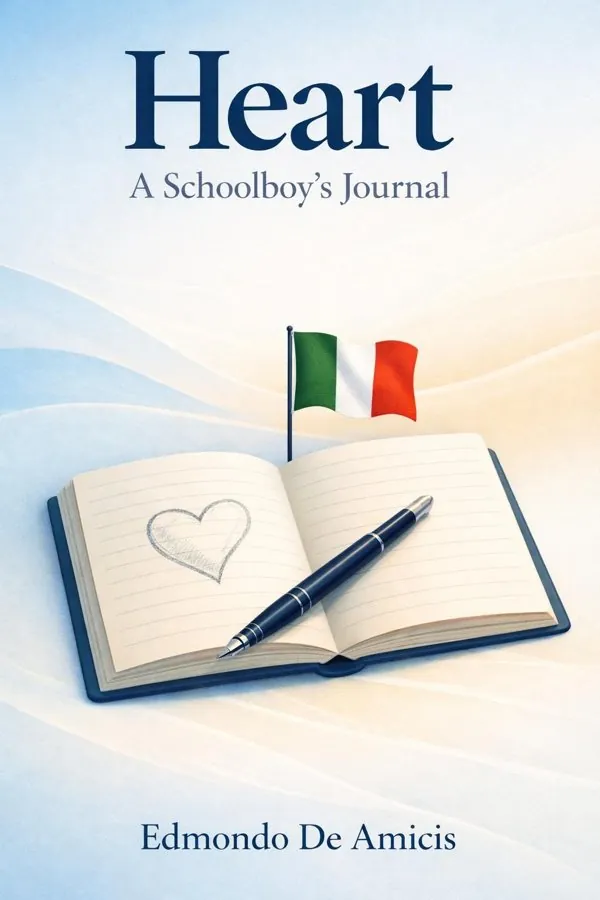
Heart: A Schoolboy's Journal: Summary & Key Insights
 10 min5 chaptersAudio available
What Is Heart: A Schoolboy's Journal About?
Heart: A Schoolboy's Journal by Edmondo De Amicis is a classics book spanning 5 pages. Heart: A Schoolboy's Journal is an English translation of Edmondo De Amicis's classic Italian novel 'Cuore'. Written as the diary of a young boy named Enrico Bottini, it chronicles a school year in Turin, Italy, capturing lessons of compassion, patriotism, and moral growth. Through Enrico’s reflections and the teacher’s monthly stories, the book emphasizes empathy, diligence, and respect for others.
This FizzRead summary covers all 5 key chapters of Heart: A Schoolboy's Journal in approximately 10 minutes, distilling the most important ideas, arguments, and takeaways from Edmondo De Amicis's work. Also available as an audio summary and Key Quotes Podcast.
Heart: A Schoolboy's Journal
Heart: A Schoolboy's Journal is an English translation of Edmondo De Amicis's classic Italian novel 'Cuore'. Written as the diary of a young boy named Enrico Bottini, it chronicles a school year in Turin, Italy, capturing lessons of compassion, patriotism, and moral growth. Through Enrico’s reflections and the teacher’s monthly stories, the book emphasizes empathy, diligence, and respect for others.
Who Should Read Heart: A Schoolboy's Journal?
This book is perfect for anyone interested in classics and looking to gain actionable insights in a short read. Whether you're a student, professional, or lifelong learner, the key ideas from Heart: A Schoolboy's Journal by Edmondo De Amicis will help you think differently.
- ✓Readers who enjoy classics and want practical takeaways
- ✓Professionals looking to apply new ideas to their work and life
- ✓Anyone who wants the core insights of Heart: A Schoolboy's Journal in just 10 minutes
Want the full summary?
Get instant access to this book summary and 100K+ more with Fizz Moment.
Get Free SummaryAvailable on App Store • Free to download
Key Chapters
As Enrico opens his diary at the start of the school year in Turin, we step into his world of desks, chalk dust, and youthful energy. He introduces his teacher, a calm guide who teaches more with his tone than with his lectures, and his classmates—boys of different social origins, reflecting the new Italy’s diversity. There are sons of workers, merchants, officers, and aristocrats, and in this little society, we see the nation’s moral laboratory.
Enrico’s parents frame his beginnings with loving seriousness. His mother whispers encouragement each morning, reminding him that study is not a duty imposed from above but a gift that deepens one’s humanity. His father, stern yet gentle, models respect, integrity, and civic responsibility. Through their voices, Enrico learns that schooling is more than competition; it is a preparation for life in community.
Enrico feels curiosity, pride, and at times, embarrassment among his peers. When he fails, when another child outperforms him, shame transforms into resolve rather than resentment. He begins to understand that education, like character, thrives on humility and diligence. In his everyday observations, he captures the pulse of human learning: the joy of discovery mixed with the discomfort of comparison.
Thus the diary form becomes an educational mirror. Enrico’s entries record not only events but emotions; each page is both confession and awakening. I wanted readers to see that the cultivation of a heart begins in recognizing others—not as rivals or strangers—but as companions on the same moral journey.
Within the crowded classroom, Enrico slowly sees the meaning of social diversity. There is Garrone, large and kind-hearted, who defends the weak without hesitation; Derossi, brilliant and generous; Coretti, the carpenter’s son who studies after helping his father carry wood; and Franti, the rebellious boy whose cruelty often provokes punishment. Each character represents a facet of society, teaching Enrico that worth cannot be measured by wealth or class.
One day, the teacher lectures about mutual respect among citizens. He reminds the students that Italy’s strength lies not in noble titles but in the honest hands of workers, soldiers, and scholars alike. Enrico feels this truth when he visits Coretti’s modest home and sees the boy’s cheerful discipline—how he studies late after tiring labor, never complaining. Through such encounters, Enrico begins to admire perseverance as the greatest dignity of all.
The friendships and rivalries that unfold in his class show that children, in their unguarded selves, replicate the larger world’s conflicts but also its potential for harmony. When Enrico quarrels with a classmate and later reconciles, he learns that forgiveness is not weakness but deep courage. The diary captures this evolution not as sentimentality but as moral discovery.
Respect, then, becomes a seed planted by understanding. I hoped my readers—especially the young—would see social equality not as a theory but as something lived every day: in how one speaks to a janitor, how one regards a poor child, how one defends another’s dignity. For Italy, for any nation, true unity begins in such simple, tender recognition.
+ 3 more chapters — available in the FizzRead app
All Chapters in Heart: A Schoolboy's Journal
About the Author
Edmondo De Amicis (1846–1908) was an Italian novelist, journalist, and short-story writer best known for his moral and educational works. His most famous book, 'Cuore' ('Heart'), became a cornerstone of Italian children's literature and was translated into many languages for its universal themes of kindness and civic virtue.
Get This Summary in Your Preferred Format
Read or listen to the Heart: A Schoolboy's Journal summary by Edmondo De Amicis anytime, anywhere. FizzRead offers multiple formats so you can learn on your terms — all free.
Available formats: App · Audio · PDF · EPUB — All included free with FizzRead
Download Heart: A Schoolboy's Journal PDF and EPUB Summary
Key Quotes from Heart: A Schoolboy's Journal
“As Enrico opens his diary at the start of the school year in Turin, we step into his world of desks, chalk dust, and youthful energy.”
“Within the crowded classroom, Enrico slowly sees the meaning of social diversity.”
Frequently Asked Questions about Heart: A Schoolboy's Journal
Heart: A Schoolboy's Journal by Edmondo De Amicis is a classics book that explores key ideas across 5 chapters. Heart: A Schoolboy's Journal is an English translation of Edmondo De Amicis's classic Italian novel 'Cuore'. Written as the diary of a young boy named Enrico Bottini, it chronicles a school year in Turin, Italy, capturing lessons of compassion, patriotism, and moral growth. Through Enrico’s reflections and the teacher’s monthly stories, the book emphasizes empathy, diligence, and respect for others.
You Might Also Like






Browse by Category
Ready to read Heart: A Schoolboy's Journal?
Get the full summary and 100K+ more books with Fizz Moment.