
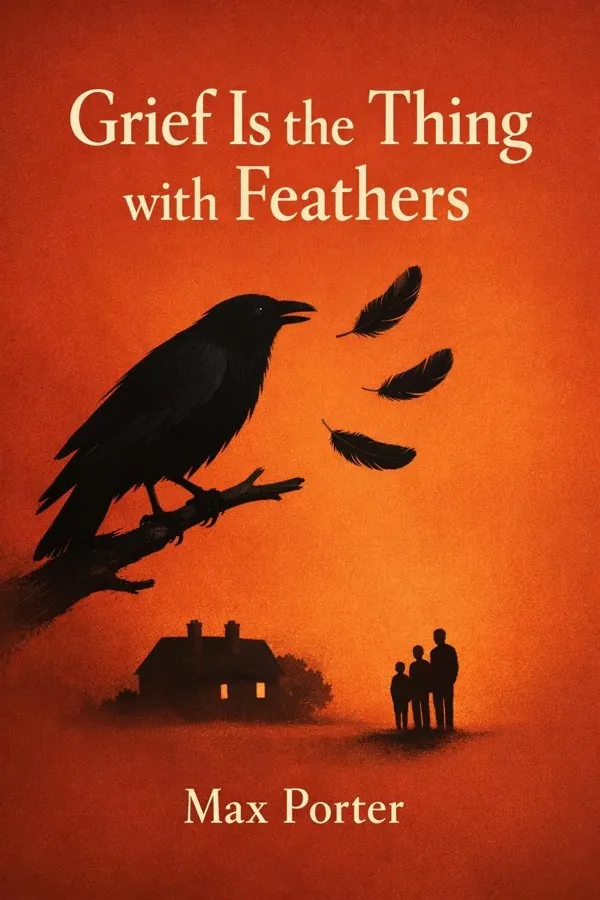
Grief Is the Thing with Feathers: Summary & Key Insights
by Max Porter
 10 min4 chaptersAudio available
What Is Grief Is the Thing with Feathers About?
Grief Is the Thing with Feathers by Max Porter is a classics book spanning 4 pages. A poetic and experimental novel that explores the raw experience of grief through the story of a father and his two sons mourning the death of their wife and mother. The narrative is interwoven with the presence of Crow, a mythic figure who embodies both chaos and healing, guiding the family through their sorrow. The book blends prose and verse to capture the surreal and transformative nature of loss.
This FizzRead summary covers all 4 key chapters of Grief Is the Thing with Feathers in approximately 10 minutes, distilling the most important ideas, arguments, and takeaways from Max Porter's work. Also available as an audio summary and Key Quotes Podcast.
Grief Is the Thing with Feathers
A poetic and experimental novel that explores the raw experience of grief through the story of a father and his two sons mourning the death of their wife and mother. The narrative is interwoven with the presence of Crow, a mythic figure who embodies both chaos and healing, guiding the family through their sorrow. The book blends prose and verse to capture the surreal and transformative nature of loss.
Who Should Read Grief Is the Thing with Feathers?
This book is perfect for anyone interested in classics and looking to gain actionable insights in a short read. Whether you're a student, professional, or lifelong learner, the key ideas from Grief Is the Thing with Feathers by Max Porter will help you think differently.
- ✓Readers who enjoy classics and want practical takeaways
- ✓Professionals looking to apply new ideas to their work and life
- ✓Anyone who wants the core insights of Grief Is the Thing with Feathers in just 10 minutes
Want the full summary?
Get instant access to this book summary and 100K+ more with Fizz Moment.
Get Free SummaryAvailable on App Store • Free to download
Key Chapters
The novel opens amid shattering quiet. A mother has died, and a London flat that once held laughter and warmth now carries only echo. The father, a scholar devoted to the poetry of Ted Hughes, moves dazedly through these rooms with his two young sons. Everything—light bulbs, half-folded laundry, cereal bowls—seems haunted by her touch. The boys perceive her absence as something inexplicable, like a missing color they keep searching for in their toys. Time becomes suspended, language fragments: this is the first reality of grief.
Then comes Crow.
He arrives in the night, unbidden and unapologetic, announcing himself with raucous humor and menace. He tells the father he will stay until he’s no longer needed. Crow’s entrance is both grotesque and liberating—his black feathers scatter through the text, splintering its realism. I created Crow to carry the contradictions that grief brings: he is a monster and a guardian, a comedian and a doctor. He ridicules pity, mocks despair, yet refuses to leave those who suffer. His speech drags myth and comedy into the family’s raw mourning, reminding us that loss is bigger than human reason.
Crow’s role is to break the stasis of sorrow. Where the father intellectualizes death, Crow insists on the bodily: the smell, the noise, the absurdity of continuing to eat cereal when the world has ended. He pushes against the family’s attempt to behave, to tidy their pain into narratives that make sense. His interventions are violent and kind in equal measure. In those dark exchanges between the father and Crow, grief ceases to be a silent weight and becomes a dialogue—a disruptive, healing conversation that the family must endure before they can move forward.
In the father’s sections, language becomes both a refuge and a trap. He is a man whose life has revolved around words, around Hughes’s poetry, around the ghosts of myth. Now, facing the unthinkable, he tries to apply those same skills to his loss. He attempts to analyze it, footnote it, contain it—as though grief were a thesis requiring citations. Yet the more he theorizes, the further he drifts from the immediacy of pain. I wrote him this way because so many of us respond to anguish by turning to intellect, hoping understanding will lessen the hurt. But grief refuses to behave. It is more physical than philosophical, more dream than dialogue.
The father’s journey is about surrender: learning to stop explaining and simply feel. Crow forces him into this. Through their exchanges—half humorous, half harrowing—the father begins to discover that survival depends less on comprehension and more on presence. He remembers small domestic gestures: washing the children’s hair, setting the table, opening a window. Slowly, through habit and duty, love takes form again.
The boys’ voices counterpoint their father’s gravity. Their sections burst with mischief, naivety, and surreal logic. They invent stories about their mother’s ghost, imagine her hiding in the hall, or pretend Crow is a friend from school. Their grief is wild, unfiltered, often tenderly absurd. I wanted their language to remain lyrical yet grounded in childish cadence—to show how imagination can both shield and expose us. Through their play, the boys unknowingly enact healing: they transform the incomprehensible into the imaginable.
Together, the father and sons form a fragile triad of memory and renewal. The home fills gradually with new stories, with moments of laughter that no longer feel guilty. Grief remains, but like Crow, it changes shape—it begins to perch quietly rather than dominate the room.
+ 2 more chapters — available in the FizzRead app
All Chapters in Grief Is the Thing with Feathers
About the Author
Max Porter is a British author known for his innovative and lyrical prose style. Before becoming a novelist, he worked as a bookseller and editor. His works often explore themes of grief, family, and the intersection of myth and everyday life.
Get This Summary in Your Preferred Format
Read or listen to the Grief Is the Thing with Feathers summary by Max Porter anytime, anywhere. FizzRead offers multiple formats so you can learn on your terms — all free.
Available formats: App · Audio · PDF · EPUB — All included free with FizzRead
Download Grief Is the Thing with Feathers PDF and EPUB Summary
Key Quotes from Grief Is the Thing with Feathers
“A mother has died, and a London flat that once held laughter and warmth now carries only echo.”
“In the father’s sections, language becomes both a refuge and a trap.”
Frequently Asked Questions about Grief Is the Thing with Feathers
Grief Is the Thing with Feathers by Max Porter is a classics book that explores key ideas across 4 chapters. A poetic and experimental novel that explores the raw experience of grief through the story of a father and his two sons mourning the death of their wife and mother. The narrative is interwoven with the presence of Crow, a mythic figure who embodies both chaos and healing, guiding the family through their sorrow. The book blends prose and verse to capture the surreal and transformative nature of loss.
You Might Also Like


Browse by Category
Ready to read Grief Is the Thing with Feathers?
Get the full summary and 100K+ more books with Fizz Moment.