
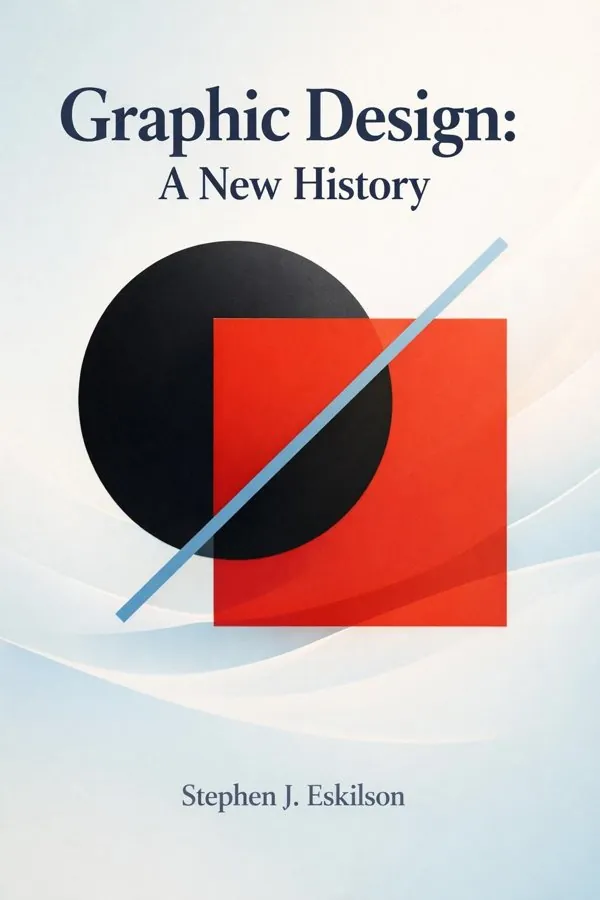
Graphic Design: A New History: Summary & Key Insights
 10 min9 chaptersAudio available
Key Takeaways from Graphic Design: A New History
Graphic design did not emerge simply because artists wanted new forms; it emerged because modern life demanded new ways to organize attention.
Sometimes the most influential design movements begin as acts of resistance.
New styles often appear when designers stop imitating the past and start reimagining the world around them.
Design changes fastest when artists challenge not just how things look, but how meaning itself is constructed.
As societies became more complex, design had to do more than attract attention; it had to manage information at scale.
What Is Graphic Design: A New History About?
Graphic Design: A New History by Stephen J. Eskilson is a design book spanning 8 pages. Graphic design is often treated as a collection of styles, trends, and famous posters, but Stephen J. Eskilson shows that it is something much larger: a history of how societies learn to see, persuade, organize, and imagine themselves. In Graphic Design: A New History, he traces the development of visual communication from the nineteenth century to the digital age, connecting design to industrialization, political upheaval, consumer culture, mass media, and technological change. Rather than presenting design as a parade of isolated masterpieces, Eskilson reveals it as a living system shaped by printers, advertisers, educators, corporations, governments, and avant-garde artists alike. The book matters because graphic design now touches nearly every part of daily life, from street signage and packaging to websites, branding, and social media interfaces. Understanding its history helps readers understand how visual choices influence behavior, values, and public memory. As an art historian and professor specializing in modern art and design history, Eskilson brings scholarly depth, clarity, and critical perspective, making this book an essential guide for students, professionals, and anyone curious about the forces behind modern visual culture.
This FizzRead summary covers all 9 key chapters of Graphic Design: A New History in approximately 10 minutes, distilling the most important ideas, arguments, and takeaways from Stephen J. Eskilson's work. Also available as an audio summary and Key Quotes Podcast.
Graphic Design: A New History
Graphic design is often treated as a collection of styles, trends, and famous posters, but Stephen J. Eskilson shows that it is something much larger: a history of how societies learn to see, persuade, organize, and imagine themselves. In Graphic Design: A New History, he traces the development of visual communication from the nineteenth century to the digital age, connecting design to industrialization, political upheaval, consumer culture, mass media, and technological change. Rather than presenting design as a parade of isolated masterpieces, Eskilson reveals it as a living system shaped by printers, advertisers, educators, corporations, governments, and avant-garde artists alike. The book matters because graphic design now touches nearly every part of daily life, from street signage and packaging to websites, branding, and social media interfaces. Understanding its history helps readers understand how visual choices influence behavior, values, and public memory. As an art historian and professor specializing in modern art and design history, Eskilson brings scholarly depth, clarity, and critical perspective, making this book an essential guide for students, professionals, and anyone curious about the forces behind modern visual culture.
Who Should Read Graphic Design: A New History?
This book is perfect for anyone interested in design and looking to gain actionable insights in a short read. Whether you're a student, professional, or lifelong learner, the key ideas from Graphic Design: A New History by Stephen J. Eskilson will help you think differently.
- ✓Readers who enjoy design and want practical takeaways
- ✓Professionals looking to apply new ideas to their work and life
- ✓Anyone who wants the core insights of Graphic Design: A New History in just 10 minutes
Want the full summary?
Get instant access to this book summary and 100K+ more with Fizz Moment.
Get Free SummaryAvailable on App Store • Free to download
Key Chapters
Graphic design did not emerge simply because artists wanted new forms; it emerged because modern life demanded new ways to organize attention. Eskilson begins in the nineteenth century, when industrialization transformed production, transportation, literacy, and urban life. As factories produced goods at unprecedented scale, manufacturers needed labels, posters, catalogs, newspapers, and advertisements to distinguish products in crowded markets. At the same time, technologies such as lithography, wood engraving, and improved printing processes made visual communication cheaper, faster, and more widely distributed.
This period matters because it set the basic conditions for modern graphic design: mass audiences, commercial competition, and reproducible images. Typography became more expressive, poster design became bolder, and printed matter began serving not only informational but persuasive and emotional functions. Design moved from the margins of craft into the center of public life. A train station poster, a theater bill, or a packaged household product became part of a new visual environment in which people constantly interpreted symbols, brands, and messages.
Eskilson shows that design history is inseparable from economic and social history. The crowded city street, the department store window, and the illustrated magazine all trained people to consume images rapidly. This remains true today. Social media ads, app icons, and e-commerce product pages are direct descendants of those early commercial experiments in visibility and persuasion.
A practical lesson follows: whenever you evaluate a design, ask what social system produced it. Is it trying to sell, instruct, regulate, entertain, or build identity? Understanding the context often explains the form. Actionable takeaway: study design not just as aesthetics, but as a response to changing technologies, markets, and audiences.
Sometimes the most influential design movements begin as acts of resistance. The Arts and Crafts movement arose as a critique of industrial capitalism’s effects on labor, objects, and daily life. Figures such as William Morris believed that machine production often degraded both workmanship and human dignity, replacing meaningful craft with lifeless uniformity. In response, Arts and Crafts designers promoted honesty of materials, careful construction, medieval inspiration, and the idea that beautiful objects should elevate everyday life.
Eskilson presents this movement not as nostalgia alone, but as a foundational moral argument about design. It asked whether visual culture should merely serve commerce or also express social values. Books, wallpaper, textiles, furniture, and ornamental design became vehicles for reform. Typography and page design reflected an ideal of unity between content, material, and form. The book itself was treated as an integrated artwork, not just a container for words.
The movement’s paradox is equally important. Although it criticized industrial mass production, many Arts and Crafts objects were expensive and accessible mainly to elites. Yet its deeper influence endured. It shaped later thinking about user experience, sustainability, ethical production, and the designer’s social responsibility. Today, the same questions reappear in debates over fast fashion, disposable packaging, ethical branding, and handcrafted digital aesthetics.
For modern practitioners, the movement offers a practical standard: design should not be judged only by efficiency or trendiness. It should also be judged by how it reflects care, coherence, and human values. Whether you are designing a printed book, a product package, or a website, ask: does this work respect its materials, its users, and the people who made it? Actionable takeaway: build one ethical criterion into every project, not just an aesthetic one.
New styles often appear when designers stop imitating the past and start reimagining the world around them. Art Nouveau represented such a turning point. Emerging around the end of the nineteenth century, it rejected rigid historical revivalism and embraced flowing organic forms, asymmetry, decorative rhythm, and the integration of art into modern life. In posters, book covers, type treatments, interiors, and packaging, Art Nouveau transformed graphic design into something more immersive and expressive.
Eskilson highlights how this movement bridged craft traditions and modern commercial culture. Designers like Alphonse Mucha and Henri van de Velde used sinuous lines, stylized figures, floral motifs, and flattened forms to create memorable visual identities. Crucially, these were not simply decorative flourishes. They shaped how viewers felt and moved through information. The poster became not just an announcement but an atmospheric experience, capable of branding a performance, a product, or a place.
Art Nouveau also demonstrated the power of stylistic unity across media. Architecture, furniture, signage, print, and illustration could all share a common visual language. This ambition foreshadowed later branding systems and cross-platform design strategies. Modern companies that coordinate packaging, websites, retail spaces, and social media visuals are pursuing a similar logic of environmental consistency.
Yet Eskilson also shows that Art Nouveau’s richness carried risks. Excessive ornament could overwhelm clarity, and stylistic intensity could limit adaptability. This tension between expression and legibility remains central to design today.
The practical lesson is to use style strategically. Distinctive visual language can make communication unforgettable, but only if it supports the message rather than obscuring it. Actionable takeaway: when building a visual identity, aim for a signature atmosphere that enhances recognition without sacrificing usability.
Design changes fastest when artists challenge not just how things look, but how meaning itself is constructed. In the early twentieth century, avant-garde movements such as Futurism, Constructivism, De Stijl, and the Bauhaus radically transformed graphic design. They rejected passive decoration and searched for visual forms suited to industrial society, political upheaval, and modern technology. Geometry, abstraction, asymmetry, photomontage, and sans-serif typography became tools for a new way of thinking.
Eskilson shows that these movements were not unified in ideology, but they shared a conviction that design could reshape perception and society. Russian Constructivists treated posters and publications as instruments of collective transformation. De Stijl pursued universal harmony through grids, primary colors, and reduction. The Bauhaus sought to unite art, industry, and education, training designers to solve problems through form, structure, and experimentation. Typography became more than lettering; it became spatial organization.
Many conventions of contemporary design descend from this period: clean layouts, modular systems, hierarchy through scale and contrast, and the belief that clarity can be achieved through reduction. A transit map, a minimalist website, or a startup deck all rely on principles first tested in these avant-garde laboratories.
At the same time, Eskilson reminds readers that formal innovation is never neutral. Constructivist design served political revolution; Bauhaus ideas responded to industrial production and social reform. Form always carries assumptions about order, progress, and human behavior.
For anyone creating visual communication, the practical application is to treat layout as thought made visible. Every grid, alignment, and contrast pattern tells users how to navigate meaning. Actionable takeaway: before adding visual elements, decide what underlying structure will organize attention and reflect your purpose.
As societies became more complex, design had to do more than attract attention; it had to manage information at scale. Between the world wars and into the mid-twentieth century, graphic design increasingly served corporations, public institutions, transportation networks, exhibitions, and media systems. Eskilson traces how designers moved from isolated artworks toward coordinated programs of communication. Identity, consistency, legibility, and reproducibility became central values.
Corporate modernism exemplified this shift. Logos, letterheads, advertisements, packaging, and signage were designed to work together, forming recognizable systems rather than disconnected pieces. Designers such as Peter Behrens helped establish the idea that visual identity could unify a company’s public face across products and media. This was a profound change. Design no longer merely decorated commerce; it organized it. It gave institutions coherence and audiences a stable visual reference.
This systems approach also expanded into public communication. Exhibition graphics, wayfinding, wartime propaganda, and editorial design required scalable methods that could function across formats and contexts. The rise of photography in layout further changed the balance between image and text, making communication more immediate and documentary in tone.
Today, the same logic structures design teams working on brand guidelines, design systems, component libraries, and omnichannel campaigns. What earlier modernists did for posters and print manuals, contemporary designers do for apps, dashboards, and interface ecosystems.
Eskilson’s larger insight is that design maturity often means moving from isolated expression to coordinated communication. Beautiful fragments matter less than coherent experience.
Actionable takeaway: if you want your design to have lasting impact, think in systems. Create rules for typography, color, imagery, spacing, and tone so that every touchpoint reinforces the same message.
Clarity is never just a neutral virtue; it is a cultural ideal with its own history. After World War II, the International Typographic Style, often associated with Swiss design, became one of the most influential models in graphic design. Eskilson explains how designers such as Josef Müller-Brockmann, Armin Hofmann, and others emphasized grid-based layouts, sans-serif typography, objective photography, asymmetric composition, and disciplined use of white space. Their work aimed for rational organization, visual economy, and universal readability.
This style spread internationally because it suited the needs of expanding institutions, corporations, transportation systems, and global publishing. In a world rebuilding itself through information exchange, standardization and legibility were powerful advantages. A clean poster, a clearly structured timetable, or a precisely arranged magazine page suggested order, trustworthiness, and modernity.
Eskilson does not reduce Swiss design to a simple formula. He shows that its strength lay in method: the designer as organizer of relationships rather than decorator of surfaces. Hierarchy, alignment, and proportion became tools for making complex content accessible. That is why the style remains so influential in web design, interface design, information graphics, and editorial systems.
Yet the book also hints at the limits of universalism. What appears objective may still reflect cultural preferences and institutional authority. A strict grid can communicate efficiency, but it can also suppress personality or local nuance. Designers must decide when neutrality helps and when it erases meaning.
The practical value of this chapter is immense. Whenever communication becomes confusing, structured typography and disciplined layout usually improve it. Actionable takeaway: use grids and typographic hierarchy not as rigid dogma, but as tools to make information easier to understand, scan, and trust.
When a style becomes dominant, the next revolution often begins by questioning its assumptions. By the late twentieth century, many designers felt that modernist clarity had hardened into orthodoxy. Postmodern graphic design challenged the belief that communication should always be neutral, universal, and stripped of historical reference. Eskilson presents postmodernism as a broad revolt that reintroduced irony, vernacular forms, expressive typography, quotation, fragmentation, and layered meaning.
Designers associated with this turn experimented with visual ambiguity and cultural hybridity. Historical styles were recycled rather than rejected. Type could be distorted, images juxtaposed unpredictably, and layouts made intentionally unstable. The point was not chaos for its own sake, but recognition that audiences interpret messages through culture, memory, identity, and power. There is no perfectly transparent communication.
This shift was especially important for editorial design, music culture, subcultural publishing, and educational contexts where emotion and voice mattered as much as order. Postmodernism widened the field of what graphic design could express. It made room for regional languages, marginalized aesthetics, and design that acknowledged contradiction instead of hiding it.
In contemporary practice, this legacy appears in experimental branding, anti-design trends, expressive digital typography, and campaigns that use collage, irony, or visual disruption to stand out. But Eskilson’s historical framing also offers caution. Novelty without purpose quickly becomes mannerism. Complexity should reveal richer meanings, not simply obscure content.
The practical lesson is that communication can be both functional and interpretive. A design can invite reflection, not just immediate consumption. Actionable takeaway: when a message needs personality, cultural specificity, or emotional texture, allow form to carry those meanings rather than forcing everything into neutral clarity.
The digital turn did more than introduce new tools; it changed what design is. Eskilson traces how computers, desktop publishing, digital imaging, and the internet transformed graphic design from a largely print-based practice into a fluid, interactive, and globally distributed field. Production processes accelerated, barriers to entry lowered, and experimentation multiplied. A designer could now manipulate type, image, motion, and layout on the same screen, often without the intermediaries that once separated concept from execution.
This democratization brought enormous creative freedom. Independent studios, small publications, and emerging designers gained access to capabilities once reserved for major institutions. Digital tools also encouraged new aesthetics: pixelation, layering, motion graphics, interface-driven composition, and variable forms responsive to user interaction. Graphic design increasingly overlapped with web design, animation, coding, branding, and user experience.
But Eskilson also makes clear that digital culture introduced new pressures. Speed increased expectations for constant novelty. Templates and software defaults risked homogenizing visual output. Global circulation blurred cultural boundaries while enabling both collaboration and appropriation. And because design became embedded in interactive systems, success could no longer be judged by appearance alone. Navigation, responsiveness, accessibility, and behavior became central concerns.
These changes define current practice. A brand identity must function on a mobile screen. Typography must scale across devices. Information design must account for scrolling, tapping, and algorithmic environments. The designer is now part visual communicator, part systems thinker, part technologist.
The practical implication is simple but demanding: learn tools, but think beyond them. Software changes quickly; principles endure. Actionable takeaway: treat digital design as the orchestration of content, interaction, and context, not merely the styling of screens.
History becomes richer the moment we stop mistaking one region’s story for the whole world’s story. One of Eskilson’s important contributions is to place graphic design within a broader global framework, especially as the field enters the late twentieth and early twenty-first centuries. While earlier histories often centered Western Europe and the United States, contemporary design culture is shaped by transnational exchange, migration, translation, local adaptation, and digital circulation.
Globalization has expanded both audiences and influences. Designers now borrow from multiple visual traditions, work across languages, and create for markets that are culturally diverse and technologically uneven. A campaign may need to function simultaneously in print, on social media, in urban signage, and across different linguistic systems. This complexity makes design more challenging, but also more inventive.
Eskilson’s historical perspective helps readers see that globalization is not just stylistic fusion. It involves power: whose aesthetics are treated as universal, whose scripts are supported by technology, whose identities are commodified, and whose visual traditions are ignored or appropriated. Good design in a global era requires sensitivity to local meaning, not just exportable polish.
This insight has immediate practical relevance. International branding, multilingual interfaces, cross-cultural packaging, and globally distributed media all demand more than technical translation. Color symbolism, reading direction, icon interpretation, typographic conventions, and cultural references vary widely. The best designers research before they simplify.
Actionable takeaway: whenever designing for diverse audiences, test your assumptions. Ask how language, symbolism, accessibility, and local context affect interpretation, and build flexibility into the system from the start.
All Chapters in Graphic Design: A New History
About the Author
Stephen J. Eskilson is an American art historian and professor best known for his scholarship in modern art and graphic design history. He has taught at Eastern Illinois University, where his work has focused on the historical development of visual culture, design movements, and the relationship between aesthetics and social change. Eskilson is respected for making complex design history accessible without oversimplifying it. His writing connects typography, posters, branding, and visual systems to the broader forces of industrialization, politics, commerce, and technology. In Graphic Design: A New History, he brings together academic depth and readable analysis, helping students, designers, and general readers understand how graphic design became one of the defining languages of modern life.
Get This Summary in Your Preferred Format
Read or listen to the Graphic Design: A New History summary by Stephen J. Eskilson anytime, anywhere. FizzRead offers multiple formats so you can learn on your terms — all free.
Available formats: App · Audio · PDF · EPUB — All included free with FizzRead
Download Graphic Design: A New History PDF and EPUB Summary
Key Quotes from Graphic Design: A New History
“Graphic design did not emerge simply because artists wanted new forms; it emerged because modern life demanded new ways to organize attention.”
“Sometimes the most influential design movements begin as acts of resistance.”
“New styles often appear when designers stop imitating the past and start reimagining the world around them.”
“Design changes fastest when artists challenge not just how things look, but how meaning itself is constructed.”
“As societies became more complex, design had to do more than attract attention; it had to manage information at scale.”
Frequently Asked Questions about Graphic Design: A New History
Graphic Design: A New History by Stephen J. Eskilson is a design book that explores key ideas across 9 chapters. Graphic design is often treated as a collection of styles, trends, and famous posters, but Stephen J. Eskilson shows that it is something much larger: a history of how societies learn to see, persuade, organize, and imagine themselves. In Graphic Design: A New History, he traces the development of visual communication from the nineteenth century to the digital age, connecting design to industrialization, political upheaval, consumer culture, mass media, and technological change. Rather than presenting design as a parade of isolated masterpieces, Eskilson reveals it as a living system shaped by printers, advertisers, educators, corporations, governments, and avant-garde artists alike. The book matters because graphic design now touches nearly every part of daily life, from street signage and packaging to websites, branding, and social media interfaces. Understanding its history helps readers understand how visual choices influence behavior, values, and public memory. As an art historian and professor specializing in modern art and design history, Eskilson brings scholarly depth, clarity, and critical perspective, making this book an essential guide for students, professionals, and anyone curious about the forces behind modern visual culture.
You Might Also Like

The Design of Everyday Things
Don Norman
10 min
The Better Angels of Our Nature
Steven Pinker
10 min
A Designer's Art
Paul Rand
10 min
Architects' Sketchbooks
Various Editors
10 min
Architectural Graphic Standards
The American Institute of Architects
10 min
Design Is Storytelling
Ellen Lupton
10 minBrowse by Category
Ready to read Graphic Design: A New History?
Get the full summary and 100K+ more books with Fizz Moment.