
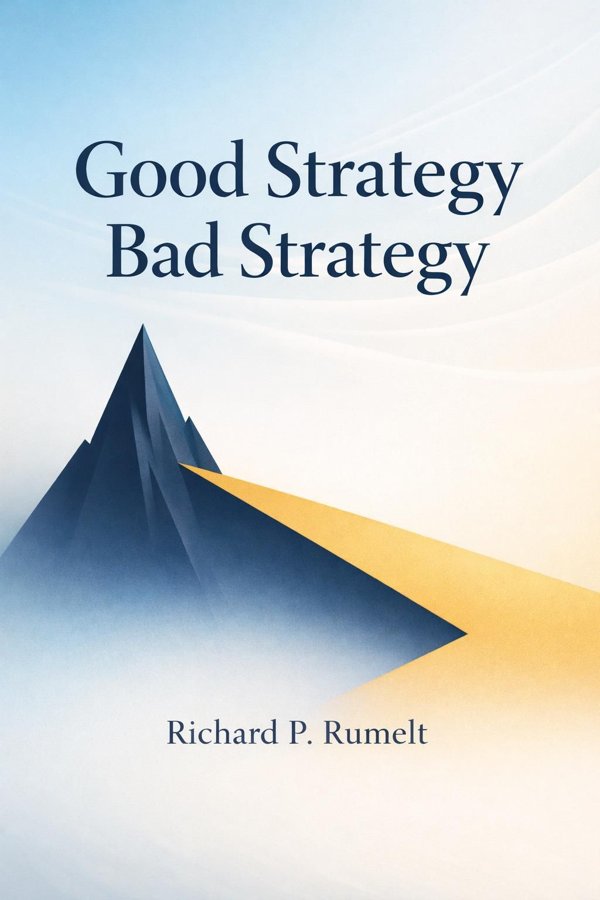
Good Strategy Bad Strategy: The Difference and Why It Matters: Summary & Key Insights
 10 min11 chaptersAudio available
What Is Good Strategy Bad Strategy: The Difference and Why It Matters About?
Good Strategy Bad Strategy: The Difference and Why It Matters by Richard P. Rumelt is a strategy book spanning 11 pages. Good Strategy Bad Strategy offers a clear and practical guide to understanding what makes a strategy effective. Richard P. Rumelt explains how good strategy focuses on identifying critical challenges and creating coherent actions to overcome them, while bad strategy is often characterized by fluff, wishful thinking, and failure to face real problems. Drawing on examples from business, military, and political contexts, Rumelt provides tools for crafting strategies that lead to meaningful results.
This FizzRead summary covers all 11 key chapters of Good Strategy Bad Strategy: The Difference and Why It Matters in approximately 10 minutes, distilling the most important ideas, arguments, and takeaways from Richard P. Rumelt's work. Also available as an audio summary and Key Quotes Podcast.
Good Strategy Bad Strategy: The Difference and Why It Matters
Good Strategy Bad Strategy offers a clear and practical guide to understanding what makes a strategy effective. Richard P. Rumelt explains how good strategy focuses on identifying critical challenges and creating coherent actions to overcome them, while bad strategy is often characterized by fluff, wishful thinking, and failure to face real problems. Drawing on examples from business, military, and political contexts, Rumelt provides tools for crafting strategies that lead to meaningful results.
Who Should Read Good Strategy Bad Strategy: The Difference and Why It Matters?
This book is perfect for anyone interested in strategy and looking to gain actionable insights in a short read. Whether you're a student, professional, or lifelong learner, the key ideas from Good Strategy Bad Strategy: The Difference and Why It Matters by Richard P. Rumelt will help you think differently.
- ✓Readers who enjoy strategy and want practical takeaways
- ✓Professionals looking to apply new ideas to their work and life
- ✓Anyone who wants the core insights of Good Strategy Bad Strategy: The Difference and Why It Matters in just 10 minutes
Want the full summary?
Get instant access to this book summary and 100K+ more with Fizz Moment.
Get Free SummaryAvailable on App Store • Free to download
Key Chapters
The starting point of every effective strategy is diagnosis. Before attempting any grand plan, one must first understand the nature of the challenge. Diagnosis is the act of defining or explaining what is going on—why the situation looks as it does, what forces are at work, what barriers stand in the way. When I work with executives, I ask them to tell me not what they want to achieve, but what is blocking progress. A clear diagnosis transforms a complex landscape into manageable patterns. Without it, even the most energetic action degenerates into confusion.
Once the diagnosis is established, the next element—the guiding policy—comes into play. This is the overarching approach to dealing with the obstacles identified. A guiding policy does not outline every specific action; rather, it provides the framework that channels individual choices. It gives coherence to decisions across the organization, ensuring all efforts align around a common logic. The guiding policy must be bold yet credible, focused rather than diffuse.
The third element is coherent action. This is the set of operations, decisions, and commitments that implement the guiding policy. Coherence means that the actions reinforce each other, rather than pulling in different directions. Often, what separates good strategy from mediocrity is not the ambition of its goals but the consistency of its execution.
To illustrate, consider IBM in the early 1990s when Lou Gerstner took charge. The company was struggling with fragmentation and declining relevance. Gerstner’s diagnosis was that IBM’s problem wasn’t technology—it was the lack of coherence. His guiding policy was to make integration—the ability to deliver systems solutions, not components—the central thrust. The coherent actions that followed restructured divisions, redefined culture, and revived IBM’s strength as a solution provider. This kernel—diagnosis, guiding policy, and coherent action—became the lever by which IBM regained its power.
The kernel is deceptively simple. Yet understanding it can transform the way a leader thinks. Every good strategy begins with what is true, not what is wished. It builds from sharp insight into structure and culminates in coordinated effort. That is the heartbeat of effective strategy.
If good strategy is clear and coherent, bad strategy is its opposite—vague, bloated, and evasive. Over years of observing organizations, I have found four hallmarks of bad strategy: fluff, failure to face challenges, mistaking goals for strategy, and setting poor strategic objectives.
Fluff is the verbiage that sounds high-minded but says nothing. It often appears in glossy presentations as words like ‘synergy’, ‘vision’, or ‘leadership excellence’. It gives the illusion of thought without substance. A company drowning in fluff has replaced hard thinking with comfortable talk.
Failure to face the challenge is perhaps the deadliest error. Leaders often convince themselves that acknowledging problems will weaken morale, so they avoid confronting them. But strategy begins with the truth. When you fail to identify the true challenge, all subsequent action floats in unreality. Kodak, for example, continued to plan as though the dominance of film would persist, long after digital imaging had reshaped its world. Its strategies were essentially exercises in denial.
A third pitfall is mistaking goals for strategy. Managers frequently announce objectives—‘We will become number one in market share’, ‘We will double revenue in three years’—and call them strategies. Goals are the desired endpoints; strategy is the means of getting there. Without a causal logic connecting steps to outcomes, you have only ambition.
Finally, poor strategic objectives erode coherence. A true strategic objective tackles a specific constraint or opportunity illuminated by diagnosis. Bad objectives, in contrast, are either too broad or too fragmented, scattering effort across unrelated directions. They sound impressive but lack a thread of logic.
Bad strategy thrives because it is easier, psychologically and politically, than good strategy. It lets leaders avoid hard choices. Good strategy demands focus—it requires saying no to many things in order to concentrate on what matters most. This discipline, though uncomfortable, is the very source of power.
+ 9 more chapters — available in the FizzRead app
All Chapters in Good Strategy Bad Strategy: The Difference and Why It Matters
About the Author
Richard P. Rumelt is an American strategist and professor at the UCLA Anderson School of Management. He is widely recognized for his work on corporate strategy and has advised major companies and governments. His research and teaching focus on the foundations of strategic thinking and the dynamics of competitive advantage.
Get This Summary in Your Preferred Format
Read or listen to the Good Strategy Bad Strategy: The Difference and Why It Matters summary by Richard P. Rumelt anytime, anywhere. FizzRead offers multiple formats so you can learn on your terms — all free.
Available formats: App · Audio · PDF · EPUB — All included free with FizzRead
Download Good Strategy Bad Strategy: The Difference and Why It Matters PDF and EPUB Summary
Key Quotes from Good Strategy Bad Strategy: The Difference and Why It Matters
“The starting point of every effective strategy is diagnosis.”
“If good strategy is clear and coherent, bad strategy is its opposite—vague, bloated, and evasive.”
Frequently Asked Questions about Good Strategy Bad Strategy: The Difference and Why It Matters
Good Strategy Bad Strategy: The Difference and Why It Matters by Richard P. Rumelt is a strategy book that explores key ideas across 11 chapters. Good Strategy Bad Strategy offers a clear and practical guide to understanding what makes a strategy effective. Richard P. Rumelt explains how good strategy focuses on identifying critical challenges and creating coherent actions to overcome them, while bad strategy is often characterized by fluff, wishful thinking, and failure to face real problems. Drawing on examples from business, military, and political contexts, Rumelt provides tools for crafting strategies that lead to meaningful results.
More by Richard P. Rumelt
You Might Also Like

Mastery
Robert Greene
10 min
Cut Costs Not Corners: A Practical Guide to Staying Competitive and Improving Profits
Colin Barrow
10 min
Good Strategy/Bad Strategy: The Difference and Why It Matters
Richard P. Rumelt
10 min
On Grand Strategy
John Lewis Gaddis
10 min
The Six Disciplines of Digital Transformation
George Westerman
10 min
7 Powers: The Foundations of Business Strategy
Hamilton Helmer
10 minBrowse by Category
Ready to read Good Strategy Bad Strategy: The Difference and Why It Matters?
Get the full summary and 100K+ more books with Fizz Moment.