
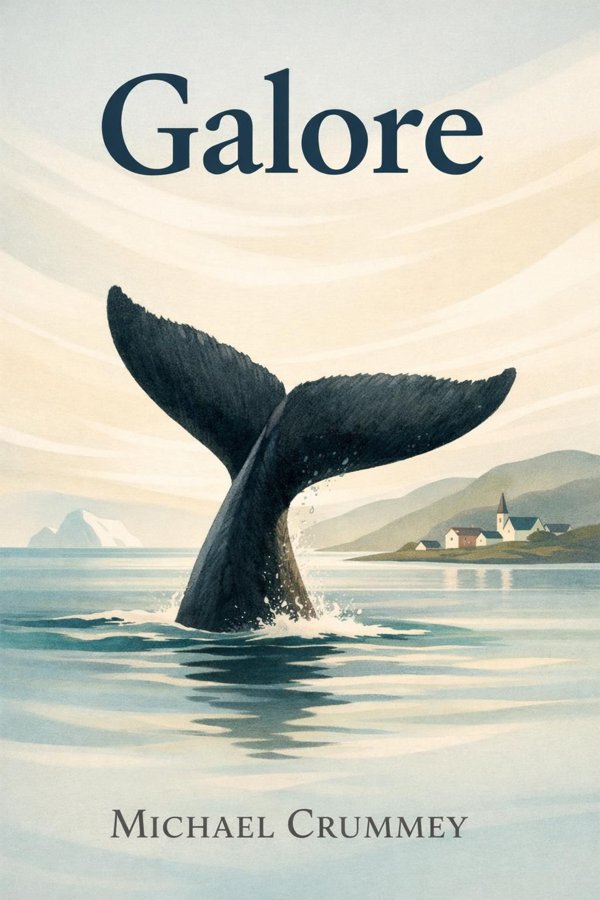
Galore: Summary & Key Insights
 10 min8 chaptersAudio available
Key Takeaways from Galore
A community often reveals itself most clearly in the way it responds to the impossible.
No settlement is held together by cooperation alone; beneath every community lies a struggle over who gets to define order.
Time does not erase stories; it hardens them into inheritance.
Stories do not just describe reality; they remake it.
In coastal life, nature is never just scenery; it is the first and last authority.
What Is Galore About?
Galore by Michael Crummey is a classics book spanning 4 pages. Set in the isolated fishing settlement of Paradise Deep, Newfoundland, Michael Crummey’s Galore is a sweeping, inventive novel about how communities are built as much from stories as from labor, bloodlines, and hardship. The book opens with one of the most unforgettable scenes in modern historical fiction: a mute man, Judah, is discovered alive inside a beached whale. From that startling beginning, Crummey unfolds a multigenerational tale of rival families, shifting power, desire, superstition, hunger, religion, and endurance over roughly two centuries. What makes Galore remarkable is not just its plot, but its atmosphere: the novel blends folklore, oral tradition, and historical realism so seamlessly that the miraculous feels like another form of truth. Crummey writes with deep authority about Newfoundland’s language, customs, and social history, drawing on the region’s cultural memory without reducing it to quaintness. The result is a richly textured classic of place-based fiction, one that explores how myths begin, how they shape identity, and how people survive in a landscape where the sea gives life as readily as it takes it away.
This FizzRead summary covers all 8 key chapters of Galore in approximately 10 minutes, distilling the most important ideas, arguments, and takeaways from Michael Crummey's work. Also available as an audio summary and Key Quotes Podcast.
Galore
Set in the isolated fishing settlement of Paradise Deep, Newfoundland, Michael Crummey’s Galore is a sweeping, inventive novel about how communities are built as much from stories as from labor, bloodlines, and hardship. The book opens with one of the most unforgettable scenes in modern historical fiction: a mute man, Judah, is discovered alive inside a beached whale. From that startling beginning, Crummey unfolds a multigenerational tale of rival families, shifting power, desire, superstition, hunger, religion, and endurance over roughly two centuries. What makes Galore remarkable is not just its plot, but its atmosphere: the novel blends folklore, oral tradition, and historical realism so seamlessly that the miraculous feels like another form of truth. Crummey writes with deep authority about Newfoundland’s language, customs, and social history, drawing on the region’s cultural memory without reducing it to quaintness. The result is a richly textured classic of place-based fiction, one that explores how myths begin, how they shape identity, and how people survive in a landscape where the sea gives life as readily as it takes it away.
Who Should Read Galore?
This book is perfect for anyone interested in classics and looking to gain actionable insights in a short read. Whether you're a student, professional, or lifelong learner, the key ideas from Galore by Michael Crummey will help you think differently.
- ✓Readers who enjoy classics and want practical takeaways
- ✓Professionals looking to apply new ideas to their work and life
- ✓Anyone who wants the core insights of Galore in just 10 minutes
Want the full summary?
Get instant access to this book summary and 100K+ more with Fizz Moment.
Get Free SummaryAvailable on App Store • Free to download
Key Chapters
A community often reveals itself most clearly in the way it responds to the impossible. Galore begins with an event that instantly tests the limits of reason and faith: a man named Judah is found alive inside a whale washed ashore. That image is biblical, absurd, comic, and sacred all at once, and Crummey uses it to establish one of the novel’s central concerns: people do not merely witness extraordinary events, they interpret them according to their fears, needs, and ambitions. For some in Paradise Deep, Judah’s appearance is a miracle. For others, it is a trick of chance, a curiosity to be explained away. But regardless of what anyone believes, the event changes the town because stories gain power not from certainty, but from repetition.
Judah himself becomes a vessel for projection. Because he enters the community as an outsider and because he is initially mute, others assign meaning to him before he can speak for himself. This reflects a broader truth about human societies: silence invites invention. We do this constantly in everyday life when we turn partial knowledge into complete narratives about people, institutions, or family history. A rumor becomes memory; memory becomes tradition.
Crummey’s insight is practical as well as literary. He shows how belief systems arise around dramatic events and then guide future behavior. In workplaces, families, and nations, origin stories shape identity long after the original facts have blurred. The lesson is not that belief is foolish, but that belief is formative. Pay attention to the stories your community tells about its beginnings, because they will influence what people think is possible, permissible, and true. Actionable takeaway: examine one “founding story” in your own family, organization, or culture and ask what values it quietly teaches.
No settlement is held together by cooperation alone; beneath every community lies a struggle over who gets to define order. In Paradise Deep, that struggle is embodied by figures such as King-me Sellers, whose will, cunning, and appetite for control help shape the settlement’s social life. Crummey refuses to romanticize small communities as naturally harmonious. Instead, he shows them as arenas where power is personal, local, and often inseparable from family status, property, religion, and gender. People survive together, but they also compete, resent, manipulate, and dominate.
This tension is what gives the novel so much of its human force. Paradise Deep is not a symbolic village detached from reality; it is a vivid social organism in which informal authority matters as much as official rules. A strong patriarch, a feared matriarch, a well-positioned family, or a charismatic outsider can redirect the emotional weather of the whole place. Crummey illustrates how rivalries do not remain private. A feud between individuals can affect marriages, labor, inheritances, and the stories later generations tell about justice and legitimacy.
The novel also highlights a crucial truth: communities are not built despite conflict, but through the way conflict is absorbed into custom. In modern terms, the same is true of companies, neighborhoods, and institutions. Politics emerges wherever resources are scarce and belonging matters. Understanding a group requires looking beyond shared values to see who benefits from them.
Crummey’s broader contribution is to show that history is often the residue of contested power. The family that controls the narrative can appear noble; the one pushed aside may become ghostly or scandalous. Actionable takeaway: when evaluating any community or organization, ask not only what traditions it celebrates, but who created those traditions and whose interests they serve.
Time does not erase stories; it hardens them into inheritance. One of Galore’s greatest achievements is its multigenerational structure, which allows Crummey to show how myths move through families and communities across decades. Characters die, children are born, alliances shift, and yet certain patterns endure. Names, grudges, longings, and legends survive in altered form, as though the town itself remembers what individuals forget. This gives the novel a tidal rhythm: history advances, but it also returns.
Crummey is especially attentive to how descendants inherit not only property or poverty, but unfinished meanings. A child may grow up under the shadow of a scandal they never witnessed. A family may cherish a version of its origins that is only partly true. Lovers may repeat dynamics set in motion generations earlier. Myth persists because it gives shape to otherwise chaotic experience. It tells people who they are before they have had the chance to decide for themselves.
This idea has broad relevance. In real life, families often pass down emotional habits alongside stories: who was brave, who was wronged, who was never forgiven. Even businesses and nations do this, using selective memory to preserve continuity. The danger is that inherited myths can become invisible forces, limiting people without their consent. The benefit is that they also offer belonging, endurance, and a vocabulary for collective identity.
Galore asks readers to see history not as a neat sequence of events but as a living web of repetition and revision. The past is not past if it continues to organize the present. Actionable takeaway: identify one story your family or community repeats about itself, then consider how that story shapes expectations about love, status, resilience, or failure today.
Stories do not just describe reality; they remake it. In Galore, storytelling functions as one of the novel’s deepest forms of power. Tales passed around Paradise Deep are not decorative folklore attached to the “real” events of history. They are themselves active forces that determine reputations, justify choices, preserve memory, and transform suffering into meaning. Crummey understands that in isolated communities especially, storytelling is a social technology. It explains the inexplicable, transmits values, and keeps the dead present among the living.
The novel repeatedly blurs the boundary between fact and tale, but this is not an argument against truth. It is an argument that human beings experience truth through narrative forms. A hunger winter, a vanished fisherman, a difficult birth, or an unexpected desire becomes bearable when folded into a story with rhythm and shape. Storytelling is survival because it helps people organize pain. It can also be dangerous, because the same narrative power that comforts can distort, erase, or trap.
Crummey’s treatment of this theme has practical force for contemporary readers. We still live by stories: personal brands, national myths, corporate mission statements, family legends, and social media identities. The question is not whether we are telling stories, but whether we recognize their influence. Who gets to tell them? What do they hide? What possibilities do they open?
Galore suggests that transformation begins when stories are heard differently or retold from another angle. A character once seen as cursed may become tragic; a supposed villain may appear wounded; a miracle may become a mirror. Actionable takeaway: revisit a difficult event from your own life and write two different versions of its story, noticing how each version changes its meaning and your relationship to it.
In coastal life, nature is never just scenery; it is the first and last authority. The sea in Galore is a living presence that shapes every layer of existence in Paradise Deep. It feeds families, dictates labor, governs migration, and delivers both bounty and catastrophe. The people of the settlement cannot think of themselves apart from it, yet they can never master it. Crummey avoids sentimental landscape writing by showing nature as morally indifferent. The sea does not reward virtue or punish sin in any simple way. It simply exerts force.
This tension is central to the novel’s worldview. Human beings make plans, form rivalries, marry, pray, and dream, but all of these unfold under ecological conditions they do not control. A beached whale can mean abundance. A storm can erase a future. Seasonal rhythms determine what is possible, and scarcity sharpens both generosity and cruelty. In that sense, the novel is also about environmental humility. People are not separate from the world around them; their beliefs, economies, and emotional lives are structured by it.
Modern readers can recognize this dynamic in new forms. Climate uncertainty, supply instability, and environmental dependence continue to shape communities, even when urban life creates an illusion of insulation. Crummey reminds us that every culture has material foundations, and when those foundations are unstable, identity becomes more precarious.
The sea also functions symbolically as a repository of mystery. It carries the unknown into the known world, whether in the form of Judah, lost bodies, rumors, or wealth. Actionable takeaway: think about the material environment that governs your own life, whether it is weather, industry, infrastructure, or geography, and ask how much of your identity has been shaped by forces you rarely name.
People turn to belief not only to explain the world, but to survive its uncertainty. In Galore, religion and superstition intermingle so naturally that separating them often feels impossible. Biblical echoes, folk practices, omens, curses, and communal rituals all coexist within the daily life of Paradise Deep. Crummey treats this mixture with respect and irony at once. He never mocks belief as mere ignorance, but neither does he present faith as a clean source of moral clarity. Instead, he shows belief as deeply human: necessary, inconsistent, and vulnerable to manipulation.
This complexity is essential to the novel’s moral atmosphere. Characters pray sincerely and act selfishly. They fear signs, seek divine order, and also bend spiritual language to support personal agendas. The sacred can console, but it can also authorize exclusion or judgment. In a place marked by danger and loss, superstition becomes a way of managing anxiety. If misfortune can be linked to a sign, a sin, or a curse, then chaos feels slightly less random.
The practical insight here is that belief systems often do social work beyond their official doctrines. In modern settings, this may look less like folk religion and more like institutional ideology, cultural taboo, or unspoken rules about what counts as respectable. People still create explanatory frameworks to make uncertainty tolerable.
Crummey’s achievement is to keep moral judgment unsettled. The novel resists easy categories of holy and profane, rational and irrational. That resistance mirrors real life, where motives are mixed and ethics are shaped by need as much as principle. Actionable takeaway: the next time you encounter a belief that seems irrational, ask what fear, hope, or need it helps organize before deciding what it means.
A place is never fully alive on the page until its language begins to breathe. One reason Galore feels so immersive is Michael Crummey’s ear for Newfoundland speech rhythms, idiom, and sensibility. He does not use regional language as ornament or novelty. Instead, voice becomes a carrier of worldview. The way people speak in the novel reveals class, intimacy, history, humor, and inherited patterns of thought. Through diction and cadence, Crummey preserves cultural memory while also making it dramatically vivid.
This matters because language is one of the primary ways communities resist disappearance. Remote or marginalized places are often flattened by outsiders into stereotype. Galore pushes back by rendering Paradise Deep from within, in terms shaped by local experience rather than external judgment. The novel demonstrates that speech is not merely a tool for communication; it is also an archive. Embedded in phrases are older beliefs, labor practices, emotional habits, and social structures.
For readers, this offers both pleasure and instruction. It asks us to slow down and inhabit a culture rather than consume it. In a globalized world where language is often standardized for efficiency, Crummey reminds us that particularity is a form of dignity. Distinct voices carry distinct ways of seeing.
There is a practical application here too. Whether in family history, regional culture, or professional life, paying attention to language reveals hidden assumptions. Which words signal belonging? Which phrases preserve old hierarchies? Which stories can only be told in a certain idiom? Actionable takeaway: listen closely to the recurring expressions in your own community or family and ask what they preserve about values, fears, and identity that more formal language leaves unsaid.
All Chapters in Galore
About the Author
Michael Crummey is a Canadian writer and poet from Newfoundland and Labrador, celebrated for fiction that draws deeply on the history, language, and lived realities of Atlantic Canada. Born in Buchans and long associated with St. John’s, he has built a reputation for combining literary precision with the cadences of oral storytelling. His novels often explore isolated communities, generational memory, labor, migration, and the uneasy overlap between folklore and fact. In addition to fiction, Crummey has published acclaimed poetry, and his work has earned major Canadian literary recognition, including award nominations and prizes. What sets him apart is his ability to render Newfoundland not as a romantic edge of the world, but as a complex cultural landscape shaped by hardship, humor, resilience, and myth. Galore stands as one of his most admired and ambitious novels.
Get This Summary in Your Preferred Format
Read or listen to the Galore summary by Michael Crummey anytime, anywhere. FizzRead offers multiple formats so you can learn on your terms — all free.
Available formats: App · Audio · PDF · EPUB — All included free with FizzRead
Download Galore PDF and EPUB Summary
Key Quotes from Galore
“A community often reveals itself most clearly in the way it responds to the impossible.”
“No settlement is held together by cooperation alone; beneath every community lies a struggle over who gets to define order.”
“Time does not erase stories; it hardens them into inheritance.”
“Stories do not just describe reality; they remake it.”
“In coastal life, nature is never just scenery; it is the first and last authority.”
Frequently Asked Questions about Galore
Galore by Michael Crummey is a classics book that explores key ideas across 8 chapters. Set in the isolated fishing settlement of Paradise Deep, Newfoundland, Michael Crummey’s Galore is a sweeping, inventive novel about how communities are built as much from stories as from labor, bloodlines, and hardship. The book opens with one of the most unforgettable scenes in modern historical fiction: a mute man, Judah, is discovered alive inside a beached whale. From that startling beginning, Crummey unfolds a multigenerational tale of rival families, shifting power, desire, superstition, hunger, religion, and endurance over roughly two centuries. What makes Galore remarkable is not just its plot, but its atmosphere: the novel blends folklore, oral tradition, and historical realism so seamlessly that the miraculous feels like another form of truth. Crummey writes with deep authority about Newfoundland’s language, customs, and social history, drawing on the region’s cultural memory without reducing it to quaintness. The result is a richly textured classic of place-based fiction, one that explores how myths begin, how they shape identity, and how people survive in a landscape where the sea gives life as readily as it takes it away.
You Might Also Like

Browse by Category
Ready to read Galore?
Get the full summary and 100K+ more books with Fizz Moment.