
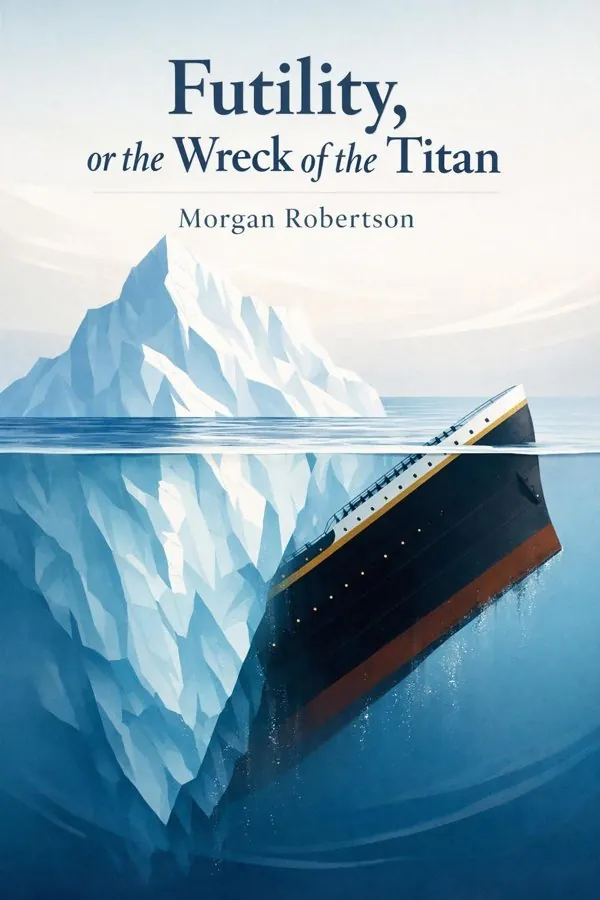
Futility, or the Wreck of the Titan: Summary & Key Insights
 10 min9 chaptersAudio available
Key Takeaways from Futility, or the Wreck of the Titan
A society often exposes its deepest values through the people it discards.
The more confidently we declare something invincible, the more vulnerable we may become to surprise.
Catastrophe often begins long before the moment of impact.
When systems fail suddenly, social polish disappears and character becomes visible.
In moments of true emergency, the people who endure are rarely the ones with the best image; they are the ones who can act clearly under pressure.
What Is Futility, or the Wreck of the Titan About?
Futility, or the Wreck of the Titan by Morgan Robertson is a classics book spanning 6 pages. Futility, or the Wreck of the Titan is a compact but haunting novella by Morgan Robertson, first published in 1898, that has become famous for its eerie resemblance to the later sinking of the Titanic. The story follows the Titan, an enormous British ocean liner celebrated as the greatest ship ever built and widely believed to be unsinkable. On board is John Rowland, a disgraced former naval officer whose personal collapse mirrors the moral blindness of the society around him. When the ship strikes an iceberg in the North Atlantic, Robertson turns an adventure narrative into a sharp meditation on pride, class, technology, and survival. What makes the book endure is not just its uncanny parallels to history, but its clear-eyed warning about human overconfidence. Robertson wrote with unusual authority: before becoming an author, he served as a merchant seaman and knew the rhythms, dangers, and hierarchy of life at sea. That experience gives the novella technical credibility and emotional force. Read today, Futility feels less like a curiosity and more like a timeless cautionary tale about what happens when ambition outruns wisdom.
This FizzRead summary covers all 9 key chapters of Futility, or the Wreck of the Titan in approximately 10 minutes, distilling the most important ideas, arguments, and takeaways from Morgan Robertson's work. Also available as an audio summary and Key Quotes Podcast.
Futility, or the Wreck of the Titan
Futility, or the Wreck of the Titan is a compact but haunting novella by Morgan Robertson, first published in 1898, that has become famous for its eerie resemblance to the later sinking of the Titanic. The story follows the Titan, an enormous British ocean liner celebrated as the greatest ship ever built and widely believed to be unsinkable. On board is John Rowland, a disgraced former naval officer whose personal collapse mirrors the moral blindness of the society around him. When the ship strikes an iceberg in the North Atlantic, Robertson turns an adventure narrative into a sharp meditation on pride, class, technology, and survival.
What makes the book endure is not just its uncanny parallels to history, but its clear-eyed warning about human overconfidence. Robertson wrote with unusual authority: before becoming an author, he served as a merchant seaman and knew the rhythms, dangers, and hierarchy of life at sea. That experience gives the novella technical credibility and emotional force. Read today, Futility feels less like a curiosity and more like a timeless cautionary tale about what happens when ambition outruns wisdom.
Who Should Read Futility, or the Wreck of the Titan?
This book is perfect for anyone interested in classics and looking to gain actionable insights in a short read. Whether you're a student, professional, or lifelong learner, the key ideas from Futility, or the Wreck of the Titan by Morgan Robertson will help you think differently.
- ✓Readers who enjoy classics and want practical takeaways
- ✓Professionals looking to apply new ideas to their work and life
- ✓Anyone who wants the core insights of Futility, or the Wreck of the Titan in just 10 minutes
Want the full summary?
Get instant access to this book summary and 100K+ more with Fizz Moment.
Get Free SummaryAvailable on App Store • Free to download
Key Chapters
A society often exposes its deepest values through the people it discards. John Rowland enters Futility, or the Wreck of the Titan not as a triumphant hero but as a broken man: once a capable naval officer, now reduced to the humiliating work of an ordinary seaman on a luxury liner built for the rich. His decline matters because Robertson does not treat it as a private misfortune alone. Rowland becomes a lens through which we see a world that praises status, performance, and appearance more than character.
Rowland’s disgrace has left him bitter, alcoholic, and inwardly unstable. Yet he retains skill, courage, and instinct. This contrast is essential. Robertson shows that human worth can survive social ruin, even when institutions no longer recognize it. The same people who dismiss Rowland are quick to trust polished authority and grand design, even when both prove unreliable. In that sense, Rowland is the book’s moral outsider: flawed enough to be ignored, but experienced enough to see danger where others see spectacle.
The pattern feels familiar in modern life. Companies overlook a seasoned employee because he lacks charisma. Communities dismiss a person after public failure, even though that person may still hold valuable judgment. Families may define someone by their worst season rather than their full humanity. Robertson invites us to ask who gets heard, who gets shamed, and what wisdom is lost in the process.
Rowland’s story also suggests that collapse does not erase responsibility. He must still choose how to act under pressure. His redemption, such as it is, comes not through speeches or restored prestige but through action in extremity.
Actionable takeaway: Look again at the “discredited” person in your workplace, family, or community. Before dismissing someone because of failure or reputation, ask what experience, insight, or resilience they may still carry.
The more confidently we declare something invincible, the more vulnerable we may become to surprise. The Titan is not merely a ship in Robertson’s novella; it is a symbol of industrial pride at full volume. Vast, luxurious, and celebrated as unsinkable, it represents the late nineteenth-century belief that engineering progress could conquer uncertainty itself. Its size and splendor are meant to reassure passengers that nature has been mastered.
Robertson deliberately builds this image to expose its weakness. The Titan is impressive, but the confidence surrounding it is the true danger. Designers, owners, and passengers place faith not only in steel and machinery, but in an idea: that human ingenuity has moved beyond old limits. Once that belief takes hold, caution begins to look unnecessary, and preparedness starts to feel like pessimism. The ship’s magnificence becomes a psychological trap.
This is one of the novella’s most lasting insights. The problem is not technology itself. Robertson is not arguing that human invention is evil or pointless. He is warning that success creates its own blind spots. The better a system performs, the easier it becomes for people to assume that failure is no longer relevant. We still see this pattern today. A financial model seems too sophisticated to break. A medical system appears too advanced to be overwhelmed. A digital platform is considered too robust to fail. Then a stress event arrives, and hidden assumptions collapse.
The Titan’s grandeur also reveals how spectacle can displace judgment. People are drawn to what is largest, fastest, and most luxurious, often treating scale as proof of safety or wisdom. Robertson reminds us that performance and prudence are not the same thing.
Actionable takeaway: Whenever you hear words like “fail-safe,” “unbreakable,” or “too advanced to fail,” pause and ask a simple question: what would happen if this system failed anyway, and are we truly prepared for that possibility?
Catastrophe often begins long before the moment of impact. In Futility, or the Wreck of the Titan, the ship’s collision with the iceberg is dramatic, but Robertson makes clear that disaster is prepared in advance by attitude. The captain and the culture around him operate with excessive confidence, pressing ahead with speed and certainty in conditions that call for restraint. The real crisis is not only physical; it is psychological.
This overconfidence grows out of status, habit, and institutional pressure. A great ship is expected to perform greatly. A captain of such a vessel is expected to project command, not hesitation. Slowing down may feel like weakness, while confidence feels like professionalism. Robertson understands a subtle truth of leadership: people are often rewarded for certainty even when uncertainty would be wiser. The result is that caution gets crowded out by image.
The lesson extends far beyond the sea. In business, leaders may continue an aggressive launch despite warning signs because delay looks costly. In politics, officials may deny vulnerability because public confidence seems more valuable than honest risk communication. In everyday life, a driver goes too fast in dangerous weather because he trusts the vehicle more than the road. Again and again, the pattern is the same: momentum replaces judgment.
Robertson also highlights how groups normalize danger. If everyone onboard believes the ship is safe, individuals become less likely to question decisions. Risk becomes socially invisible. One of the most unsettling aspects of the novella is how ordinary this feels. Tragedy is not caused by a villain alone, but by a culture that confuses confidence with control.
The practical implication is simple but demanding: wisdom requires friction. We need systems, habits, and voices that can interrupt momentum before it becomes fatal.
Actionable takeaway: In any important decision, deliberately create a “pause point.” Ask what warning signs are being minimized, who feels unable to speak up, and what a more cautious course would cost compared with preventable disaster.
When systems fail suddenly, social polish disappears and character becomes visible. The collision between the Titan and the iceberg is the novella’s central dramatic event, but Robertson uses it for more than shock. In a single violent moment, luxury turns into chaos, confidence into panic, and social order into a desperate struggle for survival. The crash reveals how thin the veneer of civilization can be when fear arrives.
Before the impact, the ship is a floating world of hierarchy and comfort. Passengers trust structure, routine, and class distinctions. After the collision, those assumptions no longer protect anyone. Robertson is fascinated by how quickly people move from ceremony to instinct. The event forces a brutal recalculation: what matters when status, wealth, and technological power cannot save you? The answer is not elegance, but preparedness, courage, and practical action.
This is one reason the novel remains powerful. Extreme situations do not create character from nothing; they expose what was already there. Some people freeze. Some cling to denial. Some become selfish. Some discover unexpected courage. In modern terms, a crisis test reveals the difference between appearance and capacity. Organizations also behave this way. A company may look stable until a market shock hits. A government may appear strong until emergency response is needed. A family may seem functional until stress uncovers patterns of avoidance or resilience.
Robertson’s scene of disaster also carries a humbling reminder: nature does not negotiate with human prestige. The iceberg is indifferent. It does not care about engineering claims, business investment, or social rank. That indifference is the novella’s hard realism.
Actionable takeaway: Don’t evaluate yourself or your institutions only by how they perform in normal conditions. Ask how you would respond under stress, and strengthen the habits, plans, and relationships that matter when comfort disappears.
In moments of true emergency, the people who endure are rarely the ones with the best image; they are the ones who can act clearly under pressure. After the Titan sinks, Robertson narrows the story into a struggle for survival centered on John Rowland. Removed from the artificial confidence of the ship, Rowland must rely on bodily endurance, seamanship, and decisiveness. The survival sections of the novella transform him from a disgraced man into a figure of raw competence.
This shift is important because Robertson does not romanticize survival as simple heroism. Survival is messy, physical, and morally demanding. It requires not only strength but judgment: what to carry, whom to trust, when to move, when to conserve energy, how to protect another life while preserving one’s own. In this stripped-down environment, practical knowledge becomes priceless. Rowland’s maritime experience, previously devalued by society, suddenly matters more than the prestige of everyone who outranked him.
This insight applies broadly. In any crisis, tacit knowledge becomes visible. The quiet nurse who knows how to stabilize chaos, the technician who understands the system’s weak points, the parent who remains calm in an emergency—these people may not be the most celebrated, but they are often the most essential. Robertson reminds us that resilience is built before crisis, through repetition, discipline, and familiarity with difficulty.
Survival in the novella is also tied to awakening. Rowland, who began the story defeated and embittered, discovers purpose through action. Robertson suggests that identity can be rebuilt not through self-image but through responsibility. We become who we are by what we do when conditions are worst.
Actionable takeaway: Build practical resilience in your own life. Learn one emergency skill, strengthen your ability to stay calm under stress, and value experienced competence more than surface-level confidence.
Human beings do not need to hate nature to misunderstand it; often we simply underestimate it. One of the novella’s deepest messages is that however advanced our technology becomes, the natural world remains larger, older, and less obedient than our plans. The Titan is designed as a triumph over distance, weather, and oceanic danger. Yet one iceberg is enough to reduce that triumph to wreckage.
Robertson’s point is not that effort is meaningless. Ships should be built, journeys attempted, and progress pursued. But every genuine achievement must coexist with humility. The sea in Futility is not malicious. It is impersonal. That impersonality matters because it removes the comforting illusion that disaster happens only to the foolish or the undeserving. Sometimes human beings are simply smaller than the forces they confront.
This insight remains urgently relevant. We live in an age of predictive tools, advanced infrastructure, and vast information systems, and yet floods, fires, pandemics, storms, and supply disruptions repeatedly reveal the limits of planning. We can reduce risk, but not abolish uncertainty. Robertson’s novella encourages a healthier relationship to power: use it, improve it, but never worship it.
There is also a moral dimension here. When people believe they control everything, they become less patient, less reverent, and less prepared. Humility is not passivity; it is disciplined realism. It asks us to respect complexity, admit contingency, and remember that confidence is not the same as mastery.
In personal life, this can mean accepting that not every outcome can be engineered. In leadership, it means building contingencies rather than promising perfection. In culture, it means resisting fantasies of total control.
Actionable takeaway: Replace the goal of complete control with the goal of wise preparedness. In any major plan, identify what remains outside your control and build margins, backups, and humility around that fact.
Luxury can disguise vulnerability, but it cannot eliminate it. Futility is often remembered for its prophetic shipwreck, yet it is also a sharp critique of class assumptions. The Titan carries wealthy passengers who are accustomed to comfort, deference, and protection. Their world suggests that money can purchase security, order, and distance from ordinary danger. Robertson dismantles that illusion with ruthless efficiency.
Onboard hierarchy shapes everything before the disaster. Labor is hidden, authority is stratified, and the ship itself serves as a theater of prestige. But once catastrophe strikes, the logic of class begins to break apart. Wealth does not teach endurance. Status does not guarantee competence. Social standing offers little protection against cold water, limited lifeboats, or the indifferent force of the sea. What matters instead are skills, judgment, and moral composure.
Robertson does not claim that class disappears entirely in crisis; rather, he shows that its promises are exposed as fragile. This remains a timely observation. In modern institutions, privilege still creates the illusion that some people are insulated from consequences. Executives may assume they are protected from organizational failure. Affluent communities may believe infrastructure problems belong elsewhere. Individuals with social influence may mistake attention for capability. Then a crisis arrives and redraws the map.
The novella’s class critique also asks readers to honor the knowledge of people who work closest to reality. Sailors, workers, mechanics, and operators often understand risk more concretely than those who merely enjoy the surface benefits of a system. Robertson, drawing on his maritime background, gives weight to that perspective.
Actionable takeaway: In any organization or community, listen seriously to the people doing the practical work. Don’t confuse wealth, title, or visibility with preparedness; ask who actually understands how things function when pressure hits.
What makes Futility unforgettable is not that it predicted the Titanic so closely, but that it understood the mindset behind such a disaster. Much of the book’s fame comes from the similarities: a gigantic British liner, claims of being unsinkable, a North Atlantic iceberg collision, insufficient lifeboats, and immense loss of life. These parallels are undeniably striking. Yet if we focus only on prediction, we risk missing Robertson’s deeper achievement.
He was not performing magic. He was extrapolating from the values and technologies of his age. As a seaman and observer of maritime culture, Robertson recognized a dangerous combination already taking shape: industrial ambition, public spectacle, commercial pressure, and human vanity. In that sense, the novella is less prophecy than diagnosis. It identifies the conditions under which a “modern miracle” becomes a modern disaster.
This distinction matters because it turns the book from curiosity into instruction. We are often fascinated by warnings only after events prove them right. But wise reading asks a harder question: what warnings around us are we currently ignoring because they seem too inconvenient, pessimistic, or improbable? A near-future crisis rarely appears impossible to those paying close attention. It usually appears merely unlikely—until it happens.
Examples are everywhere. Cybersecurity experts warn about preventable breaches. Climate scientists warn about intensified weather risks. Engineers warn about aging infrastructure. Public health specialists warn about response gaps. The pattern Robertson captures is timeless: society rewards confidence, then treats foresight as alarmism.
Actionable takeaway: When a credible warning seems uncomfortable or overly cautious, resist the urge to dismiss it. Instead, ask what assumptions make the warning easy to ignore, and what low-cost preventive action you could take before events force your attention.
Some old books survive because they are tied to a historical event; others survive because they describe permanent habits of the human mind. Futility does both. Its afterlife is inseparable from the Titanic disaster, but its real staying power comes from Robertson’s understanding of pride. The novella suggests that human beings repeatedly create systems that are too efficient, too beautiful, or too successful to question. Then we become emotionally invested in believing they cannot fail.
That pattern is not limited to ships. It appears in institutions, ideologies, careers, relationships, and even self-concepts. A leader begins to think past success guarantees future safety. A company believes scale will protect it from disruption. A person assumes intelligence alone will prevent moral failure. In each case, pride narrows perception. We stop noticing the conditions that made success possible, and we stop imagining reversal.
Robertson’s genius lies in connecting this abstract flaw to a gripping narrative. He does not preach in philosophical language. He shows pride embedded in design, conversation, pace, and policy. He makes readers feel how comfort and admiration can lull whole groups into misjudgment. That is why the book still resonates: not because we travel by ocean liner, but because we still mistake achievement for invulnerability.
There is a quiet ethical challenge here as well. Humility is not merely a defensive tactic; it is a way of seeing truthfully. It allows us to appreciate greatness without idolizing it, to pursue excellence without denying fragility, and to build boldly without forgetting consequences.
Actionable takeaway: Choose one area of success in your life and audit it honestly. Ask what hidden assumptions, neglected risks, or unchallenged habits support it, and take one concrete step to add humility, feedback, or contingency.
All Chapters in Futility, or the Wreck of the Titan
About the Author
Morgan Robertson (1861–1915) was an American writer best known for maritime fiction shaped by his years as a merchant seaman. Born in New York, he spent much of his early life at sea, serving in the merchant marine and gaining firsthand knowledge of ships, sailors, navigation, and the risks of ocean travel. That practical experience gave his fiction unusual realism and authority. He wrote numerous sea stories, adventure tales, and speculative works, but his most famous piece remains Futility, or the Wreck of the Titan, first published in 1898. After the Titanic sank in 1912, readers were struck by the novella’s remarkable similarities to the real disaster. Robertson is remembered today not just for that coincidence, but for his sharp understanding of technology, human pride, and the culture of the sea.
Get This Summary in Your Preferred Format
Read or listen to the Futility, or the Wreck of the Titan summary by Morgan Robertson anytime, anywhere. FizzRead offers multiple formats so you can learn on your terms — all free.
Available formats: App · Audio · PDF · EPUB — All included free with FizzRead
Download Futility, or the Wreck of the Titan PDF and EPUB Summary
Key Quotes from Futility, or the Wreck of the Titan
“A society often exposes its deepest values through the people it discards.”
“The more confidently we declare something invincible, the more vulnerable we may become to surprise.”
“Catastrophe often begins long before the moment of impact.”
“When systems fail suddenly, social polish disappears and character becomes visible.”
“In moments of true emergency, the people who endure are rarely the ones with the best image; they are the ones who can act clearly under pressure.”
Frequently Asked Questions about Futility, or the Wreck of the Titan
Futility, or the Wreck of the Titan by Morgan Robertson is a classics book that explores key ideas across 9 chapters. Futility, or the Wreck of the Titan is a compact but haunting novella by Morgan Robertson, first published in 1898, that has become famous for its eerie resemblance to the later sinking of the Titanic. The story follows the Titan, an enormous British ocean liner celebrated as the greatest ship ever built and widely believed to be unsinkable. On board is John Rowland, a disgraced former naval officer whose personal collapse mirrors the moral blindness of the society around him. When the ship strikes an iceberg in the North Atlantic, Robertson turns an adventure narrative into a sharp meditation on pride, class, technology, and survival. What makes the book endure is not just its uncanny parallels to history, but its clear-eyed warning about human overconfidence. Robertson wrote with unusual authority: before becoming an author, he served as a merchant seaman and knew the rhythms, dangers, and hierarchy of life at sea. That experience gives the novella technical credibility and emotional force. Read today, Futility feels less like a curiosity and more like a timeless cautionary tale about what happens when ambition outruns wisdom.
You Might Also Like






Browse by Category
Ready to read Futility, or the Wreck of the Titan?
Get the full summary and 100K+ more books with Fizz Moment.