
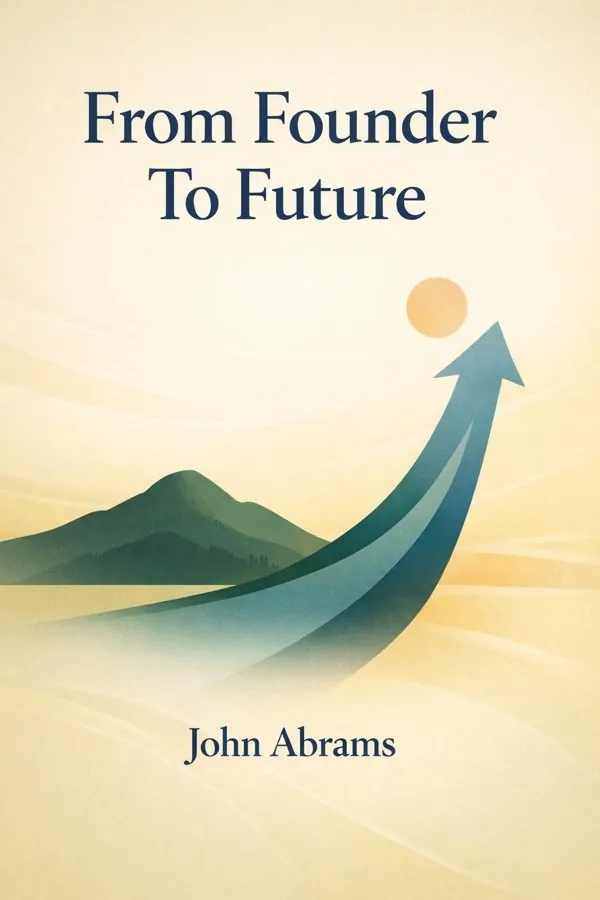
From Founder To Future: Summary & Key Insights
by John Abrams
 10 min9 chaptersAudio available
Key Takeaways from From Founder To Future
Many meaningful companies begin not with a grand strategy but with a question about how to live well and work honestly.
A mission statement means very little if it exists only on paper.
Ownership is not just a legal structure; it is a statement about who the business is for.
A founder’s greatest achievement may be building a company that no longer needs the founder at the center of everything.
Environmental responsibility becomes credible only when it shapes design, operations, and economics in visible ways.
What Is From Founder To Future About?
From Founder To Future by John Abrams is a entrepreneurship book spanning 9 pages. From Founder To Future is both a business memoir and a practical meditation on what it means to build a company that serves more than its owners. In this thoughtful account, John Abrams reflects on the creation of South Mountain Company on Martha’s Vineyard and the long, often difficult journey of turning a small carpentry business into a mission-driven, employee-owned enterprise. Rather than celebrating growth for its own sake, Abrams asks deeper questions: What is a business for? How can a company create economic value while honoring people, place, and the environment? And what happens when a founder deliberately prepares the organization to outlast his own leadership? The book matters because it offers an alternative to the familiar startup narrative of speed, scale, and exit. Abrams shows that entrepreneurship can also be local, democratic, sustainable, and rooted in community. His authority comes not from theory alone but from decades of real-world experimentation in leadership, ownership design, ecological building, and civic responsibility. For readers interested in conscious capitalism, employee ownership, or values-based leadership, this is a grounded and deeply credible guide to building a future-ready business.
This FizzRead summary covers all 9 key chapters of From Founder To Future in approximately 10 minutes, distilling the most important ideas, arguments, and takeaways from John Abrams's work. Also available as an audio summary and Key Quotes Podcast.
From Founder To Future
From Founder To Future is both a business memoir and a practical meditation on what it means to build a company that serves more than its owners. In this thoughtful account, John Abrams reflects on the creation of South Mountain Company on Martha’s Vineyard and the long, often difficult journey of turning a small carpentry business into a mission-driven, employee-owned enterprise. Rather than celebrating growth for its own sake, Abrams asks deeper questions: What is a business for? How can a company create economic value while honoring people, place, and the environment? And what happens when a founder deliberately prepares the organization to outlast his own leadership?
The book matters because it offers an alternative to the familiar startup narrative of speed, scale, and exit. Abrams shows that entrepreneurship can also be local, democratic, sustainable, and rooted in community. His authority comes not from theory alone but from decades of real-world experimentation in leadership, ownership design, ecological building, and civic responsibility. For readers interested in conscious capitalism, employee ownership, or values-based leadership, this is a grounded and deeply credible guide to building a future-ready business.
Who Should Read From Founder To Future?
This book is perfect for anyone interested in entrepreneurship and looking to gain actionable insights in a short read. Whether you're a student, professional, or lifelong learner, the key ideas from From Founder To Future by John Abrams will help you think differently.
- ✓Readers who enjoy entrepreneurship and want practical takeaways
- ✓Professionals looking to apply new ideas to their work and life
- ✓Anyone who wants the core insights of From Founder To Future in just 10 minutes
Want the full summary?
Get instant access to this book summary and 100K+ more with Fizz Moment.
Get Free SummaryAvailable on App Store • Free to download
Key Chapters
Many meaningful companies begin not with a grand strategy but with a question about how to live well and work honestly. That is how South Mountain Company began: not as a polished entrepreneurial plan, but as a small carpenter’s shop shaped by a sense that work could express values as much as it generated income. John Abrams arrived on Martha’s Vineyard drawn to its distinct character, its human scale, and the possibility of building a life rooted in craftsmanship and place. In the early years, the business had modest means, limited resources, and none of the prestige associated with later success. But it had something more important: a conviction that the quality of work, relationships, and intentions mattered.
Abrams shows that founding conditions shape culture in lasting ways. A company born from expediency alone may stay transactional. A company born from care can evolve into an institution with moral depth. South Mountain’s early identity was formed through hands-on labor, close client relationships, and respect for the local environment. Even before its mission was formally articulated, the company was already experimenting with what it meant to balance craft, livelihood, and responsibility.
This idea is highly practical for entrepreneurs. Founders often wait until later to define purpose, assuming values can be layered onto a business once it becomes stable. Abrams suggests the opposite: your earliest decisions about clients, standards, pricing, hiring, and behavior quietly become the business model. A small shop, agency, studio, or startup can begin embedding its future culture from day one.
Actionable takeaway: Write down the principles already visible in how you work today, then use them to guide the next three decisions your business makes.
A mission statement means very little if it exists only on paper. One of Abrams’s most important lessons is that values become real only when they are tested in daily operations, difficult trade-offs, and open dialogue. At South Mountain Company, the mission was not created as a branding exercise or a polished public relations tool. It emerged over time, through conversation, conflict, reflection, and repeated effort to align business practices with deeper beliefs about community, ecology, fairness, and design excellence.
This makes the book especially useful for leaders frustrated by the gap between aspirational language and organizational reality. Abrams recognizes that mission is dynamic. It evolves as a company encounters new pressures, grows in complexity, and learns from mistakes. A value like sustainability, for example, does not become meaningful because it appears in a brochure. It becomes meaningful when a company changes how it sources materials, how it designs projects, how it invests profits, and how it evaluates success.
The practical implication is that mission must be operationalized. A company that claims to value people should examine compensation, ownership, decision-making, and advancement. A company that claims to value the environment should track energy, waste, lifecycle costs, and design choices. A company that claims to value community should ask how its work affects local stakeholders, not just shareholders.
Abrams also shows that mission should invite participation. Employees need room to interpret, question, and strengthen the organization’s values. Otherwise, mission becomes founder rhetoric rather than shared culture.
Actionable takeaway: Choose one stated company value and identify three concrete policies, metrics, or routines that would prove you actually live it.
Ownership is not just a legal structure; it is a statement about who the business is for. One of the defining moves in From Founder To Future is the transition of South Mountain Company toward employee ownership. Abrams presents this shift not as a clever succession tactic, but as the natural extension of a long-held belief that people who build value should share in it. Employee ownership transformed the company from a founder-centered enterprise into a broader human community with distributed stakes, responsibilities, and rewards.
This matters because many companies talk about teamwork while retaining deeply unequal power structures. Abrams argues that if you want commitment, accountability, and long-term thinking, you must design systems that support them. Employee ownership creates a stronger link between individual effort and collective outcomes. It encourages workers to think like stewards rather than hired hands. It can also make succession less disruptive by reducing dependence on a charismatic founder.
But the book does not romanticize the change. Ownership brings complexity. It requires education, transparency, governance discipline, and a cultural willingness to think beyond self-interest. Not every employee automatically becomes a strategic thinker simply because shares are involved. The organization must teach financial literacy, clarify rights and responsibilities, and build trust over time.
For founders, this idea is especially relevant when thinking about legacy. Selling to outsiders may maximize immediate gain, but selling internally or structuring employee ownership can preserve mission, jobs, and local impact. For employees, it offers a path from labor to participation.
Actionable takeaway: If ownership transition is part of your future, begin now by educating your team about how the business makes money, creates value, and could eventually be shared.
A founder’s greatest achievement may be building a company that no longer needs the founder at the center of everything. Abrams’s leadership philosophy is grounded in humility, continuity, and institutional maturity. Rather than treating leadership as personal control, he treats it as a responsibility to build systems, relationships, and values strong enough to endure beyond one individual’s presence. This is a sharp contrast to entrepreneurial cultures that equate leadership with visibility, dominance, or indispensability.
In Abrams’s view, good leadership includes listening carefully, sharing information, making room for other voices, and accepting that wisdom is often distributed. Leaders shape culture not only through decisions but through the quality of attention they bring to people and processes. They also influence whether an organization remains brittle and founder-dependent or becomes resilient and adaptive.
This idea becomes especially important during periods of growth or succession. Many founders unintentionally create bottlenecks because they remain the chief source of judgment, relationships, and authority. That can feel efficient in the short term, but it weakens the business over time. Abrams suggests that leaders should gradually hand off responsibility, develop future leaders, and build governance structures capable of carrying the mission forward.
Practical applications include documenting key decisions, mentoring emerging leaders, clarifying roles, and creating forums where disagreement can surface constructively. It also means recognizing when the founder’s identity is beginning to constrain the company’s next chapter.
Leadership, in this framework, is less about heroic action and more about stewardship. The true test is not whether people admire the founder, but whether the organization can continue acting with integrity and competence after the founder steps back.
Actionable takeaway: List the five decisions only you currently make and begin transferring at least one of them through coaching, documentation, and shared authority.
Environmental responsibility becomes credible only when it shapes design, operations, and economics in visible ways. Abrams treats sustainability not as moral decoration but as a demanding professional discipline. At South Mountain Company, sustainable building was not simply about good intentions; it required technical learning, experimentation, and the courage to challenge familiar assumptions about cost, performance, and design priorities.
One of the strengths of the book is that it places sustainability inside the realities of business. Green aspirations often fail because leaders treat them as optional extras rather than as core design principles. Abrams argues that companies must integrate ecological thinking into how they source materials, manage energy, approach durability, and evaluate long-term value. In the building industry, that might mean designing for efficiency, using better envelopes, reducing lifecycle waste, or helping clients understand that lower operating costs and healthier buildings can justify stronger upfront investments.
This lesson extends beyond construction. Any business can ask whether its processes create unnecessary waste, whether short-term savings produce long-term harm, and whether environmental goals are backed by measurable action. Sustainability becomes stronger when linked to innovation and operational excellence rather than guilt alone.
Abrams also shows that values-based environmental work requires patience. Not every client is ready. Not every experiment works. And the market does not always reward foresight quickly. Still, persistent practice can shift expectations and create new norms.
Actionable takeaway: Identify one area where your organization can replace a short-term, cheaper choice with a more durable and responsible one, then calculate the full long-term benefit rather than the immediate cost alone.
No company exists in a vacuum. One of Abrams’s deepest insights is that place is not just a backdrop for business but a living influence on how a company behaves, what it values, and whom it serves. South Mountain Company was shaped by Martha’s Vineyard: its ecological sensitivity, social complexity, physical beauty, and tight-knit community life. That local context forced the company to think beyond transactions and consider how its work affected neighbors, landscapes, housing, and the broader civic fabric.
This perspective challenges a common entrepreneurial habit of treating success as portable and abstract. Abrams suggests that truly responsible businesses pay attention to local needs, histories, and limits. A company embedded in a place should ask not just, “What can we extract from this market?” but “How can we contribute to the health of this community?” That might involve hiring locally, supporting civic initiatives, designing context-sensitive products, or addressing problems the market routinely ignores.
The book also highlights the mutual relationship between business and belonging. A company that earns trust in a community gains more than customers; it gains legitimacy, resilience, and a richer sense of purpose. But that trust must be continually renewed through conduct. For South Mountain, this meant taking seriously the social consequences of development, the environmental implications of construction, and the responsibility of being a visible local institution.
For modern leaders, especially in an era of remote scale and anonymous growth, this is a timely reminder that rootedness can be a strategic and moral advantage.
Actionable takeaway: Map the local stakeholders your business affects most directly and choose one concrete way to improve your contribution to the place where you operate.
Sustainable businesses are not built by avoiding difficulty but by learning from it honestly. Abrams is candid about the strains that come with running a mission-driven company over many years: economic pressures, leadership tensions, organizational complexity, imperfect decisions, and the constant challenge of living up to ideals in an imperfect world. This candor gives the book much of its credibility. It is not a victory lap. It is an account of institutional learning.
One major lesson is that ideals do not eliminate conflict; in some cases they intensify it. When people care deeply about values, disagreements can become more emotionally charged. Questions about fairness, direction, and responsibility matter more, not less. Abrams suggests that healthy organizations create structures where these tensions can be discussed constructively rather than denied. Governance, transparency, and shared language become essential.
Another lesson is that growth introduces both opportunity and distortion. As organizations become more sophisticated, they can gain capacity but lose intimacy. Processes can improve clarity while also creating distance. Founders must notice when old habits no longer fit new realities. What worked for a ten-person shop may not work for a fifty-person enterprise.
For readers, this chapter of the story offers reassurance. Difficulty does not mean the mission is failing. It may mean the organization is confronting the real work of maturity. The crucial question is whether leaders respond defensively or reflectively. Institutions become enduring when they convert setbacks into better systems, wiser culture, and stronger relationships.
Actionable takeaway: After your next major problem, hold a structured review focused on what the system taught you, not just who made the mistake.
The future of work will not be improved by technology alone; it will be improved by rethinking dignity, participation, and purpose. In the closing vision of From Founder To Future, Abrams expands beyond his own company to ask what kind of economy we want to create. He is skeptical of business models that concentrate wealth, detach firms from communities, and reduce workers to disposable inputs. In their place, he advocates for forms of enterprise that are democratic, place-conscious, environmentally responsible, and built for long-term stewardship.
This is not nostalgia for a simpler past. Abrams is not arguing that every company should look like a local builder on an island. Rather, he uses South Mountain as evidence that different assumptions are possible. Work can be organized around shared ownership. Leadership can be distributed. Businesses can be profitable without being extractive. Success can mean continuity, trust, craftsmanship, and contribution, not just speed and scale.
For today’s readers, this argument feels increasingly relevant. Workers want meaning, not only wages. Communities are pushing back against extractive corporate behavior. Younger entrepreneurs are more open to hybrid models that integrate mission into structure. The book suggests that the future belongs to organizations willing to design themselves around resilience and reciprocity rather than short-term gain.
The practical challenge is to move from abstract hope to structural change. That may mean revisiting compensation, governance, stakeholder responsibility, and environmental standards. The future of work becomes more human when companies deliberately embed humanity into how they operate.
Actionable takeaway: Ask of your organization, “If we were designing this company today to maximize dignity and long-term contribution, what would we structure differently?”
All Chapters in From Founder To Future
About the Author
John Abrams is an American entrepreneur, builder, designer, and author best known as a co-founder and longtime leader of South Mountain Company, a pioneering employee-owned design, building, and renewable energy firm based on Martha’s Vineyard. Over the course of his career, he became a prominent advocate for sustainable construction, democratic ownership, and mission-driven enterprise. Abrams’s work stands out for combining practical craftsmanship with a deep commitment to environmental responsibility and community well-being. Rather than pursuing growth as an end in itself, he has focused on creating a business model that balances financial viability with social purpose. In his writing and public speaking, Abrams shares lessons from decades of experience building an organization designed to endure beyond its founder and contribute meaningfully to the place it calls home.
Get This Summary in Your Preferred Format
Read or listen to the From Founder To Future summary by John Abrams anytime, anywhere. FizzRead offers multiple formats so you can learn on your terms — all free.
Available formats: App · Audio · PDF · EPUB — All included free with FizzRead
Download From Founder To Future PDF and EPUB Summary
Key Quotes from From Founder To Future
“Many meaningful companies begin not with a grand strategy but with a question about how to live well and work honestly.”
“A mission statement means very little if it exists only on paper.”
“Ownership is not just a legal structure; it is a statement about who the business is for.”
“A founder’s greatest achievement may be building a company that no longer needs the founder at the center of everything.”
“Environmental responsibility becomes credible only when it shapes design, operations, and economics in visible ways.”
Frequently Asked Questions about From Founder To Future
From Founder To Future by John Abrams is a entrepreneurship book that explores key ideas across 9 chapters. From Founder To Future is both a business memoir and a practical meditation on what it means to build a company that serves more than its owners. In this thoughtful account, John Abrams reflects on the creation of South Mountain Company on Martha’s Vineyard and the long, often difficult journey of turning a small carpentry business into a mission-driven, employee-owned enterprise. Rather than celebrating growth for its own sake, Abrams asks deeper questions: What is a business for? How can a company create economic value while honoring people, place, and the environment? And what happens when a founder deliberately prepares the organization to outlast his own leadership? The book matters because it offers an alternative to the familiar startup narrative of speed, scale, and exit. Abrams shows that entrepreneurship can also be local, democratic, sustainable, and rooted in community. His authority comes not from theory alone but from decades of real-world experimentation in leadership, ownership design, ecological building, and civic responsibility. For readers interested in conscious capitalism, employee ownership, or values-based leadership, this is a grounded and deeply credible guide to building a future-ready business.
You Might Also Like
Lean Analytics
Alistair Croll, Benjamin Yoskovitz
10 min
21 Days To A Big Idea: Creating Breakthrough Business Concepts
Bryan Mattimore
10 min
Sam Walton: Made in America: My Story
Sam Walton
10 min
10x Is Easier Than 2x: How World-Class Entrepreneurs Achieve More by Doing Less
Dan Sullivan, Benjamin Hardy
10 min
12 Months to $1 Million: How to Pick a Winning Product, Build a Real Business, and Become a Seven-Figure Entrepreneur
Ryan Daniel Moran
10 min
24 Assets: Create a Digital, Scalable, Valuable Business
Daniel Priestley
10 minBrowse by Category
Ready to read From Founder To Future?
Get the full summary and 100K+ more books with Fizz Moment.