
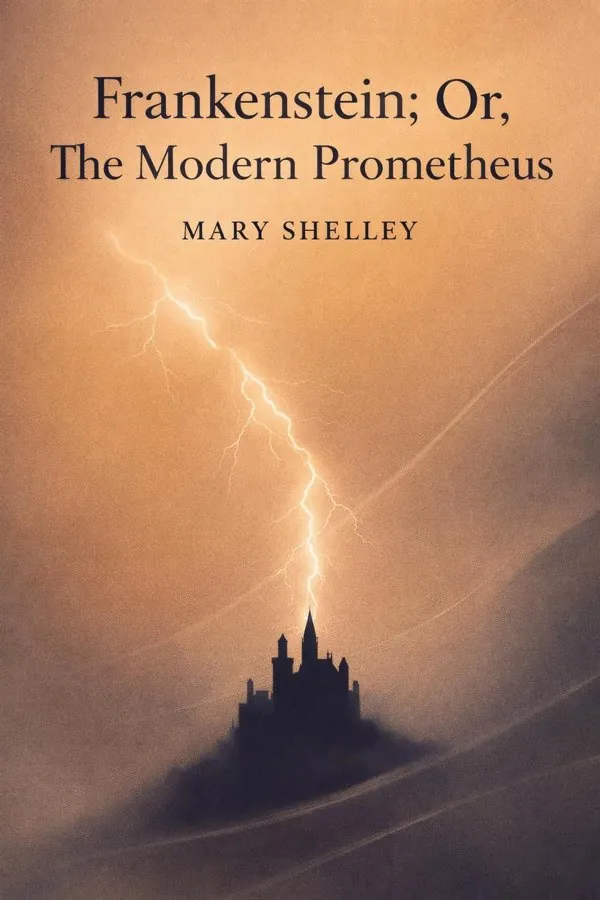
Frankenstein; Or, The Modern Prometheus: Summary & Key Insights
by Mary Shelley
 10 min7 chaptersAudio available
What Is Frankenstein; Or, The Modern Prometheus About?
Frankenstein; Or, The Modern Prometheus by Mary Shelley is a classics book spanning 7 pages. Frankenstein; or, The Modern Prometheus is a Gothic novel written by Mary Shelley in 1818. The story follows Victor Frankenstein, a scientist who creates a living being and faces tragic consequences as a result. The novel explores themes of ambition, responsibility, science, and human nature, and is considered one of the foundational works of horror and science fiction literature.
This FizzRead summary covers all 7 key chapters of Frankenstein; Or, The Modern Prometheus in approximately 10 minutes, distilling the most important ideas, arguments, and takeaways from Mary Shelley's work. Also available as an audio summary and Key Quotes Podcast.
Frankenstein; Or, The Modern Prometheus
Frankenstein; or, The Modern Prometheus is a Gothic novel written by Mary Shelley in 1818. The story follows Victor Frankenstein, a scientist who creates a living being and faces tragic consequences as a result. The novel explores themes of ambition, responsibility, science, and human nature, and is considered one of the foundational works of horror and science fiction literature.
Who Should Read Frankenstein; Or, The Modern Prometheus?
This book is perfect for anyone interested in classics and looking to gain actionable insights in a short read. Whether you're a student, professional, or lifelong learner, the key ideas from Frankenstein; Or, The Modern Prometheus by Mary Shelley will help you think differently.
- ✓Readers who enjoy classics and want practical takeaways
- ✓Professionals looking to apply new ideas to their work and life
- ✓Anyone who wants the core insights of Frankenstein; Or, The Modern Prometheus in just 10 minutes
Want the full summary?
Get instant access to this book summary and 100K+ more with Fizz Moment.
Get Free SummaryAvailable on App Store • Free to download
Key Chapters
It begins with letters penned by Robert Walton, an explorer whose spirit mirrors Victor’s in fervent pursuit of what lies beyond human reach. In Walton’s correspondence to his sister, I establish the frame — a vision of endless ice, distant ambition, and the yearning for glory that propels men into peril. Walton dreams of uncovering the mysteries of the North Pole, imagining that discovery will secure his immortality. But as his ship becomes trapped in ice, he encounters a strange and shattered figure drifting across the wasteland: Victor Frankenstein.
Through Walton’s eyes, Victor appears not as a hero of science but as its victim — gaunt, feverish, consumed by regret. The frame serves as a mirror to the story that follows; it invites readers into the mind of one who has already paid the ultimate price for ambition. Walton’s curiosity compels him to listen, and thus Victor’s voice begins. Walton represents the reader, poised between admiration and caution. His letters foreshadow the moral trajectory of the novel: the triumph of discovery haunted by the shadow of consequence.
In writing these letters, I sought to create a dual narrative — one that reflects the restlessness of human progress. Walton’s yearning for communion, his loneliness among men who dismiss his dreams, prefigures the Creature’s isolation. Both figures, though separated by circumstance, belong to the same human lineage of striving and solitude. The Arctic becomes a metaphorical landscape — not merely frozen terrain, but the cold expanse that ambition often leaves within the human heart.
And so through Walton’s prelude, I open the novel with a promise and a warning. The spirit of discovery burns bright, but the ice is ever waiting. By the time Walton meets Victor, the reader already senses the cost of seeking the forbidden fires of nature.
Victor’s own narrative begins in Geneva, amid innocence and familial affection. I depicted him as a youth marked not by depravity but by wonder. Born to loving parents and raised among companions of tender spirit — Elizabeth, his cousin and future bride, and Henry Clerval, his loyal friend — Victor’s childhood reflects perfect harmony. Yet within him grows the spark of curiosity that will undo him. He reads ancient treatises on alchemy, fascinated by the idea that humans might grasp divine secrets. Cornelius Agrippa and Paracelsus fill his imagination long before modern science guides his methods.
As Victor matures, his hunger for knowledge becomes feverish. Where others see learning as delight, he sees conquest. His mother’s death acts as the cruel turning point — grief transmuted into defiance against mortality itself. From that moment, death is not mystery but challenge. In crafting Victor’s ambition, I wanted to show how love and loss can distort vision; how the pursuit of wisdom may become a rebellion against nature.
Geneva’s idyllic calm contrasts sharply with the intellectual tempest awaiting him in Ingolstadt, where the modern world of chemistry and physiology draws him toward the eventual act of creation. There, the voices of reason and scientific rigor, represented by his mentors Waldman and Krempe, awaken Victor’s dual nature. His admiration for Waldman’s enlightenment pushes him beyond mere study toward experiment, toward the dangerous idea that life might be reassembled through human artifice.
In this chapter of his youth, the seeds of tragedy are sown not by immorality but by brilliance unchecked by empathy. Victor’s isolation begins long before the Creature’s birth; it is evident in his refusal to see knowledge as a moral act. By the time he steps into his laboratory, he has already abandoned the living for the promise of command over death. This moral blindness—this substitution of ambition for compassion—is the true genesis of horror.
+ 5 more chapters — available in the FizzRead app
All Chapters in Frankenstein; Or, The Modern Prometheus
About the Author
Mary Shelley (1797–1851) was an English novelist, daughter of writers William Godwin and Mary Wollstonecraft. She is best known for her novel 'Frankenstein', regarded as a pioneering work of science fiction. Shelley also wrote other novels, essays, and short stories, and was a prominent figure of British Romanticism.
Get This Summary in Your Preferred Format
Read or listen to the Frankenstein; Or, The Modern Prometheus summary by Mary Shelley anytime, anywhere. FizzRead offers multiple formats so you can learn on your terms — all free.
Available formats: App · Audio · PDF · EPUB — All included free with FizzRead
Download Frankenstein; Or, The Modern Prometheus PDF and EPUB Summary
Key Quotes from Frankenstein; Or, The Modern Prometheus
“It begins with letters penned by Robert Walton, an explorer whose spirit mirrors Victor’s in fervent pursuit of what lies beyond human reach.”
“Victor’s own narrative begins in Geneva, amid innocence and familial affection.”
Frequently Asked Questions about Frankenstein; Or, The Modern Prometheus
Frankenstein; Or, The Modern Prometheus by Mary Shelley is a classics book that explores key ideas across 7 chapters. Frankenstein; or, The Modern Prometheus is a Gothic novel written by Mary Shelley in 1818. The story follows Victor Frankenstein, a scientist who creates a living being and faces tragic consequences as a result. The novel explores themes of ambition, responsibility, science, and human nature, and is considered one of the foundational works of horror and science fiction literature.
You Might Also Like



Browse by Category
Ready to read Frankenstein; Or, The Modern Prometheus?
Get the full summary and 100K+ more books with Fizz Moment.