
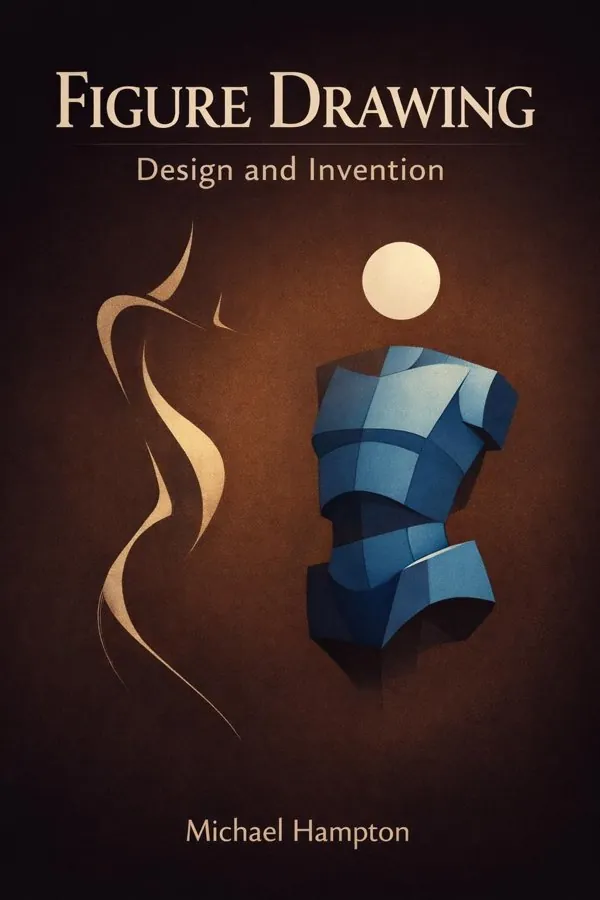
Figure Drawing: Design and Invention: Summary & Key Insights
 10 min9 chaptersAudio available
Key Takeaways from Figure Drawing: Design and Invention
A convincing figure begins long before anatomy is rendered correctly; it begins when the artist captures the living force of the pose.
Freedom in drawing does not come from avoiding structure; it comes from understanding it well enough to simplify it.
A figure feels believable not just because its anatomy is correct, but because its relationships are coherent.
If the body is an orchestra, the torso is its conductor.
The most difficult parts of figure drawing are often not the biggest forms but the smaller, more complex ones that tempt artists into detail before understanding.
What Is Figure Drawing: Design and Invention About?
Figure Drawing: Design and Invention by Michael Hampton is a design book spanning 11 pages. Figure Drawing: Design and Invention is a practical, deeply influential guide to drawing the human body with clarity, energy, and invention. Rather than teaching artists to merely copy what they see, Michael Hampton shows how to understand the figure as an organized system of rhythms, forms, landmarks, and anatomical structures. The book moves from gesture and proportion to the torso, limbs, head, hands, and feet, always emphasizing design over passive observation. Its central promise is powerful: if you can understand how the body is built and how its parts relate, you can draw it convincingly from life, memory, or imagination. What makes this book matter is its balance. Hampton does not reduce figure drawing to dry anatomy, nor does he treat gesture as vague expression. He unites motion, structure, and visual design into one coherent method that artists can actually use. His teaching has earned wide respect among illustrators, animators, fine artists, and students because it translates complex anatomy into manageable forms and rhythms. For anyone serious about drawing people with confidence, this book offers not just information, but a repeatable way of thinking.
This FizzRead summary covers all 9 key chapters of Figure Drawing: Design and Invention in approximately 10 minutes, distilling the most important ideas, arguments, and takeaways from Michael Hampton's work. Also available as an audio summary and Key Quotes Podcast.
Figure Drawing: Design and Invention
Figure Drawing: Design and Invention is a practical, deeply influential guide to drawing the human body with clarity, energy, and invention. Rather than teaching artists to merely copy what they see, Michael Hampton shows how to understand the figure as an organized system of rhythms, forms, landmarks, and anatomical structures. The book moves from gesture and proportion to the torso, limbs, head, hands, and feet, always emphasizing design over passive observation. Its central promise is powerful: if you can understand how the body is built and how its parts relate, you can draw it convincingly from life, memory, or imagination.
What makes this book matter is its balance. Hampton does not reduce figure drawing to dry anatomy, nor does he treat gesture as vague expression. He unites motion, structure, and visual design into one coherent method that artists can actually use. His teaching has earned wide respect among illustrators, animators, fine artists, and students because it translates complex anatomy into manageable forms and rhythms. For anyone serious about drawing people with confidence, this book offers not just information, but a repeatable way of thinking.
Who Should Read Figure Drawing: Design and Invention?
This book is perfect for anyone interested in design and looking to gain actionable insights in a short read. Whether you're a student, professional, or lifelong learner, the key ideas from Figure Drawing: Design and Invention by Michael Hampton will help you think differently.
- ✓Readers who enjoy design and want practical takeaways
- ✓Professionals looking to apply new ideas to their work and life
- ✓Anyone who wants the core insights of Figure Drawing: Design and Invention in just 10 minutes
Want the full summary?
Get instant access to this book summary and 100K+ more with Fizz Moment.
Get Free SummaryAvailable on App Store • Free to download
Key Chapters
A convincing figure begins long before anatomy is rendered correctly; it begins when the artist captures the living force of the pose. Hampton treats gesture as the foundation of figure drawing because gesture is what gives the body intention, direction, and emotional presence. Without it, even a technically accurate figure can feel stiff, disconnected, and inert. Gesture is not the contour of the body but the flow running through it—the action line, the opposing rhythms, the compression and extension that make a pose feel alive.
This matters because the body is never just a collection of parts. In a standing pose, for example, the tilt of the rib cage may oppose the pelvis, creating a subtle S-curve through the spine. In a running pose, the gesture is not found in the outline of the calf or shoulder, but in the larger directional sweep that connects head, torso, and limbs into one action. Hampton encourages artists to search for these larger relationships first, before details begin to distract the eye.
Practically, this means starting every drawing with rapid, simplified statements of motion. A two-minute sketch should focus on the dominant action, weight shift, and rhythm between major masses. Instead of drawing the arm as separate segments, look for the swinging arc from shoulder through wrist. Instead of defining the torso with edges, identify how the chest stretches on one side and compresses on the other.
The real power of gesture is that it trains you to see the figure as an organized event rather than a static object. Actionable takeaway: begin each figure study with 5 to 10 quick gesture sketches, limiting yourself to a few lines that describe energy, balance, and directional flow before adding any structure.
Freedom in drawing does not come from avoiding structure; it comes from understanding it well enough to simplify it. After gesture establishes the life of the pose, Hampton introduces structure as the means of making that life feel solid and readable. Structure translates the organic complexity of the body into simple three-dimensional forms—boxes, cylinders, wedges, and spheres—that can be rotated, combined, and invented from any angle.
This is one of the book’s most valuable lessons because many artists can copy a pose from reference but struggle when the angle changes or when they must draw from imagination. Structural thinking solves that problem. The rib cage can be seen as an egg-like mass, the pelvis as a block or wedge, the limbs as tapered cylinders, and the joints as turning points that connect one form to another. These simplifications are not crude shortcuts; they are tools that reveal how forms occupy space.
Consider the difference between drawing an arm as an outline and drawing it as interlocking cylinders with clear directional axes. In the first case, the arm may look flat. In the second, it can be foreshortened, lit, and rotated convincingly. The same applies to the torso: once the artist understands the chest and pelvis as separate volumes connected by the spine and abdominal forms, twisting poses become much easier to construct.
Hampton’s approach encourages artists to build the figure rather than trace it. Structural drawing gives you a framework for perspective, anatomy, and light. Actionable takeaway: in your next studies, redraw the figure using only simple 3D forms, focusing on orientation, overlap, and how each major mass connects in space.
A figure feels believable not just because its anatomy is correct, but because its relationships are coherent. Hampton emphasizes proportion and balance as the architecture underlying all successful figure drawing. Proportion concerns comparative measurement—how large the head is relative to the torso, how long the legs are compared with the arms, how the hands and feet fit into the whole. Balance concerns how the body organizes itself around gravity, support, and weight distribution.
These ideas are essential because even expressive drawing needs internal logic. A stylized figure can stretch, compress, or exaggerate proportions, but if the relationships are inconsistent or the weight feels unsupported, the drawing loses its conviction. Hampton’s method helps artists identify major landmarks and use them to compare distances and alignments across the body. The shoulders, rib cage, pelvis, knees, and ankles all participate in a chain of structural relationships.
For example, in a contrapposto standing pose, the pelvis often tilts one way while the shoulders counter-tilt the other. The body’s center of mass shifts over the supporting leg. If that weight transfer is ignored, the figure may look like it is falling, even if every limb is carefully drawn. Likewise, understanding standard head-count proportions gives artists a useful baseline, but Hampton also shows that proportion varies with body type, age, and design intent.
The point is not rigid measurement for its own sake. It is learning to compare, calibrate, and adjust so the figure feels unified. Actionable takeaway: during figure studies, check three things before refining details—the size of the major masses, the tilt relationships of shoulders and pelvis, and whether the line of balance convincingly passes through the supporting base.
If the body is an orchestra, the torso is its conductor. Hampton treats the torso as the central engine of figure drawing because it contains the largest masses, the spine’s directional flow, and many of the most expressive structural rhythms in the body. The chest and pelvis are not passive containers; they are dynamic forms that tilt, twist, compress, and stretch in response to movement. Understanding their relationship is the key to designing nearly every pose.
Artists often focus too quickly on arms, legs, or facial features, but the torso determines whether those parts will feel connected. A reaching gesture, for instance, is carried by the rib cage lifting and rotating, the abdomen lengthening on one side, and the pelvis countering the action below. In a seated pose, the torso may compress at the front, broaden at the sides, and settle with weight into the pelvis. These changes are not random surface effects; they reflect the mechanics of structure and motion.
Hampton simplifies the torso into major masses that can be understood in perspective and then enriched with anatomical landmarks such as the pit of the neck, sternum, rib arch, iliac crest, and sacrum. These landmarks help artists orient the torso in space while also clarifying surface design. This dual focus on anatomy and design is what makes the method so effective: it allows the artist to invent a pose while keeping it grounded in the body’s real logic.
When the torso is well designed, the whole figure gains authority. Actionable takeaway: practice drawing the rib cage and pelvis as separate forms connected by the spine, then explore how tilting and twisting them creates compression, stretch, and dynamic rhythm throughout the figure.
The most difficult parts of figure drawing are often not the biggest forms but the smaller, more complex ones that tempt artists into detail before understanding. Hampton addresses the limbs, head, hands, and feet through the same design logic he applies to the whole body: simplify first, clarify function second, refine anatomy last. This prevents common problems such as noodle-like arms, floating hands, flat feet, or heads that feel pasted onto the body.
The limbs are built from directional masses that taper, overlap, and hinge. The upper arm and forearm are not symmetrical tubes; they have distinct rhythms and functional asymmetries shaped by muscle groups and bony landmarks. The same is true for the leg, where the thigh and lower leg carry different masses, planes, and movement patterns. By understanding these distinctions, artists can draw limbs that feel mechanical in the best sense: purposeful, connected, and capable of action.
The head and neck present a different challenge. Here Hampton emphasizes orientation, axis, and planar design. The head must sit clearly on the neck, turn in space, and relate to the torso’s gesture. Hands and feet, meanwhile, are often overcomplicated. Hampton breaks them into larger units—the palm block, thumb mass, finger groupings, heel, arch, and toe wedge—so artists can construct them rather than symbolically sketch them.
A practical example is drawing a hand holding an object. Instead of starting with five separate fingers, establish the palm’s blocky form, the thumb’s opposition, and the finger rhythm around the object. The complexity becomes manageable once the design is organized. Actionable takeaway: study limbs, heads, hands, and feet by reducing each to major masses and directional planes before adding smaller anatomical details.
Anatomy becomes useful in drawing only when it improves your design decisions. One of Hampton’s greatest strengths is showing that artists do not need medical-level anatomical knowledge to draw well; they need functional anatomical understanding. In other words, they need to know which forms are visible, which landmarks are reliable, how muscles group together, and how anatomy changes with movement, perspective, and body type.
This approach protects artists from two common mistakes. The first is ignoring anatomy altogether and producing vague, rubbery figures. The second is memorizing isolated muscles and placing them on the body like stickers. Hampton avoids both extremes by organizing anatomy into understandable systems. He emphasizes masses over minutiae, insertion and origin patterns only when they affect surface form, and major landmarks that help orient the body in space.
For example, knowing the deltoid wraps over the shoulder and connects the arm to the torso helps explain why the arm can lift and why the shoulder has a distinct cap-like form. Understanding the rib cage’s influence beneath the pectorals and serratus makes the torso easier to design. Seeing the pelvis as a structural anchor clarifies the attachments of the thigh and abdomen. The goal is always to understand cause and effect: what structural feature creates the visible shape, and how does that shape support the drawing?
This anatomy-first-but-not-anatomy-only mindset is especially useful for illustrators, animators, and concept artists who must invent figures quickly. Actionable takeaway: when studying anatomy, focus on the major bony landmarks and muscle groups that most clearly affect surface form, then immediately apply them in simplified figure sketches from imagination.
A good figure drawing is not a set of correct parts; it is a coordinated whole. Hampton repeatedly returns to the importance of integration—the way gesture, structure, proportion, anatomy, and design must work together. This is where many students struggle. They may draw an excellent torso study, a believable leg, or a well-constructed head, but when assembled, the figure feels fragmented. Integration is the discipline of making every choice support the same visual statement.
Rhythm is central to this process. Rhythm refers to repeated directional movement through the figure: curves echoing other curves, straights balancing curves, masses linking into a clear path for the eye. Flow is what allows the viewer to move from head to torso to limbs without visual interruption. Design is what decides which lines dominate, which forms are emphasized, and how complexity is arranged for clarity.
Imagine drawing a boxer in motion. The twist of the torso, thrust of the shoulder, bend of the supporting leg, and counterbalance of the rear arm should all reinforce one action. If each part is drawn in isolation, the pose loses force. But if the artist connects the forms through shared directional logic and overlapping shapes, the whole figure becomes far more dynamic. Integration also matters in rendering: shadows, edges, and surface details should support the structure rather than obscure it.
This is the stage where technical knowledge becomes expressive language. The artist is no longer assembling anatomy but orchestrating visual experience. Actionable takeaway: after blocking in a figure, pause and trace the main rhythms across the whole body, asking whether each part supports the pose’s dominant action and whether any detail interrupts the overall flow.
The highest goal of Hampton’s method is not accurate copying but confident invention. To invent the figure means to draw human bodies from imagination, memory, or sparse reference while preserving believability, energy, and design clarity. This ability is invaluable in illustration, comics, animation, game art, and concept design, where artists often cannot rely on a perfect reference image for every pose.
Invention is often misunderstood as spontaneous creativity. Hampton shows that real invention is built on design logic. If you understand gesture, major masses, perspective, balance, landmarks, and key anatomical systems, you can generate new poses by reasoning through them. A figure reaching upward from a low camera angle becomes manageable if you know how the rib cage foreshortens, how the pelvis counterbalances, how the arm cylinders overlap, and how the gesture line organizes the pose.
This principle also changes how artists use reference. Instead of copying a photo line by line, they extract structural and rhythmic information, then rebuild the figure in their own visual language. That process leads to stronger originality. It also helps when solving problems: if a hand is hidden in reference, the artist who understands form can still construct it convincingly.
Hampton’s broader message is empowering. Drawing ability is not a mysterious gift but a trainable way of seeing and designing. The artist moves from dependence to authorship. Actionable takeaway: regularly practice drawing figures from memory after a short reference study, forcing yourself to reconstruct the pose from gesture, major forms, and landmarks rather than from visual copying alone.
Rendering is most effective when it explains structure rather than decorating it. Hampton’s treatment of form, light, and surface reminds artists that shading is not separate from drawing; it is an extension of spatial understanding. Light reveals the planes of the body, clarifies volume, and strengthens the design when used with restraint and purpose. Poor rendering, by contrast, can bury good construction beneath visual noise.
The key idea is that form should be understood before it is shaded. A cylinder-like forearm will catch light differently from a boxy pelvis or rounded cranium. The artist needs to know where planes turn, where shadows begin, and how overlapping forms affect one another. Hampton’s structural approach makes this possible because every major body part has already been simplified into understandable volumes. Once the artist knows those volumes, light can be placed logically instead of intuitively guessed.
For example, the plane break between the front and side of the thigh can be indicated with a change in value or edge quality. The shadow beneath the rib cage can reinforce the projection of the thoracic mass over the abdomen. On the face, planar simplification helps organize light across the forehead, cheekbones, nose, and jaw. Even surface anatomy becomes more readable when larger forms are clearly established first.
This lesson is especially useful for artists who jump too quickly into rendering and lose the figure’s underlying logic. Tone should serve construction, not compete with it. Actionable takeaway: before shading any figure, identify the major planes of the torso, head, and limbs, then apply shadow only where it reinforces the turning of form and the hierarchy of the design.
All Chapters in Figure Drawing: Design and Invention
About the Author
Michael Hampton is an American artist, instructor, and widely respected figure-drawing educator known for making anatomy and construction more accessible to working artists. He has taught drawing, anatomy, and design at major art schools and workshops, developing a clear instructional approach centered on gesture, structural form, and practical anatomy. Rather than treating the body as a collection of memorized muscles, Hampton emphasizes relationships, landmarks, and design logic that artists can apply directly in observation and invention. His teaching has had a strong influence on students in illustration, animation, comics, fine art, and concept design. Through Figure Drawing: Design and Invention, he has become a key voice in contemporary art education, helping artists build figures that are both anatomically informed and dynamically expressive.
Get This Summary in Your Preferred Format
Read or listen to the Figure Drawing: Design and Invention summary by Michael Hampton anytime, anywhere. FizzRead offers multiple formats so you can learn on your terms — all free.
Available formats: App · Audio · PDF · EPUB — All included free with FizzRead
Download Figure Drawing: Design and Invention PDF and EPUB Summary
Key Quotes from Figure Drawing: Design and Invention
“A convincing figure begins long before anatomy is rendered correctly; it begins when the artist captures the living force of the pose.”
“Freedom in drawing does not come from avoiding structure; it comes from understanding it well enough to simplify it.”
“A figure feels believable not just because its anatomy is correct, but because its relationships are coherent.”
“If the body is an orchestra, the torso is its conductor.”
“The most difficult parts of figure drawing are often not the biggest forms but the smaller, more complex ones that tempt artists into detail before understanding.”
Frequently Asked Questions about Figure Drawing: Design and Invention
Figure Drawing: Design and Invention by Michael Hampton is a design book that explores key ideas across 9 chapters. Figure Drawing: Design and Invention is a practical, deeply influential guide to drawing the human body with clarity, energy, and invention. Rather than teaching artists to merely copy what they see, Michael Hampton shows how to understand the figure as an organized system of rhythms, forms, landmarks, and anatomical structures. The book moves from gesture and proportion to the torso, limbs, head, hands, and feet, always emphasizing design over passive observation. Its central promise is powerful: if you can understand how the body is built and how its parts relate, you can draw it convincingly from life, memory, or imagination. What makes this book matter is its balance. Hampton does not reduce figure drawing to dry anatomy, nor does he treat gesture as vague expression. He unites motion, structure, and visual design into one coherent method that artists can actually use. His teaching has earned wide respect among illustrators, animators, fine artists, and students because it translates complex anatomy into manageable forms and rhythms. For anyone serious about drawing people with confidence, this book offers not just information, but a repeatable way of thinking.
You Might Also Like

The Design of Everyday Things
Don Norman
10 min
The Better Angels of Our Nature
Steven Pinker
10 min
A Designer's Art
Paul Rand
10 min
Architects' Sketchbooks
Various Editors
10 min
Architectural Graphic Standards
The American Institute of Architects
10 min
Design Is Storytelling
Ellen Lupton
10 minBrowse by Category
Ready to read Figure Drawing: Design and Invention?
Get the full summary and 100K+ more books with Fizz Moment.