
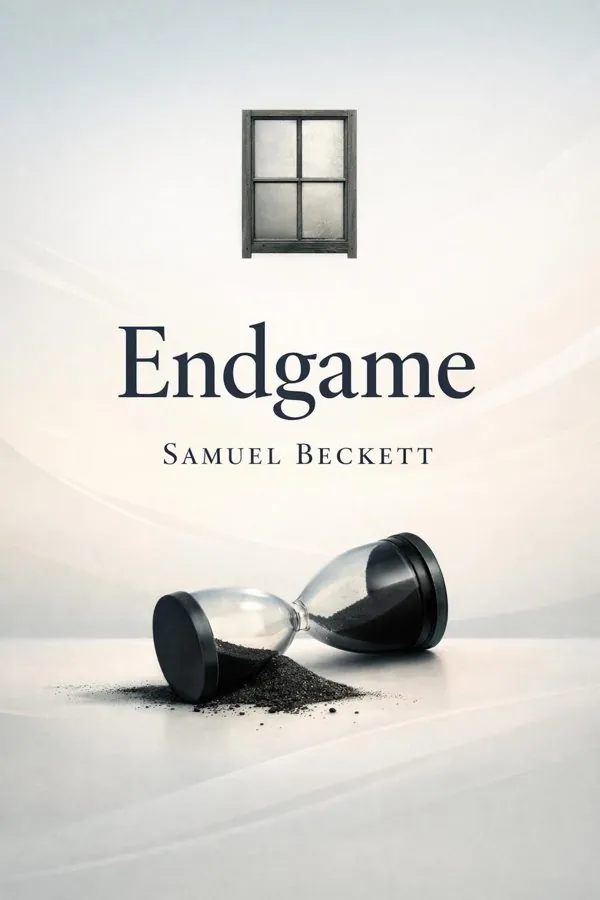
Endgame: Summary & Key Insights
 10 min5 chaptersAudio available
What Is Endgame About?
Endgame by Samuel Beckett is a classics book spanning 5 pages. Endgame is a one-act play by Samuel Beckett, originally written in French as 'Fin de partie' and later translated into English by the author himself. The play presents a bleak, minimalist setting where Hamm, a blind and paralyzed man, and his servant Clov engage in repetitive, existential dialogue. Through their interactions, Beckett explores themes of dependency, futility, and the cyclical nature of existence, characteristic of his absurdist style.
This FizzRead summary covers all 5 key chapters of Endgame in approximately 10 minutes, distilling the most important ideas, arguments, and takeaways from Samuel Beckett's work. Also available as an audio summary and Key Quotes Podcast.
Endgame
Endgame is a one-act play by Samuel Beckett, originally written in French as 'Fin de partie' and later translated into English by the author himself. The play presents a bleak, minimalist setting where Hamm, a blind and paralyzed man, and his servant Clov engage in repetitive, existential dialogue. Through their interactions, Beckett explores themes of dependency, futility, and the cyclical nature of existence, characteristic of his absurdist style.
Who Should Read Endgame?
This book is perfect for anyone interested in classics and looking to gain actionable insights in a short read. Whether you're a student, professional, or lifelong learner, the key ideas from Endgame by Samuel Beckett will help you think differently.
- ✓Readers who enjoy classics and want practical takeaways
- ✓Professionals looking to apply new ideas to their work and life
- ✓Anyone who wants the core insights of Endgame in just 10 minutes
Want the full summary?
Get instant access to this book summary and 100K+ more with Fizz Moment.
Get Free SummaryAvailable on App Store • Free to download
Key Chapters
The curtain rises on gray. A bare space, cold and stripped of comfort. Two small windows, a single armchair hidden beneath a sheet—the remnants of a world shrunken to the dimensions of confinement. I intended this opening not as a setting, but as a condition. The room is the mind after apocalypse, a landscape of the soul once time and purpose have ended.
Here, we meet Hamm, the master—blind, immobilized, and powerful only in voice. And Clov, his servant, restless, able to move but trapped in obedience. Their movements are mechanical, ritualistic, like some forgotten routine performed after its meaning has died. When Clov removes the sheet from Hamm, it is not renewal but repetition. The play does not begin so much as continue; it has always been this way. From their first exchange—between command and complaint—we see their mutual imprisonment. Hamm cannot stand; Clov cannot sit. Between these two impossibilities lies their bond.
In this paralysis of motion and purpose, every gesture acquires the weight of absurd ceremony. Hamm calls. Clov answers. Clov reports. Hamm criticizes. Such circular rituals mimic the exhausted rhythm of existence itself—no longer developing, merely continuing. The audience watches life after meaning: the performance of survival for its own sake. And yet beneath the monotony, a terrible intimacy persists—Hamm and Clov as mirror and echo, predator and prey, each unable to abandon the other because each gives the other definition.
When Hamm demands his parents, Nagg and Nell, to be fetched from their ashbins, we witness another layer of this spectral existence. The bins themselves—containers of human residue—are where the past has been filed away, half-buried yet still faintly living. If Hamm and Clov embody the present’s exhausted will, Nagg and Nell are the past speaking through decay. Their dialogues recall lost pleasures—a bicycle accident, laughter in a boat—but every attempt at tenderness dissolves into the same futility. Even memory, in this world, cannot survive without irony.
When Nell falls silent, perhaps dying, perhaps simply withdrawing, her silence reverberates like a prophecy; the world of *Endgame* is closing in upon itself. Hamm’s refusal to respond with affection reveals his terror of sentimentality—a fear that love, like life, has become merely one more performance in a theater without audience. Yet Nagg’s persistence, his small hunger, his plea for a sugar-plum, humanizes the desolation. These remnants of family bind Hamm to a world he wishes destroyed, but also to the only proofs that he once lived. Even decay cannot entirely erase connection.
+ 3 more chapters — available in the FizzRead app
All Chapters in Endgame
About the Author
Samuel Beckett (1906–1989) was an Irish novelist, playwright, and poet, widely regarded as one of the most influential writers of the 20th century. Writing in both French and English, Beckett is best known for his works exploring existential despair and the absurdity of human life, including 'Waiting for Godot' and 'Endgame'. He was awarded the Nobel Prize in Literature in 1969.
Get This Summary in Your Preferred Format
Read or listen to the Endgame summary by Samuel Beckett anytime, anywhere. FizzRead offers multiple formats so you can learn on your terms — all free.
Available formats: App · Audio · PDF · EPUB — All included free with FizzRead
Download Endgame PDF and EPUB Summary
Key Quotes from Endgame
“A bare space, cold and stripped of comfort.”
“When Hamm demands his parents, Nagg and Nell, to be fetched from their ashbins, we witness another layer of this spectral existence.”
Frequently Asked Questions about Endgame
Endgame by Samuel Beckett is a classics book that explores key ideas across 5 chapters. Endgame is a one-act play by Samuel Beckett, originally written in French as 'Fin de partie' and later translated into English by the author himself. The play presents a bleak, minimalist setting where Hamm, a blind and paralyzed man, and his servant Clov engage in repetitive, existential dialogue. Through their interactions, Beckett explores themes of dependency, futility, and the cyclical nature of existence, characteristic of his absurdist style.
You Might Also Like

Browse by Category
Ready to read Endgame?
Get the full summary and 100K+ more books with Fizz Moment.