
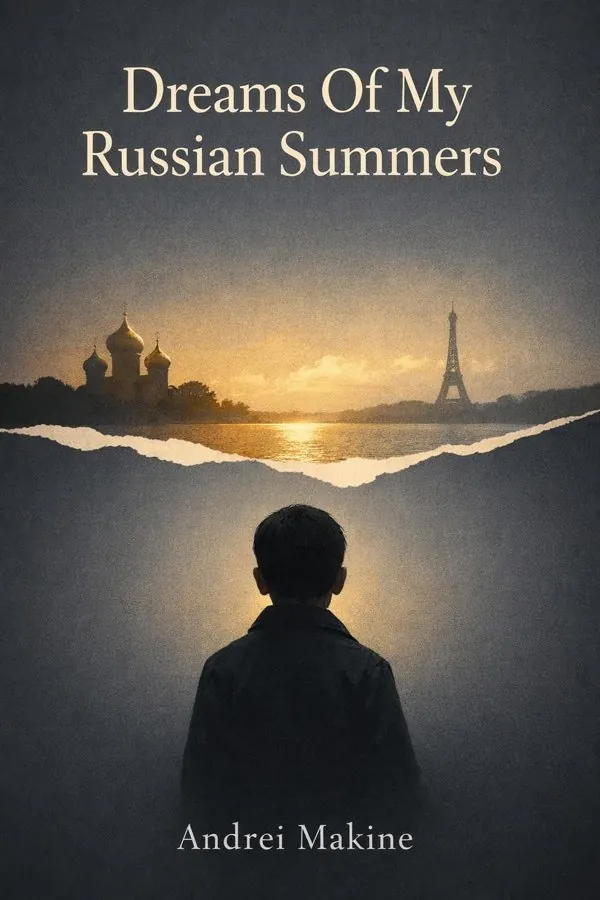
Dreams Of My Russian Summers: Summary & Key Insights
 10 min8 chaptersAudio available
Key Takeaways from Dreams Of My Russian Summers
A childhood landscape is never just scenery; it becomes the emotional grammar through which life is later understood.
Sometimes the most powerful inheritance is not property or status, but a way of seeing.
To speak in more than one cultural register is to discover that the self is never singular.
What feels magical in childhood often becomes painful in adolescence.
States try to organize history into clean narratives, but memory refuses to stay obedient.
What Is Dreams Of My Russian Summers About?
Dreams Of My Russian Summers by Andrei Makine is a classics book spanning 5 pages. Dreams Of My Russian Summers, the English title of Andrei Makine’s celebrated novel Le Testament Français, is a luminous meditation on childhood, exile, memory, and the making of identity. Set largely in Soviet Russia, the book follows a young boy whose imagination is transformed by the stories of his French grandmother, Charlotte. Through her recollections of pre-revolutionary France, he inherits a second homeland he has never seen, one built from language, atmosphere, and longing. The result is a deeply personal narrative about what it means to belong to more than one world at once. What makes the novel so powerful is that Makine turns private memory into a universal reflection on how people are formed by stories, landscapes, and inherited dreams. The book is not only about Russia and France, but about the tension between reality and imagination, history and intimacy, past and present. Makine writes with unusual authority because he himself was born in Siberia, later moved to France, and became one of the rare writers to bridge both cultures from within. Awarded both the Prix Goncourt and the Prix Médicis in 1995, this novel remains a modern classic of literary memory.
This FizzRead summary covers all 8 key chapters of Dreams Of My Russian Summers in approximately 10 minutes, distilling the most important ideas, arguments, and takeaways from Andrei Makine's work. Also available as an audio summary and Key Quotes Podcast.
Dreams Of My Russian Summers
Dreams Of My Russian Summers, the English title of Andrei Makine’s celebrated novel Le Testament Français, is a luminous meditation on childhood, exile, memory, and the making of identity. Set largely in Soviet Russia, the book follows a young boy whose imagination is transformed by the stories of his French grandmother, Charlotte. Through her recollections of pre-revolutionary France, he inherits a second homeland he has never seen, one built from language, atmosphere, and longing. The result is a deeply personal narrative about what it means to belong to more than one world at once.
What makes the novel so powerful is that Makine turns private memory into a universal reflection on how people are formed by stories, landscapes, and inherited dreams. The book is not only about Russia and France, but about the tension between reality and imagination, history and intimacy, past and present. Makine writes with unusual authority because he himself was born in Siberia, later moved to France, and became one of the rare writers to bridge both cultures from within. Awarded both the Prix Goncourt and the Prix Médicis in 1995, this novel remains a modern classic of literary memory.
Who Should Read Dreams Of My Russian Summers?
This book is perfect for anyone interested in classics and looking to gain actionable insights in a short read. Whether you're a student, professional, or lifelong learner, the key ideas from Dreams Of My Russian Summers by Andrei Makine will help you think differently.
- ✓Readers who enjoy classics and want practical takeaways
- ✓Professionals looking to apply new ideas to their work and life
- ✓Anyone who wants the core insights of Dreams Of My Russian Summers in just 10 minutes
Want the full summary?
Get instant access to this book summary and 100K+ more with Fizz Moment.
Get Free SummaryAvailable on App Store • Free to download
Key Chapters
A childhood landscape is never just scenery; it becomes the emotional grammar through which life is later understood. In Dreams Of My Russian Summers, the narrator’s earliest memories are rooted in the vast spaces of Siberia, where summers seem suspended between hardship and enchantment. He and his sister grow up in the routines of Soviet life, surrounded by discipline, austerity, and collective expectations. Yet the natural world offers another education: wide skies, stillness, heat, distance, and the feeling that life stretches beyond the rigid structures imposed by politics.
Makine shows that childhood is not simply a beginning but a territory we continue to inhabit inwardly. The Russian summers are full of tactile impressions and fleeting sensations that become the raw material of identity. They hold both tenderness and severity. On the one hand, there is intimacy with family, seasonal rhythm, and the wonder of a child discovering the world. On the other, there is the pressure of ideology and the awareness that language itself can be monitored or flattened by official culture.
What gives these memories their force is that they are not presented as innocent nostalgia. Rather, they are the place where contradiction begins. The narrator learns early that reality can contain both beauty and deprivation, both attachment and estrangement. This insight matters beyond the novel. Many people carry similarly mixed memories of childhood: homes that were loving but restrictive, communities that were supportive yet narrow, landscapes tied to both comfort and pain.
A practical way to apply this idea is to reflect on the places that formed you and ask what emotional habits they left behind. Did they teach resilience, silence, wonder, mistrust, adaptability? By naming those influences, you begin to understand your present self more clearly. Actionable takeaway: revisit one formative childhood memory and write down not what happened, but what kind of person that world was teaching you to become.
Sometimes the most powerful inheritance is not property or status, but a way of seeing. Charlotte, the narrator’s French grandmother, gives him precisely that. Through her stories of France before the Russian Revolution, she opens a portal into another civilization, one of salons, gardens, elegant gestures, private feelings, and subtle cultural codes. To the boy growing up in Soviet Russia, her memories do more than entertain him; they construct an alternative reality that feels as vivid as his own surroundings.
Charlotte’s France is not merely geographic. It is aesthetic and moral. It is embodied in words, sounds, manners, and ways of remembering. Her recollections introduce the narrator to the possibility that life can be textured differently, that emotional refinement and personal nuance can survive even after political worlds collapse. Through her, France becomes an imagined homeland, built from fragments of memory yet more emotionally resonant than official maps.
Makine uses this relationship to show how identity can be inherited through narrative. We are often shaped by stories from parents, grandparents, and communities about places we never knew directly. A family anecdote, a recipe, a photograph, or a remembered phrase can become the foundation of belonging. This is especially true in diasporic or fractured families, where the past survives through storytelling rather than stable institutions.
The novel also warns that such inheritances are never neutral. Charlotte’s France is filtered through memory and loss, making it both beautiful and incomplete. The narrator must eventually learn that every imagined homeland contains idealization. In contemporary life, this applies whenever we romanticize an ancestral culture, a family past, or a vanished era.
Actionable takeaway: ask an older family member or mentor about one place that shaped them, and listen not just for facts but for values, sensations, and emotional tones. Notice what kind of world their story quietly invites you to inherit.
To speak in more than one cultural register is to discover that the self is never singular. One of the deepest themes in Dreams Of My Russian Summers is the narrator’s growing awareness that language does not simply describe reality; it creates different versions of it. Russian and French are not interchangeable in the novel. Each carries its own rhythms, assumptions, emotional colors, and historical memories. Through Charlotte’s words, the narrator enters a linguistic space where life feels more delicate, layered, and intimate than the blunt certainties of Soviet public speech.
This creates both enrichment and dislocation. The narrator gains access to a larger interior life, but he also becomes estranged from the world around him. He learns to perceive the gap between lived experience and the language available to describe it. In Soviet society, official discourse tends toward slogans, conformity, and ideological simplification. Charlotte’s remembered French, by contrast, preserves ambiguity, style, and personal nuance. The boy realizes that to possess another language is to possess another way of feeling time, memory, and selfhood.
Makine’s insight remains highly relevant. Many people today live between languages, professional vocabularies, social codes, or cultural expectations. A person may speak one way at home, another at work, and another with friends. This can feel exhausting, but it can also deepen perception. Those who move between worlds often become more sensitive to hidden assumptions and unspoken meanings.
The practical challenge is not to choose one language of selfhood too quickly. Instead, the novel suggests embracing complexity. You do not need to resolve every contradiction in order to live truthfully. Sometimes maturity means accepting that different parts of your identity become visible in different settings.
Actionable takeaway: pay attention this week to how your tone, vocabulary, or emotional expression changes across contexts. Ask yourself which version feels most constrained, which feels most alive, and what that reveals about the life you want to build.
What feels magical in childhood often becomes painful in adolescence. As the narrator grows older, the dual inheritance that once enriched him begins to produce confusion and alienation. The stories and sensibilities passed down by Charlotte no longer exist simply as a secret source of wonder. They now complicate his relationships with school, peers, authority, and his own emerging sense of masculinity and belonging. He is no longer just listening to another world; he is being divided by it.
Adolescence sharpens the need to belong somewhere concrete. Yet the narrator finds himself inwardly aligned with a civilization that is distant, partly imagined, and socially unusable in Soviet life. He can neither fully identify with the collectivist ethos around him nor fully inhabit the France he knows only through memory and imagination. This produces a familiar modern condition: being overformed inwardly and underrecognized outwardly. He has emotional knowledge that his environment has no language for.
Makine captures how cultural dislocation can manifest as embarrassment, longing, secrecy, and a subtle inability to take part in the scripts everyone else seems to accept. Many readers will recognize versions of this experience. Children of immigrants, students changing class backgrounds, or anyone whose inner life exceeds their surroundings often discover that adolescence is not just about growing up, but about learning to carry invisible complexity.
The novel suggests that dislocation, though painful, can become a source of insight. Those who do not fully belong to one world often learn to read several worlds at once. But this gift comes at a cost: loneliness and delay. You may need years before your divided self begins to feel coherent.
Actionable takeaway: if you feel out of place in your current environment, stop treating that discomfort as proof of failure. Instead, ask what unique perspective your distance gives you. Write down one thing you can see clearly precisely because you are not completely absorbed by the crowd.
States try to organize history into clean narratives, but memory refuses to stay obedient. A central achievement of Dreams Of My Russian Summers is its quiet resistance to official versions of the past. The narrator grows up in a Soviet system that promotes standardized historical meaning, collective myth, and ideological certainty. Yet Charlotte’s stories preserve another archive: intimate, fragile, contradictory, and irreducibly human. Her recollections do not compete with state history by becoming another doctrine. They undermine it simply by remaining particular.
This distinction matters. Official history seeks coherence and legitimacy. Personal memory preserves texture: a dress, a glance, a conversation, a scent, a train station, the feeling of a vanished afternoon. Makine suggests that these details are not trivial. They are the real substance of lived existence. Through them, individuals resist being absorbed into abstractions such as nation, revolution, progress, or class destiny.
The narrator learns that truth is often embedded in minor recollections rather than public declarations. This does not mean memory is perfectly reliable. In fact, the novel is attentive to distortion, nostalgia, and embellishment. But even flawed memory protects something essential: the singularity of experience. In a world dominated by propaganda, bureaucracy, or inherited slogans, that singularity becomes a moral force.
This idea has obvious contemporary relevance. Today, political messaging, algorithmic feeds, and simplified cultural narratives still pressure people to flatten complexity. One way to resist is to preserve detailed, personal testimony. Family stories, journals, oral histories, and reflective conversation all help keep human life from being reduced to ideology.
Actionable takeaway: record one memory from your own life with as much sensory detail as possible. Do not aim for a polished story or a grand lesson. Aim for specificity. The practice of honoring lived detail is one way of protecting your experience from being swallowed by simplified narratives.
We often assume memory gives permanence to life, yet memory itself is vulnerable to time, illness, and death. In the later movement of the novel, Charlotte’s decline becomes one of its most moving and unsettling elements. As she weakens, the vast world she carried within her begins to dim. Her stories, once abundant and transformative, risk disappearing with her. For the narrator, this is not merely the impending loss of a beloved grandmother. It is the threatened erasure of an entire emotional and cultural universe.
Makine handles this with great delicacy. Charlotte’s fading is not presented as a melodramatic collapse, but as a gradual revelation of how precarious all remembrance is. A life can seem secure while someone is there to recount it, but once the voice falters, what remains? Photographs alone are not enough. Facts without living tone become thin. The novel thereby dramatizes a painful truth: memory survives only if it is received, embodied, and renewed by others.
This is why the narrator’s role changes over time. As a child, he is a listener enchanted by inherited stories. As Charlotte declines, he becomes a custodian. He must hold what she can no longer fully carry. This transition mirrors experiences many readers know from family life: the moment when elders become dependent, when stories once casually available suddenly feel urgent, and when remembrance becomes responsibility.
The broader application is clear. If we value family or communal memory, we cannot wait indefinitely to preserve it. Ask questions now. Gather letters now. Record voices now. Emotional heritage disappears faster than people expect.
Actionable takeaway: choose one elder, relative, or long-term friend and preserve one story from their life this month. Write it down, record it, or retell it to someone else. Memory lasts longer when it moves from passive admiration to active stewardship.
Exile is not only a matter of crossing borders; it can begin long before departure. One of Makine’s finest insights is that the narrator experiences exile internally even while still living in his native land. Because he has been formed by Charlotte’s stories and by a sensibility that does not fit the Soviet environment around him, he becomes estranged from his own immediate reality. He inhabits Russia physically but not entirely imaginatively. His inner life is already elsewhere.
This internal exile is more subtle than political dissent. It is not simply opposition to a regime. It is the feeling that one’s deepest reference points, emotional affinities, and standards of beauty are misaligned with the surrounding world. Such a person may appear outwardly integrated while privately living at an angle to everything around them. That condition can be painful, but it also cultivates sharp perception. Exiles, whether internal or geographic, often become expert readers of atmosphere, code, and contradiction.
The novel shows that exile is not solved merely by reaching the dreamed-of place. If your relation to identity has been shaped by absence, longing, and imagination, arrival may not dissolve estrangement. This is a profound lesson for anyone who believes that a future move, career shift, or relationship will finally create total belonging. Often the inner structure of exile travels with us.
Yet Makine does not present this solely as a wound. Internal exile can foster intellectual freedom. Because the narrator is never fully enclosed by one world, he can compare, question, and remember differently. Many creative and reflective lives begin from such distance.
Actionable takeaway: if you feel emotionally foreign to your current environment, ask whether that distance might contain information rather than just pain. Identify one perspective, sensitivity, or creative capacity that your outsider position has given you, and treat it as a resource to develop.
Maturity often begins when we stop demanding that identity become simple. In the final movement of Dreams Of My Russian Summers, the narrator moves toward reconciliation not by choosing Russia over France or memory over reality, but by accepting that his life has been shaped by both fidelity and fracture. The novel refuses the fantasy of purity. He cannot return to an untouched childhood, nor can he fully merge with Charlotte’s idealized France. What remains possible is a more demanding achievement: to inhabit complexity without resentment.
This reconciliation is deeply literary and existential. Writing becomes the means by which divided inheritances are not erased but composed. Through narrative, the narrator can preserve Charlotte’s world while also acknowledging its partiality and distance. He can honor the Russian landscape that formed him without denying the limitations of Soviet life. He can admit that the self is layered, translated, and historically marked. In this sense, memory does not trap him in nostalgia; it becomes the medium through which he creates meaning.
The lesson extends beyond the novel. Many people waste years trying to identify the one true version of themselves: the original self, the professional self, the family self, the cultural self. Makine suggests that a richer life comes from integration rather than reduction. Contradictions need interpretation, not elimination.
This does not mean passive confusion. Reconciliation requires active work: remembering honestly, resisting idealization, and turning inherited tensions into conscious form. For some, that form may be writing. For others, it may be conversation, artistic practice, ritual, or simply a more spacious self-understanding.
Actionable takeaway: make a list of two or three identities, loyalties, or values in your life that seem to conflict. Instead of forcing a choice immediately, write one sentence about how each has genuinely shaped you. Integration starts when you let multiple truths stand in the same room.
All Chapters in Dreams Of My Russian Summers
About the Author
Andrei Makine is a Franco-Russian novelist born in 1957 in Krasnoyarsk, Siberia. Raised in the Soviet Union, he later emigrated to France in the late 1980s and began writing in French, a choice that distinguished him in contemporary literature. His fiction often explores exile, memory, cultural doubleness, and the emotional power of language. Makine became internationally famous with Dreams Of My Russian Summers, the English title of Le Testament Français, which won both the Prix Goncourt and the Prix Médicis in 1995. His work is admired for its lyrical style, psychological depth, and ability to bridge Russian experience and French literary tradition. Across his novels, Makine consistently returns to questions of belonging, remembrance, and the inner life shaped by history.
Get This Summary in Your Preferred Format
Read or listen to the Dreams Of My Russian Summers summary by Andrei Makine anytime, anywhere. FizzRead offers multiple formats so you can learn on your terms — all free.
Available formats: App · Audio · PDF · EPUB — All included free with FizzRead
Download Dreams Of My Russian Summers PDF and EPUB Summary
Key Quotes from Dreams Of My Russian Summers
“A childhood landscape is never just scenery; it becomes the emotional grammar through which life is later understood.”
“Sometimes the most powerful inheritance is not property or status, but a way of seeing.”
“To speak in more than one cultural register is to discover that the self is never singular.”
“What feels magical in childhood often becomes painful in adolescence.”
“States try to organize history into clean narratives, but memory refuses to stay obedient.”
Frequently Asked Questions about Dreams Of My Russian Summers
Dreams Of My Russian Summers by Andrei Makine is a classics book that explores key ideas across 8 chapters. Dreams Of My Russian Summers, the English title of Andrei Makine’s celebrated novel Le Testament Français, is a luminous meditation on childhood, exile, memory, and the making of identity. Set largely in Soviet Russia, the book follows a young boy whose imagination is transformed by the stories of his French grandmother, Charlotte. Through her recollections of pre-revolutionary France, he inherits a second homeland he has never seen, one built from language, atmosphere, and longing. The result is a deeply personal narrative about what it means to belong to more than one world at once. What makes the novel so powerful is that Makine turns private memory into a universal reflection on how people are formed by stories, landscapes, and inherited dreams. The book is not only about Russia and France, but about the tension between reality and imagination, history and intimacy, past and present. Makine writes with unusual authority because he himself was born in Siberia, later moved to France, and became one of the rare writers to bridge both cultures from within. Awarded both the Prix Goncourt and the Prix Médicis in 1995, this novel remains a modern classic of literary memory.
You Might Also Like

Browse by Category
Ready to read Dreams Of My Russian Summers?
Get the full summary and 100K+ more books with Fizz Moment.