
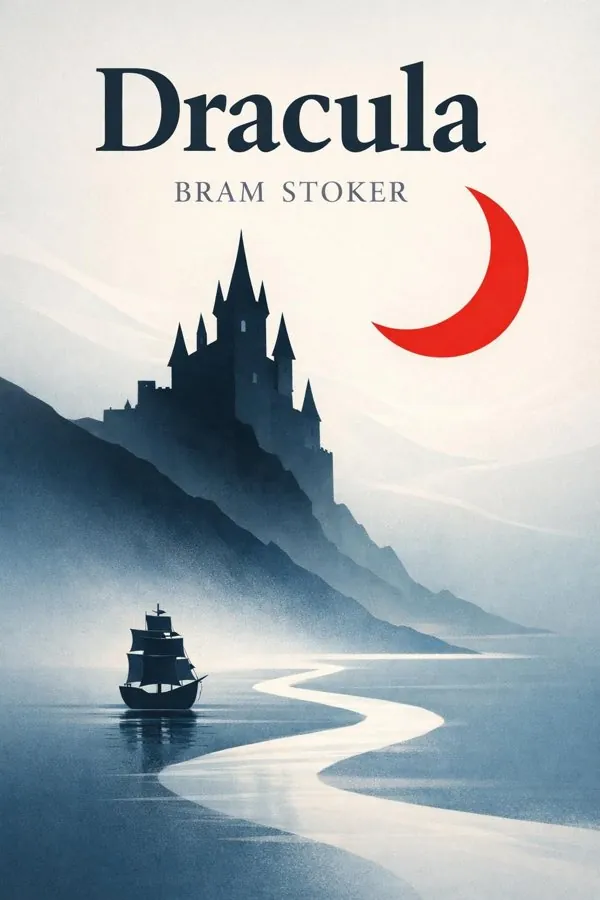
Dracula: Summary & Key Insights
by Bram Stoker
 10 min5 chaptersAudio available
What Is Dracula About?
Dracula by Bram Stoker is a classics book spanning 5 pages. Dracula is an 1897 Gothic horror novel by Irish author Bram Stoker. It tells the story of Count Dracula's attempt to move from Transylvania to England so that he may find new blood and spread the undead curse, and of the battle between Dracula and a small group of people led by Professor Abraham Van Helsing. The novel is presented through letters, diary entries, and newspaper articles, creating a sense of realism and immediacy. It established many conventions of subsequent vampire fantasy and remains one of the most influential works in the horror genre.
This FizzRead summary covers all 5 key chapters of Dracula in approximately 10 minutes, distilling the most important ideas, arguments, and takeaways from Bram Stoker's work. Also available as an audio summary and Key Quotes Podcast.
Dracula
Dracula is an 1897 Gothic horror novel by Irish author Bram Stoker. It tells the story of Count Dracula's attempt to move from Transylvania to England so that he may find new blood and spread the undead curse, and of the battle between Dracula and a small group of people led by Professor Abraham Van Helsing. The novel is presented through letters, diary entries, and newspaper articles, creating a sense of realism and immediacy. It established many conventions of subsequent vampire fantasy and remains one of the most influential works in the horror genre.
Who Should Read Dracula?
This book is perfect for anyone interested in classics and looking to gain actionable insights in a short read. Whether you're a student, professional, or lifelong learner, the key ideas from Dracula by Bram Stoker will help you think differently.
- ✓Readers who enjoy classics and want practical takeaways
- ✓Professionals looking to apply new ideas to their work and life
- ✓Anyone who wants the core insights of Dracula in just 10 minutes
Want the full summary?
Get instant access to this book summary and 100K+ more with Fizz Moment.
Get Free SummaryAvailable on App Store • Free to download
Key Chapters
When I first sent Jonathan Harker to Transylvania, I imagined him as a symbol of the modern Englishman—well-educated, self-assured, armed with books of law and lodging etiquette. He travels eastward to meet Count Dracula, a nobleman seeking to purchase land in London. From the outset, the journey is infused with a rising unease: villagers whisper fearful warnings, religious symbols are pressed into his hands, and the Carpathian mountains grow darker as he travels deeper into their heart. I built this progression intentionally—to mirror a descent from civilization into the realm of ancient superstition.
Within Dracula’s castle, Jonathan’s rational world collapses. The Count appears as a gracious host but quickly becomes an enigma—no servant ever seen, strange nocturnal habits, and a terrifying absence of reflection. One night, Jonathan witnesses Dracula scaling the walls like a lizard, in defiance of nature. Soon he grasps the truth: he is not a guest but a prisoner, trapped in a fortress haunted by a force beyond human understanding. The sense of helplessness in his journal entries echoes that of a man awakening to the fragility of reason. He tries to maintain composure, relying on habit and faith, but the castle closes in around him like a coffin. Eventually, he risks everything to escape, crawling through perilous paths to freedom. In writing those scenes, I wanted readers to taste that mixture of horror and hope—the realization that even in terror’s grip, the human spirit still struggles toward the light.
The Count’s voyage to England marks a transition from the isolated Gothic setting to the heart of the modern world. I chose the ship Demeter as his vessel because it allowed a perfect contrast: commerce and navigation—the emblems of progress—corrupted by a supernatural intrusion. The crew vanishes one by one, leaving only the captain’s log to tell the tale. By the time the ship drifts into Whitby, its cargo of Transylvanian earth and its sole remaining passenger—Dracula himself—have crossed the threshold.
Through Mina Murray’s letters and diary entries, the atmosphere shifts dramatically. Mina represents rationality and devotion, a mind organized through careful record-keeping. Her friend Lucy Westenra embodies vitality and innocence, surrounded by suitors, radiant in health—until the Count’s influence descends upon her. The choice of Lucy as Dracula’s victim was never arbitrary; she symbolizes the openness of the human soul unprotected by knowledge. Her gradual wasting, her nocturnal wanderings, and her unexplained loss of blood unfold as a kind of spiritual infection creeping through Victorian society. In London, a city humming with life, the undead finds new ground to take root.
+ 3 more chapters — available in the FizzRead app
All Chapters in Dracula
About the Author
Bram Stoker (1847–1912) was an Irish author best known for his 1897 Gothic novel Dracula. Before becoming a full-time writer, he worked as a civil servant and as the business manager of the Lyceum Theatre in London, where he was closely associated with actor Henry Irving. Stoker wrote several other novels and short stories, but Dracula remains his most enduring legacy, shaping modern depictions of vampires in literature and film.
Get This Summary in Your Preferred Format
Read or listen to the Dracula summary by Bram Stoker anytime, anywhere. FizzRead offers multiple formats so you can learn on your terms — all free.
Available formats: App · Audio · PDF · EPUB — All included free with FizzRead
Download Dracula PDF and EPUB Summary
Key Quotes from Dracula
“When I first sent Jonathan Harker to Transylvania, I imagined him as a symbol of the modern Englishman—well-educated, self-assured, armed with books of law and lodging etiquette.”
“The Count’s voyage to England marks a transition from the isolated Gothic setting to the heart of the modern world.”
Frequently Asked Questions about Dracula
Dracula by Bram Stoker is a classics book that explores key ideas across 5 chapters. Dracula is an 1897 Gothic horror novel by Irish author Bram Stoker. It tells the story of Count Dracula's attempt to move from Transylvania to England so that he may find new blood and spread the undead curse, and of the battle between Dracula and a small group of people led by Professor Abraham Van Helsing. The novel is presented through letters, diary entries, and newspaper articles, creating a sense of realism and immediacy. It established many conventions of subsequent vampire fantasy and remains one of the most influential works in the horror genre.
You Might Also Like






Browse by Category
Ready to read Dracula?
Get the full summary and 100K+ more books with Fizz Moment.