
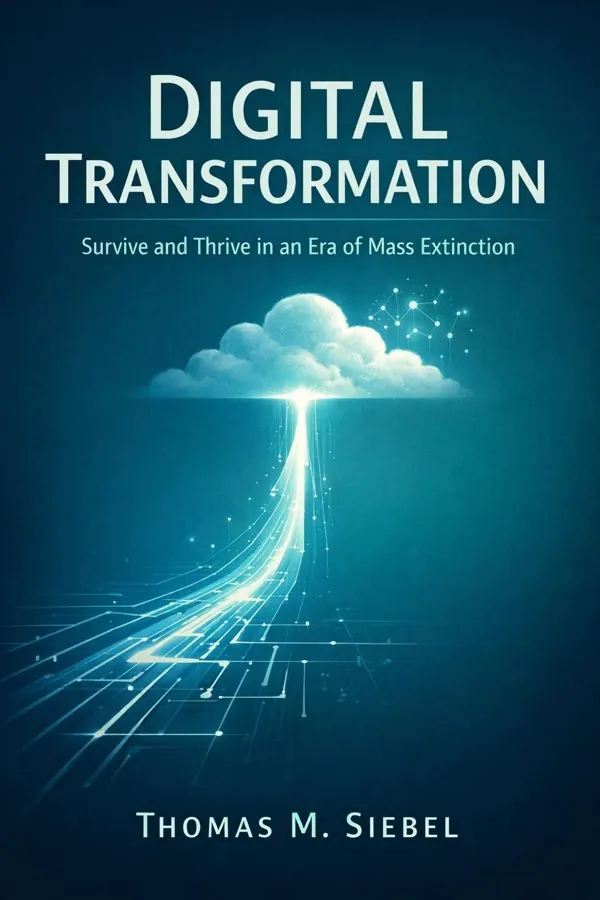
Digital Transformation: Survive and Thrive in an Era of Mass Extinction: Summary & Key Insights
 10 min4 chaptersAudio available
What Is Digital Transformation: Survive and Thrive in an Era of Mass Extinction About?
Digital Transformation: Survive and Thrive in an Era of Mass Extinction by Thomas M. Siebel is a strategy book spanning 4 pages. In this book, Silicon Valley entrepreneur Thomas M. Siebel explores how organizations can adapt and prosper amid the disruptive forces of artificial intelligence, cloud computing, big data, and the Internet of Things. Siebel provides a strategic framework for leaders to navigate digital transformation and avoid obsolescence in an era of rapid technological change.
This FizzRead summary covers all 4 key chapters of Digital Transformation: Survive and Thrive in an Era of Mass Extinction in approximately 10 minutes, distilling the most important ideas, arguments, and takeaways from Thomas M. Siebel's work. Also available as an audio summary and Key Quotes Podcast.
Digital Transformation: Survive and Thrive in an Era of Mass Extinction
In this book, Silicon Valley entrepreneur Thomas M. Siebel explores how organizations can adapt and prosper amid the disruptive forces of artificial intelligence, cloud computing, big data, and the Internet of Things. Siebel provides a strategic framework for leaders to navigate digital transformation and avoid obsolescence in an era of rapid technological change.
Who Should Read Digital Transformation: Survive and Thrive in an Era of Mass Extinction?
This book is perfect for anyone interested in strategy and looking to gain actionable insights in a short read. Whether you're a student, professional, or lifelong learner, the key ideas from Digital Transformation: Survive and Thrive in an Era of Mass Extinction by Thomas M. Siebel will help you think differently.
- ✓Readers who enjoy strategy and want practical takeaways
- ✓Professionals looking to apply new ideas to their work and life
- ✓Anyone who wants the core insights of Digital Transformation: Survive and Thrive in an Era of Mass Extinction in just 10 minutes
Want the full summary?
Get instant access to this book summary and 100K+ more with Fizz Moment.
Get Free SummaryAvailable on App Store • Free to download
Key Chapters
Every transformative age is powered by a set of core forces, and our own is defined by four: cloud computing, big data, artificial intelligence, and the Internet of Things. Each represents a pillar of an ecosystem in which data, connectivity, and computational intelligence define the new competitive landscape.
Cloud computing came first, breaking down the infrastructure barriers that had historically constrained corporations. It democratized computing power, allowing organizations to scale up or down with unprecedented speed. When enterprises moved to the cloud, they shifted from buying servers to buying outcomes. The cloud is not just cheaper hardware—it’s a platform that allows continuous innovation, global collaboration, and real-time deployment. Without it, nothing that follows would be possible.
Then came big data. The term may sound fashionable, but its meaning is profoundly economic. Data has become the raw material of the twenty-first century, as critical to value creation as oil once was. The problem is that most organizations are still drowning in their own data—collected but undeployed, owned but unanalyzed. The goal of digital transformation is to convert those immense reservoirs into insights that drive action. Predictive analytics, personalization, process automation—all depend on how effectively a business treats data as its central strategic asset.
Artificial intelligence adds the brain to this body. When we connect machine learning to massive data pools, we move from reactive to predictive enterprise behavior. Systems can now detect anomalies before they occur, optimize production autonomously, and adapt dynamically to customer needs. But AI is no magic wand; it demands clarity of purpose, high-quality data, and rigorous ethical oversight. Those who master it can redefine their industries. Those who dabble in it superficially risk creating another layer of complexity they cannot control.
And then there is the Internet of Things, the connective tissue of the digital organism. Billions of sensors, machines, and devices now communicate constantly, generating the data that AI needs to learn and act. For an energy company, an IoT network means predictive maintenance and reduced downtime. For a manufacturer, it means visibility across a global supply chain. For a city, it means sustainability and responsiveness to citizens. When integrated with AI and the cloud, IoT transforms operations from static to living systems.
The most transformative insight, however, is not in any single one of these forces but in their convergence. Cloud infrastructure delivers accessibility, IoT delivers data, big data frameworks store and process it, and AI creates intelligence from it. Together, they form a self-reinforcing cycle that continuously learns and adapts. This, I argue, is the true nature of digital transformation: the creation of an ecosystem where information, computation, and decision-making merge seamlessly at scale.
Looking back through history, we can see that every monumental technological advance has triggered a kind of mass extinction among businesses and institutions. The Industrial Revolution eliminated the artisan workshop. Electrification redefined manufacturing. Computing erased the advantage of scale in favor of speed and intelligence. Each wave reshuffled the hierarchy of economic power.
Today’s digital transformation, however, is unparalleled in breadth and speed. Whereas previous revolutions took place over decades, this one unfolds in years. The driving technologies are exponential, not linear. Processing power, data generation, and connectivity double at accelerating rates. The implication is brutal: organizations no longer have the luxury of gradual adaptation.
When I examine the companies that have thrived—Amazon, Google, Microsoft, or digitally reborn industrials like GE and Siemens—I see a pattern. They did not bolt digital technologies onto analog structures; they rebuilt their DNA. They reimagined how value was created, delivered, and experienced. This demands not only technological investment but a wholesale transformation of leadership mindset and corporate culture. The biggest threat to an incumbent is not technological inferiority but organizational denial.
In the book, I present digital transformation not as optional modernization but as existential evolution. It is guided by the same principles that govern natural selection: adaptability, learning, and innovation. The companies that thrive are those that evolve faster than their environment changes.
+ 2 more chapters — available in the FizzRead app
All Chapters in Digital Transformation: Survive and Thrive in an Era of Mass Extinction
About the Author
Thomas M. Siebel is an American technology entrepreneur and author, best known as the founder of Siebel Systems and C3.ai. He has been a prominent figure in enterprise software and digital innovation, contributing to the evolution of customer relationship management and artificial intelligence applications for business and government.
Get This Summary in Your Preferred Format
Read or listen to the Digital Transformation: Survive and Thrive in an Era of Mass Extinction summary by Thomas M. Siebel anytime, anywhere. FizzRead offers multiple formats so you can learn on your terms — all free.
Available formats: App · Audio · PDF · EPUB — All included free with FizzRead
Download Digital Transformation: Survive and Thrive in an Era of Mass Extinction PDF and EPUB Summary
Key Quotes from Digital Transformation: Survive and Thrive in an Era of Mass Extinction
“Every transformative age is powered by a set of core forces, and our own is defined by four: cloud computing, big data, artificial intelligence, and the Internet of Things.”
“Looking back through history, we can see that every monumental technological advance has triggered a kind of mass extinction among businesses and institutions.”
Frequently Asked Questions about Digital Transformation: Survive and Thrive in an Era of Mass Extinction
Digital Transformation: Survive and Thrive in an Era of Mass Extinction by Thomas M. Siebel is a strategy book that explores key ideas across 4 chapters. In this book, Silicon Valley entrepreneur Thomas M. Siebel explores how organizations can adapt and prosper amid the disruptive forces of artificial intelligence, cloud computing, big data, and the Internet of Things. Siebel provides a strategic framework for leaders to navigate digital transformation and avoid obsolescence in an era of rapid technological change.
You Might Also Like

Mastery
Robert Greene
10 min
Cut Costs Not Corners: A Practical Guide to Staying Competitive and Improving Profits
Colin Barrow
10 min
Good Strategy/Bad Strategy: The Difference and Why It Matters
Richard P. Rumelt
10 min
On Grand Strategy
John Lewis Gaddis
10 min
The Six Disciplines of Digital Transformation
George Westerman
10 min
7 Powers: The Foundations of Business Strategy
Hamilton Helmer
10 minBrowse by Category
Ready to read Digital Transformation: Survive and Thrive in an Era of Mass Extinction?
Get the full summary and 100K+ more books with Fizz Moment.