
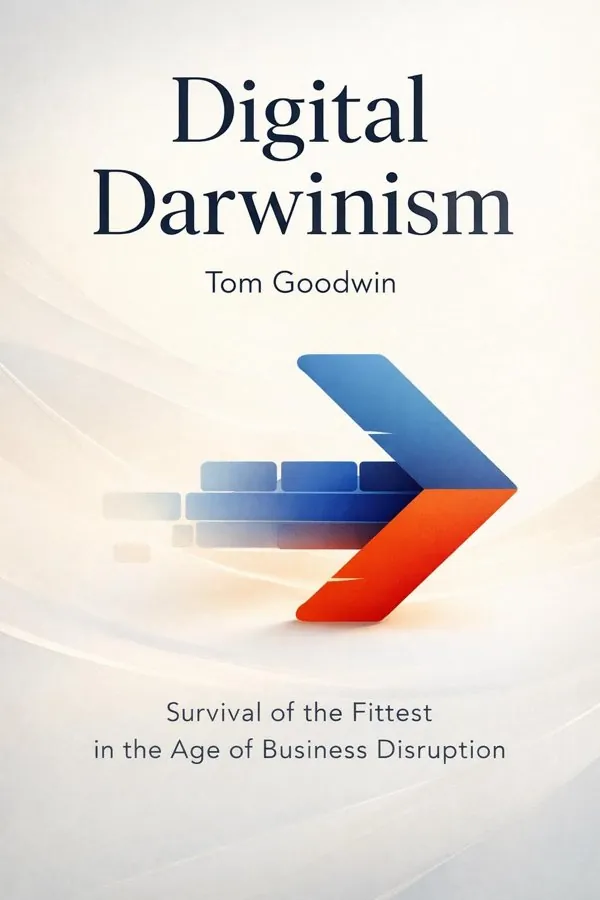
Digital Darwinism: Survival of the Fittest in the Age of Business Disruption: Summary & Key Insights
by Tom Goodwin
 10 min6 chaptersAudio available
What Is Digital Darwinism: Survival of the Fittest in the Age of Business Disruption About?
Digital Darwinism: Survival of the Fittest in the Age of Business Disruption by Tom Goodwin is a strategy book spanning 6 pages. Digital Darwinism explores how businesses must evolve to survive in an era of rapid technological change. Tom Goodwin argues that companies must adapt their strategies, structures, and mindsets to thrive amid digital disruption, emphasizing innovation, agility, and customer-centric thinking.
This FizzRead summary covers all 6 key chapters of Digital Darwinism: Survival of the Fittest in the Age of Business Disruption in approximately 10 minutes, distilling the most important ideas, arguments, and takeaways from Tom Goodwin's work. Also available as an audio summary and Key Quotes Podcast.
Digital Darwinism: Survival of the Fittest in the Age of Business Disruption
Digital Darwinism explores how businesses must evolve to survive in an era of rapid technological change. Tom Goodwin argues that companies must adapt their strategies, structures, and mindsets to thrive amid digital disruption, emphasizing innovation, agility, and customer-centric thinking.
Who Should Read Digital Darwinism: Survival of the Fittest in the Age of Business Disruption?
This book is perfect for anyone interested in strategy and looking to gain actionable insights in a short read. Whether you're a student, professional, or lifelong learner, the key ideas from Digital Darwinism: Survival of the Fittest in the Age of Business Disruption by Tom Goodwin will help you think differently.
- ✓Readers who enjoy strategy and want practical takeaways
- ✓Professionals looking to apply new ideas to their work and life
- ✓Anyone who wants the core insights of Digital Darwinism: Survival of the Fittest in the Age of Business Disruption in just 10 minutes
Want the full summary?
Get instant access to this book summary and 100K+ more with Fizz Moment.
Get Free SummaryAvailable on App Store • Free to download
Key Chapters
When I talk about disruption, I’m referring to a profound shift in how value is created and perceived. Disruption doesn’t necessarily come from breakthrough technology—it comes from rethinking the rules of engagement in a market. Airbnb disrupted hospitality not by inventing new tech but by reframing the concept of ownership and trust. Uber didn’t invent GPS or payments systems, yet it transformed transportation by connecting idle resources with unmet demand in an elegant digital layer.
This new competitive reality erases traditional boundaries. Companies no longer compete in neat segments; they compete for relevance, for moments of customer attention, for emotional resonance. Digital disruptors succeed because they eliminate friction and see their business through the eyes of the customer. They adapt faster, iterate constantly, and measure success not by market share but by experience share.
Legacy organizations, on the other hand, are often paralyzed by fear. They have become prisoners of their own structures—slow-moving, risk-averse, and focused on protecting what already exists. These companies mistake optimization for transformation. They improve processes incrementally instead of redefining their purpose. And in a world where change accelerates daily, incremental improvement is the slow road to irrelevance.
Digital Darwinism warns that ecosystems themselves are changing—the pace of evolution is no longer linear but exponential. For leaders and entrepreneurs, the question isn’t whether to change but how to change before the environment forces extinction. The winners build organizations that can sense and respond, treating adaptability as the ultimate core competency.
I often see businesses confuse adaptation with transformation. Adaptation is tweaking the edges—changing a process here, launching a new app there. Transformation, however, is redefining what the business actually is and how it creates value in the connected age. Transformation is existential; it acknowledges that survival depends on changing not only what you make but how you think, how you organize, and how you lead.
Transformation demands a new mindset—a shift away from control and prediction toward experimentation and discovery. When Spotify reinvented music consumption, it didn’t aim to digitize CDs; it rebuilt the entire relationship between artist, listener, and platform. That leap of imagination separates transformation from adaptation.
Inside many corporations, resistance to transformation is cultural. Managers are rewarded for stability, not exploration. IT departments protect infrastructure instead of enabling creativity. True transformation starts with dismantling these sacred structures. It begins with leadership willing to ask uncomfortable questions: What business are we really in? Are we designing our future or preserving our past?
I encourage readers to see transformation not as a technology project but as a behavioral shift. It’s about empowering people to learn, test, and fail fast. It's recognizing that disruption is never external—it’s a reflection of internal weakness. If you’re still running your organization by yesterday’s logic, no amount of digital tools will save you. Transformation means evolving your logic itself.
+ 4 more chapters — available in the FizzRead app
All Chapters in Digital Darwinism: Survival of the Fittest in the Age of Business Disruption
About the Author
Tom Goodwin is a global thought leader in digital transformation and innovation. He has served as an executive in marketing and technology firms and is known for his insights on how businesses can adapt to the digital age.
Get This Summary in Your Preferred Format
Read or listen to the Digital Darwinism: Survival of the Fittest in the Age of Business Disruption summary by Tom Goodwin anytime, anywhere. FizzRead offers multiple formats so you can learn on your terms — all free.
Available formats: App · Audio · PDF · EPUB — All included free with FizzRead
Download Digital Darwinism: Survival of the Fittest in the Age of Business Disruption PDF and EPUB Summary
Key Quotes from Digital Darwinism: Survival of the Fittest in the Age of Business Disruption
“When I talk about disruption, I’m referring to a profound shift in how value is created and perceived.”
“I often see businesses confuse adaptation with transformation.”
Frequently Asked Questions about Digital Darwinism: Survival of the Fittest in the Age of Business Disruption
Digital Darwinism: Survival of the Fittest in the Age of Business Disruption by Tom Goodwin is a strategy book that explores key ideas across 6 chapters. Digital Darwinism explores how businesses must evolve to survive in an era of rapid technological change. Tom Goodwin argues that companies must adapt their strategies, structures, and mindsets to thrive amid digital disruption, emphasizing innovation, agility, and customer-centric thinking.
You Might Also Like
Mastery
Robert Greene
10 min
Cut Costs Not Corners: A Practical Guide to Staying Competitive and Improving Profits
Colin Barrow
10 min
Good Strategy/Bad Strategy: The Difference and Why It Matters
Richard P. Rumelt
10 min
On Grand Strategy
John Lewis Gaddis
10 min
The Six Disciplines of Digital Transformation
George Westerman
10 min
7 Powers: The Foundations of Business Strategy
Hamilton Helmer
10 minBrowse by Category
Ready to read Digital Darwinism: Survival of the Fittest in the Age of Business Disruption?
Get the full summary and 100K+ more books with Fizz Moment.