
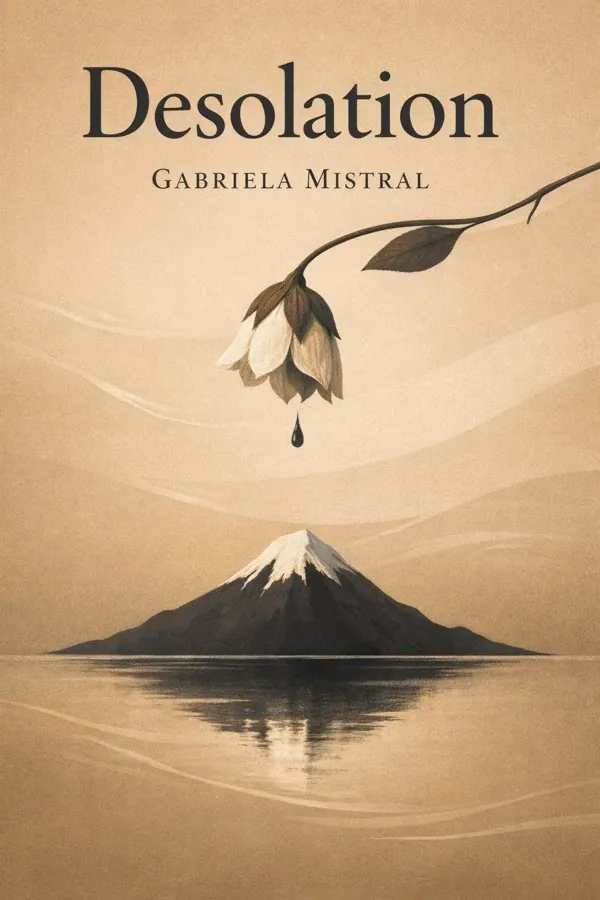
Desolation: Summary & Key Insights
 10 min8 chaptersAudio available
Key Takeaways from Desolation
One of the deepest insights in Desolation is that suffering does not merely wound us; it can also teach us how to see.
Love in Desolation is not sentimental comfort; it is a force that can nourish, haunt, elevate, and break the self.
A striking feature of Desolation is Mistral’s expansive vision of motherhood.
In Desolation, landscapes are never mere decoration.
Desolation is steeped in spiritual feeling, but it is not simplistic religious poetry.
What Is Desolation About?
Desolation by Gabriela Mistral is a classics book. Desolation is the first major poetry collection by Gabriela Mistral, the Chilean writer who would later become the first Latin American author to win the Nobel Prize in Literature. Originally published in 1922, the book gathers poems shaped by grief, spiritual searching, maternal tenderness, love, exile, faith, and the stark beauty of the natural world. It is not a book that offers easy comfort. Instead, it turns suffering into song and transforms private sorrow into a universal language of endurance. Across its pages, Mistral writes with emotional intensity and moral seriousness, exploring what it means to lose, to long, to nurture, and to continue living when the heart has been wounded. Desolation matters because it shows how poetry can carry both personal pain and collective meaning. Mistral’s voice is intimate yet expansive, rooted in Latin American landscapes while speaking to readers everywhere. Her authority comes not only from literary achievement, but from the depth of feeling and spiritual intelligence she brings to each poem. To read Desolation is to encounter a poet who makes anguish luminous without denying its weight.
This FizzRead summary covers all 8 key chapters of Desolation in approximately 10 minutes, distilling the most important ideas, arguments, and takeaways from Gabriela Mistral's work. Also available as an audio summary and Key Quotes Podcast.
Desolation
Desolation is the first major poetry collection by Gabriela Mistral, the Chilean writer who would later become the first Latin American author to win the Nobel Prize in Literature. Originally published in 1922, the book gathers poems shaped by grief, spiritual searching, maternal tenderness, love, exile, faith, and the stark beauty of the natural world. It is not a book that offers easy comfort. Instead, it turns suffering into song and transforms private sorrow into a universal language of endurance. Across its pages, Mistral writes with emotional intensity and moral seriousness, exploring what it means to lose, to long, to nurture, and to continue living when the heart has been wounded. Desolation matters because it shows how poetry can carry both personal pain and collective meaning. Mistral’s voice is intimate yet expansive, rooted in Latin American landscapes while speaking to readers everywhere. Her authority comes not only from literary achievement, but from the depth of feeling and spiritual intelligence she brings to each poem. To read Desolation is to encounter a poet who makes anguish luminous without denying its weight.
Who Should Read Desolation?
This book is perfect for anyone interested in classics and looking to gain actionable insights in a short read. Whether you're a student, professional, or lifelong learner, the key ideas from Desolation by Gabriela Mistral will help you think differently.
- ✓Readers who enjoy classics and want practical takeaways
- ✓Professionals looking to apply new ideas to their work and life
- ✓Anyone who wants the core insights of Desolation in just 10 minutes
Want the full summary?
Get instant access to this book summary and 100K+ more with Fizz Moment.
Get Free SummaryAvailable on App Store • Free to download
Key Chapters
One of the deepest insights in Desolation is that suffering does not merely wound us; it can also teach us how to see. Gabriela Mistral writes as someone who refuses to romanticize pain, yet she understands that grief changes perception. Loss strips away illusion, pride, and superficial comfort. What remains is a sharper awareness of mortality, love, loneliness, and the hidden ties between human beings. In her poems, sorrow becomes a way of knowing reality more honestly.
This is one reason the collection still feels powerful today. Mistral does not present pain as noble in itself. Instead, she shows how anguish can reveal what matters most. A broken heart may discover its capacity for tenderness. A grieving person may become more attentive to the suffering of others. Spiritual doubt may produce a more serious and humble faith. Throughout Desolation, emotional devastation is transformed into language, and that act of expression becomes a form of survival.
Readers can apply this idea beyond poetry. Journaling after loss, creating art from difficult experience, or simply naming one's emotions truthfully can turn confusion into clarity. A teacher, parent, or friend who has suffered may also become more compassionate because they know pain from the inside. Mistral suggests that we do not overcome sorrow by denying it, but by allowing it to deepen our understanding.
Actionable takeaway: When facing hardship, ask not only "How do I escape this?" but also "What is this experience revealing about what I value, fear, and need most?"
Love in Desolation is not sentimental comfort; it is a force that can nourish, haunt, elevate, and break the self. Mistral explores romantic longing, maternal devotion, spiritual desire, and love for the vulnerable. What unites these forms is intensity. Her poems suggest that genuine love makes us more alive, but also more exposed. To care deeply is to risk grief.
This complexity gives the collection its emotional range. Love appears as absence as much as presence. A beloved may be lost, unreachable, or transformed into memory. Yet even when love is painful, Mistral treats it as meaningful rather than foolish. She recognizes that attachment leaves marks on the soul, and those marks shape identity. Love is not valuable because it guarantees happiness. It is valuable because it reveals the depth of our capacity to give, mourn, and remain faithful to what mattered.
In practical terms, this idea helps readers rethink modern assumptions that difficult emotions signal failure. A relationship that ended may still have been significant. Caring for a child, student, family member, or partner may involve sacrifice, fatigue, and fear alongside joy. Mistral legitimizes these mixed feelings. She shows that love worthy of the name often carries contradiction.
For readers, Desolation can encourage emotional honesty. Instead of reducing relationships to success or failure, we can ask how they changed us and what responsibilities they awakened. Love may not always stay, but its moral and emotional truth remains.
Actionable takeaway: Reflect on one important relationship in your life and identify not only what it gave you, but what it asked you to become.
A striking feature of Desolation is Mistral’s expansive vision of motherhood. In her poetry, the maternal is not limited to biological maternity. It becomes an ethical posture of care, protection, nourishment, and grief for vulnerable life. This broader sense of motherhood allows Mistral to speak not only to parents, but to anyone who has felt responsible for another being’s well-being.
Her poems often express tenderness toward children, the poor, the abandoned, and the fragile. The maternal voice in Desolation can be intimate and gentle, but it also carries fear. To care deeply means to be haunted by the possibility of loss. Mistral understands nurture as both blessing and burden. It asks for constancy, patience, and sacrifice. Yet she also presents this labor of care as sacred. To hold another life with seriousness is to participate in something larger than the self.
This idea has modern relevance. Teachers, nurses, social workers, mentors, guardians, and older siblings often embody maternal care without fitting narrow definitions of motherhood. Communities, too, can practice a maternal ethic by protecting children, supporting the grieving, and tending to the lonely. Mistral’s poems invite readers to respect caregiving as emotional, spiritual, and cultural work, not as secondary labor.
By widening motherhood into a human capacity for sheltering others, Desolation challenges readers to ask whom they are called to protect. It also reminds us that caregiving requires recognition and renewal; those who nurture others need care as well.
Actionable takeaway: Identify one person or community you help sustain, and choose one concrete way this week to offer steadier, more intentional care.
In Desolation, landscapes are never mere decoration. Mountains, wind, night, rivers, trees, and fields become extensions of inner life. Gabriela Mistral uses nature to translate difficult emotions into physical images, giving grief, solitude, and yearning a visible shape. This is one of the collection’s great strengths: it allows readers to feel emotional states through the natural world rather than through abstract explanation alone.
When the external world reflects the soul, poetry becomes more immediate. A barren landscape can suggest emotional emptiness. A vast sky can evoke spiritual longing. Harsh light, cold earth, or restless weather can embody anxiety, memory, or estrangement. Mistral’s work is rooted in Latin American environments, yet the symbolic force of her imagery feels universal. Readers recognize themselves in her deserts, hills, and storms because nature becomes a shared emotional language.
This approach has practical value even outside literature. People often understand their inner states better when they connect them to place. Someone might say they feel foggy, storm-tossed, or dried out long before they can explain their distress analytically. Time outdoors can also offer perspective. Nature does not erase suffering, but it can give shape to it and make it more bearable. A walk, a view, a season, or a change in weather may help articulate what words alone cannot.
Mistral teaches that paying attention to the world around us can deepen self-understanding. The environment becomes not an escape from emotion, but a companion to it.
Actionable takeaway: The next time you feel overwhelmed, describe your emotional state using images from nature and notice what that comparison reveals.
Desolation is steeped in spiritual feeling, but it is not simplistic religious poetry. Mistral’s relationship to faith is intense, searching, and often troubled. She addresses God, invokes prayer, and draws from Christian imagery, yet her poems also register silence, distance, and unanswered anguish. This tension makes her work compelling. She does not hide uncertainty in order to preserve piety. Instead, she turns doubt into part of the spiritual struggle.
The result is a vision of faith that feels lived rather than idealized. In Desolation, belief is not a settled possession but a practice of wrestling. The speaker longs for transcendence, consolation, and divine meaning, yet she also experiences abandonment and desolation. These opposing movements give the collection its moral seriousness. Spiritual life is shown not as escape from pain, but as a way of bearing it without losing the hunger for meaning.
Many readers, including nonreligious ones, can relate to this dynamic. In difficult times, people often seek purpose, ritual, or language that can hold suffering. They may pray and doubt at the same time. They may desire certainty while recognizing its absence. Mistral validates this mixed condition. Her poems suggest that honest questioning may be more faithful than easy answers.
Applied practically, this means readers can approach spiritual uncertainty with less shame. Whether through prayer, meditation, reflective reading, or conversation, the task is not to force certainty but to remain open to meaning even in emotional darkness.
Actionable takeaway: If you are wrestling with belief, write down one unanswered spiritual question and one practice that still helps you stay connected to wonder, humility, or hope.
Few books explore solitude with the force of Desolation. For Mistral, being alone is not simply peaceful withdrawal. It can be abandonment, exile, interior emptiness, or estrangement from others. Yet solitude also creates the conditions for reflection, prayer, and artistic truth. This double vision is central to the collection. Loneliness hurts, but silence may also reveal what noise conceals.
Mistral understands that isolation can sharpen self-awareness. In the absence of distraction, unresolved grief rises. Memories return. Desire speaks more clearly. So does fear. But along with these painful encounters comes an opportunity: the solitary self may discover its real commitments. What remains when companionship, routine, and social performance fall away? Desolation returns repeatedly to that question.
This insight matters in contemporary life, where people often swing between overstimulation and private emptiness. Solitude is frequently confused either with freedom or with failure. Mistral presents a more nuanced picture. Time alone can become destructive if it hardens into despair, but it can also become fertile if it opens into reflection, creativity, or spiritual attention. The challenge is not merely to avoid loneliness, but to shape solitude intentionally.
Practical applications include setting aside undistracted time for reading, walking, prayer, or writing, while also maintaining relationships that prevent emotional isolation. Mistral teaches that one can learn from solitude without being consumed by it.
Actionable takeaway: Create one deliberate period of quiet this week, then ask yourself what feeling or truth becomes audible when distraction falls away.
A defining achievement of Desolation is its ability to turn intensely personal pain into something shared. Mistral writes from intimate sorrow, but her poems do not remain trapped within autobiography. Through rhythm, image, repetition, and emotional precision, she converts private experience into art that others can inhabit. This is why readers from different eras and cultures continue to feel recognized by her work.
The transformation matters because raw suffering is often chaotic. It overwhelms the mind and resists communication. Poetry does not erase that disorder, but it shapes it. Once grief enters form, it becomes speakable. It may still be painful, but it is no longer mute. In Mistral’s hands, language serves both witness and survival. She does not solve sorrow; she gives it contour and dignity.
This offers an important lesson for everyday life. People often heal not by explaining everything perfectly, but by finding forms that can carry feeling: a letter never sent, a poem, a conversation, a song, a prayer, or a carefully chosen metaphor. Expression creates distance without indifference. It allows us to stand near our pain rather than collapse under it.
Mistral also reminds readers that articulation can build community. When one person names grief honestly, others recognize their own. Art becomes a meeting place where isolated suffering turns into shared humanity.
Actionable takeaway: Choose one difficult emotion you have not fully expressed and give it a form today, whether through a paragraph, voice note, sketch, or poem.
Although Desolation is often read through the lens of Mistral’s own emotional life, the collection reaches far beyond individual heartbreak. Its voice speaks to human vulnerability in a broader sense, touching on care, injustice, death, poverty, abandonment, and spiritual hunger. Mistral’s poems move from the singular self toward a wider moral field. Her suffering becomes a doorway into compassion for others.
This expansion is part of what gives the book enduring importance. Personal lyric poetry can sometimes feel enclosed, but Mistral enlarges emotion into ethical awareness. To grieve is also to notice who else is grieving. To feel loneliness is to become more sensitive to exclusion and neglect. The inward voice becomes socially resonant. This is especially visible in poems that show tenderness toward children and the defenseless, revealing how personal sorrow can awaken responsibility rather than self-absorption.
Modern readers can apply this idea by asking how their own experiences of hardship might increase solidarity. Someone who has known financial precarity may better understand others' insecurity. Someone who has felt abandoned may become more attentive to people on the margins. Mistral suggests that inner suffering need not end in enclosure. It can become an ethical force.
Desolation therefore matters not only as confession, but as witness. It demonstrates that literature can bridge the gap between individual feeling and collective life. A deeply personal voice can still speak for shared wounds.
Actionable takeaway: Consider one pain you have known and ask how it might help you show greater patience, generosity, or attention to someone facing something similar.
All Chapters in Desolation
About the Author
Gabriela Mistral, born Lucila Godoy Alcayaga in Chile in 1889, was a poet, educator, diplomat, and one of Latin America’s most influential literary figures. She began her career as a teacher and developed a writing voice marked by emotional intensity, spiritual depth, and deep concern for children, the poor, and the marginalized. Her poetry often centers on grief, love, motherhood, nature, and faith, combining lyrical beauty with moral seriousness. Desolation, published in 1922, established her international reputation. In 1945, she became the first Latin American writer to win the Nobel Prize in Literature. Mistral also served in consular and cultural roles abroad, helping shape intellectual life beyond literature. She died in 1957, leaving a body of work that remains powerful, humane, and enduring.
Get This Summary in Your Preferred Format
Read or listen to the Desolation summary by Gabriela Mistral anytime, anywhere. FizzRead offers multiple formats so you can learn on your terms — all free.
Available formats: App · Audio · PDF · EPUB — All included free with FizzRead
Download Desolation PDF and EPUB Summary
Key Quotes from Desolation
“One of the deepest insights in Desolation is that suffering does not merely wound us; it can also teach us how to see.”
“Love in Desolation is not sentimental comfort; it is a force that can nourish, haunt, elevate, and break the self.”
“A striking feature of Desolation is Mistral’s expansive vision of motherhood.”
“In Desolation, landscapes are never mere decoration.”
“Desolation is steeped in spiritual feeling, but it is not simplistic religious poetry.”
Frequently Asked Questions about Desolation
Desolation by Gabriela Mistral is a classics book that explores key ideas across 8 chapters. Desolation is the first major poetry collection by Gabriela Mistral, the Chilean writer who would later become the first Latin American author to win the Nobel Prize in Literature. Originally published in 1922, the book gathers poems shaped by grief, spiritual searching, maternal tenderness, love, exile, faith, and the stark beauty of the natural world. It is not a book that offers easy comfort. Instead, it turns suffering into song and transforms private sorrow into a universal language of endurance. Across its pages, Mistral writes with emotional intensity and moral seriousness, exploring what it means to lose, to long, to nurture, and to continue living when the heart has been wounded. Desolation matters because it shows how poetry can carry both personal pain and collective meaning. Mistral’s voice is intimate yet expansive, rooted in Latin American landscapes while speaking to readers everywhere. Her authority comes not only from literary achievement, but from the depth of feeling and spiritual intelligence she brings to each poem. To read Desolation is to encounter a poet who makes anguish luminous without denying its weight.
You Might Also Like





Browse by Category
Ready to read Desolation?
Get the full summary and 100K+ more books with Fizz Moment.