
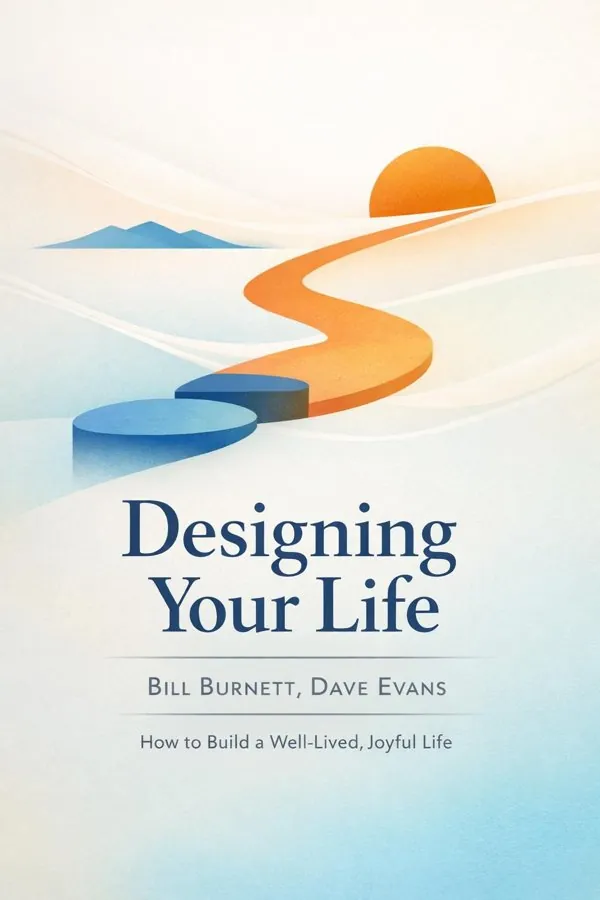
Designing Your Life: How to Build a Well-Lived, Joyful Life: Summary & Key Insights
 10 min9 chaptersAudio available
Key Takeaways from Designing Your Life: How to Build a Well-Lived, Joyful Life
A life problem is often not hard because it lacks a solution, but because it has been framed badly.
Curiosity is more than a pleasant trait; it is a survival tool for building a meaningful life.
Many life problems are not practical problems at all; they are belief problems.
Success on paper can hide a life that feels flat from the inside.
The pressure to choose one future too early can make people freeze.
What Is Designing Your Life: How to Build a Well-Lived, Joyful Life About?
Designing Your Life: How to Build a Well-Lived, Joyful Life by Bill Burnett, Dave Evans is a career book spanning 11 pages. Designing Your Life is a practical guide to applying design thinking to one of the hardest challenges anyone faces: building a meaningful life and career in an uncertain world. Rather than treating life as something you passively discover, Bill Burnett and Dave Evans argue that it can be designed through curiosity, experimentation, reflection, and small, testable actions. The book is especially powerful for people who feel stuck, overwhelmed by options, disappointed by traditional career advice, or haunted by the pressure to find a single “right” path. What makes this book matter is its shift away from abstract self-help and toward usable tools. Instead of telling readers to simply “follow their passion,” Burnett and Evans show how to identify energy-giving activities, challenge dysfunctional beliefs, prototype possible futures, and make decisions without certainty. Their ideas are grounded in years of teaching Stanford’s popular Designing Your Life course, where they helped students and professionals navigate career changes, life transitions, and personal confusion. The result is an empowering framework for anyone who wants to stop waiting for clarity and start building a life that is both joyful and well-lived.
This FizzRead summary covers all 9 key chapters of Designing Your Life: How to Build a Well-Lived, Joyful Life in approximately 10 minutes, distilling the most important ideas, arguments, and takeaways from Bill Burnett, Dave Evans's work. Also available as an audio summary and Key Quotes Podcast.
Designing Your Life: How to Build a Well-Lived, Joyful Life
Designing Your Life is a practical guide to applying design thinking to one of the hardest challenges anyone faces: building a meaningful life and career in an uncertain world. Rather than treating life as something you passively discover, Bill Burnett and Dave Evans argue that it can be designed through curiosity, experimentation, reflection, and small, testable actions. The book is especially powerful for people who feel stuck, overwhelmed by options, disappointed by traditional career advice, or haunted by the pressure to find a single “right” path.
What makes this book matter is its shift away from abstract self-help and toward usable tools. Instead of telling readers to simply “follow their passion,” Burnett and Evans show how to identify energy-giving activities, challenge dysfunctional beliefs, prototype possible futures, and make decisions without certainty. Their ideas are grounded in years of teaching Stanford’s popular Designing Your Life course, where they helped students and professionals navigate career changes, life transitions, and personal confusion.
The result is an empowering framework for anyone who wants to stop waiting for clarity and start building a life that is both joyful and well-lived.
Who Should Read Designing Your Life: How to Build a Well-Lived, Joyful Life?
This book is perfect for anyone interested in career and looking to gain actionable insights in a short read. Whether you're a student, professional, or lifelong learner, the key ideas from Designing Your Life: How to Build a Well-Lived, Joyful Life by Bill Burnett, Dave Evans will help you think differently.
- ✓Readers who enjoy career and want practical takeaways
- ✓Professionals looking to apply new ideas to their work and life
- ✓Anyone who wants the core insights of Designing Your Life: How to Build a Well-Lived, Joyful Life in just 10 minutes
Want the full summary?
Get instant access to this book summary and 100K+ more with Fizz Moment.
Get Free SummaryAvailable on App Store • Free to download
Key Chapters
A life problem is often not hard because it lacks a solution, but because it has been framed badly. One of the most important ideas in Designing Your Life is that people get stuck when they ask unhelpful questions such as “What should I do with my life?” or “What is my one true calling?” These questions are too big, too rigid, and based on the false belief that there is a single perfect answer waiting to be found. In design, the quality of the solution depends on the quality of the question.
Burnett and Evans encourage readers to reframe life challenges into problems that can actually be worked on. Instead of asking, “What is the perfect career for me?” ask, “What are some interesting directions I could explore next?” Instead of “Why am I failing?” ask, “What is this experience teaching me about what fits and what doesn’t?” This shift reduces paralysis and turns vague anxiety into practical movement.
A common example is someone unhappy in their job who assumes the problem is, “I chose the wrong profession.” But a better framing might be, “Which parts of my work drain me, and which parts give me energy?” That opens up more options: changing teams, altering responsibilities, learning new skills, or testing a different field before making a drastic leap.
The design mindset replaces perfection with iteration. You do not need the final answer to make progress. You need a better question.
Actionable takeaway: Write down one life problem that feels overwhelming, then rewrite it as a smaller, testable question that invites exploration instead of demands certainty.
Curiosity is more than a pleasant trait; it is a survival tool for building a meaningful life. When people feel lost, they often become serious, rigid, and obsessed with finding the correct answer quickly. But the authors argue that curiosity is what opens possibility. It moves you from fear to discovery and from overthinking to engagement.
In design thinking, curiosity helps you notice what attracts your attention, what questions keep recurring, and what kinds of people, environments, and activities spark energy. Instead of immediately evaluating whether an interest is practical or profitable, you begin by exploring it. This matters because many fulfilling careers and life directions do not begin as clear plans. They start as small fascinations pursued with openness.
For example, someone working in finance might notice they are consistently drawn to mentoring interns, reading about education, and volunteering at youth programs. Curiosity would prompt them not to quit immediately, but to investigate. They might interview teachers, shadow a nonprofit leader, or take a weekend course in coaching. Those small actions reveal more than endless internal debate ever could.
Curiosity also loosens identity. You do not have to know who you are forever; you can ask what interests you now. This creates momentum and lowers the emotional stakes of change. Instead of needing confidence before acting, you act in order to generate confidence.
Actionable takeaway: Make a list of five things that currently spark your curiosity, then choose one to explore through a conversation, class, article, or real-world experience within the next seven days.
Many life problems are not practical problems at all; they are belief problems. The authors call these dysfunctional beliefs: assumptions that feel true but quietly limit your options. Beliefs such as “It’s too late to change careers,” “I must love every part of my job,” or “If I haven’t figured it out by now, something is wrong with me” create emotional dead ends. When you believe them, you stop designing and start surrendering.
Designing Your Life teaches readers to identify these beliefs and replace them with more generative ones. A dysfunctional belief narrows the future; a reframed belief creates movement. For example, “I need to know my passion before I can move forward” can become “Passion grows through engagement and mastery.” “There is only one right path” can become “There are many possible lives in which I can thrive.” These are not empty affirmations. They are more accurate working assumptions that support experimentation.
This shift matters because most people are trapped less by reality than by the stories they tell about reality. Consider a mid-career professional who believes starting over would waste past experience. A better belief is that previous experience can be repurposed in new contexts. Skills such as leadership, analysis, teaching, communication, and relationship-building often travel well across industries.
The point is not blind optimism. It is to test whether your current beliefs are helping you build a life or merely preserving your fear.
Actionable takeaway: Identify one belief that makes you feel trapped, then rewrite it into a more constructive belief that allows action and test it this week with one small experiment.
Success on paper can hide a life that feels flat from the inside. One of the book’s most useful tools is the idea of paying attention to energy and engagement rather than relying only on status, salary, or external approval. The authors suggest that a good life is not built merely by asking, “What am I good at?” but also, “What gives me life?”
To discover this, they recommend an engagement journal. Over time, you record activities that leave you feeling focused, alive, and absorbed, as well as those that leave you drained, bored, or disconnected. The goal is to notice patterns. Do you feel energized by solving ambiguous problems, working one-on-one with people, creating visual systems, organizing chaos, teaching, building, writing, or collaborating? Do you lose energy in routine maintenance, solitary analysis, or highly political environments?
This is a more reliable guide than fantasy. People often think they want a glamorous role, but the daily tasks behind that role may not suit them. A person attracted to entrepreneurship, for instance, may discover they actually love ideation and customer interaction but dislike constant financial uncertainty. Another may realize they enjoy healthcare not because of medicine itself but because of service, fast-paced teamwork, and meaningful human contact.
Energy is data. It does not tell you exactly what to do, but it gives clues about your best fit. Over time, those clues can guide role changes, career pivots, or lifestyle redesign.
Actionable takeaway: For two weeks, keep a simple daily log of activities that energize or drain you, then review it for recurring themes you can use to shape future decisions.
The pressure to choose one future too early can make people freeze. Burnett and Evans address this by introducing one of the book’s signature exercises: Odyssey Plans. Instead of trying to identify a single ideal future, you design three plausible versions of the next five years of your life. This expands possibility and weakens the false belief that your life hinges on one perfect decision.
Typically, the first plan is your current path if you keep going. The second is what you would do if that path suddenly disappeared. The third is what you might try if money, status, and social expectations were less restrictive. Each plan should include work, lifestyle, and the broader shape of daily living, not just a job title. Then you evaluate each according to resources, excitement, confidence, and coherence.
This exercise often creates surprising insights. Someone in consulting may realize that their most appealing future is not another corporate role, but a hybrid life involving teaching, freelancing, and community work. A physician may discover that what they want is not to leave medicine entirely, but to move into research, policy, or education. A student torn between several interests may see that different futures can all be meaningful in different ways.
The deeper lesson is that your future is not a fixed object waiting to be discovered. It is a set of design possibilities. By generating alternatives, you lower fear and increase creativity.
Actionable takeaway: Draft three five-year life plans this week and score each one for excitement, practicality, and alignment with your values before deciding what to explore further.
People often think change requires a dramatic leap, but designers know that smart change begins with prototypes. A prototype is a small, low-risk experiment that helps you learn about a possible future before committing fully to it. In life design, this means trying things out rather than endlessly imagining them.
If you think you want to become a therapist, do not start with a graduate program application. First, talk to practicing therapists, volunteer in a support setting, attend a workshop, or observe the emotional demands of the work. If you are considering starting a business, test a service with five people before writing a full business plan. If you dream of working in sustainability, join a local project, take a short course, or interview professionals in the field.
Prototyping matters because fantasies are incomplete. We tend to project our hopes onto unknown futures and ignore the everyday realities. Small experiments reveal what the work actually feels like, what skills are required, what trade-offs exist, and whether your interest deepens with exposure. They also reduce fear because you are not making a forever decision. You are gathering data.
This approach is especially useful for career changers, recent graduates, and anyone caught between several appealing options. Clarity rarely comes before action. More often, action produces clarity.
Actionable takeaway: Choose one future you are considering and design a one-week or one-month prototype, such as an informational interview, side project, volunteer role, workshop, or shadowing experience.
A well-designed life is rarely built alone. One of the book’s less flashy but deeply important insights is that relationships are essential to life design. Many people try to solve career and life questions in isolation, believing they must independently discover the answer. Burnett and Evans argue the opposite: good design is collaborative.
Supportive relationships provide perspective, encouragement, accountability, and access. Conversations with mentors, peers, friends, former colleagues, and new contacts can help you test assumptions and reveal options you would never have imagined on your own. This is especially true during transitions. A person considering a move into product management, for example, may gain more from three honest conversations with practitioners than from months of online research.
The authors also highlight the value of life design interviews. These are not job-seeking conversations where you try to impress someone. They are learning conversations where you ask how people got where they are, what their work actually involves, what surprised them, and what advice they would offer someone exploring the field. These interviews generate concrete, reality-based insight.
A support network also matters emotionally. Change is easier when someone reflects your strengths back to you and reminds you that uncertainty is normal. The right people do not choose for you; they help you see more clearly.
Actionable takeaway: Identify three people you can learn from or lean on, and schedule at least one exploratory conversation this week focused on learning, not asking for a job.
One reason people delay decisions is the fantasy that a good choice should feel obviously right. But life decisions rarely come with total certainty. Designing Your Life offers a healthier approach: learn to make good choices with incomplete information. The goal is not certainty; it is discernment.
The authors draw on a process of gathering options, listening to your reactions, and noticing where there is alignment between your values, energy, and practical reality. They also emphasize that when several options are good, choosing becomes less about discovering the correct answer and more about committing meaningfully to one path. This is liberating because it removes the pressure to predict the entire future in advance.
A useful distinction here is between choosing and agonizing. Agonizing is what happens when you assume one wrong move will ruin everything. Choosing is what happens when you accept that no option is perfect and that any path will involve trade-offs. A person deciding between graduate school and staying in industry, for example, can evaluate both paths, prototype elements of each, and then commit to one with awareness rather than obsession.
The book also draws from traditions of discernment, encouraging readers to notice not just logical pros and cons, but emotional resonance, bodily reactions, and the deeper sense of what feels enlivening and coherent.
Actionable takeaway: When facing a decision, narrow your options, gather a bit more real-world information, then choose the one you can commit to fully rather than waiting for impossible certainty.
Perhaps the book’s most hopeful message is that you do not design your life once. You design it again and again. A well-lived life is not the result of a perfect early choice; it is the result of continual adjustment as you grow, circumstances change, and new opportunities appear. This perspective reduces regret and makes room for reinvention.
Burnett and Evans reject the idea that work and life should be treated as separate compartments. Instead, they encourage readers to think about coherence: how values, work, relationships, health, and purpose fit together. A job that looks impressive but destroys your energy, isolates you from loved ones, or clashes with your core beliefs is not well designed. Likewise, a meaningful life may include seasons of ambition, rest, caregiving, learning, experimentation, and change.
This ongoing approach is especially relevant in a world where careers are no longer linear. Industries shift, roles evolve, and identities change. The person you are at 25 may not want the same life at 40, and that is not failure. It is development. What matters is staying engaged in the process of reflection, experimentation, and recalibration.
When people feel stuck, they often think they have missed their chance. The book insists they have not. There is always a next prototype, a next conversation, a next reframed question.
Actionable takeaway: Create a monthly life design check-in where you review what is working, what is draining you, and what one small adjustment could make your life feel more coherent and joyful.
All Chapters in Designing Your Life: How to Build a Well-Lived, Joyful Life
About the Authors
Bill Burnett is the Executive Director of the Design Program at Stanford University and an accomplished product designer with decades of experience in innovation, teaching, and creative problem-solving. Dave Evans is a Stanford lecturer, speaker, and former technology executive who has held leadership roles at Apple and Electronic Arts. Together, they co-developed Stanford’s widely known Designing Your Life course, which applies design thinking principles to career planning, personal growth, and life decisions. Their work stands out because it translates the methods used to design products and experiences into tools for building a more meaningful life. Through teaching, writing, and speaking, Burnett and Evans have helped students, professionals, and career changers approach uncertainty with curiosity, experimentation, and confidence.
Get This Summary in Your Preferred Format
Read or listen to the Designing Your Life: How to Build a Well-Lived, Joyful Life summary by Bill Burnett, Dave Evans anytime, anywhere. FizzRead offers multiple formats so you can learn on your terms — all free.
Available formats: App · Audio · PDF · EPUB — All included free with FizzRead
Download Designing Your Life: How to Build a Well-Lived, Joyful Life PDF and EPUB Summary
Key Quotes from Designing Your Life: How to Build a Well-Lived, Joyful Life
“A life problem is often not hard because it lacks a solution, but because it has been framed badly.”
“Curiosity is more than a pleasant trait; it is a survival tool for building a meaningful life.”
“Many life problems are not practical problems at all; they are belief problems.”
“Success on paper can hide a life that feels flat from the inside.”
“The pressure to choose one future too early can make people freeze.”
Frequently Asked Questions about Designing Your Life: How to Build a Well-Lived, Joyful Life
Designing Your Life: How to Build a Well-Lived, Joyful Life by Bill Burnett, Dave Evans is a career book that explores key ideas across 9 chapters. Designing Your Life is a practical guide to applying design thinking to one of the hardest challenges anyone faces: building a meaningful life and career in an uncertain world. Rather than treating life as something you passively discover, Bill Burnett and Dave Evans argue that it can be designed through curiosity, experimentation, reflection, and small, testable actions. The book is especially powerful for people who feel stuck, overwhelmed by options, disappointed by traditional career advice, or haunted by the pressure to find a single “right” path. What makes this book matter is its shift away from abstract self-help and toward usable tools. Instead of telling readers to simply “follow their passion,” Burnett and Evans show how to identify energy-giving activities, challenge dysfunctional beliefs, prototype possible futures, and make decisions without certainty. Their ideas are grounded in years of teaching Stanford’s popular Designing Your Life course, where they helped students and professionals navigate career changes, life transitions, and personal confusion. The result is an empowering framework for anyone who wants to stop waiting for clarity and start building a life that is both joyful and well-lived.
More by Bill Burnett, Dave Evans
You Might Also Like
60 Seconds & You're Hired!
Robin Ryan
10 min
A New Way for Mothers: A Revolutionary Approach for Mothers to Use Their Skills and Talents While Their Children Are at School
Louise Webster
10 min
Betting on You: How to Put Yourself First and (Finally) Take Control of Your Career
Laurie Ruettimann
10 min
Born for This: How to Find the Work You Were Meant to Do
Chris Guillebeau
10 min
Brag Better: Master the Art of Fearless Self-Promotion
Meredith Fineman
10 min
Build for Tomorrow: An Action Plan for Embracing Change, Adapting Fast, and Future-Proofing Your Career
Jason Feifer
10 minBrowse by Category
Ready to read Designing Your Life: How to Build a Well-Lived, Joyful Life?
Get the full summary and 100K+ more books with Fizz Moment.