
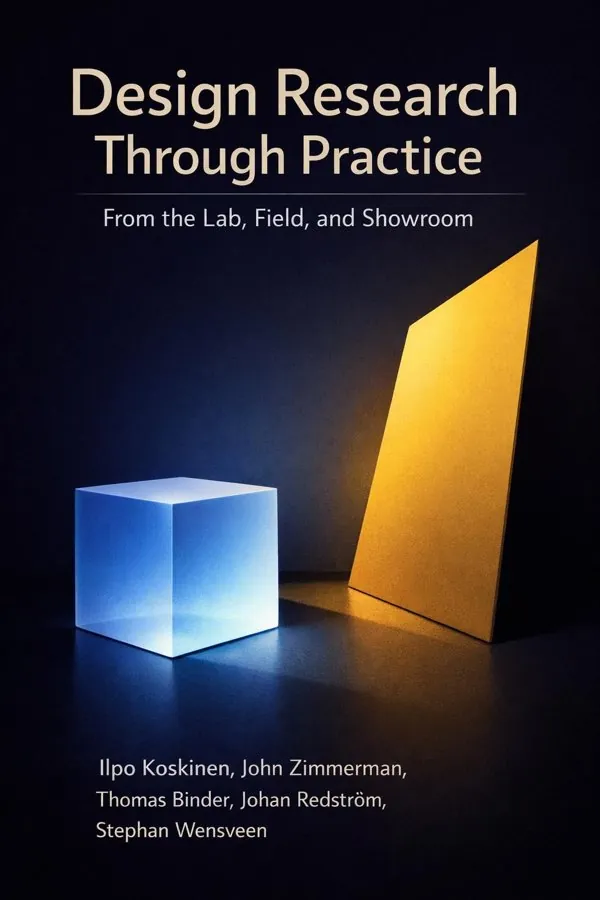
Design Research Through Practice: From the Lab, Field, and Showroom: Summary & Key Insights
by Ilpo Koskinen, John Zimmerman, Thomas Binder, Johan Redström, Stephan Wensveen
 10 min10 chaptersAudio available
What Is Design Research Through Practice: From the Lab, Field, and Showroom About?
Design Research Through Practice: From the Lab, Field, and Showroom by Ilpo Koskinen, John Zimmerman, Thomas Binder, Johan Redström, Stephan Wensveen is a design book spanning 10 pages. This book introduces a practice-based approach to design research, emphasizing how designers generate knowledge through their creative work. It explores methods and case studies from design labs, fieldwork, and showrooms, showing how design can serve as a form of inquiry. The authors discuss how design research contributes to innovation and understanding in both academic and professional contexts.
This FizzRead summary covers all 10 key chapters of Design Research Through Practice: From the Lab, Field, and Showroom in approximately 10 minutes, distilling the most important ideas, arguments, and takeaways from Ilpo Koskinen, John Zimmerman, Thomas Binder, Johan Redström, Stephan Wensveen's work. Also available as an audio summary and Key Quotes Podcast.
Design Research Through Practice: From the Lab, Field, and Showroom
This book introduces a practice-based approach to design research, emphasizing how designers generate knowledge through their creative work. It explores methods and case studies from design labs, fieldwork, and showrooms, showing how design can serve as a form of inquiry. The authors discuss how design research contributes to innovation and understanding in both academic and professional contexts.
Who Should Read Design Research Through Practice: From the Lab, Field, and Showroom?
This book is perfect for anyone interested in design and looking to gain actionable insights in a short read. Whether you're a student, professional, or lifelong learner, the key ideas from Design Research Through Practice: From the Lab, Field, and Showroom by Ilpo Koskinen, John Zimmerman, Thomas Binder, Johan Redström, Stephan Wensveen will help you think differently.
- ✓Readers who enjoy design and want practical takeaways
- ✓Professionals looking to apply new ideas to their work and life
- ✓Anyone who wants the core insights of Design Research Through Practice: From the Lab, Field, and Showroom in just 10 minutes
Want the full summary?
Get instant access to this book summary and 100K+ more with Fizz Moment.
Get Free SummaryAvailable on App Store • Free to download
Key Chapters
When we speak of the laboratory, many imagine white coats, microscopes, and a world of measurable precision. Yet in design, the lab takes a different, though equally rigorous, form. It becomes a studio — a place where ideas are built, tested, broken, and rebuilt in cycles that fuse creativity with systematic observation. In our work, the lab serves as a controlled environment for exploring new materials, interaction modalities, or technical infrastructures.
For example, in projects exploring wearable technologies or tangible interfaces, designers used the lab to iteratively prototype forms and behaviors that provoke specific experiences. Here, knowledge emerges not as objective data but as embodied understanding: how does this gesture feel, what rhythms of use emerge, what emotions are communicated through touch or response? The lab enables us to tune variables — not to isolate truth, but to choreograph possibility.
This mode of inquiry draws inspiration from models like the MIT Media Lab and Philips Design’s Vision projects, where exploration precedes clear application. What matters is that the designer-researcher learns through making. The lab’s prototypes become thought experiments — material fragments that reveal the contours of larger design spaces. In this setting, the artifact is both result and argument, demonstrating how new technologies could reshape sensorial, social, or aesthetic experiences.
Yet laboratory research also faces limits. Detached from users’ lived environments, lab prototypes risk abstraction. They can be elegant but irrelevant if not eventually confronted with real contexts of use. Thus, our journey must extend beyond controlled conditions, into the fluid, unpredictable terrain of the field.
The field represents the world outside: messy, vibrant, and full of context. Here, design research intertwines with ethnography and participatory methods, seeking to understand people not as abstract users but as partners in meaning-making. To go into the field is to listen, observe, and learn — but also to intervene, testing design ideas within the social and material fabric of real life.
In our own collaborations with communities and organizations, fieldwork often begins with ethnographic inquiry: understanding practices, rituals, constraints, and dreams. But unlike pure anthropology, the designer rarely stops at observation. We bring prototypes into these settings — speculative, sometimes rough, occasionally poetic — and let them provoke conversation. A new interactive object might shift how people handle their routines; a smart domestic appliance might expose tensions between convenience and privacy. These situated encounters yield insights no lab experiment could offer.
The field also teaches humility. In everyday life, technologies are appropriated unpredictably. A carefully designed interaction may be subverted, hacked, ignored, or loved for entirely unanticipated reasons. Rather than treat these deviations as noise, design researchers view them as data — traces of the dialogue between intention and use. The knowledge produced here is interpretive and relational, always aware of its own situatedness.
Thus, the field transforms the role of the designer from solitary problem-solver to co-inquirer. Through engagement, participation, and reflection, the designer learns how artifacts mediate experience. The field confronts us with the complexity of human worlds, reminding us that every design intervention is both an offering and a question.
+ 8 more chapters — available in the FizzRead app
All Chapters in Design Research Through Practice: From the Lab, Field, and Showroom
About the Authors
Ilpo Koskinen is a professor of design at Aalto University, Finland. John Zimmerman is a professor at Carnegie Mellon University, USA. Thomas Binder is a professor at The Royal Danish Academy of Fine Arts, Denmark. Johan Redström is a professor at Umeå Institute of Design, Sweden. Stephan Wensveen is a professor at Eindhoven University of Technology, Netherlands.
Get This Summary in Your Preferred Format
Read or listen to the Design Research Through Practice: From the Lab, Field, and Showroom summary by Ilpo Koskinen, John Zimmerman, Thomas Binder, Johan Redström, Stephan Wensveen anytime, anywhere. FizzRead offers multiple formats so you can learn on your terms — all free.
Available formats: App · Audio · PDF · EPUB — All included free with FizzRead
Download Design Research Through Practice: From the Lab, Field, and Showroom PDF and EPUB Summary
Key Quotes from Design Research Through Practice: From the Lab, Field, and Showroom
“When we speak of the laboratory, many imagine white coats, microscopes, and a world of measurable precision.”
“The field represents the world outside: messy, vibrant, and full of context.”
Frequently Asked Questions about Design Research Through Practice: From the Lab, Field, and Showroom
Design Research Through Practice: From the Lab, Field, and Showroom by Ilpo Koskinen, John Zimmerman, Thomas Binder, Johan Redström, Stephan Wensveen is a design book that explores key ideas across 10 chapters. This book introduces a practice-based approach to design research, emphasizing how designers generate knowledge through their creative work. It explores methods and case studies from design labs, fieldwork, and showrooms, showing how design can serve as a form of inquiry. The authors discuss how design research contributes to innovation and understanding in both academic and professional contexts.
You Might Also Like

The Design of Everyday Things
Don Norman
10 min
The Better Angels of Our Nature
Steven Pinker
10 min
A Designer's Art
Paul Rand
10 min
Architects' Sketchbooks
Various Editors
10 min
Architectural Graphic Standards
The American Institute of Architects
10 min
Design Is Storytelling
Ellen Lupton
10 minBrowse by Category
Ready to read Design Research Through Practice: From the Lab, Field, and Showroom?
Get the full summary and 100K+ more books with Fizz Moment.