
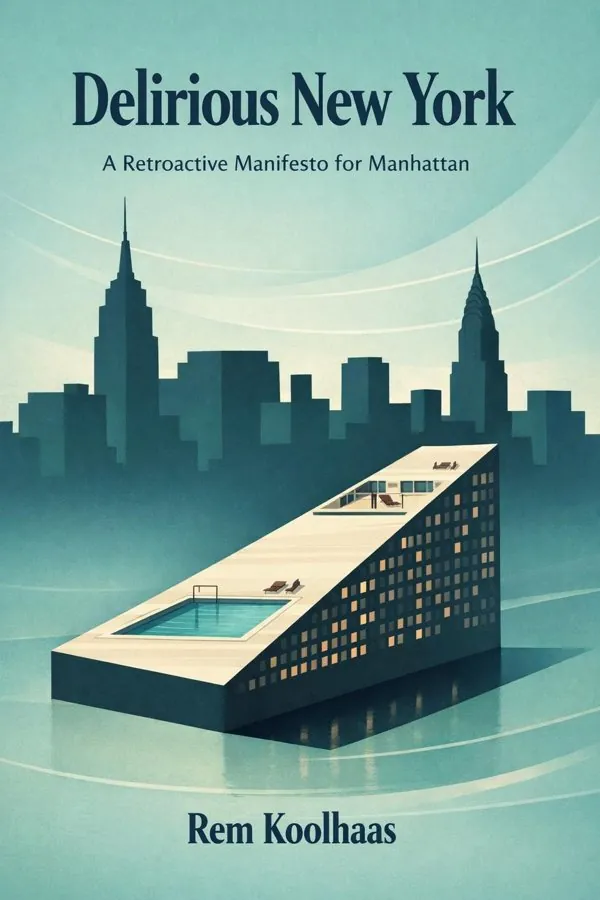
Delirious New York: A Retroactive Manifesto for Manhattan: Summary & Key Insights
by Rem Koolhaas
 10 min6 chaptersAudio available
What Is Delirious New York: A Retroactive Manifesto for Manhattan About?
Delirious New York: A Retroactive Manifesto for Manhattan by Rem Koolhaas is a design book spanning 6 pages. Delirious New York: A Retroactive Manifesto for Manhattan es un ensayo arquitectónico de Rem Koolhaas publicado originalmente en 1978. El libro examina la evolución urbana y cultural de Manhattan como un laboratorio de la modernidad, explorando cómo la congestión, la especulación y la imaginación colectiva dieron forma a su arquitectura y vida metropolitana. Koolhaas propone que la ciudad encarna una 'cultura de la congestión', donde la fantasía y la realidad coexisten en un paisaje urbano delirante.
This FizzRead summary covers all 6 key chapters of Delirious New York: A Retroactive Manifesto for Manhattan in approximately 10 minutes, distilling the most important ideas, arguments, and takeaways from Rem Koolhaas's work. Also available as an audio summary and Key Quotes Podcast.
Delirious New York: A Retroactive Manifesto for Manhattan
Delirious New York: A Retroactive Manifesto for Manhattan es un ensayo arquitectónico de Rem Koolhaas publicado originalmente en 1978. El libro examina la evolución urbana y cultural de Manhattan como un laboratorio de la modernidad, explorando cómo la congestión, la especulación y la imaginación colectiva dieron forma a su arquitectura y vida metropolitana. Koolhaas propone que la ciudad encarna una 'cultura de la congestión', donde la fantasía y la realidad coexisten en un paisaje urbano delirante.
Who Should Read Delirious New York: A Retroactive Manifesto for Manhattan?
This book is perfect for anyone interested in design and looking to gain actionable insights in a short read. Whether you're a student, professional, or lifelong learner, the key ideas from Delirious New York: A Retroactive Manifesto for Manhattan by Rem Koolhaas will help you think differently.
- ✓Readers who enjoy design and want practical takeaways
- ✓Professionals looking to apply new ideas to their work and life
- ✓Anyone who wants the core insights of Delirious New York: A Retroactive Manifesto for Manhattan in just 10 minutes
Want the full summary?
Get instant access to this book summary and 100K+ more with Fizz Moment.
Get Free SummaryAvailable on App Store • Free to download
Key Chapters
The notion of the 'Culture of Congestion' came to me as a revelation when I confronted the paradox of Manhattan’s vitality. Unlike the sanitized visions of European modernist planners, who feared density and sought the open air of rational separation, New York thrived on compression. Congestion was its bloodstream. In this condition, the collision of people, ambitions, and fantasies within a finite island created an unprecedented laboratory of coexistence. Manhattan does not shun multiplicity; it feeds on it.
I defined this culture as the will to exist in a continuous state of intensity. Its architecture—the skyscraper—becomes not merely a technical feat but a philosophical proposition. Within a single tower, the city’s contradictions coexist: luxury apartments above industrial offices, athletic clubs above boardrooms, and fantasies of leisure floating above the machinery of production. Rather than suppressing chaos, Manhattan systematized it, transforming disorder into spectacle.
This ethos of congestion shaped the city’s collective psychology. To live in Manhattan is to accept a life of perpetual exposure—geographically, socially, and emotionally. But within that exposure lies liberation: the freedom to reinvent oneself continuously, to inhabit vertical fantasies, to embrace the paradox that more people, more buildings, and more noise can somehow lead to more individuality. The 'culture of congestion' was, therefore, not the city’s curse—it was its soul.
Manhattan’s grid—the Commissioners’ Plan of 1811—was the invisible diagram that made its delirium possible. This seemingly neutral framework of rectangular blocks imposed a mathematical order upon an otherwise featureless terrain. It left no room for nature’s whim; it replaced landscape with logic. Yet, in this act of simplification lay its genius: the grid, by refusing to prescribe content, permitted infinite invention within each block. It became the ultimate enabler of speculation.
As the nineteenth century unfolded, the grid set the stage for vertical experimentation. The island’s limits—the Hudson and East Rivers—ensured scarcity of land, which in turn drove building upward. Technology—steel frames, elevators, electricity—provided the physical means, but it was the collective imagination that demanded new typologies. The skyscraper was born not as a pure engineering miracle but as a social condenser, a crystallization of the metropolis’s psychological condition.
Through the grid, every plot of ground became an equal participant in the race toward the sky. The city ceased to evolve horizontally; it discovered the infinite potential of layers. Each building was a miniature Manhattan, a universe stacked vertically within itself. Thus, the neutral grid unintentionally generated delirium: it guaranteed a sameness of perimeter while encouraging an infinity of interior worlds.
+ 4 more chapters — available in the FizzRead app
All Chapters in Delirious New York: A Retroactive Manifesto for Manhattan
About the Author
Rem Koolhaas (nacido en 1944 en Róterdam, Países Bajos) es un arquitecto, urbanista y teórico neerlandés, fundador de la Oficina de Arquitectura Metropolitana (OMA). Es conocido por su enfoque innovador y crítico hacia la arquitectura contemporánea y la planificación urbana. Ha sido galardonado con el Premio Pritzker de Arquitectura en 2000 y es autor de influyentes obras teóricas como S,M,L,XL.
Get This Summary in Your Preferred Format
Read or listen to the Delirious New York: A Retroactive Manifesto for Manhattan summary by Rem Koolhaas anytime, anywhere. FizzRead offers multiple formats so you can learn on your terms — all free.
Available formats: App · Audio · PDF · EPUB — All included free with FizzRead
Download Delirious New York: A Retroactive Manifesto for Manhattan PDF and EPUB Summary
Key Quotes from Delirious New York: A Retroactive Manifesto for Manhattan
“The notion of the 'Culture of Congestion' came to me as a revelation when I confronted the paradox of Manhattan’s vitality.”
“Manhattan’s grid—the Commissioners’ Plan of 1811—was the invisible diagram that made its delirium possible.”
Frequently Asked Questions about Delirious New York: A Retroactive Manifesto for Manhattan
Delirious New York: A Retroactive Manifesto for Manhattan by Rem Koolhaas is a design book that explores key ideas across 6 chapters. Delirious New York: A Retroactive Manifesto for Manhattan es un ensayo arquitectónico de Rem Koolhaas publicado originalmente en 1978. El libro examina la evolución urbana y cultural de Manhattan como un laboratorio de la modernidad, explorando cómo la congestión, la especulación y la imaginación colectiva dieron forma a su arquitectura y vida metropolitana. Koolhaas propone que la ciudad encarna una 'cultura de la congestión', donde la fantasía y la realidad coexisten en un paisaje urbano delirante.
More by Rem Koolhaas
You Might Also Like

The Design of Everyday Things
Don Norman
10 min
The Better Angels of Our Nature
Steven Pinker
10 min
A Designer's Art
Paul Rand
10 min
Architects' Sketchbooks
Various Editors
10 min
Architectural Graphic Standards
The American Institute of Architects
10 min
Design Is Storytelling
Ellen Lupton
10 minBrowse by Category
Ready to read Delirious New York: A Retroactive Manifesto for Manhattan?
Get the full summary and 100K+ more books with Fizz Moment.